Saturday, January 19, 2008
At last, honest Web site excuses
A South African provincial government Web site seems to have had a Webmaster with a sense of humor - and a fine awareness of the realities of Africa today.
According to a report in the London Telegraph, the error messages when a page could not be located or loaded included the following gems:
The page is on holiday and will be out of the office until next week or when it feels like coming back.
The page was considered redundant and was given a raise so it now works even less.
The page performed an illegal operation and was promoted to vice-president.
The page is sleeping. After all, this is African time we are talking about.
A government spokesman, when asked about these interesting messages, proclaimed indignantly: "To me it looks like there has been a hacking. We can't promote that. We don't believe in African time. This is totally unprofessional."
To add insult to injury, shortly after his comments the entire Web site went down.
Yep - sounds like Africa to me . . . *gigglesnort!*
Peter


Time for a few laughs
A couple of weeks ago I posted a link to a Goon Show comedy moment. I have a particularly soft spot for British comedy, so I'm going to continue the tradition by linking to another great - the one and only Jasper Carrot.
I'm sure many readers have chuckled (or belly-laughed) at some of his sketches, so without further ado let me link to three. I've arbitrarily picked animal-related ones.
The first one is definitely NSFW (not safe for work), but since this is Saturday morning I daresay most of you aren't at work - so here goes: The Bantam Cock.
The second is part animal, part DIY: The Insane Cat.
The third is taken from one of his albums, so don't bother looking at the video of a turntable playing it: just close your eyes and listen to the tale of The Mole.
There are plenty more clips on YouTube: just do a search on 'Jasper Carrot'.
Peter
Friday, January 18, 2008
Are you interested in reading book manuscripts online?
I've been having a discussion with a writers group of which I'm a member.
I think it might be a very good way for a prospective author to get feedback and constructive criticism if he/she were to put either excerpts or the full text of a manuscript online for people to download, read and return comments. Sure, there's a risk that someone might copy it in an unauthorized fashion, particularly over the Internet, but then that's a risk one will run as soon as it's published anyway. I have a greater trust in readers than that.
I'd like to hear the opinions of readers of this blog. Would you be interested in reading a work-in-progress to have the chance to express your opinions and help the author? If so, would you please add a comment to this post? I'll pass your views on to the rest of the group.
If enough people are interested, I might just start something like that right here. I've already posted two extracts from one of my manuscripts, and I might throw a full copy up here for download. We'll see.
Peter
20 Clues To Mr. Right
It seems that English ladies have a fairly demanding set of standards for what they want to see in a prospective mate. They've come up with a list of 20 attributes:
1. At least 5' 10" tall.
2. Good looking (subjective, I know).
3. Weight around 175 pounds.
4. Earns more than (the British equivalent of) $60,000.
5. Blue eyes.
6. Short dark-brown hair.
7. Medium build.
8. BA degree.
9. Never been married.
10. No children.
11. 3 previous serious relationships.
12. Clean-shaven.
13. Drives a silver Mercedes.
14. Enjoys cinema.
15. Likes eating out.
16. Has had fewer than 6 sexual partners.
17. Owns a $600,000 home (at current exchange rates).
18. Doesn't smoke.
19. Dislikes soccer (the English call it football).
20. Likes pets.
I don't do too well on that list . . . no better than 7 out of 20. How do you score, guys?
Peter
Thursday, January 17, 2008
Texas Trouble
I received the following by e-mail (hat-tip to Fred).
A couple in Sweetwater, Texas, had a lot of potted plants. During a recent cold spell, the wife was bringing a lot of them indoors to protect them from a possible freeze. It turned out that a little green garden grass snake was hidden in one of the plants. When it had warmed up, it slithered out and the wife saw it go under the sofa. She let out a very loud scream.
Her husband, who was taking a shower, ran out into the living room naked to see what the problem was. She told him there was a snake under the sofa. He got down on the floor on his hands and knees to look for it. About that time the family dog came and cold-nosed him on the behind. He thought the snake had bitten him, so he screamed and fell over on the floor.
His wife thought he had a heart attack, so she covered him up, told him to lie still and called an ambulance. The attendants rushed in, wouldn't listen to his protests, loaded him on the stretcher and started carrying him out. About that time the snake came out from under the sofa. One of the Emergency Medical Technicians saw it and dropped his end of the stretcher. That's when the man broke his leg, so he went to the hospital anyway.
The wife still had the problem of the snake in the house, so she called on a neighbor. He volunteered to capture the snake. He armed himself with a rolled-up newspaper and began poking under the couch. Soon he decided it was gone and told the woman, who sat down on the sofa in relief. While relaxing, her hand dangled in between the cushions, where she felt the snake wriggling around. She screamed and fainted, while the snake rushed back under the sofa.
The neighbor, seeing her lying there passed out, tried to use CPR to revive her. The neighbor's wife, who had just returned from shopping at the grocery store, saw her husband's mouth on the woman's mouth and slammed her husband in the back of the head with a bag of canned goods, knocking him out and cutting his scalp to a point where it needed stitches.
The noise woke the woman from her dead faint and she saw her neighbor lying on the floor with his wife bending over him, so she assumed that he had been bitten by the snake. She went to the kitchen and got a small bottle of whiskey, and began pouring it down the man's throat.
By now the police had arrived. They saw the unconscious man, smelled the whiskey, and assumed that a drunken fight had occurred. They were about to arrest them all when the women explained how it all happened over a little green snake. The police called an ambulance, which took away the neighbor and his sobbing wife.
The little snake again crawled out from under the sofa. One of the policemen drew his gun and fired at it. His bullet missed the snake and hit the leg of the end table. The table fell over and the lamp on it shattered. As the bulb broke it started a fire in the drapes. The other policeman tried to beat out the flames and fell through the window into the yard on top of the family dog. Startled, it jumped out and raced into the street, where an oncoming car swerved to avoid it and smashed into the parked police car.
Meanwhile, the burning drapes were seen by the neighbors who called the fire department. The firemen started raising the fire truck ladder when they were halfway down the street. The rising ladder tore out the overhead wires and put out the electricity and disconnected the telephones in a ten-square-city-block area (but they did get the house fire out).
Time passed.
Both men were discharged from the hospital, the house was repaired, the dog came home, the police acquired a new car, and all was right with the world.
A while later the original couple were watching TV and the weatherman announced a cold snap for that night. The wife asked her husband if he thought they should bring in their plants for the night.
That's when he shot her.
*gigglesnort!*
Peter
Wednesday, January 16, 2008
The USAF Needs Ghostbusters???
It's reported that a team of real-life ghostbusters is to visit the Wright-Patterson Air Force Base in Ohio to deal with a little problem they're having.
According to the report: "The Atlantic Paranormal Society, known as TAPS, visits the base this week to investigate three buildings where workers have reported phenomena which they cannot explain such as hearing footsteps, voices and seeing apparitions - specifically one of a little boy in building 219 and one of an older woman in building 70."
You know, I've never served with any branch of the US armed forces, but I have served in those of another country. Based on my memories of that service, I'm willing to wager a large sum of money that right now, aviators in the US Marines, US Navy and US Army are feverishly consulting their colleagues to figure out how to provide their USAF comrades-in-arms with a series of truly horrendous ghostly experiences for the benefit of the TAPS researchers.
I'm betting they'll see something like a Marine eagle-globe-and-anchor insignia wafting through the air while a spectral voice intones, "All Air Force pilots are . . . " (fill in the appropriate word from your own memories of military service!)
This should be good! :-)
Peter
Doofus Of The Day #3
I love it when dumb crooks do things like this . . . :-)
A certain Mr. Derrick Kosch decided to commit an armed robbery in Kokomo, IN. He should have been more careful . . . because he shot himself in the gonads in the process.
Bleeding profusely he ran from the scene and took refuge at his grandmother's house. He told her that he'd been shot by someone trying to rob him, and she duly called 911 for assistance. An ambulance and police officers arrived in short order and recognized the luckless Mr. Kosch from security video footage. He's now in hospital under arrest.
I wonder how he's going to explain his asset-diminished status to his fellow criminals in the shower in jail? "Well, ya see, I wuz robbin' this joint an' . . . "
I'd love to be a fly on the wall to hear the laughter! :-)
Peter
Tuesday, January 15, 2008
Beware of Big Brother - at work and at home!
This should make everyone who uses a computer, a cellphone or a similar personal device really, really angry.
Microsoft has applied for a patent that will 'allow managers to monitor employees’ performance by measuring their heart rate, body temperature, movement, facial expression and blood pressure'.
Basically this technology will turn your device into a permanently-alert spy on anything and everything you do. It's clear that it can be applied to every moment of your life. A second, more detailed report states, 'The systems work not only through desktop or laptop computers but even through mobile phones or handheld PCs, meaning that even out of the office the employee can still be monitored. In its most advanced format, the system will monitor users’ private interests.' (Bold print my emphasis.)
I don't know about you, but I'm more than fed up with the 'surveillance society' already confronting us. Cameras on the street, red-light cameras that are allegedly installed for reasons of traffic safety but are clearly no more than a revenue-generating device, airport security that isn't secure and doesn't work, the expressed desire of US government officials to monitor every item of data moving across the Internet, similar moves in the European Union . . . and now this.
Folks, if we don't take a stand, this is going to happen. We've sunk as far as we have precisely because far too many people simply let their privacy go by default. It may already be too late to stop a great deal of the damage . . . but if we sit back and accept it, we deserve no better.
It's time to let our elected representatives know that we won't stand for this.
Peter
Racing car versus airliner - who wins?
Today an interesting race took place in New Zealand.
It was between an A1GP racing car and an Air New Zealand Boeing 777-200, each occupying adjoining runways at the Auckland International Airport.
The plane won the first heat, but the racing car won the second. There are two good videos of the event. The first shows only part of the second race, but features extensive comments from the driver of the racing car, Jonny Reid.
The second was taken by a spectator and is much less clear, but shows both races, giving us a much better idea of the relative speeds involved.
Looks like a fun time was had by all.
Peter
Monday, January 14, 2008
Would you like your eggs in 9mm. or .45?
For those interested in a novel way to fry eggs, how about making them gun-shaped?

Now to cut bacon into ammunition shapes . . . :-)
(Hat-tip to my buddy Greg for e-mailing me the details.)
Peter
Way To Go, Marines! Semper Fi!
I can't tell you how pleased I am to read reports like this.
It seems that the US Marine Corps, through a 'junior military reserve program', is organizing highly disciplined schooling for teenagers in troubled areas. An article discusses the program at the Marine Military Math and Science Academy in Chicago, which is described as 'the first public Marine academy in the nation'.
I'm seething, though, at the idiotic comments of opponents of the program. One Oscar Castro, speaking for the 'National Youth and Militarism Program' (whatever that may be) complains: "To call these young people child soldiers might be technically inaccurate, but it does reveal the truth of it." Oh, bullshit, Mr. Castro! Do you understand your own words? You've just said that it's inaccurate to call them 'child soldiers', and then - in so many words - called them precisely that! Ever heard of 'logic' or 'reason' or 'common sense'? I thought not . . .
I suppose I shouldn't be surprised. A quick Web search reveals a groundswell of opposition to such 'military schools', all of it from what I'd call moonbat left-wing lunatics. They uniformly display opposition to anything I'd consider common sense and knee-jerk approval of all the elements of public education that have so miserably failed our students, particularly in impoverished and crime-ridden areas.
Let me tell you something, Mr. Castro. I was as idiotic, self-centered and selfish a teenager as anyone else. (For those teens reading this who might think they're not that way, it's possible, but if so you'll be the exception that proves the rule. If we're honest, all of us who've left our teens behind us will admit that we were that way to at least some extent.) When I went into the military at age 17, I was a boy. I came out of it a man. I learned the hard way things such as respect for my fellow servicemen and -women, discipline (both self and unit), fitness, co-operation and a host of other really valuable life lessons. It made me a far better person than I'd have been without it. Combat service does that in spades, even more than barrack service.
I served in the armed forces of another nation, but had the great privilege of working with some former US Marines there. They were uniformly outstanding soldiers - no, more than that: warriors - who took pride in their work and taught us to do the same. It's my loss that I've never had the opportunity to be a Marine, but I have the highest possible respect for them. If they can impart some of the Marine Corps ethos to troubled youth, and help them to learn the lessons about life that all Marines must learn, then more power to them!
I wish I'd had the opportunity to go through such a program in school myself. I hope they spread far and wide across this nation. I think they're exactly what our troubled education system needs. Thank you, Marines! If I ever meet any of you engaged in such incredibly valuable and useful work, the beers are on me (after school hours, of course!).
Peter
An historical treasure-trove is now online
This is huge, friends. Huge. At least, if you're at all interested in the history of knowledge, how we've come to understand ourselves and our world, and how we're going to tackle the problems currently facing humanity.
The British journal Nature was founded almost 140 years ago. Its first issue appeared on November 4, 1869. In that issue was set out what today we'd call a 'mission statement': First, to place before the general public the grand results of scientific work and scientific discovery; and to urge the claims of science to move to a more general recognition in education and in daily life. Secondly, to aid scientific men themselves, by giving early information of all advances made in any branch of natural knowledge throughout the world . . .
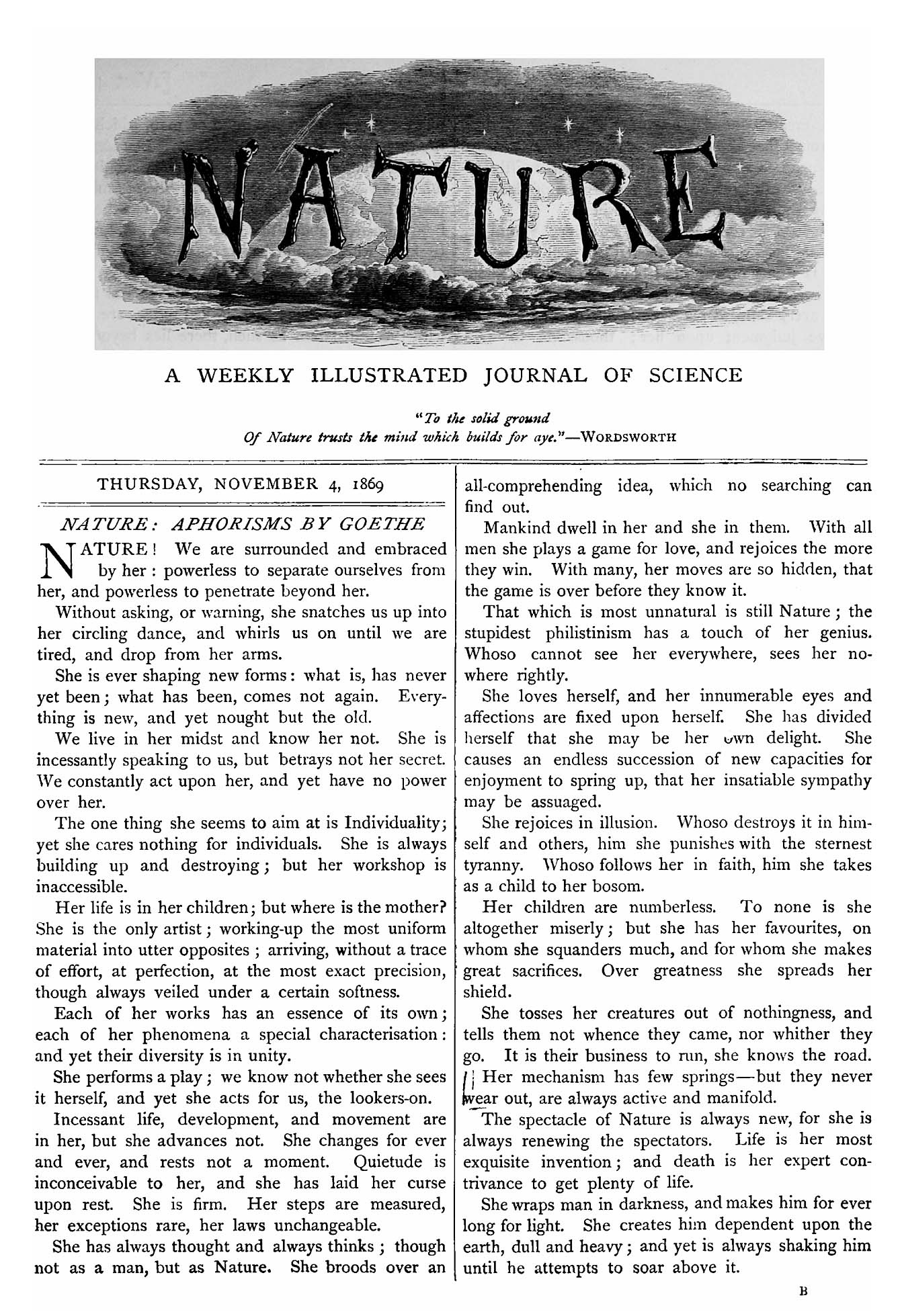
The journal certainly lived up to those purposes. Its pages have carried virtually all the great scientific controversies and discoveries of the times. Darwin's theories; elements in the periodic table as they were discovered; the existence of the neutron; Einstein's theory of relativity; paleoanthropology; nuclear physics; the discovery of the laser; the existence of DNA; nanotechnology; the revelation of the hole in the Earth's ozone layer . . . the list of scholarly articles and revelations is almost endless. Many of the authors of Nature's articles went on to win Nobel prizes and other honors for their achievements.
In its almost 140 years of publication there have been only seven editors of Nature. The first, Norman Lockyear, occupied the 'throne' for half a century, setting a good precedent. Such continuity of leadership has proved very useful in practice.
You'll find all the details at Nature's historical Web site. Highly recommended - but be prepared to lose hours as you absorb some of the finest material in the history of science and discovery. Definitely not for casual Web-surfing. If you're into that sort of thing (as I am) there are more and more such resources on the Web, which is wonderful if you're far from a decent library. Try the online works of Charles Darwin for a start. He's a controversial figure and much of his work has been superseded, but he remains a seminal figure in scientific history.
My personal favorite from the history of Nature? The journal showed its whimsical side by giving a scientific name to the Loch Ness Monster - Nessiteras Rhombopteryx.
(By the way, if you're interested in scientific discovery and how it affects us, may I strongly recommend Al Fin? It's linked in my blogroll sidebar. It's filled with interesting snippets of information and links to more, and is a daily 'must read' for me.)
Peter
Sunday, January 13, 2008
Two adventurers make it across the Tasman Sea - by kayak!
Last year two adventurers in Australia, James Castrission and Justin Jones, decided to take their kayak for a paddle . . . a fourteen-hundred-mile paddle, to be exact. They would attempt the first crossing by kayak of the Tasman Sea between Australia and New Zealand.

Their morale can't have been helped by the news that a solo kayaker, Andrew MacAuley, had disappeared during his attempt. On February 13th last year he sent out a garbled distress call. After an intensive search his empty, overturned kayak was discovered. Pictures on his camera proved that he'd seen the coast of New Zealand - but something must have gone tragically wrong. His body was never found.
Nevertheless, Castrission and Jones didn't allow MacAuley's death to damp their enthusiasm. They left on November 13th last year and have been paddling ever since. They've had all sorts of problems, from weather that delayed them far beyond their schedule (forcing them to ration their food) to pumps and desalinators that ceased to function: but on Sunday morning, January 13th 2008, they made it at last.

They were welcomed by several thousand cheering spectators, complete with local Maoris chanting a haka. Of course, a Maori friend tells me that they were probably singing "Welcome to New Zealand - now go back to Australia!" :-)
My hat's off to you, guys. That was one hell of an achievement. Thanks for keeping the spirit of adventure alive for all of us - and I reckon your success is a fitting memorial to Andrew Macauley. Wherever he is now, I hope he knows about it and has the chance to hoist a cold one in your honor.
For those interested, there's a whole lot more video and photographs on the expedition's Web site.
Peter
Saturday, January 12, 2008
Weekend Wings #2: Return Of The Airship?
Airships and balloons have been with us for many centuries. Initially balloons were unpowered and at the mercy of the wind and weather. Both hot air and gas-filled balloons were developed at the same time. The Montgolfier brothers demonstrated their first hot air balloon in 1783, with the first human flight following a few months later.

Jacques Charles demonstrated the first hydrogen balloon in the same year and made the first human flight in it ten days after the Montgolfier brothers.

The first balloon powered by human muscles was built by Jean-Pierre Blanchard in 1784. The following year he crossed the English Channel in a balloon propelled by flapping 'wings'.
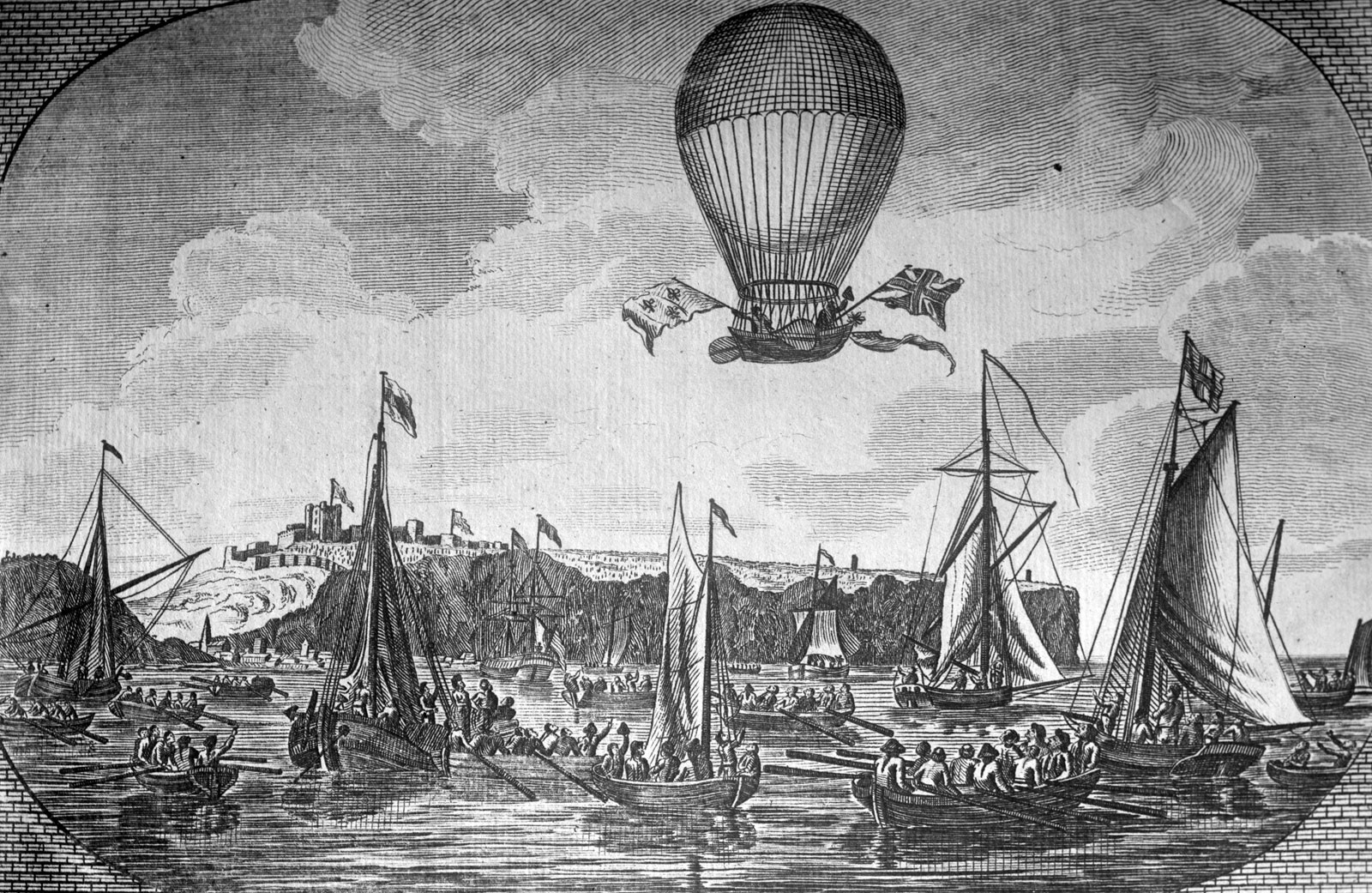
It didn't take too long for engines to be married to the balloon. In 1852 Henri Giffard installed a steam engine beneath a balloon and flew successfully from Paris to Trappes, a distance of about 17 miles (27 km.).

Airships soon developed distinct classifications. Balloons were simple 'bags' holding gas or hot air, without a framework. Non-rigid airships (often called 'blimps') used a shaped bag without a framework or supporting structure. Semi-rigid airships used a supporting structure such as a central keel to which the gas bags were attached. Rigid airships such as the famous Zeppelins used a full structure or framework containing the gas bags.
Another distinction must be made between aerostats and airships. In one sense any aircraft remaining aloft due to buoyancy is an aerostat, including airships: but in practice the term has come to be applied to all moored or tethered balloons. Airships are self-propelled and not tethered during flight.
The 'Golden Age' of airships began in 1900 with the flight of the first Zeppelin.

These airships were named for their designer, Count Ferdinand von Zeppelin of Germany. Their military potential was rapidly realized by the German armed forces, and during World War I a large number of Zeppelins carried out bombing raids over England. However, as aircraft performance improved it became clear that the slow, unwieldy airship would never be able to survive in combat against them. Some very rare footage from the period is shown below.
Despite such setbacks, Zeppelin L.59 made a record long-distance flight in 1917 in an attempt to carry supplies from Germany to its armed forces in what is today Tanzania. Although unsuccessful, the mission nevertheless covered over 4,200 miles in five days.
Between the wars intensive efforts were made to develop the airship as a passenger and freight transport. Only Germany achieved any real success in the 1930's. The Graf Zeppelin operated scheduled service between Germany and Brazil and completed the first airborne circumnavigation of the world by an airship.

Later the Hindenburg operated between Germany and the USA. It was destroyed in one of the most horrifying disasters of the period when it caught fire and was completely destroyed on arrival in New Jersey in 1937.
Britain pursued for a time the so-called 'Burney Scheme' for a network of airship routes linking it with the colonies. However, one of the prototypes for the scheme, the R101, crashed and was destroyed with heavy loss of life. The scheme was subsequently abandoned.
The USA pursued airships for military purposes during the 1920's and 1930's, culminating in two remarkable craft, the USS Akron (pictured below) and USS Macon. Both used helium as a lifting gas instead of hydrogen, eliminating the risk of fire. However, helium was so scarce at the time that both airships could not be operated simultaneously. If one was filled with helium there wasn't enough to spare for the other.

Both carried fighter aircraft which could be launched in flight and recovered in mid-air.

However, Akron was destroyed in a storm off New Jersey in 1933 and Macon was lost due to structural failure off California in 1935. That ended military airship development in the USA.
During World War II all sides used so-called 'barrage balloons', tethered aerostats to make it difficult for aircraft to dive on a target. The US Navy used over a hundred and fifty blimps for anti-submarine patrols.

They operated not only along the US coast but also in the Caribbean, off Brazil, and in the Mediterranean theater. They achieved little success in terms of U-boats destroyed, but probably contributed much to the overall safety of the sealanes by forcing enemy submarines to remain submerged where they could not move fast. Only one ship was lost from a blimp-escorted convoy throughout the war.
Both Britain and Japan used balloon-launched bombs against their enemies. Britain launched almost 100,000 against Germany from 1942-1944 in Operation Outward. Japan launched some 9,000 'fire balloons' against the USA in 1944-45.

Only a few hundred reached the US and caused minimal damage. The most serious incident saw five children and a woman killed in Oregon in June 1945. The possibility exists that several hundred of these balloons may yet lie undiscovered in wilderness areas, and their explosive cargoes are likely to be still dangerous.
In the fifty years following World War II airships ceased to be a major factor in air transport. A few were built as blimps for advertising and photography platforms, but in the main the craft were abandoned during the Jet Age. However, that may be about to change. There have been a number of interesting developments in the past decade or so.
Zeppelins are being built again. The Zeppelin NT is in use to carry tourists on sight-seeing tours: one is now in service in Japan.

There has been some interest in using airships to move bulky, heavy cargo, and a Russian company is proposing a model to carry up to 180 tons. However, airships' main application today seems to be in the field of communications and surveillance. An 'Internet Airship' has been proposed to provide wide coverage for wireless networks over Europe. The US Army is testing a remotely-piloted airship as a communications node:
Airships are also under consideration for ultra-high-altitude use. Lockheed-Martin is contracted to build a prototype High Altitude Airship. It will cruise above 60,000 feet altitude and generate its own electricity through conformal solar panels.

Another exciting development has been the hybrid airship: one that derives part of its lift from lighter-than-air gases, and part from a lifting body design that relies on forward movement to generate aerodynamic lift. Lockheed-Martin's 'Skunk Works' recently flew a prototype vehicle of this design to immense interest among those following the genre. A video of the first flight is below.
Lockheed-Martin seems to be investing a great deal of time and trouble into airships. The company recently patented a torpedo-launched high-altitude inflatable endurance airship. The mind boggles at the thought of special forces troops being submarine-launched through a torpedo tube and floating to their target in airships . . . but who knows?
Other possibilities are under investigation around the world. For example, South Africa is considering a maritime surveillance system whereby a radar in orbit would transmit impulses to the surface. Their reflections would be picked up by an airship-mounted antenna at very high altitude. Such a hybrid system could cover hundreds of thousands of square miles of ocean at relatively low cost.
There are more novel ideas out there. One ingenious designer is proposing an airship hotel (pictures and video at the link). There's even been a suggestion that airships could be used to carry heavy cargoes to near-orbital altitudes, there to rendezvous with a docking station and transfer their load to other vessels which would lift them the rest of the way into orbit. It's all theoretical at the moment, but if the many obstacles to such an idea can be overcome it offers a much lower-cost route to orbit than any current technology.
One potential drawback to this upsurge of interest in airships is that the world's supply of helium is strictly limited and is already running low. Either new efforts will have to be made to extract it, or some alternative will have to be found. Still, provided this can be done, a centuries-old technology might just be making a comeback.
Peter
The Importance Of Being Armed
There's an awful lot of nonsense said (by those who should know better) about how dangerous guns are, and how evil those 'gun-lovers' are, and so on. (Personally I've never met anyone who 'loves' their gun[s], or has any sort of relationship with them . . . but perhaps I'm behind the times.)
In my book on prison ministry I describe some of the lessons I've learned through working with convicts. I'd like to quote a couple of paragraphs from my manuscript:
There are those who claim that we should rely on police and law enforcement agencies to protect us. I’m afraid that’s nonsense. I have the highest respect for our law enforcement officers, but they have no legal obligation whatsoever to protect individuals except under certain very restricted and limited circumstances. A lot of people don’t realize this, but it’s true. Our courts have explicitly ruled that it is a ‘fundamental principle of American law that a government and its agents are under no general duty to provide public services, such as police protection, to any individual citizen’. Anyone who tells you otherwise is either uninformed or lying. If a ‘politically correct’ spokesman urges citizens not to resist criminals but rather to leave things to law enforcement, consider the matter in the light of this cold, hard truth and act accordingly.
Furthermore, all too often police only get to the scene of a crime in time to fill out the forms and clean up the mess. To give just a few examples: in 1999 in New York City, NY, according to statistics released by the Mayor’s office, the average amount of time it took a police officer to respond to a 911 call was 10.3 minutes. Kansas City, MO police reported their average response time as ‘five to ten minutes’ in 2005. In the same year Priority One responses to 911 calls in Atlanta, GA and nearby counties took an average of nine to fifteen minutes. If the average response times are that long, this means there are many calls that take even longer. Dear reader, remember that you’ve got to get to a phone and call 911 before the police can respond at all! What if you can’t? What if the criminals have cut the telephone line or the cellphone tower is out of range? Also, if you think that even the average response times aren’t enough for a determined, violent attacker to beat, rape or murder you (and perhaps your family as well) then you’re deluded. I have personally witnessed a club-wielding attacker kill a fit, strong man in less than ten seconds. Yes, it’s that fast if the assailant, like many violent criminals, knows what he’s doing. Plan accordingly to defend yourself and your loved ones.
For those who think I’m being unduly alarmist, I invite you to inspect your local crime statistics at the DA’s office or through your law enforcement agencies. Remember that even in the safest areas criminals can arrive without warning (as Wesley did - see his story in Chapter 2 - and as some cities and towns found out to their cost when they accepted evacuees from Hurricane Katrina in 2005). Ask about average response times to 911 calls in your area. If local authorities can’t or won’t provide the figures you might want to ask yourself, “Why not?” Is it because they’re abysmally slow? Follow the local news (particularly the police blotter) and look for reports of violent crimes. I’ve counted over a hundred in the past month alone within half an hour’s drive from my home. Remember that the odds of being a victim of a violent crime during adulthood in the USA are better than two to one (see Chapter 2). With all this information you’ll be able to objectively assess the risks you face in your particular environment and decide what precautions are appropriate and suitable to guard against them. If you truly think you don’t need any, there’s a bridge in New York City I’d like to sell you. Cash only and small bills, please.
Those paragraphs have just been confirmed by recent developments in Lake County, Indiana. Three months ago a woman found herself trapped in her home by a stalker who was making violent entry. Scared half out of her wits, she called 911. The entire conversation is captured in the YouTube post below. The encounter ended with her shooting her stalker, killing him (and jolly well done, say I!)
Think about it. If she hadn't had a gun, just how much damage would he have done to her before the cops arrived? Note my comment above about how long it took a man with a club to kill another man. I saw that personally, readers. It's frighteningly easy for a strong, violent man to kill you. You need an equalizer . . . and in circumstances like this, a gun's the only equalizer that will save your life.
Think about it.
Peter
Friday, January 11, 2008
Harbin Festival
During this month the Harbin International Ice And Snow Sculpture Festival is under way in northern China. It's one of the great festivals of its kind in the world, and one of my ambitions is to visit it at least once before I die.

Last month "15,000 workers began cutting ice blocks from the river's frozen surface, and 16 days and 120,000 cubic metres (4.2 million cubic feet) of ice later, the show was ready."
This year also sees the largest snow sculpture ever created. 'Romantic Feelings' is 115 feet high and 656 feet long, according to the Daily Mail, which also reports that there are 600 sculptors from 40 countries in this year's Festival.

The exhibitions of snow and ice sculpture, snow buildings and other displays (many built by international teams) are breathtakingly beautiful. There are three really great collections of photographs of the 2003, 2005 and 2007 Festivals on the Web. It'll take an hour or two to look at all of them (each one has multiple pages) but I highly recommend browsing through them when you can spare the time.
Peter
Thursday, January 10, 2008
Clever advertisement
I like it when companies do something original in the way of an advertisement. Here's one from a Dutch travel agency.
(Hat-tip to Flight Global.)
Peter
Cheezburger does it again
Many of you, I'm sure, are familiar with the 'Lolcat' phenomenon - pictures of cats and/or kittens speaking a strangely abbreviated language. I link to one of the main Lolcat sites in my blogroll.
Well, cats aren't the only animals portrayed. This one just about made me spray my monitor with my morning cup of tea.

As my buddy Lawdog would say, *gigglesnort!*
That picture reminds me overwhelmingly of all the politicians plastered all over our TV screens at the moment. Wonder if I could persuade one of the major networks to adopt it as the theme picture for political debates?
(Lawdog's also discovered another aspect to the Lolcat phenomenon. Double *gigglesnort!*)
Peter
The most important car in years?

Although I've put a question-mark behind the title of this post, I think the just-announced Tata Motors 'Nano' car really is the most important car to come along in years. It's certainly got other major manufacturers thinking hard, with Volkswagen, Ford, Renault and Nissan already announcing plans for their own bare-bones vehicles.
The reason it's so important is simple: the base vehicle costs only the equivalent of $2,500. That's right - two and a half thousand dollars. Tata is based in India, where there's an immense pent-up demand for transport but very little in the way of low-cost alternatives to the scooter or bicycle (unless you count the donkey cart!). As Mr. Ratan Tata, chairman of Tata Motors, has said; "I observed families riding on two-wheelers - the father driving the scooter, his young kid standing in front of him, his wife seated behind him holding a little baby. It led me to wonder whether one could conceive of a safe, affordable, all-weather form of transport for such a family."
They certainly seem to have succeeded. The Nano seats up to five, has a 33hp. 623 cubic centimeter (38 cubic inch) rear-mounted engine with continuously variable transmission (meaning no clutch or conventional gears) and an adequate if not stellar performance (maximum speed about 60 mph) and claimed fuel economy of about 50 mpg. There are no frills: manual windows, no air-conditioning or carpets, just bare-bones transportation.

And when you think about it, isn't that long overdue? For the vast majority of car owners the Nano will address all their real needs. They aren't taking long trips through the countryside, or loading up their cars with large numbers of people. As a city commuter car this has real possibilities (perhaps adding a small air-conditioner for those long traffic jams). It probably wouldn't be very comfortable for a multi-hundred-mile journey, but those who make such journeys will buy more suitable vehicles anyway.
Furthermore, its small size and lack of power-draining accessories make it a perfect candidate for conversion to battery power once the new generation of capacitors hits the market (for an example, see here). Already they're achieving three to four times the battery life (or range, in car terms) of what's available today. Once you can install a battery and electric motor giving two to three hundred miles between plug-in recharges, this becomes a perfect city and suburban vehicle. The added expense of the electric drive may push the total cost into the $4-$5,000 range, but even so that's very affordable.
It has wider economic implications. Ratan Tata again:
"What we also wish to do, which is still not fully clear and a concept at this point of time, is to create any opportunity for entrepreneurs. Low cost units in different parts of the country will assemble the car where Tata Motors will take the responsibility for training on site and other aspects related to quality etc. We will give young entrepreneurs the opportunity to establish enterprises in distributed areas to produce this for us. We will produce all the high volume parts and send them as kits to these assembly units. This will also enable us to address some international markets in Indonesia, Africa etc on the same kind of basis.
So what we are looking at is designing a product that can be produced in high volumes, which we will do and than can also be viable in small volumes on a batch-basis from kits. With many products, if you conceive them for mass manufacture they cannot be produced in another form. This is what we are trying to do. It is taking more time because we have given ourselves a more complex situation, says Tata.
What he would like to see ideally, in the India of tomorrow, is 10 young graduates getting together out of an IIT and saying, Instead of having to work for somebody, we would become an enterprise of our own. He adds, Hopefully we would like that enterprise to also sell the vehicle in that area. We would like the service engineer to be trained by us that could perhaps serve the customer. He could use the spare parts of this enterprise to service the customer. Can we change the traditional manner in which the customer is supported on the product?
Eventually, the idea is to not only to give India a low-cost car but create many jobs in different places for young people who otherwise would have to work for someone."
This is potentially huge. Instead of needing large factories all across the globe one could look at decentralized assembly and service facilities - with all the reduction in environmental impact that such a step promises.
A small prediction, friends: this car will be worth watching. It'll also be interesting to see how the 'traditional' car manufacturers respond to the challenge. You can bet they really, really don't like what Tata has achieved here. I look for them to try to either shut it down, or beat it to death with their own competing models - which will promptly disappear from the market if they succeed.
I'm sure there'll be lots of bumps in the road ahead (you should pardon the expression) and problems to be worked out, but I think we owe Mr. Tata and his company a resounding vote of thanks for driving this project forward. It might just change the car market worldwide as we know it. This should be interesting!
Peter
Wednesday, January 9, 2008
The Latest On The First Data / Citi Merchant Services Scandal
Friends, I've written about this in an earlier post (scroll down three posts if you don't want to click on the link).
It now appears that the real culprit behind the rejection of credit card transactions for such firearms purchases might be First Data rather than Citi Merchant Services. A report on Merchant Talk states that:
"Effective today, First Data has just terminated all of its firearm merchants selling in non face-to-face transactions. For those of you not familiar with credit card processing, First Data is responsible for more than 60% of payment processing in the United States. They have not only terminated many of these legitimate and established merchants but they have done so while holding all outgoing funds. Several banks have followed suit with CitiGroup (NYSE C) immediately jumping on the bandwagon and Bank of America (NYSE BAC) expected to follow.I fully agree with the author of the Merchant Talk post. People, if this is true we need to hammer First Data into the ground. I suggest we all pass the word about this and ask First Data for clarification - they helpfully provide contact names, numbers and e-mail addresses to do so. Let's make our opinion known to them loud and clear. This nonsense cannot, repeat, cannot be allowed to stand.
While I personally don’t own a gun, nor plan to, I respect the rights of people to legally own and legally sell them. While the system isn’t perfect, for major banks and processors to take a stance like this is wrong and illegal. I suspect that the National Rifle Association will follow up with an official response.
Please don’t make this a matter of whether you agree with gun sales or not, it’s not the job of First Data or any such private organization to take this stance. I imagine that the matter will be overturned in court.
Let’s see, what industry is next? People, this is a prime example of my earlier post today and I hope that the government steps in immediately to stop private industry from making such decisions immediately. Whatever your opinion is on firearms, this is only the beginning. Because if this manages to stick, before long your industry may be next."
Peter
Subscribe to:
Posts (Atom)