For those in the path of the latest deep freeze:

Given the likely temperatures, one might advise the wearing of underwear irrespective of the wind speed - but that's probably un-Scottish of me, or something like that.

Peter
For those in the path of the latest deep freeze:
Given the likely temperatures, one might advise the wearing of underwear irrespective of the wind speed - but that's probably un-Scottish of me, or something like that.
Peter
I had to smile at an award recently conferred in New York City. It reminded me of Aesop's famous fable.
The M42 Crosstown was just crowned the slowest bus in the Big Apple — a title that its riders say comes as no surprise.
The MTA shuttle earned the first “un-coveted Pokey award” from the New York Public Interest Research Group in three years after clocking in at an exhausting 5.25 miles per hour on average.
At that pace, the M42 would have fittingly finished in 42,232nd place of the 59,226 runners at this year’s NYC Marathon.
At a press conference Monday, MTA Chief of Policy & External Relations John McCarthy acknowledged the M42’s Pokey win, but said the award should have been given to 42nd Street instead of the shuttle.
“It’s really not the bus’s fault. The bus wakes up in the morning and it wants to provide great service; it wants to go fast. That’s what it’s equipped to do and the bus operator wants to drive the bus quickly. The problem is that things are in the way,” said McCarthy.
“I’d like to take this award and hand it to 42nd street because it’s the street, it’s the road and it’s the vehicles that are blocking buses that are the problem and continue to be the problem.”
There's more at the link.
The report amused me, but I had to concede that the explanation offered by Mr. McCarthy was most likely all too accurate. I've driven in New York and Massachusetts, and almost universally drivers there proved to be the least polite, most aggressive and unhelpful of any I've found in the rest of the United States. In New York, there seemed to be a competition among drivers over who could be the most obstructive and just plain nasty to tourists and visitors. I loathed my time on the road in those two states, and won't willingly return to them for that reason.
I'm sure city-proud New Yorkers will object to my comparison, and insist that it's really not that bad there. To that, all I can say is that if the average New York City driver of my [admittedly limited] experience tried to drive as he's accustomed in Dallas or Houston, he'd be jailed in short order by the local cops - if, that is, local drivers hadn't administered a short, sharp lesson in manners before then!
Peter
Found in several places on social media:

Perhaps, if enough SNAP/EBT recipients lose their heads and riot over the suspension of those benefits, the taxpayers who fund them will also rise up in revolt and demand that their taxes be used for the good of the country, rather than the feeding of the feckless.

Peter
From a reader over at Larry Lambert's place:
"I like to think that my Scots-Irish ancestors came to America in the early 1700s because it later gave them one more chance to shoot at the British."
Now why is that so instantly believable? Could be because I have Scots and Irish ancestors as well . . .

I'm battling to complete a short story before the deadline for submissions later this week, so this cartoon made me laugh. Click the image to be taken to a larger version at the Foxes In Love Web page.

I can almost hear the simultaneous groan from my writing and publishing buddies as they see it . . .

Peter
CNN brings us this life-changing news headline:
Of all the medical information I never expected to hear (or need, for that matter), I daresay that has to rank pretty high up the list. Didn't we have enough strain in our lives already?
Oh, well. To quote the Moody Blues, "Face piles of trials with smiles"!

Peter
He's not backward in coming forward.
Personally, I think Jussie Smollet made up the whole thing to attack President Trump's policies and make himself look good to the DEI/BLM/Antifa crowd. It's good to know some of his own people recognize that too, and aren't afraid to call him on it.
Peter
I know exactly how many knees I’ve hit, says Eden, who completed his service in the Israel Defense Forces as a sniper in its Golani infantry brigade six months ago. For much of the time, he was stationed along the border with the Gaza Strip. His assignment: to repel Palestinian demonstrators who approached the fence.
“I kept the casing of every round I fired,” he says. “I have them in my room. So I don’t have to make an estimate – I know: 52 definite hits.”
But there are also “non-definite” hits, right?
“There were incidents when the bullet didn’t stop and also hit the knee of someone behind [the one I aimed at]. Those are mistakes that happen.”
Is 52 a lot?
“I haven’t really thought about it. It’s not hundreds of liquidations like in the movie ‘American Sniper’: We’re talking about knees. I’m not making light of it, I shot a human being, but still ...”
. . .
Shedding light on this very recent slice of history entails talking to snipers: After all, they were the dominant and most significant force in suppressing the demonstrations at the fence. Their targets ranged from young Palestinians who were trying to infiltrate into Israel or who threw Molotov cocktails at soldiers, to prominent, unarmed protesters who were considered to be major inciters. Both categories drew the same response: Live ammunition fired at the legs.
There's more at the link.
Looking at the violent demonstrations on TV, I suspect a few perforated kneecaps could be classified as a relatively mild response. If the demonstrators complain that it hurts, we could always suggest that they put an ICE pack on it . . .

As usual, Stephan Pastis does a bang-up job (you should pardon the expression) of describing American society in this day and (troubled) age. Click the image to be taken to a larger version of the cartoon at the "Pearls Before Swine" Web page.
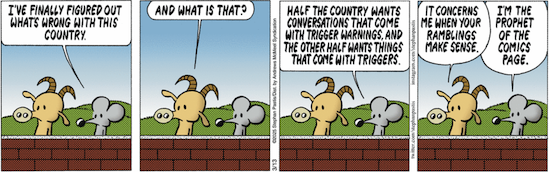
I've heard from a number of contacts in the firearms industry that before last year's elections, most of their customers were conservatives or libertarians. Since President Trump took office, they report many more liberal and progressive Democrats coming in to arm themselves. That's not what I'd call a very optimistic forecast for social discourse in America . . .

Peter
I'm 100% behind this request.
Concerned Catholics are asking the DOJ to look into the actions of multiple Catholic related individuals and entities and their relationship and actions in response to government funding.
. . .
Prominent Catholics ... have sent the following letter to Vice President JD Vance:
<snip>
Many Catholics believe the USCCB, Catholic dioceses, Catholic Charities, Catholic Relief Services, and all NGOs that have received government funding through the Catholic Church must make a full disclosure of how the funds were used. For example, it was reported that the Diocese of Fort Worth, TX, which has received over 1 billion dollars in federal funding, partnered with the Islamic Circle of North America that has ties with terrorist organizations.
Although the USCCB has argued that it has used federal funds primarily to help resettle vetted refugees and immigrants, one wonders if the USCCB exercised due diligence in respect to those whom they settled. How many illegal immigrants did they assist? Did any of the funds end up in the hands of cartels who are involved in criminal behavior such as sex trafficking and the smuggling of Fentanyl? What did they do to protect vulnerable children and women?
In fact, most faithful Catholics are happy that it seems that USAID will no longer be using the USCCB to help settle refugees and immigrants. It grieves us a great deal to suggest that the Church cannot be trusted, but we fear that is the case.
There's more at the link.
As regular readers will know, I served the Catholic Church as a priest and chaplain for several years, until the American bishops' abysmal, immoral, disastrous mishandling of the clergy youth sex abuse scandal led me to walk away. I saw at first hand how many Catholic organizations had become so focused on the worldly aspects of their mission that they'd almost forgotten the Divine. Some were no longer ministries - merely charities, and pretty secular ones at that. What's worse, over the past couple of decades they have become one of the principle architects and enablers of illegal alien migration into this country, abandoning what should have been their primary national loyalty in the name of transnational secular humanism.
I hope and pray the Vice President will follow up on this open letter, and do something about it. If you'd like to add your name to the list of people seeking intervention, you can sign a petition here. I've already added my name.
Hmmm . . . could we camouflage Elon Musk and a few of his D.O.G.E. assistants in cassocks, and sneak them into the next meeting of the Bishops, to penetrate their computer network and see what they've been up to? It might cause an unholy row, but then, right now that's the point, isn't it?

Peter
Zero Hedge warns that massive job cuts in the federal government may lead to a recession in certain parts of the country.
The Trump administration's epic purge of federal workers is shaping into one of the most significant job cuts in a generation. Early indicators suggest Northern Virginia, Washington, DC, and Maryland may be in the beginning innings of an economic downturn, as jobless claims rise and a surge in active housing listings signals a very ominous outlook.
On Thursday morning, Torsten Slok, chief economist at Apollo, joined Bloomberg TV, warning, "The consensus expects total DOGE-related job cuts to be 300,000 ... However, studies show that for every federal employee, there are two contractors. As a result, layoffs could potentially be closer to 1 million," Slok noted.
There's more at the link.
I suppose Mr. Slok has a point; one side of the coin, if you will. However, the other side of the coin is much more advantageous to all of us. It's our tax dollars that created and paid for the jobs that are now being cut. Effectively, they were an unnecessary tax on the entire nation, not just certain areas. Now that they're being cut, all of us should feel the economic relief from that tax, one way or another. Quite how that will work out remains to be seen, but I'd much rather remove that economic burden from our budget and use the savings to pay down the national deficit that we've incurred through unnecessary and wasteful spending.
Yes, the Washington D.C. area may slip into local recession with all the job losses that may be incurred. However, those jobs are the reason why, until now, it was the highest-paid region in the country, with the most expensive houses and other amenities. Perhaps that will now come back into balance with the rest of us plebs!
Peter
I'm sure there will be many longer-term lessons coming out of the Los Angeles fires; the importance of locating oneself as far from predictable hazards as possible, fireproofing one's home, and so on. However, some lessons jump right out at us, and confirm a great deal of what we've discussed in these pages. Others shed new light on some issues that we may not have considered.
First, getting away from the danger. Countless reports from Los Angeles speak of gridlock on the roads. One woman said it took her two hours to travel two city blocks! Others speak of abandoned cars, blocking roads so completely that they had to be moved by bulldozer (with inevitable damage to the vehicles concerned). If we live in an area where such gridlock is likely (including most modern cities, sad to say), we need to take that into account. Will we be able to "get out of Dodge" if we need to? If not, we need to place greater emphasis on staying in place, and making our homes more secure against likely hazards.
Second, consider whether our local and regional governments are worthy of trust. Those in Los Angeles appear to be anything but! Their handling of this emergency has been nothing short of catastrophic. In part, I accept that the sheer scale of the disaster is partly responsible for that; but the lack of leadership, poor implementation of basic emergency measures such as adequate reserves of water for firefighting, emphasis on political correctness rather than practical training in the Fire Department, and other factors are equally to blame. Can we trust our lives to our local authorities? If not, what are we going to do about it? If we can't change the situation, shouldn't we be considering a move to a safer area, where we are more likely to be able to make it on our own or with the help of neighbors?
(Speaking of help from neighbors, it's worth looking at video of the areas that have burned, taken before the fires started. In a semi-desert environment, where fires are a known hazard and occur routinely, it astonishes me how many homes had trees and other vegetation right up against their walls. They effectively made themselves into firetraps. If everyone in the area had planned their gardens defensively, agreeing (or being coerced through regulations) to minimize flammable vegetation and implement basic anti-fire methods of construction and decoration, how many more houses would have survived? I'm willing to bet that at the very least, the fires would have spread more slowly, allowing firefighters more time and space to contain them, and possibly making evacuation easier as well.)
A really big problem has just been laid bare for all to see. If we've laid in emergency supplies, are they protected against this sort of disaster? If we have them in our homes, along with everything else we hold dear, they're anything but protected. They'll burn along with our houses. If we have some at home, and others stored nearby (e.g. at a friend's house, or in a storage unit at a local facility, a few blocks or miles away), will the latter be secure? In a fire as widespread as those in Los Angeles, that location may burn too. Furthermore, what about getting there? If the roads are gridlocked, choked with abandoned vehicles, there may be no way for us to get to our remotely stored supplies with a vehicle big enough to carry some or all of them to where they're needed. Another thing: we may be able to get there only on foot or by bicycle, thanks to blocked roads. How many supplies can we carry on our backs or bikes, and for how far? Are they packaged in small enough containers, by both weight and volume, to make that feasible? Do we have backpacks, wheeled folding carts, etc. available at our storage location to make moving them easier? Who's going to protect them from looters while we're taking some to another location?
I know two people who are pretty well prepared for such emergencies, as far as their respective budgets allow. One is fairly well off. He's bought a two-ton cargo trailer that he can hitch behind his family's primary vehicle (a big SUV). It's parked behind his house, and kept in good condition. In it he keeps, permanently stored, 30 days' food for his family and pets, and five or six days' water. There's a suitcase of clothing per person, seasonally adjusted for cold or hot weather. There are also camping supplies (tent, sleeping-bags, pads, camp cooking gear, etc.) and a few containers of propane, gasoline, etc., so that they can get a safe distance away from danger and stay mobile. The remaining space in the trailer is left open for whatever they need on departure, including pet travel cages, etc. They'll grab essential documents, money, etc. on their way out of the door, if necessary.
The other family I know isn't nearly so well off, and can't afford that level of preparation, but they've done what they can. They bought a fold-up trailer from Harbor Freight, which can nominally carry up to 1,720 pounds weight (although they figure a practical load will be about half that in a cheap Chinesium product). They've built a removable wood framework around it to secure boxes and totes, and added a spare wheel. It's normally stored folded and upright in their garage. In time of need, they'll take it out and assemble it, then add a series of plastic weatherproof totes containing a week or two's food and water, short-term clothing needs, and other emergency supplies. A couple of the totes are kept ready packed; others are on standby, empty, to be filled when needed. A tarpaulin or two are ready to cover the load, giving at least some protection against wind, weather and prying eyes and fingers. They reckon they can be ready to go in twenty to thirty minutes after receiving the evacuation warning.
Both those families are probably as well prepared as they can be for an emergency like the Los Angeles fires. They may (probably will) lose everything in their homes, if worse comes to worst: but they're ready to take enough with them to ensure they'll survive, and have a foundation on which to build as they recover. My wife and I aren't in either of their leagues right now, largely due to financial issues: but believe me, after Los Angeles, I'm looking very hard at buying a small folding trailer to store in our garage for emergency use, and thinking about what to pack on it. That suddenly seems like a very useful idea indeed! I'll start putting money aside towards that need.
Finally, consider communications. Cellphones are all very well, provided that there are cellphone towers available and unburned! Small, low-cost FRS or GMRS radios can be bought at many camping stores and supermarkets, and offer another useful option. CB radios are a little more powerful, and after the decline of the CB "craze" some years ago, aren't as heavily used as some other channels. I think every member of your family (except perhaps small children) would benefit from having their own communications device, along with clearly understood instructions on when and where and how to use it. If you're dependent on the availability of the Internet for business purposes, consider Starlink's Roam option, which uses a small portable satellite dish that fits into a backpack. There are many other options available - although in a big fire situation like Los Angeles, I suggest avoiding smoke signals!
Anyway, those are just some thoughts that have come to mind over the past few days. Do you have any others to contribute? If so, please let us know in Comments.
Peter
Mr. B, writing at "In The Middle Of The Right", makes an entirely valid and very important point that seems to have been forgotten by most of the mainstream media, our establishment, and the progressive left. Here's an excerpt.
Reality is what it is. If your viewpoint, your version of reality, is different than everyone else’s, you need to look at what you think…..Ferinstance: if you think that saying that the world is flat is correct in the face of evidence otherwise, then you are wrong. Period. Full stop. Believing the world is flat is, frankly, stupid and delusional. Getting angry because your “viewpoint” is rejected, and lashing out is childish and spiteful and just plain foolish. We, as a society, are just as foolish by allowing people like the dude above to think their (obviously invalid and foolish ) view is valid and acceptable and putting up with their stupidity just gets us more stupidity. White is white, and black is black, saying that they are another color is lying…to yourself.
Just because a woman wants to think “Big is Beautiful” doesn’t mean that fat girls are as pretty or attractive as women who take care of themselves. Shy’s lying to herself or to her fat friend. Trans people (I.E. Men that pretend to be women or women who pretend to be men) are not the opposite sex just because they put on a skirt or pants. To believe otherwise is stupid. Trans men can’t have babies or nurse, and trans women are not strong men, even with supplements of Testosterone. Saying otherwise is stupid.
. . .
People who deny reality because it makes them uncomfortable or they just don’t like what is….are fools ... Sticking to that belief in the face of evidence that shows otherwise is stupid. Otherwise intelligent people are often stupid. Of course, telling or showing them that they are stupid (and being stubborn about it) often angers them even more, making them even more stubborn….and more stupid.
I can believe I can fly all I want, right up ’til I step off that cliff. Being upset when reality (and the ground) smacks me in the face is stupid….Stepping off the cliff is stupid. Don’t like the truth? Reality and the world just don’t care. Being upset that you can’t fly is also stupid.
Man or woman (and those are the only choices), to deny reality is stupid and it really is stupid to think otherwise. Reality is what it is. Deal with it. Stop being foolish.
We, as a society, need to stop pandering to people, be they straight or trans or gay, men or women, old or young, that feel that their alternate view of reality is just as valid.
There's more at the link. Go read the whole thing. It's important.
This blatant falsehood manifests itself particularly in the "You can't criticize me! You can't judge me! You can't say I'm wrong!" crowd. Look, if what you're believing, or preaching, or doing, flies in the face of objective fact and natural reality, I can judge you (your actions, at any rate - not your soul, that's God's business) and I can say you're wrong. I will. Loudly and frequently. To indulge your false fantasy would make me as guilty of ignoring reality as you are!
I saw this particularly as a prison chaplain. We had psychologists on staff whose job was to help inmates figure out where they'd gone wrong, and help them to change. The problem is that far too many of those psychologists tried to lead the inmate to come to the right conclusions on his or her own, without actually telling them they were wrong. In many cases, those inmates had never been taught how to think, and had none of the normal frame of reference (morality, civics, etc.) used in our society. To expect them to come to the "right" conclusions when they were filled with the "wrong" personal history, information (or the lack thereof), relationships, etc. was nonsensical - yet those psychologists persisted in that approach. They had to. That's what the "system" demanded - and that's why we have a 70%+ recidivism rate among US prison inmates over the first five years after they're released.
I was considered an unsympathetic and "hard" chaplain by many inmates because I would not indulge their self-centered fantasies. I also wouldn't allow them to blame others for the bad choices they made. Sure, their backgrounds, families, experience, etc. all helped condition them; but the ultimate decision to do wrong was theirs, and theirs alone. Do-gooders were always on at me to accept that they were criminals because of their deprived background: but those same do-gooders refused to face the reality that others growing up with precisely the same background (in many cases, brothers and sisters of the criminals) did not make the same choices, and did not become criminals. In the end, it all boiled down to an individual's personal choices and personal judgment. He/she could not blame others for what he/she had voluntarily chosen to do, and to become.
The same applies to those who want to live in a fantasy world without reference to reality. It's on them - and we do them, and ourselves, a disservice if we allow that to continue.
Peter
I'm sure readers have been following the repetitive saga of ships' anchors dragging (accidentally, of course - yeah, right!) along the bottom of the Baltic Sea and cutting communications cables, fuel pipelines, etc. In each case over the past couple of months, Russian and/or Chinese involvement has been alleged.
The governments in the region have been vehement in their condemnation of such "accidents", and casting suspicion upon Russia as the impetus behind them.
Remind me, please, o governments . . . whose gas pipelines under the Baltic were destroyed by sabotage just a couple of years ago, after the start of the Ukraine invasion? They weren't in the war zone, but their destruction undoubtedly harmed Russia's economy (and will cost hundreds of millions of dollars to repair, if they are ever repaired). Nobody has claimed responsibility, but it seems clear that the sabotage could not have been carried out without a lot of official eyes looking the other way (including in the USA, which might even have carried out the attack - nobody knows for sure).
As far as Russia is concerned, its pipelines were attacked first. I reckon their perspective is "If you do it to us, why shouldn't we do it to you?" Goose, gander, meet sauce. That's a very hard perspective to counter, isn't it? It's nothing more than the Golden Rule in operation. "Do unto others as you would have them do unto you."
Makes you think, doesn't it?
Peter
... is to start reversing all this.

It'll be a big job, but if we don't get stuck in it'll just get worse and worse, until it's impossible to get rid of the burden. Here's hoping President Trump and his crew can at least make a start.
Armor up!
Peter
From Ashley St. Clair on X:

Whether or not one supports President Trump, it's hard to argue with that!
Peter
Vox Day has published a lengthy after-action report from someone in North Carolina. If you have any interest in preparing for disasters great or small, you should click over there and read the whole thing. I'm going to publish just one short excerpt, because I think it makes an important point.
Right now DoT contractors are trying to reconstruct roads so large recovery teams can get into places like Chimney Rock but have to constantly avoid killing GoPro Bros on 4 wheelers and dirt bikes. One equipment operator at church yesterday said they had to double back to re-repair a stretch of road that was rutted out and left unusable by a group on ATVs, no one knows who they were. There are hundreds of local, able bodied men that know the lay of the land and exactly who they are looking for. Do not bring your lifted jeep to NC to try and save people because TikTok said you should. Its really hard to believe how much disaster rubber necking is happening out there right now.
There's more at the link. Go read the whole thing. It's worth your time.
That really is an important point. I hadn't thought that "disaster rubber necking" would be a thing in the chaos that is North Carolina's hill country right now, but it seems I was wrong. Such idiots only get in everyone else's way, and frequently require rescue themselves when they try to get into areas that are not safe. Don't go there to look - only to help. Voyeurs can watch TV like everyone else!
Peter
From fellow blogger Mike Miles:

I've seen precisely that in Africa on far too many occasions. Refugees or "migrants" move from one place to another for whatever reason, and rely on the United Nations and NGO's to feed, house and care for them. When that aid is cut off (as inevitably happens when the money runs out), they turn to crime and/or violent unrest to get (take) what they need.
From their perspective, of course, they have no choice. There's no aid available, nobody's going to give them food or clothing or transport, they have no future without the ability to earn a living - so why not riot, rob and loot? They literally have no alternative. Unfortunately for all concerned, the things they want to steal already belong to others, who need them just as badly. If they don't defend what they've got, they're going to starve in their turn. That means ongoing violence and disruption to society at a minimum - effectively, civil war.
If you've followed the politics and anthropology of the Third World, you know what I'm talking about. The Democratic Republic of the Congo, Somalia and Sri Lanka are recent examples. International aid organizations are merely a Band-Aid slapped on top of such festering sores of poverty, deprivation and need. The same can be said of those "aid" organizations who are arranging the distribution of "migrants" to various parts of the USA, and giving them money, food and other assistance.
Right now, the US taxpayer is subsidizing all of that. What happens when that money stops flowing? Will the resulting violence be used as an excuse to keep the aid going, no matter whether we can afford it or not? Will the authorities crack down on criminal violence to keep it under control? Or will they let the destitute "migrants" run wild, after first making sure that they've been sent to areas that don't support the administration allowing that to happen? For that matter, will citizens be allowed to defend themselves against this upsurge of violence, or will they be blamed for it and their defensive weapons confiscated or restricted?
I think we all can guess the answers to those questions. If you're in any doubt about what's behind it - why so many of our politicians approve of such measures - see here for an explanation.
Peter
I had to laugh out loud at this cartoon from Stephan Pastis. Click the image to be taken to a larger version at the "Pearls Before Swine" Web page.

I've long since lost count of the number of parents who complained to me, as a pastor and chaplain, about their kids' seeming inability to communicate (or their lack of interest therein). I had to explain to them that kids' minds are different from adults. They're hyper-focused on the here and now, what they're doing and who (and with what) they're doing it. Letting other people know about it, or remembering that they're supposed to be somewhere (or doing something) else, is outside their wheelhouse while they're preoccupied with something more intriguing (or naughty).
Oh, well. I don't have kids of my own, but I'm told they turn out to be worth it in the end!

Peter


