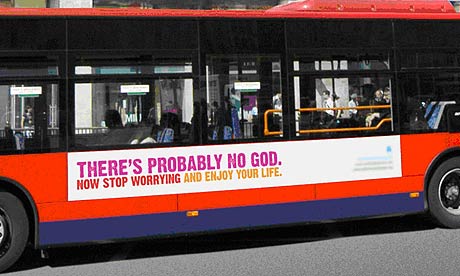
I wonder what the reaction will be to the
British Humanist Society's latest advertising campaign? They've just launched a fund-raiser to display advertisements on London buses reading, 'There's Probably No God. Now stop worrying and enjoy your life.'
 As the Guardian put it
, 'The godless move in mysterious ways' - and
the Times, tongue firmly in cheek, called it a 'heaven-sent ad opportunity'.
I'm amused by the campaign, and, perhaps oddly for a believer and a pastor, I fully support the right of those behind it to display these advertisements. There are far too many so-called 'people of faith' who don't really have faith at all! They don't so much believe as follow a comforting ritual they learned from their parents, or drifted into without much consideration of what was involved. There are a huge proportion of believers - of every faith, not just Christianity - who honor their 'belief' far more in the breach than in the observance. They may show up to services, but their way of life outside the service is often the diametrical opposite of what it should be.
I think this atheist campaign might actually do a lot of good, in that it may make people think about their faith. If they ask themselves, "Why do I believe?", that can only be a good thing. Blind faith, unexplored, unanalyzed, is seldom a meaningful thing. It's more of a knee-jerk reaction. I'm all in favor of a thorough exploration of reality, leading to a reasoned, rational commitment to the system of belief one chooses. That's why I believe as I do.
I'm never offended by those of other beliefs, be they other Christian churches, non-Christian religions, or atheists. I fully support their right to believe - or not - according to their understanding, and the light they've been given (or exposed to) in their lives. Of course, I expect them to extend to me the same courtesy. Unfortunately, militant atheism - like so many militant philosophies or doctrines - can't demonstrate tolerance and acceptance like this. It's the chief failing of organizations like the BHS. For example, they're part of the
Accord Coalition, which is campaigning at present to remove State funding from religious schools that base their entry requirements on the practice of a given faith. Trouble is, no-one is forcing parents to enrol their kids at such schools: and since those same parents pay taxes for education, why shouldn't they have the right to have those same taxes applied to their kids' schooling? If you remove State assistance from such schools, effectively the parents concerned will be paying tax for something that is of no benefit to them at all.
My perspective would be that either such parents should be exempted from the general education taxation, so that their funds are freed to educate their children as they wish; or that taxpayers should have the option to designate the education portion of their tax payments as either being for secular education alone, or also available for faith-based schools. In this way, the rights of the taxpayer and believer alike would be respected.
I have several atheist friends and acquaintances, and we get on just fine together. They know that I'm a believer, but I don't try to shove it down their throats or beat them over the head with a Bible. I know they don't believe in God, but they don't try to mock or scorn me for my faith. Given that mutual tolerance, we're able to associate in relative harmony. I wish more people of faith (or atheism) would try harder to demonstrate the same acceptance! If Jesus were alive today, and met an atheist, I can't see Him turning his back on him in contempt. I rather think He'd try to talk to him with respect and love, and show him by His example that there's more to life than nothingness. I try to do the same.
As I've said before on this blog, I don't think religion is something one
believes - it's something one
lives, something one
does. It's an action, rather than a verbal statement or intellectual position. I hope that the BHS campaign makes some who are believers in name only, rather than in lived reality, examine their positions more closely. It might help them to put their faith into practice a little more!
Tolerance notwithstanding, I have to close, tongue in cheek, by quoting the late
Archbishop Fulton Sheen. His definition of an atheist was: "A man with no invisible means of support!"

Peter