Gathered from around the Internet over the past week. Click any image for a larger view.


Gathered from around the Internet over the past week. Click any image for a larger view.
Last week we lost Roger Whittaker, one of my favorite singers and a staple of the "easy listening" circuit for the best part of half a century. He had very few big hits, but sold something like 50 million records to a very loyal fan base, and - unusually - entertained in countries and languages other than his own, particularly German, for many years. Some of his songs remain among my personal favorites, six of which I've selected in his memory this morning.
His first major hit was 1969's "Durham Town".
Also from the 1960's is his upbeat song, "Mexican Whistler". Whittaker was an expert whistler, and featured it on several of his hits.
He could be reflective and thoughtful, too. Here's "Why".
From the early 1970's, here's "New World in the Morning".
My personal favorite out of all his many songs is "I don't believe in 'If' anymore".
And what more appropriate song to close this memorial than "The Last Farewell"?
Thanks for the music, Mr. Whittaker. You will be missed.
Peter
John D. Widden was a sailor in the 19th century, starting at the most tender of ages in 1834 and retiring as a ship's captain in 1870. He wrote an autobiography titled "Ocean Life in the Old Sailing Ship Days - From Forecastle To Quarter-Deck".
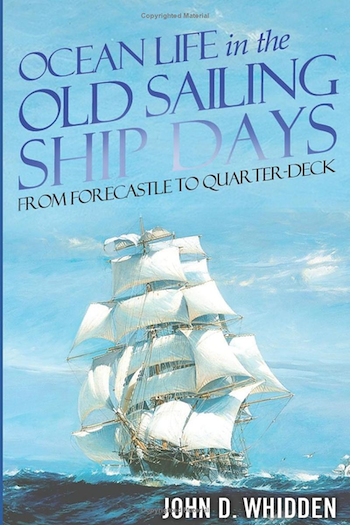
The blurb reads:
John D. Whidden started out at sea in 1834, at the age of twelve, and did not retire until 1870.
This is his account of over a quarter-century spent on the high seas.
Orphaned at five, nothing held Whidden back from embarking on sea life seven years later. Serving as an apprentice, he quickly proved his worth, and earned himself a mate’s position by his early twenties. Graduating to third, second and first office, he ended his career in command of, and having part-ownership of his own vessel.
This memoir, Ocean Life in the Old Sailing Ship Days, records a series of real events, from his childhood impressions of rough and ready seamen, to his thrilling and brutal experiences of war.
His travels saw him spanning the world, with stops at major ports such as Honolulu, Buenos Aires, Calcutta, and Liverpool.
His life spans the changes in the shipping industry over the 19th and into the 20th century.
During the Civil War, Whidden was heavily involved in profitable island trading in the Bahamas to elude Confederate sailors. However, shortly after the close of the war, in 1870, Whidden left sailing as he found it being overtaken by foreign interests.
John D. Whidden (1832-1911) wrote Ocean Life in the Old Sailing Days in 1908, partly as a memoir, but also to offer a snippet of the “old sailing ship days” before major changes occurred to its business environment, fundamentally changing its nature. It is a classic account of a different way of life, which will appeal to both sailing enthusiasts and historians alike.
I thought the opening chapter might set the scene for a very interesting autobiography. Recommended to all who love ships, the sea, and the age of sail.
I was born on High Street in Boston, Mass., in the year 1832, and lost my parents when I was but five years of age. My mother died at Mobile, Alabama, where my father was engaged in business, and my father died in Savannah, Georgia, the year after. Upon their decease, my grandparents having taken charge of my sister and myself, we were brought up in their family at Marblehead, Mass., and I attended the public schools until I attained the age of twelve years.
At this time I was called a very fair scholar, well up in reading, writing, and geography, fair in arithmetic, and intensely interested in books of travel and adventure, while all works treating of the sea, tales of travel in foreign lands, shipwrecks and everything pertaining to the ocean, had a very great fascination for me.
Marblehead being a seaport town, my time, when not in school or employed around the house doing chores, was spent with my companions about the wharves, swimming or climbing about the vessels at the docks, rowing around the harbor in the small boats, or dories, that we would borrow from the various captains or skippers of the fishing craft, — mostly schooners from fifty to ninety tons burthen, engaged in the Grand Banks fisheries, of which at this time there was a fleet of nearly a hundred sail, all hailing from and owned in Marblehead.
What a treat for us boys when a square rigger — as we designated all barks, ships, and brigs — came sailing into the harbor, perhaps from Cadiz, Spain, laden with salt for the fishing fleet to take to the Grand Banks of Newfoundland for their spring fares, and when she hauled into the wharf to discharge her cargo into the salt sheds, how we youngsters swarmed on board, exploring every nook and cranny of her, climbing over her rigging, daring each other to mount higher and higher, until with a feeling of triumph I at last placed my cap upon the main royal truck, the highest point, and looking down saw the admiring, though envious, gaze of my young companions!
Then, again, to sit around the fo’c’sle after the work for the day was over, to see the sailors at their meals, and hear them spin their yarns, was happiness indeed.
To go to sea, become a sailor, visit foreign lands, and in due time become the captain of a fine ship, this was the goal to be looked forward to, the great aim of our lives. It certainly was of mine, and I judge of all, or nearly all, of my playmates.
My grandparents were not in favor of my adopting a sailor’s life, wishing me to learn a trade, but to this I was opposed, and rang the changes upon the advantages of a seafaring life, until they gave way and consented.
Shortly after this decision, on my return from school one day I was ushered into the parlor, where sat a gentleman in conversation with my grandmother, to whom I was introduced. He was Captain James King, of Salem, Mass., and I learned for the first time that I was to join the ship he commanded in two weeks, the ship being the fine new half clipper named the “Ariel,” just launched, and lying at Newburyport, bound round to New York to load flour for Liverpool, England, from thence to China, she having been built for a Canton trader.
This was joyful news indeed, and I went out from the parlor, after making my best bow and answering all his questions in a satisfactory manner, the happiest boy in the old town.
During our conversation, my grandmother touched upon my good qualities, and said to Captain King that she did not see how she could part with me, I was so useful and willing to do anything about the house, such a help to her, etc., etc., to all of which I listened in considerable astonishment, for, while my grandmother was one of the best of souls and very fond of me, yet I was constantly getting into trouble, and received more scoldings, no doubt richly deserved, than pettings. In fact, at this time I had fallen into disgrace, and I afterward thought it the predisposing cause of her consent being obtained to my going to sea.
The facts were as follows: At regular intervals during the year, and especially about the holidays, Thanksgiving and Christmas, my grandmother made up and baked what she called a “batch” of pies, — mince, apple, and squash predominating. I was very fond of pie, and at these times I was in great demand to peel and core apples, seed raisins, chop meat and suet for the mince; taking a most active part, and a very willing one, in all that was going on in this line.
Then came the baking. Our kitchen was large and roomy, and the fireplace immense. This was before cooking stoves came into use. On the left side of the fireplace was a large brick oven, where all the baking was done, and when this occurred it was in large quantities, about thirty or forty pies constituting a “batch.” After baking, they were stored in what was called the “back chamber closet,” very large and convenient, having tiers of shelves around it, there to remain until wanted. It was a goodly and attractive sight to my eyes whenever a fresh “batch” was stored away. I longed to get at them, but the old lady, probably feeling that I was not to be trusted when pies were around, always kept the closet locked and the keys stowed safely in her ample pocket. My little bedroom adjoined this chamber, and in going and returning I was obliged to pass through it. Always in the morning I invariably tried this closet door, and always found it locked, but this morning my grandmother had forgotten to lock it, although she had taken out the key! I could hardly credit it. Opening the door I looked in, where lay the rows of pies, temptingly displayed in tiers, shelf over shelf. I would not have stolen money, or anything else, but the sight was too much, and I yielded to temptation. I did not dare take a whole pie, as that would be missed at once. To cut one would be open to the same objection, i.e. discovery. I pondered awhile how I should enjoy the fruits of my “find” and yet escape detection. A brilliant thought struck me. Slipping down-stairs I entered the kitchen. My grandma was busily engaged, and I could see was likely to be, for half or three quarters of an hour, at least. Hastily smuggling a case-knife into my pocket, I passed out of and around the house and entered by the side door. Creeping softly up the back stairs, in a moment I was again in the closet. Standing on a chair, and taking a pie from the top shelf, knowing these would be the last used, I inserted the thin knife between the upper and lower crusts, and working carefully round was able to lift the top crust sufficiently to enable me to get at and eat all the mince from the inside. Carefully replacing the top crust, and patting the edges down, the pie to a casual observer showed no difference, in the looks, from any other pie. Pleased with my first experiment, I proceeded to try another, and did not finish my feast until I had eaten the insides out of six or seven pies.
Each day I visited the closet and regaled myself on mince or apple pie, taking no note of the number; in short, I was just living on pie. No wonder my dear old grandmother thought my appetite was failing and grew anxious about me, but the end was near!
One day, on my return from school, I found we had company to tea, two or three ladies. This was good news, for company days were red letter days to me, as we always had something extra in the way of cake, preserves, and pies; in short, a great addition to every-day fare.
The tea was ready, the table nicely laid, and the guests seated around it, my grandmother at the head to serve the tea, grandpa at her left, and myself at her right. I can see her now, smiling, and beaming upon her guests, as she glanced around the well-appointed board.
Ann, our old servant, had been commissioned to bring down two or three pies, which were on the hearth in front of the fire, warming. At the right moment one of the pies was placed in front of the old lady. As she took the knife and fork in her hands to cut it, she made a few remarks on how she made her pies, how careful she was to select the ingredients, etc., ending with the query whether Mrs. Jones would prefer apple or mince?
“Well, really, Mrs. Appleton,” replied the lady, “they look so nice, I believe I’ll take a small piece of each.”
“Why, certainly,” replied my grandmother, laying her knife upon the pie, which crashed through it like an egg-shell!
I shall never forget the feeling of terror that seized me, or the look of astonishment on my grandmother’s face, as she turned reproachfully to Ann, and said: “Why, Ann! You’ve forgotten to put any mince in this pie,” adding, rather sternly, “You may pass me up another pie.”
Ann’s face was a study. She was a splendid cook, and to be called down before company for not putting mince or apple in pies, and baking them without, was past her comprehension. She could not understand it. Another pie was placed upon the table, and again the old lady started to cut it, meanwhile apologizing for keeping her guest waiting. Same result! Laying down her knife and fork, she looked at my grandpa, and then at me.
Although not a word had been said, I could contain myself no longer and blurted out, “I didn’t do it.”
This of course was a dead give-away.
My grandfather arose, and taking me by the shoulder marched me to the door, telling me to go to bed, and he would attend to me by and by, which he did, and I lost all appetite for pie for the time intervening between this event and my leaving home.
Now came the bustle of preparation. The carpenter, old Mr. Jerry Smith, was given the commission to make my little blue sea-chest. As no member of the family had ever been to sea, the old folks were somewhat at a loss as to what I would require, but this was got over by pressing into the service old Captain Edmund Bray, a retired shipmaster, who readily entered into the family councils, and, acting on his suggestions, my outfit was soon completed and packed away in my chest.
On Monday morning, I was to leave home, and taking my books from school Friday night for the last time, I bade the master goodbye, spending Saturday with the boys in all their games, it being a holiday.
Sunday I attended church all day, and the following morning said the last goodbye, and started for the station with my grandfather. Arriving a little before train time, he spent the interval in giving me good advice, which I am afraid was not listened to as earnestly as it should have been, when handing me my tickets for Newburyport, with six new half-dollars, which were very highly appreciated, money having always been a very scarce article during my school days. I stepped on board the train and in a few moments was speeding away toward my future home, at least it would be my home for a year or more.
Arriving at Newburyport, I hired a conveyance and was driven to the wharf with my chest, there obtaining the first view of the ship in which I was to make my start in life, and, as I took in her trim appearance, and looked aloft at her long, tapering spars, realizing that I was really a member of her crew, a feeling of pride came over me, and all regrets, if I had any, were swept away, and I felt I had made no mistake in adopting a sailor’s life.
The first and second officers were on board, with the carpenter, who came out to assist me in getting my chest on board and stowed away in the fo’c’sle, where for the time I was the only occupant, the carpenter having his room aft.
Having got my mattress into one of the upper berths, I got out my blankets and sheets, with “comforter” or spread, and proceeded to make my bed after a home pattern. At this time sheets and pillow-cases were unheard of articles in a ship’s fo’c’sle, but of this fact I was not aware, so made my bed as near as I remembered it in my little chamber at home. This being done, I went on deck, making the acquaintance of the first and second officers, by whom I was set to work at odd jobs about deck, sweeping up, and anything I was told to do.
As the crew had not come down from Boston, there was no cooking on board, but the officers and myself got our meals at a place called “Brown’s Tavern,” but a short distance from the wharf.
A week passed, and I had become quite accustomed to being on shipboard. After having received instructions from the second mate before going aloft, I had won considerable credit by sending down the main royal yard, and did the work in a manner that brought a compliment from him, i.e. “an old hand could not have done it better.”
This pleased me very much, and I began to consider myself quite a sailor. But, “pride goeth before a fall.”
It was the close, of a drear December day. Snow, rain, and sleet had been falling, and about four in the afternoon I had gone below in the fo’c’sle to get ready to go up to the tavern for supper, when I heard a great commotion on the deck overhead. The companion doors were thrown open, and down rained chests, bags, and hammocks, wet and dirty, followed by the crew who had just arrived on the train from Boston.
There were about twenty men, of all nationalities, and as soon as they landed in the fo’c’sle they began pitching the bags and hammocks into the berths, all talking and swearing, for they were not in good humor, being about as wet as their luggage.
I had drawn up, and was standing on my little chest alongside my berth, when, without any ceremony or asking “by your leave,” an old grizzled shellback tossed into my clean berth a wet, dirty bag and hammock.
Although I had stood, half in awe, watching the scene, not venturing a word, this act of old Tom’s was too much, and laying my hand upon his arm I remonstrated: “Don’t do that! You’ll soil my sheets!”
Tom gave me a puzzled look for a moment, and exclaimed, “Who in thunder are you?”
I hastened to assure him that I was a sailor, one of the crew, and that was my berth, and my bed was made up. With a queer look he mounted my sea-chest and glanced into my berth. Never shall I forget his look of wonder, and the ineffable scorn conveyed in his tone as he turned around to his chum, and exclaimed with withering sarcasm, “Well I’m blessed, Joe,” (only he did not say “blessed”) “if the beggar ain’t got sheets!”
I made no reply, but I felt that in his eyes, at least, I was no sailor, and when they had gone to supper, shortly after, off came the sheets and pillow-cases, which were stored at the bottom of my chest, nevermore to do duty as bedding on that ship.
Two days after, the weather having cleared, the crew came on board, also the pilot and captain, and with a fine westerly breeze sail was made at the wharf, the fasts cast off, and the ship headed for the bar. As soon as crossed, the pilot was discharged, and all sail made, topmast stun’sail booms got up and run out, stun’sails got out and sent up, anchors secured, and everything movable about decks made fast.
All was bustle and excitement attendant upon leaving port, and particularly in this case, as the “Ariel” was a new ship, on her maiden voyage, and many a glance was cast over the ship’s side to note her speed. Meanwhile the log was hove, and showing better than ten knot, a general feeling of satisfaction was felt fore and aft. The sea was comparatively smooth, and everything new to me. I was in my element, long looked forward to, and entered into everything with a will. Where I did not fully understand all orders I went with the crowd, and took note of what was going on, managing to get along very well.
At four o’clock the crew were called aft and the watches chosen, after which the port, or mate’s, watch went below to supper, while the starboard, or second mate’s, cleared up decks. They put everything in order for the night, while the boys swept up.
At four bells, — six o’clock, — the mate’s watch again came on deck to relieve the starboard, who went below for supper, remaining until eight o’clock, — eight bells, — when they again came up, relieving the port watch, who went below until midnight.
I will here state that from four to eight o’clock P. M. is divided into two watches of two hours each, and this changes the watches each night; so that the port watch has eight hours below one night, i.e. from eight to twelve P. M. and from four to eight A. M., while the starboard has eight hours on deck, having only four hours below to sleep, i.e. from twelve midnight until four o’clock A. M. The “dog” watches, as they are called, serve to change the long watches, so that the two get their eight hours below every other night, and it is a rule that the second mate’s watch always has the eight hours on deck the first night at sea.
I had been chosen in the second mate’s watch, Mr. Henry Fabens’s, and went to supper at six, with the rest. It consisted of hash, salt meat, hard ship’s biscuit, and tea sweetened with molasses. After supper the men filled their pipes, smoked and “yarned” until eight bells, when they again went on deck, myself with them, to stand my first watch at sea.
The wheel was relieved, the lookout man mounted the steps to the to’gallant fo’c’sle, while the remainder of the watch either paced the deck from the break of the fo’c’sle to the stern of the long boat, or picked out a snug berth, sheltered from the wind, to spin a long “yarn” to while away the four hours that must intervene before they could turn into a warm berth.
Old Tom, who since the sheet and pillow-case business had hardly taken any notice of me, started to do a turn of walking, pacing regularly from the fo’c’sle to amidships and return.
I wonder how many youngsters today would be willing (let alone able) to leave home at the age of 12, and enter into a dangerous, hardworking career at sea? I suspect our ancestors were a hardier breed than we've become . . .
Peter
That's what Christopher Rufo calls our present dysfunctional arrangement in America. He writes:
You’re not imagining that the world has gone mad.
Healthy debate has been replaced by activist hysterics. Speech is declared violence, while violence is excused as speech. Masculinity is condemned as regressive, while men in skirts and heels are celebrated in the public square.
It’s easy to laugh at these outbursts as the ravings of a small but vocal minority, but the compromised health of our body politic is not a trivial concern. A strange, new pattern of psychological dysfunction has infiltrated our most prestigious institutions, our corporate bureaucracies, and the highest offices in the land.
In short, we’re sick. Our society is out of balance. We’ve been consumed by a cluster of disorder that appeals to our worst instincts and deranges our most important social functions.
We need to recover our sanity. But to do so, we must first know exactly what we’re dealing with: the emergence of a Cluster B Society.
He goes into detail in the brief podcast below. It's twelve minutes of your time that will be very well spent by watching it. Highly, highly recommended viewing.
There are relatively few commentators on the American scene today whom I respect, and whose views I share in most important elements. Christopher Rufo is one of them. His Substack is worth visiting on a regular basis.
Peter
... it may be a security risk. By that, I mean an email address like "Firstname.Lastname@ISP.com", with a period in the prefix before the @ sign. Friend and fellow author John Van Stry reports:
I have the gmail address for my last name. Just me. I have it.
Now there aren't a lot of people with my last name in the world (less than a hundred) and SOME OF THEM use: FirstName.LastName for their gmail address.
Guess who ALL of their emails go to?
NOT JUST THEM.
I have access to ALL of their toll pass accounts, their APARTMENT COMPLEX CODES, their MEDICAL INFORMATION, you ****ing name it and sooner or later I end up with it. Because they put a ****ing dot in their name and MOST mail software is bought at the cut rate version of buymart and guess what? It can't handle that DOT.
So if YOU have a dot in YOUR email name, understand that there is someone else out there, who has the email that caused you to get the dot who is getting ALL OF YOUR PRIVATE ****.
There's more at the link.
This affects me, because I have several email accounts with a split prefix, that I use for different purposes. I'm going to have to look into that, and probably change them - which is a lot of work, and a massive time sink, but I guess will have to be done for security reasons.
Technology. Grrrrr!!! (Also known as "Why won't the computer do what I want it to do, instead of what I tell it to do?")

Peter
I had to laugh at this report from San Francisco.
A group of demonstrators protested outside the Hilton Hotel in San Francisco's Financial District, where Women's Declaration International USA is holding its convention. "WDI" says it's focused on reigniting the Women's Liberation Movement, but critics say that's misleading.
"Their group is what we call 'TERFs,' Trans-exclusionary radical feminists," said Nancy Kato from Reproductive Justice Coalition.
Activist Kato says she believes WDI's mission is anti-Trans.
"Their basic premise is patriarchy and men are the enemy and therefore focused on Trans women, to say they are not real women," Kato.
. . .
Police intervened when several counter protesters attending the women's conference showed up, including Corrina D'Annible.
"What specific rights are Trans-identified individuals asking for that they don't already have to begin with? So if we're talking about the right for males to invade women's spaces, like I said, the history of male violence is long and storied," D'Annible said.
WDI conference organizers ... told us in a statement ... "We are enjoying our discussions about the rights, privacy and safety of women and girls, including reproductive liberty and the rights of lesbian and bisexual women."
Protesters called out the Hilton for hosting the conference.
There's more at the link.
This, of course, is the bitter fruit of identity politics, so beloved of the progressive left. They specialize in identifying groups and then telling members of those groups that they suffer discrimination, need to stand up for "their" rights, and so on. As this report demonstrates, pretty soon groups splinter into more groups, and fight each other for their slice of the "rights" pie - and all the time the grey eminences manipulate them all for their own benefit.
San Francisco is rampant with such "divide and rule" politics. That's why nothing has been done to stop the homeless trashing the city, the extremists trashing anyone and everyone who won't get on their bandwagon, and the politicians who feather their own nests while effectively abandoning their electorate to the consequences of their failures.
I wish both sides in this case the best of luck. Go ahead! Demonstrate against each other and criticize each other to your heart's content! The rest of us in "normal America" will look on in bemusement, shake our heads, and then get back to the business of normal living, while you amuse yourselves in the ephemeral, nonsensical, ridiculous cloud cuckoo land in which you've chosen to cocoon yourselves away from reality.
Peter
... here are two items of interest. Both deal with sensitive issues, and may be offensive to some readers, so I suggest you don't read further if you want to avoid such difficulties. Also, if you haven't yet read yesterday's article, I suggest you do so before continuing.
First, here's a TEDx talk by Gail Dines titled "Growing Up in a Pornified Culture". It shows very clearly the sort of society in which our young ladies are growing up - and it's terrifying to anyone of a more traditional morality. If you're a parent, you should watch the whole thing.
Next, an article that appeared this morning at The Free Press titled "The Woman Who Stood Up to the Porn Industry—and Won". Here's an excerpt.
Not only has Schlegel curbed the billion-dollar online porn industry for the first time in history, forcing websites to protect kids in Louisiana and pull out of at least three U.S. states, she has offered a legislative blueprint for others across the country.
“I am truly humbled to see that we began a movement that has swept the country and began a long overdue conversation about how we can protect kids from hardcore pornography,” she says.
Schlegel’s crusade started back in December 2021. She had listened to The Howard Stern Show and 21-year-old pop sensation Billie Eilish talking about online porn. Eilish told Stern that she began watching “abusive” images at the age of 11, and that this had warped her sense of how to behave during sex and what women’s bodies look like.
“No vagina looks like this,” Eilish told Stern. “I feel incredibly devastated that I was exposed to so much porn.”
Schlegel was struck by Eilish’s openness, that she was “just a young girl being vulnerable enough to share those details with the world.”
The singer’s story also chimed with Schlegel’s professional experience both as a sex addiction therapist and a court-appointed special advocate for abused and neglected children in the foster care system. She knew the issues facing young clients raised on unlimited free online porn—the decoupling of intimacy from sex; the inability to get aroused without porn playing in the background; a warped idea of what your partner actually wants.
“If you’ve never had your first kiss but you’ve seen hardcore pornography, it’s going to mold the way you view sexuality,” Schlegel said. “You’re not dealing with a fully formed adult brain that's like, ‘Oh, so I shouldn’t strangle my partner?’ ”
If Schlegel understood the damage pornography causes, she also knew how easy it is for children to access it. And she realized that now she was a state legislator, she was uniquely positioned to do something about it.
There's more at the link. Recommended reading.
Both of these resources help to explain why modern relationships are so sexualized, and how they exclude so many traditional aspects of femininity and the marital bond that we discussed yesterday. I hope they help make sense of the mess so many of our relationships are in.
Peter
It's from the Indian movie "Baahubali 2: The Conclusion", which has an incredibly convoluted plot that I won't attempt to describe here. You can read more about it at the link.
One doesn't necessarily have to understand the movie to marvel at this extended fight scene. Suffice it to say that sacred cows on fire aren't the least of its special effects! Watch it in full-screen mode to get the most out of it.
Spectacular, wasn't it? Unbelievable, too, of course - but then, that's the way with most Bollywood productions of this sort.
Peter
Found on MeWe. Click the image for a larger view.

That gets it said.
I suggest posting that picture in the teachers' lounge of every kindergarten and elementary school in the country. Next to it, I'd like to see reward posters offering a bounty on those "teachers" who insist on corrupting our youth in that way.
Works for me . . . how about you?
Peter
I'm reminded of the meeting between Josey Wales and Ten Bears in the movie "The Outlaw Josey Wales". The Comanche chief told Wales, "There is iron in your words of death". It looks like a cartel boss in Ecuador went one step further when he took the iron, and his death, to the grave. The New York Post reports:
A murdered Ecuadorian cartel boss known as “El Fatal” was buried with hundreds of pistols, shotguns and rifles in his coffin so he could be “armed to the teeth in the afterlife.”
Now-viral images show Sevillano in an open casket as people rush to fill it with high-caliber weapons — reportedly so that he would be “armed to the teeth in the afterlife and could defend himself.”
There's more at the link.
I suppose there's a risk that a rival cartel, short of weapons, will dig up "El Fatal" and relieve him of his afterlife arsenal. That will provoke retaliation, of course, and counter-retaliation, and . . .
If his grave remains undisturbed, with all that metal buried in his casket, it'll definitely be a case of "rust in peace"!

Peter
I recently read an article in The Atlantic titled "Nobody Should Care About a Woman’s ‘Body Count’". The original is paywalled, but a non-paywalled version may be found here. I'm not going to excerpt it here, but I recommend reading it for yourself if the subject interests you. Basically, the author is arguing that it doesn't matter how many sexual partners a woman has had, and it shouldn't affect her as far as desirability is concerned.
I'd argue that it does, indeed, matter: and that it also matters as far as men are concerned. Admittedly, my viewpoint is conditioned by my Christian faith and having many years' experience as a pastor in dealing with relationships, good and bad. I will add that it wasn't always that way. In my younger days, I had relationships that I now regret, that were more "what can I get out of it?" rather than "what can I put into it?". I fear many of us can say the same. I wish we could have greater wisdom when we were young . . . it would avoid a lot of the damage we do to ourselves, and others, in those "salad days, when we were green in judgment". Unfortunately, life's not like that.
The huge damage inflicted on meaningful relationships by the "hookup culture" is that it's taken what is (or should be) the most important bonding experience a couple can share, and turned it into a cheap commodity, a voyeur's pornographic fulfilment, a search for new toys to give a more "profound" physical experience. For centuries - indeed, millennia - the sexual relationship was considered the physical expression of an existing spiritual and societal bond or "contract". Whether in a romantic relationship or an arranged one, the contract of marriage was supposed to precede the act of marriage (i.e. sex). Admittedly, this was often honored more in the breach than in the observance, but the theory nevertheless held sway, and governed human society for a very, very long time, no matter what culture or nationality or religion was involved. The sexual revolution stood that theory on its head. Sex was no longer a means of expressing that pre-existing bond. Instead, it became divorced from the bond, becoming no more than a casual encounter that might, or might not, lead to something more intimate in the mental and spiritual sense.
I think the general acceptance of that divorce, and the "commoditization" of sex, have caused immense damage to human relationships. It's long been said that a woman can't give herself sexually to a man without inevitably committing a part of her personality, her very being, in the exchange. I know modern psychologists and anthropologists decry this, but in my pastoral experience, I'd say there's a lot of truth in that old saw. I think women do, inevitably, commit a lot more of themselves when things get physical than men do. After all, the woman is letting someone else enter her. She's involved in an act that, absent external chemical or other intervention, is supposed to open the way to new life growing within her. In other words, the creative aspect of sex is something intrinsic to her reaction and response. It can't be otherwise, because only she can bear a child. Men can participate in the initial act, but they don't face the prospect of carrying another living human being inside them for nine months. Inevitably, for them, sex is more physical, less mental and spiritual, less bound-up in creation and more in recreation.
I've been struck by the number of women who've expressed regret to me about having had too many casual sexual encounters in their younger days. It's far from infrequent. They speak of having "wasted intimacy on those who didn't deserve it", or "gone along to get along", or submitted to the "if it feels good, do it" zeitgeist. Now, in later life, they wish they hadn't, and feel that the intimacy they've achieved with a long-term partner just isn't the same as if they'd been less experienced and more committed. They've seldom linked that to the creative aspect of sex from a woman's perspective, but I think that relationship can be demonstrated - at least to my satisfaction. Others may differ, of course.
Even men, if they're honest, will agree that there's a vast difference between "having sex" and "making love". The former can be impartial, almost agnostic, a mere exchange of bodily fluids, sometimes a commercial transaction rather than a human interaction. The latter is a giving of self combined with a receiving of the gift of self from another, an exchange, a sharing, a duality. I had a conversation once with a woman who was far more sexually "liberated" than I was. She challenged me to describe how making love to my wife was any different from making love to any woman. I thought for a moment, then answered that I wouldn't be "making love" with someone I didn't actually love. The physical act of sex, under those conditions, would not be "love-making" at all. On the other hand, making love with the woman I love was like coming home. I belonged there. When she welcomed me into her body, she welcomed me into her soul as well, and renewed her presence in mine at the same time. The other woman thought for a long, long moment in silence, and then said, with tears in her eyes, "I've never known anything like that... but now I wish I did."
The tragedy is that the more we devalue sex, the more we make it merely another physical transaction instead of something soul-deep, the less it can be a pathway to that level of intimacy. I've worked with couples where one or both partners had previously had literally hundreds of sexual encounters with others before they married. Almost universally, I found that their own physical relationship lacked any aspect or feeling of union, of becoming one spiritually and mentally as well as physically. It was effectively no more than mutual masturbation, because they had reduced sex to that level before they met each other. They no longer were able to give themselves in the act of marriage, because it was no longer the act of marriage at all. It was just another thing, something to do to pass the time or feel good before tackling other, more important things. Other couples who'd had dozens, rather than hundreds, of prior sexual relationships experienced something of the same difficulty, although to a lesser extent than those who'd "burned out" their sexuality by going to extremes. As a rule of thumb, I found that couples who'd had few romantic and (particularly) physical relationships before marriage found their marital bond (including the physical) much more meaningful and fulfilling than others who'd been more "experienced" ("jaded" or "burned-out" might be better terms).
Notice that I haven't brought God or religion into this at all. These appear to be human actions and reactions regardless of faith. When a couple has religious beliefs as well, the latter appear to reinforce and strengthen and elevate their bond to a whole new level, and I'm profoundly grateful to have been able to help some of them achieve that. However, even in the absence of faith, the basic make-up of the human psyche appears to be consistent. Abuse intimacy, and one can no longer experience it to its fullest extent. At its worst, one may no longer be able to experience it at all. The number of sexual partners one has had - whether one is male or female - is therefore, in my experience, a significant indicator of the likelihood - or otherwise - of potential or actual problems in a subsequent permanent relationship.
I know my views will be controversial, particularly to those with a more liberated perspective. Therefore, I invite readers to contribute their thoughts in Comments. I think we might all benefit from a wider discussion of this issue.
Peter
Looks like hostilities have erupted once again between Azerbaijan and Armenia, the former the aggressor (this time) and the latter the defender. However, there are a number of factors that make this rather more threatening than earlier conflicts.
As if we needed another hot spot in that part of the world . . .
Peter
Alaskan wildlife reminds me very much of African wildlife - they do as they please, and don't give a damn if you don't like it!
A mama black bear and her cub had their fill of sweets Tuesday morning when they climbed into a van delivering Krispy Kreme Doughnuts and devoured several boxes of the freshly baked treats.
The van was parked on Joint Base Elmendorf-Richardson when it happened. As a delivery driver was making a regular stop at an Express store on base, he briefly left the van door open to deliver doughnuts to the store. That’s when the mother bear and her cub snuck inside.
“You could hear them breaking open the packages,” said Shelly Deano, manager of the JBER store. “We were trying to beat on the van but they just kept eating all the doughnuts. They ate 20 packages of the doughnut holes and I believe six packages of the three-pack chocolate doughnuts.”
Deano called base security, which eventually got the bears to leave the van by blasting loud sirens. She said they ambled off into the nearby woods.
There's more at the link, including a video report with pictures of the bears chowing down.
Momma bear and cub on a sugar high . . . no wonder the locals didn't want to get too close! I bet they'll be chasing after every Krispy Kreme delivery truck they see from now on.

Peter
It's becoming more and more clear that the mass illegal migration across our southern border is being deliberately engineered to destroy the United States as we know it. You won't hear a word about that from most politicians or the mainstream media, but the reality of what we're facing is undeniable.
Many observers have figured it out. Blogger HMS Defiant warns:
Some people have elected to ignore all of the downstream consequences of letting millions of impoverished ignorant no-skill people into the country to bolster the democratic party's vote farming schemes. What are the problems you ask.
1. The swell the ranks of unemployed/unemployable and foster greater crime and drug use and add to the homeless issue created by the left.
2. They will soon overwhelm all of our public infrastructure and make waiting times for hospitals, doctors, nurses, and classrooms overwhelming and even more outrageous.
3. They almost certainly won't have any form of insurance. That's going to hurt every hospital in the country and they are also going to start driving just as soon as they can steal or buy a cheap car and when they hit you, and they will, you will find out what it means and in the mean time your insurance rates are going to rise dramatically.
4. Every single public benefit that was ever created to benefit Americans will be diluted to the point of meaninglesness as it is forced to deal with the every increasing numbers of poor and ignorant border crossers.
If you are not interested in local politics you better get interested because those people are the ones that are going to twist every single good thing you like about where you live to the purpose of feeding, educating and housing the illegals over and before feeding, housing and educating the people who were born here.
There's more at the link.
T. L. Davis has been warning of this for a long time. In his latest post on SubStack, "Engineering the Wreckage", he writes:
The drain of illegals, especially with their $2,200 a month for each parent and child, making the take $4,400 for a family of four when reconstructed makes the budget unworkable. Just that alone, but the economy is being engineered toward wreckage in so many other ways ... nothing is as expensive as social benefits, especially when they go to those who have contributed nothing.
Now, the push is to get these illegals working. Ha! They didn’t come here to work. That was in the past, when they were promised nothing, then they knew they had to work, but now, all they have to do is exist and the federal government, under Joe Biden or any other Democrat and most Republicans, will pay them whatever they want…until they don’t.
For me, that’s the end game for this invasion. The Biden regime knows that all it has to do to unleash hell on the American people is to stop paying all of these illegals. This is probably part of the plan to interfere 2024 election, delaying it, they will say, but they have no intention of going forward with any future elections. All they need is a constant crisis that they’re able to manufacture at will ... The flood of immigration is designed to wreck the welfare system and force people into confrontation with each other.
Again, more at the link.
The flood of illegals is getting worse, not better. We're now seeing coordinated cartel operations to swamp what little border security we have left.
Drug cartels are sieging the border by deliberately sending thousands of migrants a day to hand themselves over to Border Patrol officers in different US border towns, sources revealed to The Post.
The tactic is meant to tie up already overworked border agents so Mexico’s cartels can carry on their drug and human smuggling operations undisturbed in less populated areas, law enforcement officials explained.
. . .
“The way it’s being orchestrated through the cartels, I believe it’s meant to overwhelm the system. The [places] that are being impacted the most are border communities,” former El Paso City Councilmember Claudia Rodriquez told The Post.
. . .
Across the entire southwest border, as many 9,400 migrants have crossed into the US in a single 24-hour period. That almost matches the record-setting week in May just before the government changed the rules for migrants crossing into the US, which saw over 10,000 people flood into the country per day.
Folks, it's as plain as the nose on my face that this is nothing less than a deliberately engineered crisis, one designed to consolidate the position of the powers that be and enable them to use the emergency they're generating as an excuse and a lever to hold onto power. It's a blatant implementation of the Cloward-Piven strategy from the 1960's:
Cloward and Piven ... stated that many Americans who were eligible for welfare were not receiving benefits, and that a welfare enrollment drive would strain local budgets, precipitating a crisis at the state and local levels that would be a wake-up call for the federal government, particularly the Democratic Party. There would also be side consequences of this strategy, according to Cloward and Piven. These would include: easing the plight of the poor in the short-term (through their participation in the welfare system); shoring up support for the national Democratic Party – then splintered by pluralistic interests (through its cultivation of poor and minority constituencies by implementing a national "solution" to poverty); and relieving local governments of the financially and politically onerous burdens of public welfare (through a national "solution" to poverty).
Cloward and Piven's article is focused on forcing the Democratic Party, which in 1966 controlled the presidency and both houses of the United States Congress, to take federal action to help the poor. They stated that full enrollment of those eligible for welfare "would produce bureaucratic disruption in welfare agencies and fiscal disruption in local and state governments" that would: "...deepen existing divisions among elements in the big-city Democratic coalition: the remaining white middle class, the working-class ethnic groups and the growing minority poor. To avoid a further weakening of that historic coalition, a national Democratic administration would be constrained to advance a federal solution to poverty that would override local welfare failures, local class and racial conflicts and local revenue dilemmas."
. . .
Michael Reisch and Janice Andrews wrote that Cloward and Piven "proposed to create a crisis in the current welfare system – by exploiting the gap between welfare law and practice – that would ultimately bring about its collapse..."
That describes precisely the effect that the illegal alien invasion is already having. We're being overwhelmed by those who will become willing puppets of the system. Some have already speculated that if popular resistance increases, illegal aliens will be co-opted into law enforcement and paramilitary units to maintain "law and order" by suppressing opposition. If one looks at what's happened in the countries many of these people have come from (for example, Venezuela and its "colectivos", or Haiti and its criminal gangs that effectively run the country, or armed cartel terrorism in Mexico - the same cartels who are driving the illegal alien invasion of the USA), that's not a far-fetched speculation at all. There's no reason to think the same might not happen here.
If things blow up, as I fear they will, the big cities are going to be Ground Zero. That's where most of the illegal aliens are concentrated, and where they receive most of their support from overly generous social programs. If you live in a city with a heavy concentration of illegal aliens, you should be well advanced with your plans and preparations for how to deal with such an event. It's far from unlikely. Even out here in the sticks (relatively speaking), we're keeping our eyes open and preparing for trouble. You should be, too. We've discussed at length in these pages some of the preparations you should be making. Actually doing it is up to you.
Peter
I had to laugh at this headline at the Babylon Bee.

It stems from a controversy over Dove's hiring of a Black Lives Matter activist as a self-proclaimed "Dove ambassador" helping to promote "fat liberation".
Beauty giant Dove is facing a Bud Light-style boycott for partnering with controversial Black Lives Matter activist Zyanha Bryant, who was previously accused of getting a white student expelled over “misheard” comments.
. . .
It is just the latest backlash against controversial partnerships by big companies, most notably Bud Light, which has suffered a huge financial hit after teaming up with transgender activist Dylan Mulvaney.
Bryant, a student activist at the University of Virginia, had accused [Morgan] Bettinger of referring to BLM protesters as “good speed bumps” in the summer of 2020 — only to later admit she likely “misheard” her.
She campaigned to get the white student suspended from campus, and Bettinger’s record shows she faced disciplinary actions for her comments, which she fears may hinder her ability to get into law school.
Greg Price, the communications director for the State Freedom Caucus Network, said the decision to ignore that controversy and pick Bryant as an ambassador “is what actual privilege in America looks like.”
“BLM activist completely ruined the life of an innocent white girl with a false accusation of racism and gets a brand deal with Dove while Morgan Bettinger was kicked out of school and now needs medication in order to sleep.”
There's more at the link.
In a brilliant parody report, the Babylon Bee responded:
"This is the new depiction of Dove beauty," said Unilever marketing executive Marsha Rainwater. "Who wants to look at majestic, graceful doves and thin, statuesque women when you can buy products with fat manatees that have morbidly obese spokesmodels endorsing them? Our thoughts exactly."
The company made headlines last week when it announced it was partnering with 400-pound Black Lives Matter activist Zyahna Bryant to portray a more inclusive stance on body image. "It helps score us some ‘woke points,'" explained Rainwater. "Plus, we had a ton of excess food left over from a company banquet that we needed to clear out, so having an enormous, insatiable beast roaming the halls is beneficial in other ways, too. It's a win-win!"
Again, more at the link.
The satirists at the Babylon Bee frequently enliven my day with their snide remarks about the fatuous stupidity that so often surrounds our society. More power to them!
(I bet my friend and bestselling author Larry Correia is laughing too!)
Peter
I'm getting more and more comments here that I'm having to delete, rather than publish, because of several problems.
Peter
I was aware of a strong undercurrent of xenophobia in South Africa during my years there. I think part of it was due to strong tribal identification in Africa - it's your tribe versus all the others, and anyone not of your tribe is an "other" by definition, regardless of whether you share a skin color, religion, or anything else. (That's pretty universal in more primitive cultures around the world, by the way. In an inordinate number of cases, tribes' names for themselves in their own language refer to themselves as "the people", meaning that any and all others are not "people". For example, the Comanche tribe refer to themselves as "Nʉmʉnʉʉ" or "Nemenuh", meaning "the people".)
It seems nothing's changed in South Africa - in fact, xenophobia appears to be getting overtly political.
Operation Dudula was set-up in Soweto two years ago, the first group to formalise what had been sporadic waves of xenophobia-fuelled vigilante attacks in South Africa that date back to shortly after white-minority rule ended in 1994. It calls itself a civic movement, running on an anti-migrant platform, with the word "dudula" meaning "to force out" in Zulu.
Soweto was at the forefront of anti-apartheid resistance and home to Nelson Mandela, South Africa's first democratically elected president. Now, the township has become the home of the country's most-prominent anti-migrant group.
With one in three South Africans out of work in one of the most unequal societies in the world, foreigners in general have become an easy target.
. . .
Operation Dudula has ... now transformed itself from a local anti-migrant group into a national political party, stating its aims to contest next year's general election.
. . .
Ms Dabula says critics of Operation Dudula who maintain it is a collective of violent vigilantes are wrong.
"We don't promote violence and we don't want people to feel harassed," but adds: "We cannot be overtaken by foreign nationals and do nothing about it."
Hundreds of supporters travelled to attend its first national conference in Johannesburg in May, where members voted to register the group as a political party.
Waving South African flags, dancing and singing their way through the streets to the City Hall, it feels like a celebration.
However, the songs they are singing carry a threatening message: "Burn the foreigner. We will go to the garage, buy some petrol and burn the foreigner."
There's more at the link.
The BBC produced a one-hour documentary on "the rise of xenophobia in South Africa and the violent targeting of migrants". It's worth watching, if the subject interests you - and it should, because the same phenomenon is increasingly visible in the USA as well.
We're seeing the same xenophobia develop in our own communities, and it's entirely understandable. People who have relied on "their" government to help and support them are finding more and more that "their" supports are being diverted to the illegal aliens flooding across our southern border - and they're getting very angry about it. Consider these headlines:
Chicago Mayor Tells Residents To Make ‘Sacrifices’ To Benefit Illegal Immigrants
Chicago residents upset resources are going toward immigrants as more Texas buses arrive
Suing. Heckling. Cursing. NYC Protests Against Migrants Escalate
‘You’re free’: Hundreds of illegal migrants released onto San Diego streets
El Paso among border cities seeing migrants dumped onto streets: ‘We will run out of capacity’
Video shows train filled with migrants heading toward US southern border from Mexico
I could have cited many more reports, from many more cities. Those merely illustrate the trend.
I keep my eyes and ears open to local reactions to the immigrant crisis. It's far from a "white problem". Many local (i.e. North Texas) black and hispanic residents are even more resentful of the alien invasion than whites are. I've heard a number of them go so far as to voice threats against any migrants who try to settle here and "take our jobs" or "fool with our women". They're not mild threats, either. People here are well aware of the "alien barrio" that's being erected near Houston, whether locals there like it or not (they weren't consulted). That's just a few hours' drive from here. Our locals are determined to prevent anything similar happening in this area - and public sentiment around here seems to be solidly behind them.
I wonder if the Democratic Party has shot itself in the foot, politically speaking, with its outright, outspoken support for illegal migration? It's historically relied upon black communities - and, to a certain extent, hispanic communities - for a lot of its electoral support. Now both those communities are feeling threatened, indeed overwhelmed, by the illegal alien problem. Will they withdraw their support from Democrats? If they do, will they merely stay at home instead of voting, or will they actively support another person or party? If they can't bring themselves to vote Republican, could they become the core of a new, anti-illegal-alien party like Operation Dudula is becoming in South Africa?
Another important question is how Mexican crime cartels are likely to respond if xenophobia gains ground in America. The cartels are currently making as much money, if not more, from getting illegal aliens through Mexico and into the USA as they are from drug dealing. If their income from that source is threatened by anti-immigrant sentiment in the USA, can they afford to tolerate it? Will they try to impose migrants on communities by violence? It's not a far-fetched question, because the cartels have shown willing (in Mexico) to use violence as a tool of policy under almost any circumstances, and even to take on the government and armed forces in open violent confrontation if they think it necessary.
This is going to get more and more "interesting" (in the sense of the fabled Chinese curse), particularly as the 2024 election campaign gets under way.
Peter
Gathered around the Internet over the past week. Click any image for a larger view.


It's time for something completely different. Instead of focusing on a particular composer, or piece of music, or genre, let's look at a particular musical instrument. This half-hour documentary focuses on the pipe organ: specifically, the organ of the Fourth Presbyterian Church in Chicago. The church's Web site describes the organ as follows:
The Edith G. and Edward J. Andrew Pipe Organ, built by Quimby Organ Company, is an American symphonic organ with a great deal of influence from the British organ builders T. C. Lewis and Henry Willis.
The instrument includes delicate symphonic colors, including a harp, English horn, and many lush string tones, as well as zymbelsterns (bells) and chimes. Pairing that with its warm foundation tones and expansive color, the Andrew Pipe Organ is able to play any organ literature. It is particularly well suited, however, to accompanying congregational singing and choir anthems, inspiring people and bringing them closer to God with expressions of majesty, sorrow, and joy.
Its console is the only organ in Chicago — and one of the few in all of the U.S. — to have five manuals (keyboards). These keyboards, along with the pedals, control the nine divisions of the organ. These are made up of 143 ranks and 8,343 pipes, making the Andrew Organ the largest pipe organ not only in Chicago but throughout the Midwest. The combination action has 10,000 memory levels.
There's more at the link.
It's a humdinger of an instrument. See for yourself.
If I'm ever in Chicago, I'll have to make a point of going to Fourth Presbyterian Church to see (and, if possible, hear) it.
Peter


