Monday, February 17, 2025

Yet again, jobs take a hit


Waste Management, a very large - dare I say it? - garbage industry in Texas, is planning a significant reduction in its workforce.  The reasons behind it are seldom discussed, but apply to many sectors of the economy.


Houston-based Waste Management will continue to shed jobs in 2025 by reducing dependency on roles that require physical labor and turning more to technology and automation for its services.

“There has been a long-term plan to not backfill specific vacated roles. By 2026, we’re anticipating that will lead to the reduction of about 5,000 positions,” said Kelly Caplan, senior director of external communications. ”At the same time, increased automation is reducing the demand for these types of labor-intensive roles.”

. . .

“Our average heavy equipment operator is approaching 53 years old. It becomes difficult to find folks to drive a truck or to work on a piece of heavy equipment,” Fish said on the show. “So this is almost by necessity that we’re using technology to replace difficult-to-hire roles. I think one thing that I wanted to make sure I was clear about on here, though, is we’re not laying folks off. All we’re doing is using attrition. Some of those jobs have very high turnover rates.”


There's more at the link.

Note the critical issues:

  1. These aren't layoffs, but natural attrition.  Nobody will be fired, but as they resign or retire, they won't be replaced.
  2. It's hard to recruit employees for jobs that are physically hard work, unpleasant, etc.  Therefore, automation is not only a viable alternative, it may be the only alternative.
  3. Companies are now building reduced workforces into their plans for the future.

That's going to impact a large number of industries and a lot more companies in the not very distant future.  Expect it to impact the number of jobs that need to be filled.  Excuses from pro-migrant pressure groups that migrants are "doing the jobs Americans won't do" sound pretty hollow against the reality that most of those jobs won't exist soon.

We've already seen how robotics and automation are impacting farms.  Preparing the fields, planting, fertilizing, weeding and harvesting the crops can now be automated to a surprising extent, reducing the required workforce by a very large proportion.  Cellular telephone technology, drone (UAV) supervision, artificial intelligence, satellite navigation and other innovations are becoming commonplace.  Sure, the initial costs of the automation are high, but once it's paid for, it just goes on working (given routine maintenance).  Its long-term cost averages significantly less than the wages of the number of people it would take to do the same work.  It doesn't get sick, doesn't need vacations, works long hours without complaint, and never goes on strike.  I know of a couple of big vegetable farms that now employ only about 15% of the staff they used to hire every season, and many of those they hire are skilled, educated technicians rather than unskilled labor.  They earn big money to do a sophisticated job.  Farm work ain't what it used to be . . .

Fast food is seeing the same transformation.  Young men and women used to start out their careers by flipping burgers in a fast food joint, or waiting on tables.  In many places, automated ordering kiosks have replaced cashiers to take orders, and food preparation is increasingly being handled by robotic equipment.  All the advantages discussed above of automating farms apply to restaurants and fast food outlets, too.

Washington D.C. is now experiencing (at express-train speeds) the same phenomenon.  Huge, overstaffed, slow, kludgy federal bureaucracies have grown too big to afford, and too large to be efficient at their jobs.  President Trump is taking an axe to them, reducing workforces, insisting on technological updates where necessary, and slashing budgets to reflect our economic reality.  It has to happen.  If President Trump did not do it, someone else would have to, or else our sclerotic bureaucracy would implode under its own weight.  However, tens (even hundreds) of thousands of jobs are going to be lost in the process.  What will happen to those who are laid off?  Do they have the skills to find good jobs elsewhere?  In an era where good workers are harder and harder to find, will such jobs even be available for them, or will they have been automated out of existence?  In the private sector at least, the answer to the latter question is increasingly "Yes".

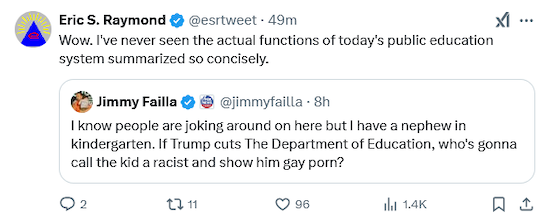
Have our schools adapted?  Are they preparing students to enter this increasingly technological workplace, to deal with the advanced automation they're going to encounter?  I fear not.  In fact, I think the poor quality of education in American schools is making them less able to deal with it than if they were home-schooled.  Note this exchange on X over the weekend:


Think about that in the context of an increasingly automated society - and then compare it to schools that still behave like dinosaurs.  Sure, there are big dangers about ideologically warped AI trying to propagandize our kids, rather than educate them;  but whether we like it or not, the advantages of AI-assisted education are already so evident as to make them virtually unstoppable.  Even companies that forbid their employees to use outside AI tools are faced with widespread disobedience from their staff, who simply find such tools too useful to ignore.  I'm willing to bet that companies like Waste Management are already figuring out how AI can help their garbage disposal operations, too.

Makes you think, doesn't it?

Peter


Memes that made me laugh 249


Gathered from around the Internet over the past week.  Click any image for a larger view.


Sunday, February 16, 2025

Sunday morning music


I got to thinking over the past few days about the passage of time, days, weeks, months, years, even decades.  It was prompted by news of the death of an old comrade in arms, with whom I lost touch after I moved to the USA in the 1990's.  Anyway, that started me thinking about songs dealing with the passage of time.  There must be thousands of them out there;  it's a common theme in love songs, country ballads, and a host of other genres.

Here, in no particular order, are a few of the songs I remember about time passing.  Without planning it that way, they all date from the 1950's and 1960's.  First, from Simon and Garfunkel, "April Come She Will".


Next, Sandy Denny and the Strawbs with "Who Knows Where The Time Goes".


From Magna Carta, here's a lovely folk-style tune, "Time For The Leaving".


With tongue firmly in cheek, here's Flanders and Swann with "A Song Of The Weather".


And finally, here's a very early Jethro Tull song, "We Used To Know".  If the chords seem familiar, there's a little-known reason for that, as I'll explain in a moment.


Here's a 1996 live recording of that piece, which Ian Anderson opens by explaining how and why the Eagles' hit "Hotel California" sounds rather like "We Used To Know".


There you have it:  five songs, picked at random, about the passage of time.  What are your favorites on that subject?  Let us know in Comments, and provide a link to a version of the song if you can find one.

Peter


Friday, February 14, 2025

Happy Valentine's Day to all you lovers!


Hopefully, yours is going better than Stephan Pastis'.  Click the image to be taken to a larger version at the "Pearls Before Swine" Web page.


Peter


Lest we forget...


... the current crisis in government revolves around both major political parties, the Republicans as much as the Democrats.

The appallingly wasteful and uncontrolled expenditure being uncovered by D.O.G.E. is long overdue for exposure, and any right-thinking American, regardless of his or her political views, should applaud its efforts.  However, let's not lose sight of the fact that these abuses were put in place over decades, not just during the past Administration.  Some of them date back to the 1980's, if I'm reading D.O.G.E. press releases correctly.  That means they were implemented under both Republican and Democratic administrations, and passed by Congress and the Senate with both Republican and Democratic votes.

It's tempting to say, "Oh, look what the Democrats have been doing!" - but it's also only half the story.  Republicans have been equally guilty.  President Trump isn't the enemy of the Democrats as such:  he's the enemy of the entire system of government that's been milking America like a cow, with no accountability and an endless appetite for corruption.

I think we should all look at our congressional representatives and our senators, and figure out how long they've been in office.  If it's more than five to ten years, I think it's probably a good idea to look for new blood to replace them, because they may by now have been corrupted.  As Lord Acton famously said back in 1887:


Power tends to corrupt, and absolute power corrupts absolutely. Great men are almost always bad men.


I think history has proved him to be pretty accurate.  No matter how well a "great man" starts out, he all too often ends up corrupted by the greatness of his position.  That would probably apply to President Trump as well if he were to stay in office indefinitely, but of course he won't.  He has less than four years to complete his work, and pass it on to someone who will hopefully continue it.

"Power corrupts" both Republicans and Democrats.  Let's move them on before they can become too corrupted, and replace them with others at regular intervals.  It's our best safeguard against that evil.

A final thought, one that a number of people have expressed in recent weeks.  If President Trump had won re-election in 2020, he would never have had the same impact as he's had this year.  Because he lost that election (many of us think he was cheated of it), he had time to think and plan ahead;  and the frantic, frenetic attempts by the Democratic Party to demonize him and render him politically impotent only made him stronger and more determined.  In a very real sense, the progressive left of American politics have created their own nemesis in a new, revitalized President Trump.  The same can be said for all the "Never Trump!" RINO's (Republicans In Name Only) who tried to kick President Trump while he was down.  I daresay they're regretting their choices now . . .

Peter


Thursday, February 13, 2025

Don't the mainstream media ever get tired of lying?


The mainstream media appear to be desperately searching for anything even remotely negative to say about the Trump administration.  The latest is food distribution under USAID.  From MSN:


In a warehouse in the East African port of Djibouti, USAID estimates there’s roughly 40,000 metric tons of food aid procured from American farmers worth about $40 million at risk of spoiling in the heat and humidity.

There’s also $10 million of emergency food supplies at risk in a South African warehouse and another $39 million of aid waiting for shipment from Houston, Texas, according to a report this week from the beleaguered agency’s inspector general’s office. The White House fired the agency’s inspector general after the report came out.

All told, the watchdog estimated there’s nearly $500 million of emergency food assistance paid for by US taxpayers at risk of being ruined by the Trump administration’s disruptive freeze of all US foreign aid and Elon Musk’s chaotic attempt to shut down the United States Agency for International Development, which has seen thousands of staff fired or put on leave and even its name stripped off its Washington headquarters.  


There's more at the link.

And from CBS:


Almost $500 million in food aid is at risk of spoilage as it sits in ports, ships and warehouses after funding for the U.S. Agency for International Development, or USAID, was paused by the Trump administration, according to a Feb. 10 report from a government watchdog. 

The report from USAID's inspector general highlighted the risks of "safeguarding and distribution" of $8.2 billion in unspent humanitarian aid after the Trump administration ordered almost all staff to be placed on leave and ordered a review of U.S. foreign assistance programs. 

USAID, which provides humanitarian aid to more than 100 countries, buys food directly from U.S. farmers and manufacturers, which have typically provided about 40% of international food assistance, according to a 2021 report from the Congressional Research Service. With USAID funding paused, there is concern among U.S. farmers about the market for some of their products, including Kansas sorghum producers, according to the Topeka Capital-Journal. 


Again, more at the link.

Clearly, the mainstream media has its marching orders from Propaganda Central, and they're all scurrying to paint the most negative possible picture of the results of USAID's decline and fall.  Well, I've worked in the Third World for decades.  I've seen USAID food distributed in several countries.  I've helped organize, and led, aid convoys into disrupted and/or disaster areas.  I know whereof I speak - and I can tell you that those reports are mostly bull****.

First off, the food that USAID distributes (or should that be "distributed"?) isn't broccoli and bananas, guaranteed to go bad within days.  It's dry grains such as rice, wheat, sorghum, and so on.  It's flour (in large quantities) from wheat, maize and other grains.  It's beans of any number of varieties.  The stuff lasts for months, if not years, and is selected with that as a primary requirement.  Since destinations for that aid seldom have luxuries such as refrigeration or air-conditioning, you send them food that can remain edible and healthy under such conditions.

Secondly, the "risks" of "safeguarding and distribution" are real, whether or not USAID is involved.  Have you seen photographs of tents made from or supplied by USAID, in use by terrorist movements such as Hamas, the Taliban and others?  Of course you have.  Have you seen TV footage of food for sale in African village markets, including sacks filled with USAID-supplied grain?  Yep, that too.  All those aid products were stolen by those selling and/or using them.  They don't pay for them.  They don't even ask for them.  They simply raid the warehouses where they're stored and take what they want, or hijack entire convoys loaded with aid products.

(Theft wasn't a major problem with those aid convoys I organized and led.  That's because I kept a "slush fund" of some of the aid money, and used it to hire a local gang of thugs.  I would promise the gangster - sorry, he preferred to be called a "warlord" - that if he and his AK-47-festooned goons would guard our trucks and their cargoes against theft by others, I'd pay him a fairly lavish sum (by local standards) upon our safe return to what passed for civilization in that part of the world.  He was usually happy to agree.  A few who agreed, then tried to rob me, learned the hard way that I was prepared for that and would deal with it in a rather... ah, robust fashion.  After word spread among their peers, the survivors proved rather more cooperative.  Why aid organizations couldn't or wouldn't do the same thing, I have no idea - qualms of conscience, perhaps?  To me, the choice was simple.  If you wanted the aid to get where it was needed, you used the tools at your disposal.  If you didn't use them, your aid didn't get to where it was needed.  Q.E.D., end of story, end of problem.)

As for US farmers suffering a loss if the USAID market is closed to them, I doubt very much that will be a problem.  USAID's food budget is a tiny fraction of what countries all over the world pay to import food from the USA.  That demand will continue.  US food aid will also continue, and that food will continue to be bought from US farmers.  It just won't have "USAID" on the sacks containing it - there'll be another name or departmental logo.  The bureaucrats will doubtless come up with something catchy and friendly-sounding to accommodate international sensitivities.  Perhaps we could start a rumor that the USA is putting saltpeter or copper sulphate into its food aid, to curb rampant Third World libidos?  That should reduce the demand for our farm products quite substantially . . .

So I don't think we need to worry about USAID food "rotting" in warehouses, and the problem of having it stolen will be no worse than if USAID was actually supervising it as usual.  It got stolen then, and that will continue, because USAID and its local partners have seldom, if ever, done anything effective to protect it from theft.

Ignore the bleats of outraged sensitivities from the mainstream media.  They're all parroting the same script, and none of them know what they're talking about.  The truth is not in them.


Peter


Activist judges, unveiled


Breitbart has an excellent article providing details of the activist judges who are trying to block President Trump's policies and executive orders.  It's eye-opening, to say the least.  Here's just one example.


Chief Judge John J. McConnell Jr., of the U.S. District Court for the District of Rhode Island, nominated by President Barack Obama

A Democrat donor, McConnell is attempting to block another spending freeze from Trump and is even taking the extreme approach of threatening administration officials with criminal charges if it is not reversed.

But McConnell is more than just a typical Democrat. He’s a committed activist, as the Daily Caller reported:

While he was in private practice as an attorney until 2009, McConnell donated hundreds of thousands to Democratic campaigns and political action committees, including 2008 presidential campaigns of Hillary Clinton, Joe Biden and Barack Obama, according to Federal Election Commission records. He also donated over $8,000 to Democratic Rhode Island Sen. Sheldon Whitehouse’s 2006 senate campaign.

He not only worked at the ACLU, but he was on the board of directors for the Rhode Island branch of Planned Parenthood for four years.

“The scale of McConnell’s political giving sets him apart from most other judges nominated during the Trump and Obama administrations,” according to Roll Call:

In the last 30 years, he contributed half a million dollars to federal political committees, more than any other judge nominated by Presidents Barack Obama or Donald Trump. About $190,000 went to members of Congress. At least $200,000 more went directly to the Democratic Party and its state affiliates, according to a review of Federal Election Commission records.

He contributed nearly $12,000 to Whitehouse and almost $9,000 to Rhode Island’s senior senator, Democrat Jack Reed. As his home-state senators, both had the power to propel or torpedo his nomination. Whitehouse was on the Senate Judiciary Committee in 2011 and voted on McConnell’s confirmation to the federal bench that year. McConnell had also made contributions to top Democratic leaders such as Sens. Charles E. Schumer and Richard J. Durbin; and to Sen. Al Franken, who also voted on McConnell’s confirmation.

A person with this level of partisanship ought to be recused from any cases that are remotely political in nature.


There's more at the link.

The article is worth reading for its multiple examples of "judge-shopping" or "court-shopping".  Progressive activists try to bring their cases before such judges, in the sure knowledge that they're much more likely to get the results they want.

Peter


Wednesday, February 12, 2025

There's a lot going on...


If you haven't already read it, click over to Coffee & Covid and read today's essay.  It's a bit mind-blowing in its implications.  I won't try to excerpt it here - just go read it there.  It's worth your time.

Peter


They're stealing a billion dollars every year of OUR money to fund the Uniparty


For years people knowledgeable about the situation in Washington D.C. have spoken of the "Uniparty" - politicians who work together regardless of Democratic or Republican Party affiliation to pursue common interests and common aims.  It appears that members of the Uniparty have enriched themselves by feeding at the public trough for a very long time - unacknowledged, of course, and unimpaired by any sense of ethics or morals.

Now, however, the investigations by D.O.G.E. into the financial mess President Trump has inherited are bearing fruit - and, in the process, exposing the Uniparty's common organs.  Datarepublican reports:


The seven NGOs in the chart below, in my view, represent the Uniparty. Each of these organizations receives substantial financial support from USAID or the Department of State.  [Click the image for a larger, readable view.]

Around 2019, the phrase “democracy in danger” began to dominate public discourse, amplified by the media. This was odd—after all, the U.S. is a democracy (or more precisely, a constitutional republic). But as I traced the influence of these NGOs, a pattern emerged: they are controlled by establishment politicians, they play a major role in shaping political narratives worldwide, and their core mission is always framed as “protecting democracy.”

Originally, these NGOs were created to support U.S. democratic efforts abroad—many of them emerging during the Cold War to combat the spread of communism. But with the fall of the Soviet Union, their original purpose faded. Instead of dissolving, they redefined their mission. Now, they have positioned themselves as the guardians of democracy itself.

This shift explains why Trump’s re-election was framed as a "threat to democracy." To these NGOs, “democracy” means themselves. Their survival depends on maintaining that role, and any challenge to their authority is perceived as a direct attack on democracy itself.

. . .

Most of these NGOs were born during the Reagan years. While not all USAID and State Department funding flows through them, they control the purse strings for much of America’s global financial influence.

DEI initiatives created a system of unaccountability and dependency, which ended up injecting more money into them and further entrenches their power.

They see any challenge to their authority as a threat to democracy itself. But their greatest enemy is still the same one they've had since the Cold War—Russia. They've never lost the "Cold War" boomer mindset.

In their minds, they’re the superheroes keeping America from crumbling. And that entitles them to their travel perks, cushy post-election gigs, and all the other benefits that come with running an unacknowledged empire.


There's much more at the link.

The taxpayer funds allocated to each NGO for (presumably) one recent fiscal year (not specified) come to a total amount of no less than $1,027,930,770.  That's one billion, twenty-seven million, nine hundred and thirty thousand, seven hundred and seventy dollars.

Who's it going to?  Click over to Datarepublican's post and read the list of those running those seven NGO's.  You'll see an awful lot of familiar politicians' names, from both sides of the aisle.  Mitt Romney?  Check.  Elise Stefanik?  Check.  Steny Hoyer?  Check.  Donna Brazile?  Check.  They're all looking out for themselves and each other, and they have a billion dollars of taxpayers' money every year to do it with.

Folks, far too many of our politicians are robbing us blind, whether Republican or Democrat.  We need to identify all those responsible, and kick them out of office as quickly as possible.  If we don't, we deserve to lose everything they'll continue to steal from us.


Peter


The law of unintended consequences - political edition


The Telegraph in London has an interesting perspective on how President Trump is using the Democratic Party's own weapons against it (article may be paywalled).


Democrats created all the tools Trump is using to attack official Washington. Oops. They hoped to centralise power in the presidency and break through the old limitations of the 1787 Constitution. They largely succeeded after decades of effort.

What the authors of this transformation never expected was a president who would use the great powers they handed him to dismantle their own cherished projects. Yet that is exactly what Trump is doing.

This political ju-jitsu puts Chuck Schumer, Hakeem Jeffries, and their friends in a very awkward position. They grab the bullhorn to scream “no one elected Musk”. They’re right, of course. But then no one elected the bureaucrats they are defending, and they are far more insulated from control by elected officials.

. . .

The irony is unmistakable. Trump is using the powers of a strong White House to attack the administrative architecture built so laboriously by Democrats. Their progressive agenda is captured by the phrase “Living Constitution,” and was first articulated by Prof Woodrow Wilson (before he became president) and Herbert Croly. It began, in practice, in 1937, when the Supreme Court buckled to Franklin Roosevelt’s pressure and ruled that his new agencies and their regulatory actions were constitutional. Until then, the Court had ruled the other way.

After that, the largest steps were taken by Lyndon Johnson, whose Great Society programme created Washington’s complex array of bureaucracies. Barack Obama put the capstone in place with his healthcare legislation, a Democratic goal since Harry Truman.

These cumulative efforts shifted power away from the states and, within Washington, from Congress to the president and a proliferating array of Executive Branch agencies. The president could then govern by executive orders and regulatory actions by those agencies. Although Congress still passed laws, its principal role was reduced to overseeing those agencies (poorly) and approving engorged, consolidated budgets.

Only recently has this trajectory begun to change. That change is the core of the fight in Washington now. A more conservative Supreme Court has begun setting more stringent limits on bureaucratic discretion, both by eliminating deference to agency decisions and by requiring Congressional authorisation for major rules. Trump is acting along parallel lines. Together, these actions by the Supreme Court and a populist president are attempting to alter the long arc of a government that is increasingly centralised, intrusive, and bureaucratic.

The irony is that Trump and his team can take these giant steps, often unilaterally, only because they have grasped the tools created by Democrats and progressive advocates. Trump is using those tools in ways their architects never anticipated. “Nobody expects the Spanish Inquisition,” as Monty Python said. Now, the Grand Inquisitor has arrived, wielding the very weapons Democrats gave him.


There's more at the link.

"Nobody expects the Spanish Inquisition" . . . and I never thought to see that phrase used to describe an American President!


Peter


Tuesday, February 11, 2025

Bad news for our insurance premiums


In mid-January I noted that California had implemented insurance "reforms" that would allow insurers to recoup losses in one part of the state (e.g. the Pacific Palisades fire) from all the insured in that state, by raising everyone's premiums, no matter where they live.

It now appears that something similar is happening across America, even if we live thousands of miles away from the disaster area.


Regulators in many states are allowing insurance companies to raise rates to cover the cost of events that insurers have had to pay elsewhere, as well as increasing the money for things like the rising cost of reinsurance, which insurance firms purchase to limit their risks of major catastrophic events.

“In a world where we have persistently large shocks, you’re getting big cross-subsidies across the country,” said Ishita Sen, a professor at Harvard Business School who was part of a team that conducted a 2022 study on the effects of costly disasters on homeowners insurance rates nationwide. “The past suggests that after big wildfires, other states have ended up paying for it.”

The Insurance Information Institute, an insurance industry trade group, disputes the study’s findings. It says that increases in rates come because insurers are judging the greater risks and costs across most of the country, not because homeowners’ premiums in one area are being used to pay for disasters in other regions.

. . .

Schneyer said some shifting of costs and risks is inevitable for large, national insurers, which benefit from customers facing different perils in different geographies. Asked about what he would say to someone in the Midwest paying more for hurricane risks along the Gulf and East Coasts, and fire risks in the West, he said that “they should hope if they need a new home because their home is destroyed by a tornado, or need a new roof that is damaged by large hail, their insurer would pay for that.”

“That’s risk-sharing. That’s how risk works in the insurance industry,” he added.


There's more at the link.

In the past, our insurance "markets" were apparently centered around the risks each area faced.  States with a hurricane problem, or a tornado problem, or a wildfire problem, were typically grouped with other states facing the same dangers.  The cost of a major natural disaster of that type were estimated and/or averaged, and that led to insurance rates matching the risks and costs involved.  Now, however, it appears that all risks everywhere in the country are going to be costed and averaged in that way, so that my insurance premium in Texas is going to have to contribute something to the cost of rebuilding the Pacific Palisades suburb in Los Angeles, or pay for hurricane damage in Florida, or whatever.

In one sense, this is logical, because insurance companies operate on a national basis and need to cover themselves against national risks.  However, it flies directly in the face of traditional insurance practices, which had states setting limits on how much premiums may be increased in the light of the risks that their in-state policyholders face.  Can that state-by-state legislative/regulatory system continue if insurance companies are going to demand that customers in a low-risk state nevertheless pay premiums as if they were in a higher-risk area, to cover those who actually do live in such areas?

I don't pretend to know the answer to this.  All I know is, I'm paying a lot more for property insurance than I used to, and I don't like it.  It may become unaffordable, or add so much to mortgage costs that some properties become impossible to sell - because nobody can afford to pay both the mortgage and the insurance premiums each month.

Oy.

Peter


Is Ukraine selling US weapons to cartels and on the black market???


Tucker Carlson thinks so.  Here he discusses the possibility with retired LtCol Daniel Davis.  The video is keyed to start and end at the appropriate segment of their conversation, which is about five minutes in length.


That's a terrifying thought.  What if a drug cartel, or a well-funded terrorist movement, bought a few MANPADS (man-portable ground-to-air missiles) and used them to bring down an airliner or two?  They could shut down the entire commercial air market in a country, or even more than one country.  The damage that would do to the world economy is catastrophic, to say the least.

I'm looking for more evidence to substantiate Mr. Carlson's claim that Ukraine is selling weapons on the black market.  I'm not talking about rumor or innuendo - I mean hard evidence, like matching up serial numbers of weapons against shipments.  If any reader has more information about that, please let us know in Comments.

Peter


Monday, February 10, 2025

The Trump revolution and the Deep State's fightback - light versus darkness


Over the weekend, an article by Eko titled simply "Override" went viral across social media - and deservedly so.  It's one of the best analyses and expositions of what President Trump's administration has done in the three weeks that it's been in office.  Here's a brief excerpt from a long, complex article.


In Treasury's basement, fluorescent lights hummed above four young coders. Their screens cast blue light across government-issue desks, illuminating energy drink cans and agency badges. As their algorithms crawled through decades of payment data, one number kept growing: $17 billion in redundant programs. And counting.

"We're in," Akash Bobba messaged the team. "All of it."

Edward Coristine's code had already mapped three subsystems. Luke Farritor's algorithms were tracing payment flows across agencies. Ethan Shaotran's analysis revealed patterns that career officials didn't even know existed. By dawn, they would understand more about Treasury's operations than people who had worked there for decades.

This wasn't a hack. This wasn't a breach. This was authorized disruption.

While career bureaucrats prepared orientation packets and welcome memos, DOGE's team was already deep inside the payment systems. No committees. No approvals. No red tape. Just four coders with unprecedented access and algorithms ready to run.

"The beautiful thing about payment systems," noted a transition official watching their screens, "is that they don't lie. You can spin policy all day long, but money leaves a trail."

That trail led to staggering discoveries. Programs marked as independent revealed coordinated funding streams. Grants labeled as humanitarian aid showed curious detours through complex networks. Black budgets once shrouded in secrecy began to unravel under algorithmic scrutiny.

By 6 AM, Treasury's career officials began arriving for work. They found systems they thought impenetrable already mapped. Networks they believed hidden already exposed. Power structures built over decades revealed in hours.

Their traditional defenses—slow-walking decisions, leaking damaging stories, stonewalling requests—proved useless against an opponent moving faster than their systems could react. By the time they drafted their first memo objecting to this breach, three more systems had already been mapped.

"Pull this thread," a senior official warned, watching patterns emerge across DOGE's screens, "and the whole sweater unravels."

He wasn't wrong. But he misunderstood something crucial: That was exactly the point.

This wasn't just another transition. This wasn't just another reform effort. This was the start of something unprecedented: a revolution powered by preparation, presidential will, and technological precision.

The storm had arrived. And Treasury was just the beginning.


There's much more at the link, and it's all essential reading, IMHO.  I can't recommend it too highly.

Eko has just published a follow-up article, "The Machine Fights Back:  Inside Treasury's War Against Its Own Reformers".  Here's another short excerpt.


Here's what Treasury didn't want exposed:

Over $100 billion flowing annually to accounts without Social Security numbers. No temporary ID numbers. No verification. Nothing.

When Musk asked Treasury officials how much was "unequivocal and obvious fraud," the answer revealed decades of corruption: HALF

Let that sink in.

$50 billion per YEAR.

A billion dollars every SINGLE week disappearing into accounts that shouldn't exist.

The kind of fraud that would shut down any bank in America.

The kind that would land any business owner in federal prison.

But Treasury had perfected its system:

1. Process payments
2. Ignore controls
3. Keep the machine running

Yesterday, something shifted. A judge's order appeared, ex parte—meaning only one side could speak. No warning. No defense allowed. Just a wall erected between Treasury officials and their own department's data.

. . .

Think about what that means: The Secretary of the Treasury—effectively the CFO of the United States government—legally barred from seeing how money moves through his own department. The people's appointee blocked from viewing the people's accounts. Young coders mapping the missing controls ordered to stop looking.

The MACHINE (that’s what I’ll be calling the DS from now on) has judges. Has lawyers. Has media. Has entire states moving in coordination.

. . .

This isn't about spreadsheets anymore. This isn't about waste or controls or management. This is about who controls the machine.

Because when you find something like empty fields in Treasury's payment system, you're not just finding missing data. You're finding purpose. When basic controls sit blank while billions vanish weekly, that's not incompetence. That's design.

The machine is fighting back.


Again, more at the link, and also very important reading, IMHO.

This is essentially the conflict we're going to see across the Executive Branch going forward.  The bureaucrats who administer the US government have done so on their own terms, using mechanisms they've created to make their jobs easier, without informing the public (or, in many cases, their political masters).  Fraud and waste have been built into those mechanisms, because it's easier - less work for bureaucrats - to simply process payments rather than check on them line by line and expenditure by expenditure.  That ease has, in turn, fostered monumental corruption, because politicians (by tolerating such lax bureaucratic systems, and indeed encouraging them) have opened gateways through which they, and their favored causes and groups and individuals, can skim the cream off government (i.e. taxpayer) income and divert it to their favored projects (not least of which has all too often been themselves).

The way to undo such bureaucratic systems and shenanigans is to expose them:  to let the American people see what has been done in their name, and put it right through administrative and judicial means.  Those who created such systems, and profited from them, seek the opposite:  to keep them all hidden, to prevent them being exposed, so they can carry on grafting from the American people and enriching themselves and their favored causes and people.


The courts are going to have to do a lot of the work.  The judge who barred the Treasury Secretary from doing his job is clearly partisan and biased, by any rational, objective standard.  No judge has the right, in terms of the Constitution, to bar elected and/or duly appointed officials from simply doing their job (which by its very nature includes exposing and dealing with inefficiency, corruption and dishonesty).  That's basic to our system of government - but in this case, the judge has ignored that.  One hopes President Trump will ignore such unconstitutional court orders, or at least take them higher in the judicial system as quickly as possible.

Being a retired pastor and chaplain, I find a strong spiritual element in all this.  In the Bible, the first chapter of the First Letter of St. John contains these words:


This is the message which we have heard from Him and declare to you, that God is light and in Him is no darkness at all.  If we say that we have fellowship with Him, and walk in darkness, we lie and do not practice the truth.  But if we walk in the light as He is in the light, we have fellowship with one another, and the blood of Jesus Christ His Son cleanses us from all sin.


If that applies to Christian believers and their relationship with God, how much more should it apply to politicians and bureaucrats and their relationship with the electorate?  The latter have done everything possible to avoid "walking in the light".  President Trump and the D.O.G.E. team are doing everything possible to drag them, kicking and screaming, into the light.  Only when they've succeeded in doing so will there be "fellowship" between Americans, mutual trust that neither side is trying to hoodwink or steal from the other.

Makes you think, doesn't it?

Peter


Memes that made me laugh 248


Gathered from around the Internet over the past week.  Click any image for a larger view.


Sunday, February 9, 2025

Sunday morning music


A somewhat unusual musical joke this morning, courtesy of In The Middle Of The Right, who posted this video.  It's set to the Bee Gees' hit "Stayin' Alive" from the movie "Saturday Night Fever".


And, for those who don't remember the disco era, here's the original tune.


Mercifully, the disco era didn't last long.

Peter


Friday, February 7, 2025

A reminder: foul language and rudeness are not tolerated here


In recent weeks, I've noticed an upsurge in comments that are vituperative, ill-tempered, downright profane attacks on other commenters, as well as very nasty things being said about certain politicians and political parties.

Folks, those comments are not going to be published here.  End of story.

I've said many times that I try to keep this blog family-friendly.  That means at least a basic level of politeness is required from those who wish to interact with other readers here.  It's not difficult, and I don't think it's unreasonable.  Simply "do unto others as you would have them do unto you".  If you don't want to be referred to or talked about in foul, intemperate terms, please don't do it to others - and if you do want to be referred to or talked about in that way, I suggest you seek immediate psychiatric or psychological help rather than waste your time commenting here.

If that offends you, I'm sorry, but that's the way it is.  If you disagree, you're free to start your own blog and say whatever you please.

Peter


$200 million for animal transgender research???


This absolutely boggles my mind.  If it's true that Dr. Fauci sponsored and/or approved this research, then I suspect his evil may be beyond redemption.  Watch this five-minute video, and prepared to be left speechless.


How many thousands - perhaps tens, or even hundreds, of thousands - of innocent animals were mutilated, drugged, tortured like this for no good medical reason at all?

I'm beginning to think I'd like to see one last government grant approved.  This one would be to take every person in government who thought up, approved, paid for, or conducted such research to be arrested, confined in laboratory animal cages, and used for medical research - without benefit of anesthetic - until they die in the same misery they've inflicted on so many animals, and so many people.

Words fail me.


Peter


Thursday, February 6, 2025

Poverty - a chicken-or-egg-first situation


Courtesy of an article at Come And Make It, I came across this video.  I found it interesting and informative;  and, based on many years working in "the projects" from time to time, and volunteering at a homeless shelter, and working with prison inmates who pleaded poverty as an excuse for their crimes, I think it does a reasonable job at exposing why inner-city or "ghetto" poverty is a real issue.

Recommended viewing.


There's a lot more to poverty, of course, and much more that can be said.  However, this video does a pretty good job of examining poverty in the context of the United States, and in particular of our cities.  It doesn't give enough attention, IMHO, to the "poverty industry" of NGO's, consultants, therapists and others who make a good living out of "managing" or "addressing" the causes, effects and reality of poverty, without ever doing anything to resolve the issues they identify - because that would cut off their income, and nobody (at least, from their perspective) wants that.

How far can one go in helping the poor without making them so dependent on that help that they lose all incentive, all desire, to get out of poverty?  How much can one give people without them coming to expect that everything in life is a "gimme", and nothing is "I've got to work to earn this"?

*Sigh*

Peter


African-American History Month!


Found in several places on social media.  Click the image for a larger view.


Since, using the same criterion of birth, I'm also African-American (albeit with a strong side of Caucasian), that means I should be celebrating, too!  I'm on it like white on rice . . . oh, was it indelicate of me to say that?


Peter


Wednesday, February 5, 2025

That gets it said


Found on social media:


It's funny, but it's also tragic.  Oh, well.  Let the cleanup continue!

Peter