Sunday, January 25, 2009

Doofus Of The Day #151


Today's Doofus award is a collective one, to the police precinct in Chicago that let this happen.

A 14-year-old aspiring police officer donned a uniform, walked into a Chicago police station and managed to get an assignment — patroling in a squad car for five hours before he was detected, police said Sunday.

The boy did not have a gun, never issued any tickets and didn't drive the squad car, Deputy Superintendent Daniel Dugan said.

Assistant Superintendent James Jackson said the ruse was discovered only after the boy's patrol with an actual officer ended Saturday. Officers noticed his uniform lacked a star that is part of the regulation uniform.

Police said they were investigating how the deception went undetected for so long in what they described as a serious security breach. Police said disciplinary steps are possible pending the outcome of the investigation.

Police didn't identify the boy because of his age. He has been charged as a juvenile with impersonating an officer.

Dugan said the boy looks older than 14 and was motivated by a desire to be an officer, not malice or "ill intent".

The boy once took part in a Chicago program for youth interested in policing, so he would have been familiar with some procedures, perhaps helping him blend in, police spokeswoman Monique Bond said.


Yes, this is funny, and full marks to the youngster for creativity . . . but what if he'd got into a shootout with a criminal? What if his partner had thought he could rely on him to back him up, only to find out - perhaps at the cost of his life or good health - that he was mistaken?

This should have been picked up before he ever got into a patrol car. Bad blunder, Chicago P.D.

Peter

This'll make you think!


The short video clip below raises all sorts of interesting questions.

Did you know:

  • There are more honors (high-IQ) children in India than the USA has children?
  • The top 10 in-demand jobs in 2010 did not exist in 2004?
  • We are currently preparing students for jobs that don't yet exist, using technologies that haven't been invented, in order to solve problems we don't even know are problems yet?
  • One out of eight couples married in the USA last year met online?
  • In terms of its number of users, if Myspace were a country, it would be the 5th largest in the world (between Indonesia and Brazil)?
  • In 1984, there were 1,000 Internet devices; in 1992, there were 1,000,000; and in 2008, there were 1,000,000,000?
  • There are about 540,000 words in the English language - about five times as many as during Shakespeare's time?
  • It's estimated that a week's worth of the New York Times contains more information than a person was likely to come across in a lifetime in the 18th century?

The video will tell you more.


Makes you think, doesn't it?

Peter

A somber piece of history


I was sobered by a report in the New Scientist.

An old glass jar inside a beaten up old safe at the bottom of a waste pit may seem an unlikely place to find a pivotal piece of 20th century history. But that's just where the first bulk batch of weapons-grade plutonium ever made has been found - abandoned at the world's oldest nuclear processing site.

The potentially dangerous find was made at Hanford, Washington State, the site of a nuclear reservation, established in 1943 to support the US's pioneering nuclear weapons program.


Hanford made the plutonium-239 for Trinity, the first ever nuclear weapon test, on 16 July 1945. Just three-and-a-half weeks later, more Hanford plutonium was used in the nuclear strike on the Japanese city of Nagasaki.

But sloppy work by the contractors running the site saw all kinds of chemical and radioactive waste indiscriminately buried in pits underground over the 40 years Hanford was operational, earning it the accolade of the dirtiest place on Earth.

In 2004, clean-up work uncovered a battered, rusted, and broken old safe containing a glass jug inside which was 400 millilitres of plutonium.


Recent tests by Jon Schwantes' team at the Pacific Northwest National Laboratory in Richland, Washington, has shown this plutonium was the first ever processed at the site, and the first made on a usable scale anywhere in the world.

. . .

But despite its historic significance, Schwantes doesn't plan to put the sample in a museum. He is working with New Brunswick Labs to create a standard reference sample for plutonium-239 from the material, partly because of its primacy as the oldest sample. "The other factor is its extreme purity - 99.96% plutonium-239 is as pure a sample of 239 I have seen produced from any reactor," says Schwantes.


Go to the link to read more. Very interesting scientific history.

It's sobering to think that part of the very first batch of plutonium ever to come into existence on this planet has survived all these years, buried in a waste dump. I'm very glad they're cleaning up the mess that the Hanford establishment became: and I hope this first sample of what was to kill so many people will now serve a more peaceful purpose.

Peter

The future of personal data storage?


I'm profoundly disturbed by the growing emphasis on 'cloud computing'. Many companies, particularly Google, are pushing this technology, and computer manufacturers are beginning to sell devices (such as the tiny 'netbook' laptop computers) that rely on it.

The huge problem with cloud computing is that all one's data (and the applications one uses to access it, such as word processors, accounting software, etc.) are stored on remote data centers, not under one's immediate control. If one's Internet access is cut off somehow, one can't continue to work on the data locally - one's helpless until the connection is restored. Furthermore, there's the huge problem of data privacy. News of hackers breaking into commercial systems to steal credit card numbers, etc. is an almost daily event. If you think that any data storage company is going to put as much emphasis (and spend as much money) on safeguarding Joe Q. Average's private data as a commercial enterprise will spend, I've got news for you.

Some argue that this doesn't matter any more: that our personal, individual privacy is a thing of the past. I don't agree. Say you store all your pictures on your computer's hard disk. Now you switch over to 'cloud computing' and store them on a central server. Sure, it has advantages - you can access them from anywhere at any time, and you can share them more easily. However, what if among them, you have pictures that are extremely private - for example, nude or semi-nude pictures of yourself or your lover? What if your private diary is also stored there, with notes that are intended for yourself alone, never to be shared? What happens if a disgruntled ex-partner manages to use your sign-on ID and password to access them, and circulates them? You can secure your own PC against such an event, but not your online persona. Where does that leave you?

The Guardian has a good article highlighting these dangers in the light of a new product from Google.

Google is to launch a service that would enable users to access their personal computer from any internet connection, according to industry reports. But campaigners warn that it would give the online behemoth unprecedented control over individuals' personal data.

The Google Drive, or "GDrive", could kill off the desktop computer, which relies on a powerful hard drive. Instead a user's personal files and operating system could be stored on Google's own servers and accessed via the internet.

The long-rumoured GDrive is expected to be launched this year, according to the technology news website TG Daily, which described it as "the most anticipated Google product so far". It is seen as a paradigm shift away from Microsoft's Windows operating system, which runs inside most of the world's computers, in favour of "cloud computing", where the processing and storage is done thousands of miles away in remote data centres.

Home and business users are increasingly turning to web-based services, usually free, ranging from email (such as Hotmail and Gmail) and digital photo storage (such as Flickr and Picasa) to more applications for documents and spreadsheets (such as Google Apps). The loss of a laptop or crash of a hard drive does not jeopardise the data because it is regularly saved in "the cloud" and can be accessed via the web from any machine.

The GDrive would follow this logic to its conclusion by shifting the contents of a user's hard drive to the Google servers. The PC would be a simpler, cheaper device acting as a portal to the web, perhaps via an adaptation of Google's operating system for mobile phones, Android. Users would think of their computer as software rather than hardware.

It is this prospect that alarms critics of Google's ambitions. Peter Brown, executive director of the Free Software Foundation, a charity defending computer users' liberties, did not dispute the convenience offered, but said: "It's a little bit like saying, 'we're in a dictatorship, the trains are running on time.' But does it matter to you that someone can see everything on your computer? Does it matter that Google can be subpoenaed at any time to hand over all your data to the American government?"


I'm in full agreement with Mr. Brown on this - not to mention the other dangers I've cited. I think I'll be keeping a honking great hard disk on my desktop, with all my personal files and data, plus software to access them. If computer technology moves on to the point where I can't get updated or current versions of the software, it'll be hey-ho, off to Linux and an older-fashioned way of doing things!

Peter

Saturday, January 24, 2009

Doofus Of The Day #150


A tip o' the hat to Julie for e-mailing me this story.

If you're going to break into a home through the roof, there are a couple of precautions you should bear in mind.

First, make sure no-one's at home to greet you.

Second: in the height of summer, directly beneath a tin roof, don't stay up there too long - or you'll be parboiled!

FOR two hours he hid inside the roof, the sun beating down on the tin above sending the temperature in his hiding place soaring.

Finally the burglar, who was forced to crouch in the tiny cavity after the family he intended to rob came home unexpectedly, could take no more and fainted.

The half-baked crook came crashing through the ceiling and landed at the feet of a horrified couple and their five young children almost 4m below.

Food distributor Darren Young described yesterday how he and wife Deslie and five of their six children were at their Newcastle home on the New South Wales Central Coast on Wednesday when the would-be thief made a sudden and unlikely entrance.

In a shower of plaster and insulation, the intruder slammed face-down into the hardwood floor and started groaning for help.


"I just heard this thunderous crash and thought it must be the kids doing something," Darren said.

"I ran in and there is this bloke lying there groaning. I didn't even realise where he had come from at that stage. I thought he must have been hiding in the cupboard."

Deslie also ran out after the crash, fearing her husband had suffered a heart attack.

With their terrified children looking on, the couple armed themselves with a pair of mildly threatening ceramic ornaments and screamed at the bumbling burglar to get out of their house.

The intruder staggered outside before collapsing in the backyard, where the Youngs and neighbours held him with the ornaments and a set of oars until police arrived.

The family thought they had heard faint calls for help about 30 minutes before, but had no idea the pleas were coming from their uninvited guest cooped up in the cavity over their heads.

Police believe the 28-year-old Newcastle man gained entry through a laundry manhole up to two hours before but was forced to hide after the family returned home.

With temperatures outside almost 40C, the cavity probably acted like a furnace slowly heating the criminal until he became faint and fell through the ceiling.

He was taken to hospital with a broken wrist, where he remained yesterday afternoon under police guard.


Never mind the broken wrist - I'm sure he was done medium rare by then. How long until he's done to a turn?


Peter

Unlikely animal friendships


I've been sent a few links in recent weeks giving details of unlikely animal friendships. Some of them seemed so improbable that I spent a bit of time verifying them, to see whether they were genuine. To my surprise, they were: so here are three selected oddball animal relationships.

First, the predators that play with dogs!


It seemed really weird, until I found that there are many other reported instances of similar behavior. Here's one, in a narrated slide show format. Worth watching.

Next, a killer whale that became separated from its pack, and grew up alone in Canada's Nootka Sound. Named Luna by locals, he formed relationships with other local wildlife, including this dog, with whom he seemed to want to play! (If the dog had jumped in, however, I'm not sure how long the play would have lasted . . . )


Sadly, this orca appears to have been killed in 2006 by the propeller of a visiting ship, according to this CBS report.

Finally, there's the story of Tarra and Bella - elephant and dog!


I know a few oddball animal relationship stories from my many years in Africa, but of course they're not on video or properly documented. If I can find some supporting material, I might post some of them in future.

Peter

For photography fans


I've recently discovered a most fascinating site for those interested in architectural photography. It's Tom Fletcher's New York Architecture. It has literally thousands of images of New York City, in color and black-and-white, arranged by landmark and by theme. One could spend hours browsing through it - I have! Highly recommended viewing for those interested in the subject.

I found his collection of historical black-and-white images of New York most interesting. I've taken the liberty of reproducing a few here, just to give you a taste of the many, many more to be found on his site.


Herald Square, 1895


Fifth Avenue, Easter 1900


Lower Manhattan, 1928


Arm wrestling in Harlem


Metropolitan Opera, 1937


Pike & Henry, Lower East Side


Fascinating pictures! I hope they make you want to go and view the rest of his site. It's worth the visit.

Peter

Weekend Wings #32: Aerial Bombardment: The Beginning


Almost as soon as the first aircraft were developed, their proponents and advocates began to examine ways in which they could contribute to the art and science of warfare. The development of aerial bombardment began almost by accident, an afterthought on the part of an adventurous pilot, but was soon to become an all-consuming interest to many air arms.

This series of Weekend Wings articles will focus on bombing in the strategic sense - attacking an enemy’s infrastructure and means of supporting its war effort - rather than in the tactical sense of operating in support of ground forces. The latter is a fascinating study in itself, but involves a different set of challenges, which must wait for their own series of articles. Nevertheless, the principles involved in aiming bombs and hitting the target are very similar.

I'm afraid we have to begin by getting just a little bit technical. The problem of how to aim bombs must be analyzed and explained. The history of aerial bombardment is largely the story of how methods of bomb-aiming improved over the years. From World War I through World War II and the Korean War, 'dumb' bombs - i.e. unguided weapons - were the norm. Later, from the Vietnam War onwards, 'smart' bombs - i.e. bombs that are either guided, or guide themselves, to the target - would become more prevalent, until today the majority of weapons dropped in Iraq or Afghanistan are 'smart'. However, in this initial study, we'll examine how to get 'dumb' bombs on target.

The first factor is the aircraft's speed. An aircraft has to fly towards a target to drop bombs on it. Its actual forward speed must be known, otherwise the bombs can't be dropped accurately in level flight. Determining that speed is the single most important component in level bombing - and before the advent of the Global Positioning System (GPS), it was a very involved process.

An aircraft's speed is worked out as follows:

  1. First, the air pressure caused by the aircraft's forward motion is calculated. This is done by sampling the pressure of air flowing into a pitot tube. This is known as the pitot pressure (also known as 'ram air pressure'), caused by air being 'rammed' into the tube as the aircraft moves forward. The pitot tube is usually mounted out on a wing or clear of the fuselage to ensure an uninterrupted air flow, so that the pitot pressure can be accurately determined.
  2. The pitot pressure is then compared with the static pressure. This is the 'raw' air pressure at the aircraft's altitude, without any allowance for wind or aircraft velocity. It's measured through a static port, situated at a place on the aircraft's fuselage where the effects of air flow are minimized. (Static pressure is also used by barometric altimeters in a different way to determine the aircraft's altitude.)
  3. The difference between the pitot pressure and the static pressure, derived through the pitot-static system, is used to derive indicated airspeed. This shows only the aircraft's speed through the air - not necessarily the same as speed over the ground. It is displayed in the cockpit on the airspeed indicator (although that instrument may also - or alternatively - display corrected airspeed, as described in the following points).
  4. Indicated airspeed must next be converted to calibrated airspeed. This allows for instrument error on the aircraft (e.g. if a pitot tube is known to record a pressure reading of 10% below the actual pressure, the resulting error in displayed airspeed can be compensated for, either manually or electronically, to determine the true air pressure, and hence give a more accurate airspeed reading). It also allows for any known error in the static pressure system, whereby the air pressure surrounding the aircraft may be measured as being higher or lower than it is in reality. Such errors are inevitable, given the position of the pressure sensing systems on the aircraft, and are in fact called position error. Factoring position error into indicated airspeed gives calibrated airspeed.
  5. In aircraft flying at high speeds and/or altitudes, calibrated airspeed must be converted into equivalent airspeed. This is because compressibility error creeps in at altitudes of over 10,000 feet or airspeeds greater than 200 knots (230 mph). Since the magnitude of this error can be calculated, based on speed and/or altitude, calibrated airspeed can be corrected to equivalent airspeed - the airspeed at sea level which corresponds to the same dynamic pressure as true airspeed at altitude. Obviously, this step wasn't necessary in the slow, low-flying aircraft of World War I, but by the end of World War II it had become a significant factor.
  6. Calibrated airspeed (for slower, lower-flying aircraft) or equivalent airspeed (for faster, higher-flying aircraft) must now be converted into true airspeed. The latter is defined as the speed of the aircraft relative to the mass of air within which it is flying. To derive it, the direction and strength of the wind must be known, as this can slow down the aircraft (when coming from ahead), or speed it up (when coming from behind). This is complicated by the fact that winds within a weather system may be variable in strength, may come from different directions depending on the aircraft's location within the weather system, and may vary with altitude. At very high altitudes, the jet stream becomes a factor of great importance. (It was to make possible the Japanese balloon bomb campaign in World War II, and would significantly hamper US bombing of Japan, as we shall see). Correcting for such air currents, we derive the true speed through the air of an aircraft.
  7. True air speed is important for control of an aircraft, as its stalling speed, handling, etc. all depend on its velocity relative to the air through which it's moving. However, airspeed is not the same as speed over the ground - which is vital for navigation. If an aircraft is flying with an airspeed of 200 mph, into a headwind of 50 mph, its forward progress over the ground will be approximately 150 mph. It may be carrying enough fuel to fly for four hours at that speed, but instead of covering 800 miles in four hours, it will cover only 600. This might mean that it runs out of fuel before reaching its destination. Therefore, speed over the ground must be calculated by physical observation (i.e. the time it takes to get from one landmark to another), or (in modern times) by electronic means (radar vectors from an air traffic controller, or readouts from a GPS system, or other technical means).


So, the aircraft's speed has to be determined accurately. If it maintains a constant velocity, the speed of the bombs as they drop, in the horizontal plane, can be fairly accurately calculated. They’ll begin their fall at the same speed as the aircraft. Wind resistance will slow them down (because, unlike the aircraft, they have no engines to maintain their speed), so their forward motion will gradually decrease. However, if the aircraft’s velocity is not constant - if it’s continually speeding up or slowing down - then the bombs’ horizontal speed can’t be accurately predicted at the start of their fall, and hence their speed during the drop becomes a matter of guesswork. In the primitive, low-powered aircraft of early days, which could be significantly slowed or speeded up by even a gust of wind from ahead or behind, this was a significant factor.

(Indeed, I’ve been in a Tiger Moth biplane, flying into a stiff headwind, where the aircraft was showing an airspeed of about 80 knots - but we were actually flying backwards! Looking over the side of the cockpit, and comparing our position to fixed objects on the ground, showed that the aircraft was slowly but steadily being pushed backwards, despite being perfectly controllable. The pilot eventually turned around and headed back to the airfield, unable to make any progress that day.)

The wind speed and direction are also subject to change. They may be known at the point of departure, but be completely different over the target. The crew will have to measure them as best they can while on the inward flight, and make allowance for them in dropping their bombs. In the primitive aircraft of World War I, this wasn’t always easy, or even feasible, particularly at night, when the drift of the aircraft could not be readily measured against a fixed position on the ground.

Second, there’s the aircraft’s course and heading. These are not necessarily the same. If an aircraft wants to steer a course of, say, due East, or 90°, in windless conditions, that’s fairly straightforward. However, if there’s a crosswind (let’s say from the South, at 180°), that wind will push the aircraft to the North of its course. It’ll have to steer slightly South of its intended course, so that its actual track over the ground is on the correct line. Thus, the aircraft may steer a heading of 100° in order to make good an actual course of 90°. The aircraft will give the appearance of ‘crabbing’, flying at an angle to its actual course.

This has implications for the fall of bombs dropped from that aircraft. For a start, they won’t fall along the line of the aircraft’s heading, but along its course. Its approach to the target will have to take this into account. The bombs will also be affected by the crosswind from the South. They don’t have rudders or engines or wings, to enable them to fly a different heading so as to maintain the desired course: so allowance must be made in the aircraft’s heading to compensate for their drift as they fall. This may mean, for example, that the aircraft must fly a heading of 110° - double the ‘offset’ it needs to compensate for its own drift - in order to have the bombs fall on target. However, that in turn means that the aircraft must adjust the starting point for its bomb run, approaching the target along a different line, so that it can release the bombs at a point in its flight where their fall will intersect the location of the target. This requires careful planning and preparation - and, of course, an ability to read the direction and speed of the wind. Techniques and technological aids to do this were not available in the early years of flight.

Third, there’s the arc of the bombs’ fall. This is partly dictated by the aircraft’s speed. They begin their fall at the same speed as the aircraft that drops them. As wind resistance slows them, their forward speed decreases: but at the same time, gravity is accelerating their downward speed, until they reach ‘terminal velocity’, the speed at which their fall can no longer accelerate due to wind resistance. The shape of the arc can be affected by the shape of the bombs, of course. A fat, wind-resisting bomb will slow down more rapidly in the horizontal plane, and attain a lower vertical terminal velocity, than will a slim, streamlined bomb, optimized to cut through the air as cleanly as possible.

This can readily be seen in the photograph below. The upper bomb is a World War II-vintage US AN-M34 2,000 pound bomb, length 7' 6.2", diameter 23.3". The lower bomb is a modern US Mk-84 2,000 pound bomb, length 9' 10", diameter 14". The photograph is not exactly to scale, but is close enough to show the differences in shape and wind resistance. The modern Mk-84 bomb is much more streamlined (31% longer and 40% slimmer), optimized for carriage beneath the wings of a strike aircraft at near-supersonic speeds. As can be imagined, the older AN-M34 design, if carried in the same way by the same aircraft, would cause so much drag as to significantly reduce its speed.


The AN-M34 would offer much more wind resistance when dropped, so its horizontal speed would slow more rapidly and its vertical ‘terminal velocity’ would be lower than the modern Mk-84 bomb. Depending on which bomb was carried, allowance would have to be made for these factors in determining the release point.

Air resistance on the bomb would also be affected by minor variations in manufacturing tolerances, the presence or absence of mud, dirt and other excrescences, and even the uniformity of the paint on the bomb’s casing. A lump of thick, heavy mud on the bomb might make it fall unevenly, by making one side more wind-resistant than the other. Tail fins set at the wrong angle, even slightly, might affect its fall. Irregularities in the bomb casings, or uneven loading of the explosive charge, could also unbalance the bomb. Two bombs from the same factory, dropped at the same moment, might fall several hundred feet - or even yards - apart, due to factors like these.

The fourth factor is the altitude from which the bombs are dropped. The lower the aircraft, the less time the bombs will take to fall, and the less affected they will be by wind drift and other factors. Therefore, a low bombing altitude means they can be aimed more accurately. However, if they’re dropped from too low a height, the aircraft may be caught in the blast of their explosion, and be damaged or destroyed. In due course, delayed-action fuses would be developed to permit the aircraft to escape, but this would take years before reaching operational squadrons.

Another altitude-related factor is the presence or absence of air defenses. A low-flying aircraft is very vulnerable to ground fire, even from rifles and machine-guns. If it flies low enough to ensure great accuracy, it’s highly likely to be damaged or destroyed by such fire. On the other hand, if it flies high enough to avoid such defenses, its bombing accuracy will suffer.

Even in World War I, ground-based anti-aircraft defenses became a very important factor. The pictures below illustrate anti-aircraft weapons from this era.


World War I US short-range anti-aircraft gun


World War I German anti-aircraft machine-gun


World War I French vehicle-mounted anti-aircraft gun


As aircraft speeds increased and they became better protected against ground fire, so anti-aircraft defenses also improved. Guns were augmented (in some cases supplanted) by guided missiles, and today the first generation of beam weapons is under development. Prototypes have already shot down target aircraft, and even artillery shells and rockets, in mid-air, and operational weapons are expected to be deployed within the next decade. They may ultimately render low-altitude, close-range air support so dangerous as to be impractical.

Returning to our bombing problem, there’s also the difference between altitude and height above ground. Altitude can be referred to as height above a given norm (usually sea level). An aircraft flying at, say, 8,000 feet altitude is maintaining that height against the ‘reference mark’ of sea level. However, the ground beneath it is normally not level. There are flat portions; mountains and valleys; gentle rises and dips; and so on. In other words, the aircraft’s height above the ground may vary wildly, from a few hundred to several thousand feet, even as it’s maintaining a constant altitude above sea level.

This has obvious implications for bomb-aiming. The aircraft must know the target’s altitude as well as its own, and release its bombs so that their fall will intersect the target’s location, not only along a horizontal line, but also a vertical line - the difference in height between them, measured in terms of the time the bombs will take to fall that distance. If the target (for example, a road through a mountain pass) is on the slope of a hill, bombs aimed to hit the bottom part of the road will have to be released at a distance which takes account of its lower altitude, while those intended to hit a higher part of the road, further up the hill, will have to make allowance for a higher target altitude (and hence a shorter bomb drop duration). This can be a very complex and involved calculation, even with modern computer assistance.

All of this, of course, presumes that the aircraft is capable of determining its own altitude with accuracy. Before the days of radar altimeters or GPS, barometric altimeters, operated by air pressure, were the only way to determine altitude. However, air pressure at the the aircraft's departure point was seldom equal to the air pressure at its target. In addition, weather systems (storms, etc.) could bring with them wildly fluctuating air pressures, which could induce error in earlier, more primitive systems even before the aircraft reached the target.

Apart from altitude, the wind speed and direction over the target would have to be determined, as these would affect the path to be flown into the target area and the corrections needed to drop the bombs accurately. It would become increasingly important to obtain information about the weather, atmospheric pressure, etc. over the target before dispatching bombers to strike it, so as to be able to correct for such variations - but the very presence of a weather reconnaissance aircraft could signal a forthcoming raid, and alert the defenders. This dilemma has never been completely resolved to this day, even with satellite reconnaissance and other high-tech systems at the disposal of air planners.

Weather was, in fact, the single biggest obstacle to successful bombing throughout both World Wars. Bad weather could prevent bombers getting off the ground, or reaching their target, or even seeing the target to bomb it, or landing safely at their bases after completing their mission. Until reliable technological methods of blind flying and bombing were developed, bombing accuracy in anything but fine weather would prove an elusive goal. In addition, the primitive open-cockpit aircraft of the early years exposed their crews to the full fury of cold, bad weather, etc. This could so exhaust them, and slow down their responses at the controls, that they might be incapable of fulfilling their mission. Even in the enclosed crew spaces of World War II aircraft, this continued to be a problem.

This list of bombing problems is not fully comprehensive. As I said earlier, there were other factors which emerged as aircraft flew higher and faster. However, we’ll cover them in a future instalment in this series. For now, let’s take a look at the beginning of aerial bombardment, and see how the combatants fared in the face of such obstacles.

The first aircraft were woefully underpowered, hard to control, and had more than enough trouble simply lifting themselves and a pilot into the air - never mind the added weight of a passenger! However, improvements were rapid. By the end of the first decade of the twentieth century, aircraft capable of carrying the weight of two people were reasonably common. It didn’t take long for airmen to figure out that instead of a second person, equipment (such as cameras) or weapons (such as bombs) could be carried instead.

There was considerable scepticism as to whether the aircraft could ever be a useful instrument of aggressive warfare. An editorial in the Scientific American magazine of October 1910 pontificated:

Outside of scouting duties, we are inclined to think that the field of usefulness of the aeroplane will be rather limited. Because of its small carrying capacity, and the necessity for its operating at great altitude, if it is to escape hostile fire, the amount of damage it will do by dropping explosives upon cities, forts, hostile camps, or bodies of troops in the field to say nothing of battleships at sea, will be so limited as to have no material effects on the issues of a campaign . . .


However, events were soon to prove such scepticism unfounded.

The first aerial bombardment by powered aircraft recorded in history was conducted during the Italo-Turkish War of 1911-12. Italy sent nine aircraft of four different types to Libya as part of its invasion force, under the command of Captain Carlo Piazza, a well-known racing pilot. Piazza flew a Blériot XI (the same type used by Louis Blériot to fly the English Channel for the first time in 1909) on the first military reconnaissance flight by an airplane in history on October 23rd, 1911.


Replica of Blériot XI


On November 1st, 1911, Lieutenant Giulio Gavotti took aloft with him four small 4½-pound grenades. Flying his Rumpler Taube monoplane at an altitude of 600 feet over Turkish positions at Ain Zara in Libya, he took the grenades from a leather pouch, screwed in the detonators, and dropped them over the side of the aircraft. No-one was killed or injured, and little damage done: but Lt. Gavotti had earned his place in history as the first person to drop bombs on an enemy in wartime from an aircraft.


Rumpler Taube


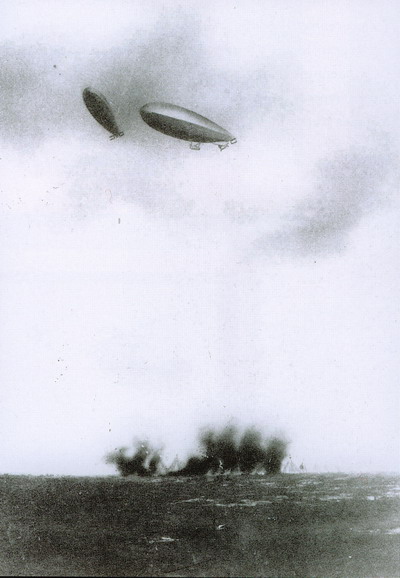
Italian airships were used for military reconnaissance West of Tripoli, behind Turkish lines, on March 5th, 1912, and in doing so became the first dirigibles ever used for a military purpose. They also bombarded Turkish positions near Tripoli later that same month - once again with little to show for it apart from some spectacular plumes of sand.


Of course, in both cases there were no means to aim the bombs. The pilots simply tried to determine ‘by eye’ when they were over their targets, then physically manhandled the tiny ‘bombs’ over the side of their cockpits, hoping for the best. They weren't even able to determine their true airspeed, in the absence of any reliable instruments. Needless to say, the results weren’t very satisfactory. Nevertheless, these first primitive aerial bombardments were a portent of the far more lethal and damaging techniques to come.

Other nations were swift to follow Italy’s example. A Bulgarian pilot dropped home-made bombs on a Turkish military base during the First Balkan War in 1912, without much success. The French Air Force began experimenting with bombing from aircraft in the same year, followed by Britain in 1913.

The USA was the first to demonstrate the use of firearms from aircraft. On August 20th, 1910, at Sheepshead Bay racetrack near New York City, Lieutenant Jacob Fickel, a passenger in a Curtiss Model D aircraft piloted by Glenn Curtiss himself, fired a rifle at a target from an altitude of approximately 100 feet. This proved that the recoil of a weapon would not damage the primitive, flimsy aircraft (a question which may seem laughable today, but was much debated at the time).


Glenn Curtiss and Lieutenant Fickel


In 1912, Captain C. D. Chandler of the US Army fired an air-cooled recoilless machine gun successfully from a Wright B Flyer over College Park, Maryland. The weapon was based on the patented design of Samuel Neal McClean, who sold it to the Automatic Arms Company, where Isaac N. Lewis developed it further into the world-famous Lewis Gun, which saw service in World Wars I and II.


Wright B Flyer


Lewis guns installed on Royal Aircraft Factory F.E.2d.


Another important development, not immediately bombardment-related but destined to become so, was the use of ships as aircraft carriers. On November 14th, 1910, Eugene Ely made the first takeoff from a warship, the cruiser USS Birmingham, anchored near Hampton Roads, Virginia, in a Curtiss Model D. On January 18th, 1911, he made the first carrier landing onto a 125-foot (38-meter) platform on the warship USS Pennsylvania, anchored in San Francisco Bay.


Ely lands aboard USS Pennsylvania, January 18th, 1911


The Mexican Revolution saw the first aerial bombardment of warships. Captain Gustavo Salinas Camiña, who had learned to fly at the Aero Club of America at Flushing Meadows, New York, in 1912, was one of five aviators serving General Venustiano Carranza in his struggle against General Victoriano Huerta, who had seized power in Mexico after President Francisco Madero was assassinated. Camiña was one of two pilots assigned by Carranza to assist General Àlvaro Obregón in the North-West campaign.

On April 14th, 1914, Camiña was ordered to engage two Huertista warships, the Morelos and the Guerrero, that were attacking one of ObregĂłn’s gunboats, the Tampico. Flying a Curtiss Model D biplane (a later model, without forward canard wings, known as the ‘Headless Pusher’), that he’d named Sonora, and taking his mechanic, Teodoro Madariaga, with him, Camiña dropped home-made dynamite bombs on the Guerrero, not scoring any hits, but scaring her and her compatriot out to sea and saving the Tampico. The combined naval and air action became known as the Battle of Topolobampo, after a nearby port.


Captain Camiña stands alongside his biplane Sonora


In 1943, as chief of the Mexican Army Air Forces, while on a visit to the USA, Camiña recalled:

The bombs I used were home-made, with a charge of 52 sticks of dynamite. Primitive as they were, they worked like a charm. At the time I was flying an old Wright pusher type. It occurred to me that the day would come when we would have planes of weight-carrying efficiency beyond one’s fondest hopes, and then the plane would come into its own as a military assault weapon of fabulous power. That day has come.


Until now all aircraft had been of light weight and very low power. It was widely assumed that a heavy aircraft with multiple engines would be unable to take off at all, and even if it did, would be impossible to control. The man who changed that view forever was Igor Sikorsky. On May 13th, 1913, his Russky Vityaz (‘Russian Knight’, also called ‘Le Grand’) aircraft took off from St. Petersburg, Russia, on its maiden flight.


Sikorsky's Russky Vityaz


This aircraft, which was indeed colossal for its day, had a wingspan of 92 feet (three-quarters of the distance flown by the Wright Brothers on their first flight a decade before, and similar to the wingspan of an early-model Boeing 737 jet airliner). It was initially designed to use two engines, but none of adequate power were to be had: so the design was modified to use four, each of 100 horsepower, mounted between its wings. This made it the first four-engined aircraft in the world. The plane weighed four and a half tons, and was amazingly luxurious, with two passenger cabins, a washroom, and even an exterior balcony in the nose on which passengers could promenade!

Only one example of the Russky Vityaz was built. It made 53 successful flights, and established a world endurance record of 1 hr. 54 m. with eight passengers aboard, before being destroyed in a freak accident. While it was parked on the ground, a Morane aircraft flew overhead - and its engine fell out! The engine fell onto the Russky Vityaz, damaging it beyond repair. Undaunted, Sikorsky used the knowledge gained from this aircraft to build another, even bigger model, of which more in a future article.

So, by the beginning of World War I, much of the foundation for aerial bombardment had been laid. Bombs (albeit small and crude) had been dropped from aircraft and airships; rifles and machine-guns had been fired from them; and larger aircraft, which could carry a heavier weight of munitions, had been demonstrated to be feasible. However, there were still no aircraft designed to carry armament from the outset, and no way to aim bombs from the air at ground or naval targets. All depended on the skill (and luck) of the pilot in judging his drop to hit the target. In every single case thus far, such skill (and luck) had proved lamentably lacking.

At the outbreak of World War I, the major combatants’ military air arms were approximately as follows, in descending order of their size:

France: 260 aircraft, 171 trained pilots.
Russia: 100 aircraft, 28 trained pilots.
Germany: 46 aircraft, 52 trained pilots.
Great Britain: 29 aircraft, 88 trained pilots.
Italy: 26 aircraft, 89 trained pilots.
Japan: 14 aircraft, 8 trained pilots.
USA: 8 aircraft, 14 trained pilots.


Remember that none of these aircraft were armed, or fitted to carry bombs. Indeed, the US Army’s doctrinal approach, as set out in a 1914 Field Service Regulation, stated explicitly that aircraft were only to be used for strategic and tactical reconnaissance - nothing more! There was also no such thing as a ‘standard’ aircraft type. The French total of 260 aircraft is said by one authority to have comprised no less than 37 different types of airplane, making standardization, training and maintenance a nightmare.

In the next episode of 'Weekend Wings' we'll examine aerial bombardment during World War I, and its development in the 1920's and 1930's.

Peter

Friday, January 23, 2009

Sir Winston Churchill


On January 24th, 1965, at the age of 90, Sir Winston Churchill died at his home in Hyde Park Gate, London.


He died beloved of his fellow Britons, whom he had led through the darkest days of World War II to final victory. He was accorded a State funeral, and as the train bearing his body passed through the English countryside, people in their thousands gathered at the trackside to bare their heads in respect.

He was undoubtedly the greatest British leader of the 20th Century, and probably among the top ten world leaders of that century as well: and, in all of British history, I'm sure he'd bear favorable comparison with any other candidate for the title of Greatest British Leader Of All Time. Certainly, none had to face greater challenges and disasters than he.

In this day and age, when the mainstream media makes a mockery of the word 'hero' by applying it to all and sundry, let's remember that 'heroism' involves the risk of one's life. Churchill put his own life at risk in military service on more than one occasion, including commanding his battalion in France during World War I. His example in the Second World War inspired heroism among his countrymen, and remains to us today as a shining light amid a world that had otherwise fallen into darkness.

Here are three of his greatest moments during World War II. First, after the fall of France, he encourages Britain to fight on.


After the Japanese attack on Pearl Harbor and the entry of the USA into the war, Churchill (whose mother was American) was invited to address both houses of the US Government.


Finally, at the end of the war in Europe, he was able to give thanks to and for Britain, and caution them that Japan remained to be defeated.


Let us remember Sir Winston with all honor. "Come the hour, come the man" - and when the hour struck, he was there when needed. We shall not see his like again.

Peter

An explosive revelation!


During the Berlin Airlift of 1948/49, Tegel Airport was built in the French Sector of the city. I described it, with photographs, in Weekend Wings #22. Much of the foundation for the runway and hardstands was made up of rubble from bomb-damaged buildings in the city, left by the massive British and US air raids during World War II.


What I hadn't known - and what had apparently been largely forgotten until now - was that beneath that rubble, there was some rather less desirable 'filler material'.

Authorities have known for some time that old World War II munitions lie underneath the runways at Berlin’s Tegel airport, but now the airport plans to dig them up in early 2009, daily Berliner Morgenpost reported on Friday.

Clean up crews will work to uncover old bombs and grenades at some 500 points, city development head Ingeborg Junge-Reyer told the paper.

The bomb recovery is part of the city’s work to adhere to the United Nation’s International Civil Aviation Organization (ICAO) requirements, which state that big planes like the Airbus A 330 – which land and take off at Tegel - need wider runways.

As the Berlin city government discussed the project, politicians called Tegel an "objectively dangerous situation" because of "live munitions near the ground surface" that could be detonated by vehicles, airplanes or "mowing and landscape work that digs into the ground," the paper reported.

The head of Berlin’s civil underground engineering department Frieder BĂĽhring told the paper that the "suspicion" of old munitions was not adequate for the city to undertake a preventative clean-up project, but that it was necessary to protect workers from potential explosions during the runway expansion. The chance of a bomb going off, however, is as likely as winning the lottery, he added.

More than 60 years after the end of World War II, weapons recovery remains an important task for police and private companies throughout Germany. Allied forces dropped more than 2.7 million tonnes of explosives across Germany during the war. Some of the ordnance did not explode and has become increasingly dangerous with time and corrosion.

Another major ordnance find cropped up on the Baltic Sea coast in September 2008 when municipal workers spotted a four-metre long (12-foot) piece of a World War II era torpedo near the Timmendorf beach.

Entire neighbourhoods are frequently evacuated for bomb removal, and most are defused without incident. Construction and road workers are trained to call emergency services the moment they suspect they've found unexploded ordnance, but accidents still occasionally happen.

People are periodically killed when they stumble upon old war explosives around the country. In 1994, three construction workers were killed and eight bystanders injured when an unexpected bomb detonated, tearing through nearby buildings and cars in Berlin. In 2006, a road worker was killed near Frankfurt when his excavator hit a bomb.


And to think that airliners have been landing, parking, loading and taking off on top of unexploded ordnance at Tegel for decades! I'm both horrified and outraged that no-one thought to warn passengers about this sooner. It would certainly have ensured that I never, ever took a flight into or from that airport!

I'll be very interested to see how much explosive they find beneath the rubble. If it's as much as some suspect, I'll have to ascribe it to a miracle that no aircraft was blown straight back into the sky as it touched down!

Ever get the feeling that as far as airlines and airports are concerned, you, as a passenger, don't count for very much? If nothing else, this demonstrates that very comprehensively . . .

Peter

Domestic disasters


The film 'Disaster Movie' is about to be launched on DVD. The film's Web site describes it thus:

DISASTER MOVIE follows the comic misadventures of a group of ridiculously attractive twenty-somethings during one fateful night as they try to make their way to safety while every known natural disaster and catastrophic event - asteroids, twisters, earthquakes, the works - hits the city and their path as they try to solve a series of mysteries to end the rampant destruction.


As part of the launch publicity campaign, the film's producers asked the British Royal Society for the Prevention of Accidents to gather statistics on common domestic disasters - things leading to injuries bad enough to require at least minimal treatment. According to Metro UK, the list is quite staggering.

Embarrassing incidents occur with alarming regularity – more than 14,000 people ended up in hospital with compromising vegetable-related injuries.

About 500 adventurous types turned up at A&E having knobbled themselves with a sex aid.

And a mysterious 41 had had a close encounter with a goat, show figures from the Royal Society for the Prevention of Accidents.

Then there are the fatal accidents – unfortunate souls have drowned in cat bowls and been killed by a sofa bed while looking for the remote control.

One 23-year-old from Rochdale, Greater Manchester, died after slipping and becoming impaled on a lamp in the garden.

We can also damage other people, as shown by the mother who accidentally glued her daughter's eyes shut by squeezing in nail glue instead of eye drops.

'There is a seasonal aspect to accidents,' said Dr Andrew Dove of Nottingham University Hospital. 'We've had a number of people injured by the Christmas turkey. One patient suffered a fractured skull after a frozen turkey fell on their head.'


One question . . . just how the hell did a frozen turkey get high enough to fall on someone's head??? Was this a Christmas version of caber-tossing, substituting a frozen turkey for a fresh pine log?


Peter

Topic Of The Day


A correspondent on an e-mail list to which I belong sent a query out today, asking for topic suggestions for an Argumentation Essay that his teacher spouse wanted to set for her students. Many fairly conventional subjects were proposed, such as:

  • Lee Harvey Oswald acted alone / was part of a larger conspiracy;
  • The pen is / is not mightier than the sword;
  • The European Union has been a success / a failure.


However, fellow list member Ken W. sent me into a fit of laughter with this suggestion:

If it takes 30 square feet of mosquito netting to cover a baby hippopotamus, how long does it take a fly with a peg leg to bore through an onion?


Another List member replied simply, "One day, 17 hours, 23 minutes and 44 seconds."

I want to know more! Does the size and/or ripeness and/or number of layers in the onion make any difference? Is a Vidalia sweet onion easier for a fly to bore through than a less flavorful yellow onion? And does the fly cry while boring through the layers? Indeed, can the baby hippopotamus use the mosquito netting to keep flies off the onion altogether?

Come on, readers, help a guy out here! Let's hear your suggestions in Comments.

As my friend Lawdog would say, *Gigglesnort!*

Peter

Thursday, January 22, 2009

Doofus Of The Day #149


Our Doofus today is from Oldsmar, FL.

Authorities say an Oldsmar man crashed into a parked pick-up truck, a business, a fence and a tree before he finally landed in the Pinellas County Jail.

According to a news release, Scott Lane Crowther left a store Tuesday night, climbed into his car and backed into the truck. He then rammed the truck through the front window of the business he had just left.

But Crowther kept driving, plowing through a fence and crashing into a vacant business. He hit a tree while he was trying to flee the scene and witnesses held him until deputies arrived.

Crowther was taken to a hospital with injuries that weren't life threatening.


I can't help but wonder what caused that. Doesn't sound like alcohol - he wasn't at a bar. To hit all those things, in rapid succession . . . that takes some doing! Definitely a Doofus candidate - plus the 'Press On Regardless' award for the month?


Peter

A grim discovery of what we're doing to nature - and ourselves


Many years ago I had a conversation with my sister, who's a highly qualified nurse and academic instructor. We were discussing the problems of drugs taken in combination with one another: that while one drug may be perfectly safe in and of itself, when combined with another drug, or dietary supplement, its effect may be negated, or even turned into something negative.

My sister pointed out that this was even more of a problem in nature. There are tens of thousands of chemical compounds developed over the past century or so: medicines, fertilizers, manufacturing chemicals, plastics and polymers, and so on. These have all leaked out into nature, whether by deliberate discharge, negligence over their disposal, breakdown of products containing them, even human waste products discharged into sewage systems. She said that what worried her was that all these tens of thousands of compounds were now interacting in nature in ways that have never been tested in any laboratory. How do we know what some of the new combinations may do?

One very worrying answer has just been reported in Britain.

The cocktail of gender-bending chemicals entering rivers and streams is more potent and harmful than anyone realised, it has been revealed.

Scientists have found an entirely new class of chemicals that is changing male fish into females – and which could be contributing to the soaring rate of infertility and defects in men.

They have yet to find the source of the chemicals, known as anti-androgens, but believe they could come from pesticides, industrial pollution or pharmaceutical drugs.

Until now it was assumed that the most serious gender bending man-made chemicals were those that mimicked the female sex hormone oestrogen.

The new pollutants, which were discovered in more than 30 rivers, work by blocking male sex hormones such as testosterone. In animal tests they have shown to cause low sperm counts and genital deformities.

Professor Charles Tyler, of Exeter University who was involved in the study, said the mix of anti-androgens and oestrogen mimicking chemicals was a 'double whammy' for wildlife – and possibly humans.

'There are likely to be many reasons behind the rise in male fertility problems in humans, but these findings could reveal one, previously unknown, factor,' he said.

'Anti-androgens can induce a lot of conditions we see in humans, such as low fertility and an increase in genital deformities, very readily.'

People could be exposed to anti-androgens in pesticides on food, through airborne pollution or from drugs. The findings come from a three-year study at Exeter and Brunel Universities.

Scientists looked at samples of water from 30 sites near sewage outlets and at 1,500 fish. Genetically engineered yeast cells can be used in a laboratory to determine levels of anti-androgens. The researchers were astonished at what they found.

Male fish exposed to the highest levels of anti-androgens were most likely to be 'feminised' – and have egg cells in their testes.

Dr Susan Jobling of Brunel University, said: 'We have identified a new group of chemicals, but do not know where they are coming from. A principal aim of our work is now to identify the source of these pollutants and work with regulators and industry to test the effects of a mixture of these chemicals.'


The article lists a number of potential contributors to the problem:

  • Bisphenol A (BPA): Oestrogen-mimicking chemical found in clear plastic bottles, food containers, dental sealants and the lining of food cans.
  • Phthalates: Oestrogen mimicking plastic softener used in toys, PVC, flooring, shower curtains, and air fresheners.
  • Polybrominated Diphenyl Ethers: Flame retardant used in casing of computers and TV's, furniture, lighting and carpets. Mimics oestrogen.
  • Oestrogen: By-product of contraceptive pill and hormone replacement therapy. It enters environment by sewage.


I wish the scientists investigating this the best of luck. I'd hate to be part of the generation that condemned the human race to extinction with our own effluent! The alleged threat of human-caused 'climate change' may be 'chump change' by comparison.

Peter

'Fantastic Voyage' not so fantastic any more?


How many of you remember the 1966 film 'Fantastic Voyage'?


Those who don't know it can read more at the link. Briefly, it involved technology to miniaturize a submarine and its crew to perform a life-saving operation by 'swimming' through human blood vessels into the brain of the patient.

It now appears that science may be getting close to this previously 'fantastic' idea.

More than 40 years on, the concept of a microscopic ‘submarine’ that can swim through narrow blood vessels and help save a patient’s life has moved closer to reality.

Scientists have designed one of the world’s tiniest motors, just a quarter of a millimetre wide, which they believe will be powerful enough to drive a tiny robot around the body and even into the delicate structures of the brains of stroke victims.
graphic

Equipped with a camera, the remote-controlled device could send vital pictures back to the surgeon, remove body tissue for a biopsy or deliver drugs to where they are needed most.

In Fantastic Voyage a submarine called Proteus was miniaturised, complete with its crew of doctors, and injected into a man’s bloodstream to remove a clot in his brain.

The designers behind the new motor, which is less than the width of two human hairs, have named their creation Proteus in a nod to the Oscar-winning film made in 1966.

So far it has succeeded in swimming through human blood in the laboratory, but scientists hope it could also power its way up the narrow arteries of the brain.

Strong enough to swim against the blood’s flow, the micro motor harnesses piezoelectricity – the same kind of energy used in gas lighters.

Instead of using a propeller, it has a tail less than a millimetre long which swishes thousands of times a second in a motion modelled on the food poisoning bug E coli which uses a tail, or flagella, to move about.

In conventional keyhole surgery, catheter tubes inserted into the body can cause serious, and even fatal, damage if they puncture narrow arteries.

But the new motor could easily guide cameras, drugs and needles through the narrowest arteries, according to the researchers from Melbourne’s Monash University who developed it.

Professor James Friend said of his invention: ‘It is less fragile, simpler to control and approximately 70 per cent smaller than the smallest design produced so far.

‘Our hope is that it can be used to save people’s lives because it will be able to reach parts of the body that surgeons cannot currently reach.


Here's a video showing the concept.


Fascinating! I wonder what they're going to come up with next?

Peter

A sad day for German fast food


The inventor of the German version of the world-famous döner kebab, Mahmut Agyün, died this week. He was 87 years old.

In the words of a German obituary:

AygĂĽn came up with the now ubiquitous döner while working at the “City Imbiss” snack shop in West Berlin in 1971. Cutting meat off a huge rotating spit, he was inspired to put it in pita bread and dress it up with vegetables and yoghurt sauce. Selling for two marks, the döner quickly became a staple of German street food alongside Teutonic favourites such as the bratwurst.


Although AygĂĽn went on to considerable culinary success in Berlin, he didn’t make money from the thousands of kebab shops across Germany that copied him because he failed to patent his invention.

Still, he will be remembered by countless legions of döner kebab fans around the world.


The German version of this international cuisine, originating in Turkey, spread like wildfire. It's estimated that today, over half the döner kebabs sold worldwide follow the German recipe, rather than the traditional one. Listing all the international variations, Wikipedia notes:

In many cities throughout Germany, the Turkish Döner Kebab and Vegetarischer Döner, made with Falafel, are far more popular than hamburgers or sausages, especially with young people, who eat a "Döner" (as it is usually just called) for lunch, dinner and late at night after returning from clubs and bars (costs: between €1 and €3 in Berlin, although may be more expensive in other smaller German cities where Döner shops are not as prevalent).

Typically, along with the meat, a salad consisting of chopped lettuce, cabbage, onions, cucumber, and tomatoes is offered, as well as a choice of sauces (hot sauce ["scharfe Soße"], herb sauce ["Kräutersoße"], garlic sauce ["Knoblauchsoße"], or yoghurt ["Joghurtsoße"]). The filling is served in thick flatbread ("Fladenbrot") that is usually toasted or warmed. There are different variations on the Döner Kebab, one of which is the "Kebab mit Pommes." This is similar to a normal Döner Kebab, except it has french fries in addition to the meat. Another variety is achieved by placing the ingredients on a Lahmacun (a flat round dough topped with minced meat and spices) and then rolling the ingredients inside the dough into a tube that is eaten out of a wrapping of usually aluminum foil ("Döner Pizza"). When plain dough is used (without the typical Lahmacun spices and minced meat) you refer to the rolled Kebab as "Dürüm Döner" or "Döner Yufka" [shown below].


The packaging of the Döner itself in Germany is typically a wax paper sleeve with an image of a male cook sharpening a knife in front of a large spit.

Statistically, the Germans consume 200 to 300 metric tonnes of Döner Kebab per day. In 1998, they spent about €1.5 billion on Döner Kebab. Germany's large Turkish minority is probably the biggest reason for the widespread sale of Döner Kebab sandwiches there: After World War II, large numbers of Turks were invited to come to Germany as "guest workers", to help with the German reconstruction effort and fill a then acute labour shortage caused by the loss of manpower in WWII. Some of these Turkish workers eventually stayed in Germany, and opening small food shops and takeaways was an excellent option in terms of progressing from more menial jobs.


I was introduced to German-style döner kebab in Berlin on a cold, snowy night many years ago. It warmed me up from the inside out, making a miserable evening into a memorable one. I've been a fan ever since. One can't get döner kebab in Louisiana for love or money (the local Cajun cooks would probably burn one at the stake for introducing another foreign innovation to their cherished back yard!), but I try to get one whenever I'm in a more döner-friendly location.


If you've never had one, you're in for a treat. Get one soon!

Peter

Twenty-five years ago today . . .


. . . during the third quarter of Superbowl XVIII, an iconic commercial was played. It was never broadcast again - but it's been hailed as one of the greatest commercials ever made.


The Apple Macintosh '1984' advertisement won the Grand Prix at the Cannes Lions International Advertising Festival later that year, and went on to garner many other awards. It would be named in 2007 as the best advertisement in the history of the Super Bowl; be called the 'Number One greatest commercial of all time' by TV Guide in 1999; and, in 1995, won Advertising Age's award for the greatest commercial ever made.

The funny thing is, many computer users of today weren't even born then, or weren't old enough to understand what a revolution the Macintosh was in its day. It introduced the graphical user interface (GUI) to the mass market. Sure, the GUI had been around before in some high-end products like workstations, but the Macintosh pushed it onto the normal desktop. Microsoft would follow suit with its Windows product in due course, which is today ubiquitous. However, Apple devotees still maintain that Apple's operating system and interface remain superior to Windows. I've used both, and I like Apple very much, but quite frankly I don't worry about minor differences between the interfaces. To me, what's important is the work that I'm doing, rather than the platform on which I'm doing it.

I started working with computers in the mid-1970's, military systems to begin with, then commercial mainframes, then minicomputers, then micro-computers. I can recall the Apple II, the IBM PC of 1981, the PC/XT with its hard disk, and the IBM PC-AT of 1984 with its 80286 processor running at 6mHz. (headlined by PC Magazine as having 'Blinding speed! Amazing storage!'). Of course, today's PC's make all those systems look like typewriters by comparison.

Ah, yes, the good old days . . . but quite frankly, I prefer modern systems.

Peter

Wednesday, January 21, 2009

Cat - meet subwoofer


Courtesy of I Can Has Cheezburger?, we have this video. Normally the only 'woofer' a cat meets is a dog, but I guess this proves the exception to the rule!


Peter

What does your taste in art say about you?


I normally don't pay much attention to Internet quizzes, but this one caught my fancy.


Your result for What Your Taste in Art Says About You Test...

Conscientious, Fulfilled, and Spiritual

28 Renaissance, 12 Islamic, 18 Ukiyo-e, -30 Cubist, -39 Abstract and 6 Impressionist!


The result is described as follows:


The Renaissance was a cultural movement that profoundly affected European intellectual life. Beginning in Italy, and spreading to the rest of Europe by the 16th century, its influence affected literature, philosopy, religion, art, politics, science, and all other aspects of intellectual enquiry. Renaissance artists looked at the human aspect of life in their art. They did not reject religion but tended to look at it in it's purest form to create visions they thought depicted the ideals of religion. Painters of this time had their own style and created works based on morality, religion, and human nature. Many of the paintings depicted what they believed to be the corrupt nature of man.

People that like Renaissance paintings like things that are more challenging. They tend to have a high emotional stability. They also tend to be more concientious then average. They have a basic understanding of human nature and therefore are not easily surprised by anything that people may do. They enjoy life and enjoy living. They are very aware of their own mortality but do not dwell on the end but what they are doing in the present. They enjoy learning, but may tend to be a bit more closed minded to new ideas as they feel that the viewpoint they have has been well researched and considered. These people are more old fashioned and not quite as progressive. They enjoy the finer things in life like comfort, a good meal, and homelife. They tend to be more spiritual or religious by nature. They are open to new aesthetic experiences.


Hmm . . . I wonder whether my 'Doofus Of The Day' articles count as 'aesthetic'?


Click here to take the test for yourself. If you feel so inclined, post your results in Comments.

Peter