Monday, September 16, 2024

"Air forces have ceased to be dominant..."


"...when it comes to influencing the war on the ground".  That's the conclusion of Strategy Page when it comes to modern drone warfare.  The lengthy article draws other inferences that may surprise you.  Here's an excerpt.


Ukrainians had the advantage of material and intellectual support from NATO countries. Ukraine was the first to develop and use small, innovative drone designs. These often came from civilians, who were seeking to assist friends of family members in the army. Building drones in homes or garages became a major source of drones for Ukrainian troops.

Russia adapted to their disadvantage in drone development by concentrating on electronic jammers, as well as building a lot of drones, often copying successful Ukrainian drones. By rapidly upgrading their jammer technology, Russians can disrupt a lot of new Ukrainian drone tech for a while. This disruption is becoming more important for the Russians because Ukraine has developed several generations of long range that are increasingly reaching their targets deep a thousand or more kilometers inside Russia. That means Russian economic and military facilities far from Ukraine are suddenly under attack. These targets include refineries and fuel storage sites as well as weapons development, manufacturing, and storage facilities. In 2023 these attacks destroyed about fifteen percent of Russian refining capacity, reducing, for months, the amount of vehicle fuel available for commercial and military users.

Air bases and ballistic missile storage or launch sites are also under attack. Targets as distant as the Russian Northern Fleet bases around Murmansk are under attack. This has caused a shortage of anti-aircraft systems that can intercept some or all of the drones depending on how many drones and air defense systems are involved.

To deal with this Ukraine has increased production of drones considerably and the objective for 2024 is two million new drones built, mostly armed ones. Halfway through 2024, the production goal is being met. These numbers are comparable to artillery ammunition production, which for Russia is estimated to be three million rounds a year. Hundreds of armed drones used in single attacks are seen as more effective than conventional tube artillery, which is now seen as a poor substitute for drones. Factories for manufacturing drones are often established in underground facilities to avoid Russian missile attacks. Nearly all the components needed for drone production are available commercially and can be purchased from European or American suppliers and imported. Custom components are manufactured locally in well protected installations. Drone quality and quantity are a Ukrainian advantage they do not want to lose.

Russia is also increasing drone production, in part because they lost their few A-50 surveillance aircraft in 2023 and since then depended on drones for surveillance. Another Russian disadvantage is their reliance on larger and more expensive surveillance and attack drones. The Russians have been quick to adapt and copy Ukrainian drone designs whenever they obtain a new one that had crash landed intact. Often all it takes is a description of a new Ukrainian drone. Russian drone manufacturers have become adept at copying Ukrainian drone designs based on minimal information. Because of this both Ukrainian and Russian troops face the same drone threat.


There's more at the link.

I wonder how an Air Force of the future will look.  Is there any reason why troops on the ground can't carry their own integrated drone support with them, launching their own UAV's to reconnoiter ground ahead, deal with enemy positions and troops, and open a way to advance?  Is an Air Force still needed to do that job?  How will its composition change to reflect that?  What about army air support?  For example, can helicopter casualty evacuation or gunship support continue in their present form?  Can an outpost be resupplied and supported by cargo drones, or will they become nothing more than targets for attack drones designed to keep their supplies from reaching the place where they're needed?

Right now everything's up in the air (literally and figuratively).  How the "rush to drones" will work itself out in the long term can't be foreseen at present.  I suspect that the advent of battlefield energy weapons - laser beams and the like, which can be fired hundreds of times at light speed without needing ammunition resupply - may neutralize drones very effectively;  but they can also be used as anti-personnel and anti-vehicle weapons, which will open even more cans of worms.

As I've said before, I'm glad my days in uniform are over.  Ground troops are going to be living in an extremely unhealthy environment, technologically speaking . . .

Peter


Memes that made me laugh 227


Gathered around the Internet over the past week.  Click any image for a larger view.


Sunday, September 15, 2024

Sunday morning music


Czech composer Bedřich Smetana composed a series of six symphonic poems that he collectively titled  Má vlast ("My Fatherland").  The second of these poems, Vltava, describes the river of that name (also known as "The Moldau" from the river's German name).  Smetana himself wrote of the piece:


The composition describes the course of the Vltava, starting from the two small springs, the Studená and Teplá Vltava, to the unification of both streams into a single current, the course of the Vltava through woods and meadows, through landscapes where a farmer's wedding is celebrated, the round dance of the mermaids in the night's moonshine: on the nearby rocks loom proud castles, palaces and ruins aloft. The Vltava swirls into the St John's Rapids; then it widens and flows toward Prague, past the Vyšehrad, and then majestically vanishes into the distance, ending at the Elbe.


It's become one of his best-known works, and is today a standard part of the symphonic repertoire.

I find most renditions of Vltava are too fast, which tends to obscure the haunting, delicate opening passages.  This performance by the Vienna Philharmonic, conducted by Daniel Barenboim, avoids that pitfall.


A lovely performance of a beautiful piece.

Peter


Friday, September 13, 2024

Beer duels - 1870 edition


Drinking games are common among students, military service personnel and others.  It seems they have a long history.  The Old Foodie offers this description of German students' beer duel rules and regulations, dating from 1870.


III. Beer-Duels.

9. A beer-duel is a duel in which the weapons are beer, and the conqueror is he who first drinks a certain quantity in a constitutional manner.

10. As in every duel, so here, there must first be an offense given. After every offense a challenge must be given within at least five beer-minutes. The offense is of two sorts, "sage" and "beer-baby."

11. In case a beer-boy is called "sage," he can either challenge the offender, or, when he thinks the offense was involuntary, or proceeded from some other cause, he can reply with "Doctor." The other must then challenge him, or reply with "Pope." After " Pope" a challenge must be given. In case of a duel on "sage," each party drinks a half; "Doctor," a whole; "Pope," two wholes.

12. When a beer-boy is called "beer-baby," a challenge must be given, and each party drinks a half.

13. Each principal must choose a second, and the second of the challengee an umpire. The challenger's second commands, "Let the Popes (or Doctors) seize!" the challengee's second says, "Attack!" the other replies, "Out!" In a duel on "beer-baby," the challengee chooses an umpire, who equalizes the weapons. The challenger says, "One;" the challengee, "Two;" the challenger, "Three;" whereupon they begin to drink.

14. The umpire declares him in beer-shame who drinks unconstitutionally, or who was the last to say "beer-baby." To drink unconstitutionally is, to begin to drink before the word "Out," or "Three;" to slop out beer (bleed) during the drinking; to leave a little (called Philistine), enough to cover the bottom of the mug; or, to break the mug in setting it down.

15. Seconds and umpires must be beer-honorable beerboys, and the umpire is bound on Grand Cerevis to decide according to his best knowledge and belief.


There's more at the link, including explanations of terms that may be unfamiliar to modern readers.

I recommend The Old Foodie blog for all sorts of interesting snippets about food and drink from the past.  I've only scratched the surface of it so far, and I foresee many months of interesting reading ahead.  The blog hasn't been updated since 2017, so I hope it remains available - it's worth preserving.

Peter


The reality of chronic pain


A continual problem during my kidney-related adventures (!) over the past nine months or so has been how to describe my pain level to doctors, nurses, etc.  They all ask about the 1-10 scale of pain, from negligible to unbearable, as if it's a Gospel truth, and when I can't really pinpoint my pain level on that scale, they get impatient.  Some even seem to wonder whether I'm malingering.

They just don't get how debilitating ongoing, permanent, chronic pain can be, or how it affects one's pain tolerance overall.  Since suffering a disabling back injury in 2004, followed by two surgeries, a spinal fusion and permanent nerve damage, my pain level has been constant.  On the 1-10 scale typically used, I'd say it's routinely at a 3-4 level, spiking to 5-6 on bad pain days (which come along every ten days to two weeks or so, almost on a schedule).  However, medical personnel don't understand how one can cope with such a constant pain level.  They regard it as impossible, and find it hard to believe that anyone can exist normally while living with it.  Very few actually listen when I describe what it feels like.

I came across the post below (by someone using the moniker "invisiblefoxfire" on an unknown social media site;  the post was copied to MeWe by someone else).  It describes pretty accurately, from my perspective, what a pain scale should be for chronic pain sufferers.  I know some of my readers have that problem, too, so I'm re-posting it here as a way for us to describe our situation to those who can't experience it for themselves.


Been telling my (young and abled) physiotherapist for years that I'm in pain all the time and when he asks me to tell him how bad something hurts from 1-10, I really don't know how to answer that.  He'll say "Tell me if it hurts" and I have to say every time "You mean... in addition to how much it always hurts?"  Anyway I love the guy, but he kept asking the same questions in the same way and not understanding why it was hard for me to answer.

Then I found this graphic ... and I showed it to him at an appointment.  (Click the image for a larger, readable view.)

He started reading from the bottom to the top, reading each "normal" level followed by the "chronic" level next to it, and at first he was laughing.  When he got to about 7/4 he stopped laughing and said "Okay well this is getting less entertaining and more concerning."  He went completely silent for a moment after he finished, then turned to look at me with real concern in his eyes and asked me if this chart was really accurate.  And when I said "Yeah, dude" and gave him a big goofy grin and a shrug, I saw something click for the first time.


I'll let other readers who endure chronic pain make their own comments, but as far as I'm concerned, yes, that chronic illness pain scale is accurate.  I live daily at the 6/3 to 7/4 levels.  I've gotten so used to background pain that I sometimes don't notice minor injuries, because their hurt is lost in the overall "noise", so to speak.  On bad pain days, I endure the 8/5 and sometimes the 9/6 levels, popping pain pills to make myself livable-with (if you know what I mean).  During the worst weeks of my kidney problems, with that pain added on top of what I normally endure, I was taking up to half a dozen (strong, prescription-level) painkillers every day.  They made the pain bearable, but only just.

My physician commented that she'd put notes on my charts with other specialists, to warn them that because of long-standing chronic pain, my pain tolerance was much higher than their average patient, but many of them didn't appear to listen to her.  I hope she sends that chart to them next time (yes, I'm forwarding this blog post to her).  If your doctor or medical practitioner(s) find it hard to grasp how bad your pain levels are, you might want to print out that chart and show it to them.  It's the best description I've yet found of how really severe, ongoing pain affects our lives.

(BTW, I'm not posting this to gain your sympathy, or brag about my pain tolerance.  I'm doing so because I know from personal experience how hard it is for "normal" people to judge just how debilitating long-term chronic pain can be.  I'd like to help other readers, who suffer from the same problem, explain it to their caregivers and loved ones.  I hope this helps.)

Peter


Thursday, September 12, 2024

Egypt makes a strategic switch


Egypt received its first F-16 fighter in 1982, and continued buying them until 2013.  Today, it has just over 200 of them, equipping nine squadrons in its Air Force.  However, they aren't the latest version and have limited upgrade capability, because the USA refuses to sell the most modern gear to Middle Eastern powers that might use it against Israel.  Therefore, when it came time to decide on an F-16 replacement, Egypt decided to look elsewhere.  It's just announced that it will buy Chinese Chengdu J-10c fighter aircraft, equivalent to the latest-model F-16, with equally modern weapons systems available.

This is significant for a number of reasons.

  • Egypt has further diversified its military suppliers away from dependence on the USA and towards greater international cooperation.  Frankly, given the dysfunctional foreign and military policies the US has displayed during the current Administration, I'm only surprised it took this long for Egypt to make that call.
  • The purchase will give Egypt a major upgrade in its military capability, with weapons that are current-generation rather than decades out of date.  For what it's worth, the J-10c's will match the capability of Israel's F-16's, although hostilities between Egypt and Israel are presently very unlikely.  It certainly changes the strategic dynamic confronting Israel's defense policies.
  • A large order like this gives China a big boost in international arms purchases, possibly offering opportunities for sales to other Middle Eastern nations.  That, in turn, may erode US influence in the region.
  • What, if any, significance this deal may have for Israel's actions in Gaza remains to be seen.  There are other ramifications for Israel that will doubtless become visible over the next few months and years.
As far as Israel is concerned, the deal is bound to lead to some interesting historical soul-searching, because the Chengdu J-10 benefited from a lot of Israeli input during its initial design and testing.  I've written about how Israeli aerospace engineers who'd worked on that country's Lavi project went to South Africa, where they helped to develop its Carver fighter project.  When that was canceled, a number of those engineers moved on to China, and worked on the J-10 project.  Now, the fruits of that last move are coming to Egypt to equip its air force - a potential opponent of Israel, if things go wrong.

History can definitely be ironic, can't it?

Peter


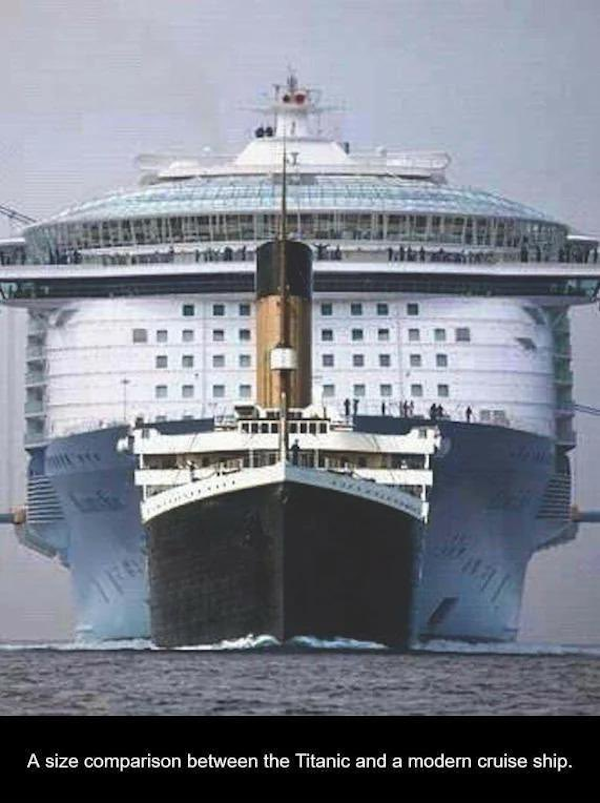
Size matters!


Following on from our discussion yesterday about a sailing cargo ship versus a modern container ship, I found this photographic comparison interesting.  Click the image for a larger view.


There are more interesting size comparisons at the link.  Interesting viewing.

I think we don't understand just how big modern vessels have become until we see that sort of comparison.  Frankly, I wouldn't like to sail on either of them . . . too many people crammed together, with little privacy or chance for some peace and quiet!

Peter


So much for free markets - automotive edition


It seems that in formerly Great Britain, if you want to order a specific model of vehicle, you may have to wait for your place in the quota to be filled.


Car makers are rationing sales of petrol and hybrid vehicles in Britain to avoid hefty net zero fines, according to one of the country’s biggest dealership chains.

Robert Forrester, chief executive of Vertu Motors, said manufacturers were delaying deliveries of cars until next year amid fears they will otherwise breach quotas set for them by the Government.

This means someone ordering a car today at some dealerships will not receive it until February, he said. 

At the same time, Mr Forrester warned manufacturers and dealers were grappling with a glut of more expensive electric vehicles (EVs) that are “not easily finding homes”. 

He said: “In some franchises there’s a restriction on supply of petrol cars and hybrid cars, which is actually where the demand is. 

“It’s almost as if we can’t supply the cars that people want, but we’ve got plenty of the cars that maybe they don’t want.

“They [manufacturers] are trying to avoid the fines. So they’re constraining the ability for us to supply petrol cars in order to try and keep to the government targets.”

The chief executive blamed the zero emission vehicle (ZEV) mandate, which requires at least 22pc of cars sold by manufacturers to be electric from this year.


There's more at the link.

Sounds like a neat bureaucratic rat-trap.  They want to stop manufacturers producing certain types of vehicles, but they can't very well simply forbid them to do so - that would be a violation of the country's free market.  Therefore, they mandate that a certain proportion of what they manufacture must conform to a bureaucratic prescription.  If they fail to meet that proportion, they're fined very heavily - which they can't afford;  so the manufacturers have no choice but to meet that mandate, even though their customers don't want the bureaucratically-approved vehicles.

The customers have no recourse at all, because the manufacturers are caught in a bureaucratic cleft stick.  They can't afford to pay the fines for disobeying the regulations, and their customers won't pay the higher prices they'd need to charge to be able to pay those fines - so the customers have no choice but to wait for the cars they want.

I understand that there's a growing market in "car buying holidays".  British residents go across the Channel for a week or two's holiday in France or Spain, and while they're there they buy the vehicle they want;  then they bring it back with them, and register it in Britain.  Apparently a number of models can even be had in right-hand-drive in Europe, so they'll be easier to manage on British roads.  I wonder how long it'll take the bureaucrats to block that approach?

I also wonder how long it'll be before our bureaucrats try similar shenanigans here.  Some states already are (California in particular).  Will American consumers be willing to boycott manufacturers who won't produce the vehicles they want?  Up until now, that hasn't been a factor.  Watch this space . . .

Peter


Wednesday, September 11, 2024

He's not wrong...


From Stephan Pastis.  Click the image to be taken to a larger version at the "Pearls Before Swine" Web page.


That also puts last night's debate between the Presidential candidates into perspective.  One of them at least is programmed by and under the control of the "elite class".  The other scares that same class silly, which is why they're trying everything they can to get rid of him, or failing that, demolish his candidacy.


Peter


That's all very well, but...


... it offers no economy of scale whatsoever.


The world’s largest sailing cargo ship is making its maiden voyage across the Atlantic Ocean. It left a port in France in early August, and it is on track to deliver 1000 tonnes of cognac and champagne to New York City by 3 September. Its shipments have a carbon footprint one tenth that of a standard container ship.

. . .

Anemos is no ancient seafaring vessel. Its cloth sails are deployed and handled using an automated system instead of human sailors, and its rigging system for controlling the sails was inspired by ocean racing vessels and designed using computer simulations.

This system lets Anemos transport one tonne of cargo over a kilometre while producing less than 2 grams of carbon emissions – a carbon footprint 10 times smaller than the huge container ships that transport most of the world’s goods, which emit at least 20 grams per tonne over a kilometre.

When primarily relying on wind power, the ship can reach speeds of more than 19 kilometres per hour – and it could potentially sail faster in stronger conditions such as the North Atlantic trade winds, says Le Grand. For backup propulsion, the ship uses two diesel-electric engines.

Anemos is part of a planned fleet of eight ships that could eventually transport 200,000 tonnes of goods annually while saving an estimated 40,000 tonnes of carbon emissions.


There's more at the link.

Sounds terrific, and terribly green, and all that sort of thing, until one considers:

  • A thousand-ton cargo is about one one-hundredth (often less) of what a modern container ship delivers on a single voyage, faster, and over longer distances;
  • For all its technological sophistication, the ship still relies on a notoriously fickle source of power - namely, the wind, which "blows where it wishes, and you hear the sound of it, but cannot tell where it comes from and where it goes";
  • An eight-ship fleet carrying 200,000 tons of freight every year equates to the cargo capacity of two regular (or one super-large) container ship(s) carrying that much freight every month or two;
  • If the wind doesn't blow (or blow in the right direction at the right strength), diesel-electric engines take over, and take the "green factor" with them.
One has to admire the dedication to their principles of those behind this project.  It's certainly innovative, and in an environmentally conscious world, I'm sure there's a place for it.  However, it's never going to be able to carry the immense volume of global maritime trade, and can never hope to be economically viable except where an environmental premium can be charged for its cargoes (one that environmentally conscious customers can be trusted to pay, that is).

Peter


We remember


May the souls of all who were murdered on September 11, 2001, rest in peace, and may their sins be forgiven them . . . and may the rest of us never forget them.

Peter


Tuesday, September 10, 2024

Restaurants face economic indigestion?


We've known for years that non-essential expenditure is one of the first things consumers cut back on when economic times get tough.  It's been a major factor in the closing of tens of thousands of US restaurants over the past few years, many of which have gone bankrupt.

However, I hadn't realized that in China, things are even more difficult for restaurants.


As more than a million restaurants closed their doors in recent months, diners in China are ordering takeout instead, amid skyrocketing numbers of food delivery riders.

Amid a flagging economy, glitzy shopping malls, noodle shops and eateries have been shutting down across the country, according to local media reports.

More than a million food and beverage outlets, including 30,000 noodle shops, shut down in the first half of this year, close to the total for the whole of last year, catering industry news service Canguanju reported.

The report came as Taiwanese dumpling chain Din Tai Fung ... said it would shutter 14 of its stores in northern China, citing the economic downturn.

Economic commentator Si Ling told RFA Mandarin that Din Tai Fung’s move is representative of the state of luxury or high-end dining in China, and a bellwether of economic buoyancy.

“Din Tai Fung was once very successful in China, off the back of booming economic growth,” Si said. “This shows how China’s middle class is shrinking at a faster and faster rate.”

“This huge consumer group is voting with its feet – there’s no faking that,” he said, in an apparent reference to the Chinese government’s insistence on positive economic news.


There's more at the link.

That's a heck of a statistic.  China has four times the population of the USA, so if it loses a million restaurants in a year, that's equivalent to the US losing a quarter of a million restaurants over the same period.  We're in economic tough times, all right, but not that tough!

It tends to put our problems into perspective.  We complain about our economy, but many other parts of the world have even more reason to complain.  Given the emphasis on globalism rather than nationalism in today's economies, I somehow doubt we'll find a solution to our economic problems unless and until they do, too - or until we abandon globalism and look to fix our own problems in our own way.  Sadly, that's not politically correct under the present system . . . which we hope will improve soon.

Peter


A techno-geek's dream - but will it actually work?


I did a double-take when confronted by this article.


The Wenger Giant, also known as the Wenger 16999, is the largest Swiss Army Knife ever made.

The Giant comprises 87 tools that can perform 141 different functions. It is the only SAK that has the most tools, as it has every tool that Wenger has ever produced for their 85mm Swiss Army Knives ... the Guinness Book Of World Records awarded it the distinction of being the ‘most multifunctional penknife‘.


There's more at the link.  Here's a video demonstration of the beast.


I have to ask:  is it actually a practical, usable tool?  Seems to me it's so big and bulky as a whole, compared to the size of each individual tool in it, that it'd be almost impossible to wield it with any dexterity.  It's a great conversation-piece, sure, and it testifies to your wealth that you can afford to own it, but actually to use it?  Perhaps not so much . . .


Peter


Doofus Of The Day #1,118


Today's award goes to a gun-owner in Chesterfield, Virginia.  This brief video report tells the story.


Chesterfield County Fire and EMS were understandably not terribly happy about it.

I have no idea why anybody would store a gun - much less a loaded gun - in an oven.  There doesn't seem to be any logical reason to do so.  One hopes the gun's owner has now learned his or her lesson . . . but that level of stupidity may take more than one incident to drive the point home (or should that be the hollow-point?).

Peter


Monday, September 9, 2024

Shocking? No - just basic logistics


The Daily Mail is expressing horror at just how few of the Royal Navy's combat vessels are actually in service.


The 'utterly dire' state of the Royal Navy fleet can be revealed today, with not one of its six attack submarines at sea.

Only nine out of 25 warships and attack – as opposed to nuclear – submarines are active or deployed. 

The rest of the fleet has racked up a staggering 30 years of missed days at sea as vessels are either broken down, being modified or undergoing trials.

. . .

Retired Rear Admiral Chris Parry said last night: 'This situation is utterly dire – we haven't got enough ships to protect our aircraft carriers and we haven't got any attack submarines to protect our nuclear deterrent.'

It is understood that shortages of engineers and dry-dock facilities are exacerbating the situation.

The worst offenders in the naval fleet are assault ship HMS Bulwark and destroyer HMS Daring – which have both been inactive for more than seven years. 

The submarine HMS Ambush has apparently been idle for 765 days since taking part in Nato exercises in the Arctic in 2022.

Most alarmingly, the shortage of attack submarines has apparently led to US submarines being called on to protect the UK's 'bomber' submarines.

The four 'bombers', at least one of which has to be at sea, carry this country's nuclear deterrent. 


There's more at the link.

Sounds scary, doesn't it?  However, the scary bit isn't how few ships are actually in service - it's the low number of ships overall.  25 vessels is a pathetic size for a Navy that was once the leading fleet in the world.  It's not enough to begin fighting a serious war at sea, let alone win one.  Basically, it's a defeat waiting to happen.  The Royal Navy should be three to four times its present size to have even a ghost of a chance in a major war . . . but thanks to government income being wasted on welfare schemes and handouts to illegal aliens, there's no money to afford it.

The real problem is that in any given Navy, the number of ships available for deployment in peacetime is going to be approximately one-third of the total number of ships in service.  Want to keep four frigates at sea?  You need twelve in all.  Want to keep four aircraft-carriers deployed?  Again, you need twelve in all.  Those ships not ready for service are undergoing short- or long-term maintenance;  training new crews, for themselves and for others of their class(es);  resupplying and replenishing their resources;  exercising their crews to come together into an efficient, effective unit;  and doing all the routine shipboard tasks that naval veterans will remember all too well.  (Oh, yes - and they have to fit in liberty periods and leave for their crews, too!)

In wartime you can defer routine maintenance, if necessary, but then you have to deal with battle damage and replacing ships (and seamen) that are sunk.  Thus, you may be able to keep half your ships in the combat zone at any one time, but the others will be under immense pressure to fix damage, carry out maintenance, train replacement crews, and get back in the fight.

Yes, the Royal Navy is in a dire strait, but it's not because so few ships are fit for sea right now - it's that there are so few ships in the fleet as a whole.  In so many words, it's no longer a combat effective service.

Peter


Is the American job market being deliberately manipulated in favor of migrants?


I was alarmed by claims that a non-governmental organization (NGO) called Switchboard appears to have insinuated itself into so many job application processes and procedures that it almost controls the market.  Unfortunately, it doesn't appear to be using that dominance to help Americans - rather the opposite, if reports are correct.


The Haitian Invasion of Ohio has created a lot of buzz. There are a lot of unexplained aspects of it that people find odd. One of these strange happenings is that locals reported that the jobs the Haitians came for were never advertised to the local population. So how did the Haitians find out about them?

It turns out that a network of federal grant recipient organizations have quietly seized control of nearly the entire job market in the US and work to ensure that openings remain "hidden" so that refugee's can take them ahead of American citizens. How many job openings remain hidden? The internal estimates of this network put the number of hidden openings at 80% of all available jobs.

EIGHTY PERCENT 

The way that this network has seized control of the labor market of the United States is easy enough to understand. Firstly, it has positioned itself as a way to remove recruiting costs for employers. Next, it offers employers laborers who can work for lower wages by also providing it's "refugees" with a plethora of social welfare not available to a typical American worker. Finally, it can provide access to the entire global labor market by setting the conditions of "refugee" status to efectively cover anyone in the world. 

If an employer needs nurses, janitors, programmers, police or literally any kind of worker the network can provide them to employers at a lower rate of pay than what an American citizen would require due to not having access to the same welfare benefits. 

These globally sourced scab workers don't require health insurance and have all living expenses subsidized by federal programs. If the typical American had all their health, food, and housing costs covered they would also be able to work for a fraction of their existing wages.


There's more at the link.  You can read Switchboard's self-promoting information guide here.  The company's Web site provides a useful Resources listing, of which many organizations are clearly "refugee"-centric.

I don't know whether the claims made above are correct.  They sound as if they're proven, but I'm looking for more evidence to confirm it.  Can any reader provide further insight?  Are there other organizations doing the same thing?  If this claim is true, and if Switchboard and others are trying to "shut out" American workers in favor of migrants, this will be an explosive issue come the elections.

Peter


Memes that made me laugh 226


Gathered from around the Internet over the past week.  Click any image for a larger view.


Sunday, September 8, 2024

Sunday morning music


Here's a piece we've heard before, one of the best-loved in the classical music repertoire:  Beethoven's Choral Fantasy.  This performance is anchored by pianist Tengku Irfan, with the Singapore Symphony Orchestra and Youth Choir conducted by Andrew Litton.  I chose it not only because it's a good recording, but because the conductor really gets into the swing of things in the final, choral movement, bouncing around like a teeny-bopper at a rave.  It made me smile, so I thought you'd enjoy it too.


It's all in the bounce, man . . .


Peter


Friday, September 6, 2024

The toaster-****** problem


I'd never heard of this until I came across it on X the other day.  It made me laugh out loud, so I thought I'd share it with you.


WARNING:  This is absolutely full of the F-word and its derivatives.  If you're sensitive to that, you really don't want to follow the link below!


From Devon Eriksen on X:


Some of you may be wondering why the entire bureaucratic caste of the USA is completely obsessed with weird sex stuff. 

Sure, we can all have good fun ranting about how insane this cult is, and watching them melt down when we leave skid marks on their sacred icons, but sooner or later, you gotta ask... why.

It's the toaster-****** problem. Some of you may be familiar. Goes like this, and I quote:


There's much more at the link.

Do not click over there if foul language bothers you!  Despite that, I found it very amusing.

Peter


Yet more child abuse...


I should be inured to this by now, but the parade of atrocities just goes on and on and on.


‘Ferocious violence’ accompanied ‘shocking’ levels of abuse at Ireland’s religious-run schools, report finds

Nearly 2,400 allegations of sexual abuse across hundreds of Ireland’s religious-run schools have been documented in a new report, marking the latest grim revelations to emerge from the country’s historic Church-State entanglement.

The report, released Tuesday, documented 2,395 allegations of historical child sexual abuse, involving 884 alleged abusers in 308 schools across the country.

Most of the allegations were reported from the records of 42 religious orders that currently run or previously ran schools in Ireland. The scope of the allegations ranges from 1927-2013. More than half the men accused – which include teachers and priests – have died, it said.

Ireland’s Minister for Education Norma Foley said Tuesday that the level of abuse detailed in the report was “truly shocking – and so is the number of alleged abusers.”

She called the report a “harrowing document, containing some of the most appalling accounts of sexual abuse.”


There's more at the link.

Needless to say, the usual suspects are making grave noises about how sorry they are that this happened, and that the Catholic Church will do everything it can to ensure it never happens again . . . but they won't do the one thing absolutely necessary to prevent that - namely, change the way the Church is governed.  As long as what amounts to absolute power is in the hands of a very few "organization men" (and women, when it comes to female religious orders), and delegated to parish priests and other subordinate managers, for just so long this atrocity will continue, because there are few if any practical checks and balances on those in the system.

I should know.  I was a part of that system until the child sex abuse scandal forced me to confront reality, and led me to leave my priesthood and the Church.  That decision has caused me more pain and angst than any other I've ever taken . . . but I felt then, and still do, that I had no moral alternative.  I formally complained to my Bishop that every measure the Church was instituting to fix the problem was no more than pious window-dressing, and would do nothing to resolve the problem.  I was told to shut up and obey orders (in rather stronger language than that).  I was ordered to tell my congregation that they could trust the Bishops to do the right thing, and lead the Church out of this mess, and all would be well in future.  Since I could see with my own eyes that that was a lie from start to finish, it left me with a stark choice;  obey the powers that be, or obey my conscience.  I was not alone in making that decision.

Today, almost a generation after the scandal broke, the situation has not improved to any great measure.  Prelates and priests are still being exposed as pedophiles, some of them of the grossest kind, active in their sin for decades.  They were not exposed until one or more of their crimes broke through the veil of silence and became public knowledge, and even then, many of them have remained relatively unpunished - even defiant, as if their activities were not wrong or evil in any way.  I have no idea how they can square that with the Gospel warning.  I daresay they'll find out one day whether they were right.

I said, when this all blew up, that we'd see Church officials suggesting that most of the problem was in the past, and no longer relevant to today's Church.  Sure enough, a generation later, I'm seeing precisely that defense made.  It's already being raised about the Irish report - "Yes, but most of those cases are decades old, and the perpetrators are dead!"  Doesn't mean that the damage they did has not continued, and permeated into Irish society to a horrifying extent.  How many of those abused kids went on to become abusers themselves, or emotionally so shut-in that they made their spouses' and childrens' lives a misery?  Far too many, I'd think . . . those are known consequences of such abuse.  What's more, there are enough current cases of abuse to give the lie to the claim that "It's all historical!".

I can only suggest to Catholic parents, in the strongest possible terms, that they should be very cautious indeed about entrusting their kids to the "care" of the Church, particularly without constant supervision they can trust.  They certainly can't put their faith in the Church's definition of "trustworthy supervision"!

I did not sleep well last night, after reading that report.  I don't see how any believer can, particularly Catholic clergy - unless they write it off as yet more anti-Catholic spite and propaganda, that can be ignored.


Peter