Wednesday, December 18, 2019

Wolves, cattle, wilderness and control


I'm reminded, yet again, that in so many cases, government edicts or actions don't necessarily have anything to do with the problem they claim to address.  Instead, they're an attempt to impose greater control over part or all of the populace, so that bureaucrats and special interest groups can force their will upon them.  Gun control?  It's about control, not guns.  Obamacare?  It's about centralized control of health care and those who need it, not about medicine as such.  Draconian traffic rules and regulations?  It's all too often about "revenue generation by cop", rather than road safety.

The latest example may be wolf conservation.  This article admittedly appears to be biased in favor of ranchers grazing their cattle on public lands:  but it also presents some interesting facts.

The proposed ballot measure forcing introduction of wolves into Western Colorado has touched off another debate pitting ranchers and livestock advocates against proponents (primarily the Sierra Club and a coalition of outside environmental organizations calling themselves the Southern Rockies Wolf Restoration Project.) They argue the supposed benefits, and the dangers, of bringing in wolves. But it seems clear to me that this debate is not about wolves – it is about cattle.

This has almost nothing to do with wildlife. The canine predators are merely the latest tool in a generation-long campaign to stop ranchers from raising cattle, and Americans from eating beef.

. . .

For years, environmental industry websites have used language like this: “… do not want to eliminate all grazing, but instead, we advocate for management that ensures grazing practices are sustainable, allowing lands to remain ecologically diverse with healthy, functioning ecosystems.” Translation: we want to ban cows on public lands, but can’t admit it because that might be unpopular.

Indeed, it would be extremely unpopular if people understood its impact on the food supply.

. . .

Almost 20 years ago, the “Foundation for Deep Ecology” published a giant full-color book railing against cattle grazing. “Welfare Ranching: The Subsidized Destruction of the American West” was dedicated to those “who have had the courage and insight to challenge the use of America’s public lands as private feedlots, and who have dreamed of western landscapes made wild and whole again.”

Still, some anti-cattle leaders understood Americans were not about to give up beef. But they knew how deeply people care about wildlife, so they devised the wolf strategy. Knowing wolves and cattle don’t peacefully coexist, if they could reintroduce wolves into the mix, nature would take care of the “cattle problem.”

Mike Phillips, director of billionaire land magnate Ted Turner’s Endangered Species Fund, outlined that strategy in a wolf symposium speech in 2000. He spoke about wolf reintroductions in the south, and in Yellowstone. But the climax of his wolf speech was an attack on the cattle industry.

There's more at the link.

I have a particular interest in the wolf problem because, as part of writing my Ames Archives Western series of novels, I've studied the historical evidence about the relationship between predators and cattle.  There's more than abundant evidence that wolves killed and injured thousands of cattle every year, particularly calves and nursing mothers, until the predators were brought under control through a determined program that amounted to extermination in many districts.  (You'll find a few infamous cattle-killing wolves listed here:  follow the links for more information.)  I think extermination programs went too far:  but, if I'd been a rancher back then, watching my herds (and my livelihood) decimated by such predation, I'd probably have been a lot more sympathetic to them.

Advocates for the wolves tend to gloss over that historical reality, or even deny it altogether.  I went on a tour of one wolf sanctuary in Colorado where the guide, in so many words, insisted that wolves are delicate, sensitive creatures who've been misunderstood by ranchers, and there was no reason why they couldn't coexist with cattle.  I think ranchers and farmers of my acquaintance (and yes, I know a few of each) would have a rather different and more sulfurous opinion!

Be that as it may, I'm deeply skeptical about the actions of the pro-wolf lobby in this clash of interests.  The former appear to be trying to ride roughshod over the objections of the ranchers (who surely have an equally valid say in the matter), and force the reintroduction of wolves to areas where they'd long been eradicated, regardless of the effect of such a step on the farmers and ranchers who've taken over the area in the interim.  They refuse to deal with the reality on the ground:  they'd rather ignore it, and/or compel it to change under the impact of legislated force majeure measures.  "The people have voted for this - therefore, you've got to do it, whether you like it or not!"  The fact that the people doing the voting are, in most cases, urban residents who know little or nothing about ranching or farming, but are casting their ballots with their emotions stirred up by heart-rending propaganda videos about the poor, misunderstood wolf, is never mentioned.

That perspective is also evident in the language of the ballot proposal.  It says merely that in the event of wolf predation of cattle, the rancher and the State of Colorado shall attempt to negotiate a figure for compensation.  If that negotiation fails, or is not undertaken in good faith by either side . . . what then?  The matter reverts to the courts, and that's too expensive for most ranchers and farmers to do in every case.  It seems to me like they'd be on a hiding to nowhere.

It's a dilemma, to be sure:  but I think there are few efforts being made to seriously listen to, and/or accommodate, the interests of both sides.  Instead, it's coming down to control, yet again.  "Do as I say - or else!"  Unfortunately for the environmentalists, the practice known as "shoot, shovel and shut up" is as applicable as ever.  I know it's been applied to unpopular conservation programs more than once.  I expect it will happen again.  There's no controlling that!

Peter

Tuesday, December 17, 2019

Heh


This meme over at Chief Nose Wetter's place made me laugh.


It particularly made me laugh because it reminded me of an Africa story.

I belong to an e-mail list that, among other topics, sometimes discusses hunting in Africa.  I recall, some years ago, a member of the list talking about an upcoming hunting safari in Africa, his first.  He was an experienced mountaineer, and told us he planned to take his portaledge tent with him.  He normally hung it from a piton in a cliff face, to sleep in comfort;  so, in Africa, he planned to hang it from a tree branch for the same purpose.  I'm sure you've heard of portaledges, or seen pictures like this one, courtesy of Daily Climbing:


He was rather taken aback when those of us who knew Africa burst out laughing.  We had to explain that leopards typically carry their kills into trees to eat them, where lions and other predators can't interfere.  Upon seeing his portaledge, with him in it, the average leopard would go down on all four knees and thank the Great God Bongo of the Congo for a meal that hangs itself in a tree, ready to eat, without him having to work for it!

He changed his plans.


Peter

The Horowitz report: exposing the plot to overthrow a President


After the release of the Horowitz report last week, I've been waiting to see how the reactions shook out, and particularly what emerged after a thoughtful, careful analysis of what it revealed.  There's been a lot of breathless hype, of course, and a great deal of partisan political pontification.  Nevertheless, as more and more information came out, there's a growing anger and concern across the political spectrum as we've come to see how the "deep State" deliberately plotted to overthrow the result of a democratic election.

I've put together seven articles that I thought made very important points about the report.  They're from both sides of the political aisle, ranging from left-wing to right-wing;  but because they're reasoned, thoughtful, rational analyses (rather than emotional, knee-jerk responses), they come to remarkably similar conclusions.  I highly recommend reading all of them in full to "get the picture", not just the short excerpts I've quoted here.  Click its headline to go to each article.


1.  The Danger of Making Ruthlessness Seem Reasonable.  (Ricochet - published at the same time as the Horowitz report, and relevant to the reactions we've seen to that report, IMHO)

American politics has changed. And more importantly, American society seems to have changed ... At [this] point, no actions, no matter how drastic or ruthless, are off the table. Confronting and shaming people in public. Chasing the families of suspected conservatives out of restaurants. Scaring the families of prominent conservatives. Arresting elderly nobodies like Roger Stone in SWAT raids in the middle of the night, with CNN along to broadcast it worldwide. It seems vicious, but hey, we’re trying to save the world here, so it’s ok. Really. Are you with us, or against us? Are you evil, or nice?

. . .

These people are dangerous. They make ruthlessness seem reasonable.

. . .

The impeachment charade is not a joke. Neither are climate protests, or boycotting businesses suspected of being insufficiently leftist, or economic sanctions against businesses in states that don’t enact your preferred policies regarding transsexual bathrooms. It may seem ridiculous, but it’s not funny.

This is scary stuff. And I don’t see a solution. This is just the way the left does politics now. It wasn’t just Hillary Clinton who learned a lot from Saul Alinsky. The Democrat party has decided that such ruthless tactics are reasonable. I suspect that things will get much worse before they get better.


2.  A Prognostication.  (Liberty's Torch)

If none of the wrongdoers suffer appropriate legal penalties, why should the average American trouble himself over the law? Why should he concede the smallest groat of cooperation to the “authorities?” You don’t have to be a Certified Galactic Intellect to reason thus. John Q. Public will reach that conclusion quite handily on his own. And except for those who find their habit patterns impossible to break, the public will act on it.

. . .

If no one is called to account for this obvious attempt to overturn the election of 2016...if the FBI, CIA, DoJ, and FISA apparatus are not purged from top to bottom, with the worst offenders awarded long prison terms...if the Democrats and their media mouthpieces aren’t haled before courts of law and compelled to answer for their misrepresentations and outright slanders and libels...there will be an explosion of lawlessness. There will be chaos. And chaos means bloodshed.

Pray.


3.  ‘Corroboration Zero’: An Inspector General’s Report Reveals the Steele Dossier Was Always a Joke.  (Rolling Stone)

If the report released Monday by Justice Department Inspector General Michael Horowitz constitutes a “clearing” of the FBI, never clear me of anything. Holy God, what a clown show the Trump-Russia investigation was.

Like the much-ballyhooed report by Special Counsel Robert Mueller, the Horowitz report is a Rorschach test, in which partisans will find what they want to find.

. . .

… the news media essentially reported on the FBI’s wrong reporting of Steele’s wrong reporting … As a result, a “well-developed conspiracy” theory based on a report that Comey described as “salacious and unverified material that a responsible journalist wouldn’t report without corroborating,” became the driving news story in a superpower nation for two years.


4.  When Hate Becomes an Agenda.  (American Greatness)

Impeachment has turned into a cruel caricature of a rare constitutional remedy for presidential criminality. Justice Department Inspector General Michael Horowitz’s report proved a compendium of FBI lying, fraud, and vendetta. There is not a single prominent figure in Horowitz’s lengthy report who has not left a written or video trail of anti-Trump bias (James Comey, Peter Strozk, the Ohrs, Lisa Page, Kevin Clinesmith) or has had some sort of questionable financial relationship with the Clintons or their affiliates (Alexander Downer, Andrew McCabe).

. . .

The prior subtext to impeachment—if not smeared or stopped, Trump will win in 2020 … is [now] shamelessly voiced by leaders in the party such as Rep. Jerrold Nadler (D-N.Y.), House Speaker Nancy Pelosi (D-Calif.), and Rep. Adam Schiff (D-Calif.) … Again, the common denominator in all these catastrophes is an existential hatred of Donald Trump—his person, his family, his successes, his agenda, and his supporters. The two writs for impeachment are simply: 1) We loathe Trump 2) He will sabotage our agenda if we don’t impeach and remove him.


5.  The Hidden Hand.  (And magazine)

The IG report … misses the essence of what just transpired.  It is like reading a description of the actions and motivations of a troupe of marionettes in a stage play and missing the fact that they are all simply doing what those pulling the strings make them do.

The FBI did not conduct an investigation of Donald Trump and his associates that ultimately proved to be based on false information and continue that investigation long past the time it should have been shut down simply because some people made some errors in judgment or some procedures need to be changed.  That investigation was simply the most visible piece of a deliberate, covert attempt to overthrow the democratic process.  The perpetrators of that crime have yet to be brought to justice and identified.  Let’s hope that happens soon.

Time for the hidden hand to be revealed.


6.  The Inspector General’s Report on 2016 FBI Spying Reveals a Scandal of Historic Magnitude: Not Only for the FBI but Also the U.S. Media.  (The Intercept)

If you don’t consider FBI lying, concealment of evidence, and manipulation of documents in order to spy on a U.S. citizen in the middle of a presidential campaign to be a major scandal, what is? … these security state agencies are … out-of-control, virtually unlimited police state factions that lie, abuse their spying and law enforcement powers, and subvert democracy and civic and political freedoms as a matter of course … The IG Report leaves no doubt about it. It’s brimming with proof of FBI subterfuge and deceit…

. . .

But the revelations of the IG Report are not merely a massive FBI scandal. They are also a massive media scandal, because they reveal that so much of what the U.S. media has authoritatively claimed about all of these matters for more than two years is completely false.

. . .

The narrative manufactured by the security state agencies and laundered by their reliable media servants about these critical matters was a sham, a fraud, a lie. Yet again, U.S. discourse was subsumed by propaganda because the U.S. media and key parts of the security state have decided that subverting the Trump presidency is of such a high priority – that their political judgment outweighs the results of the election – that everything, including outright lying even to courts let alone the public, is justified because the ends are so noble.

. . .

None of these journalists have acknowledged an iota of error in the wake of this report because they know that lying is not just permitted but encouraged as long as it pleases and vindicates the political beliefs of their audiences. Until that stops, credibility and faith in journalism will never be restored, and – despite how toxic it is to have a media that has no claim on credibility – that despised status will be fully deserved.


7.  Can We Impeach The FBI Now?  (The American Conservative)

The current Horowitz Report, read alongside his previous report on how the FBI played inside the 2016 election vis-a-vis Clinton, should leave no doubt that the Bureau tried to influence the election of a president and then delegitimize him when he won. It wasn’t the Russians; it was us. And if you walk away concluding that the FBI fumbled things, acted amateurishly, failed to do what some claim they set out to do, well, just wait until next time.


I recommend Glenn Greenwald's analysis (#6 above) in particular.  What he says about the US media is particularly important as we enter an election year in 2020.  The media have gone all-in on the Russiagate and impeachment narrative.  Now that so much of the false foundation for those lies has been exposed, will they tone down their rhetoric?  Or will they double down, and redouble their efforts to drive President Trump from office with a barrage of lies and falsehoods?

I hope for the former, but I fear the latter.  2020 is going to be a long, rough year in US politics, no matter what one's views or party preferences.


*Sigh*


Peter

Monday, December 16, 2019

You think you're tough? Try removing your own appendix!


I recently came across a fascinating article about a Russian doctor who cut out his own appendix, after being left with no alternative.

During an expedition to the Antarctic, Russian surgeon Leonid Rogozov became seriously ill. He needed an operation - and as the only doctor on the team, he realised he would have to do it himself.

. . .

Rogozov was part of the sixth Soviet Antarctic expedition - a team of 12 had been sent to build a new base at the Schirmacher Oasis.

The Novolazarevskaya Station was up and running by the middle of February 1961, and with their mission complete the group settled down to see out the hostile winter months.

"He was confronted with a very difficult situation of life and death," says Vladislav. "He could wait for no help, or make an attempt to operate on himself."

It was not an easy choice. Rogozov knew his appendix could burst and if that happened, it would almost certainly kill him - and while he considered his options, his symptoms got worse.

"He had to open his own abdomen to take his intestines out," says Vladislav. "He didn't know if that was humanly possible."

. . .

Rogozov worked out a detailed plan for how the operation would unfold and assigned his colleagues specific roles and tasks.

He nominated two main assistants to hand him instruments, position the lamp, and hold a mirror - he planned to use the reflection to see what he was doing. The station director was also in the room, in case one of the others became faint.

"He was so systematic he even instructed them what to do if he was losing consciousness - how to inject him with adrenalin and perform artificial ventilation," says Vladislav. "I don't think his preparation could have been better."

A general anaesthetic was out of the question. He was able to administer a local anaesthetic to his abdominal wall but once he had cut through, removing the appendix would have to be done without further pain relief, in order to keep his head as clear as possible.

There's more at the link.

Click over to the article to read about the surgery and its successful outcome.  It's a remarkable story.  On his safe return to the Soviet Union some time later, Dr. Rogozov was awarded the Order of the Red Banner of Labor for his accomplishment, and the example he'd set to other adventurers and explorers.  He died in 2000 at the age of 66.

Peter

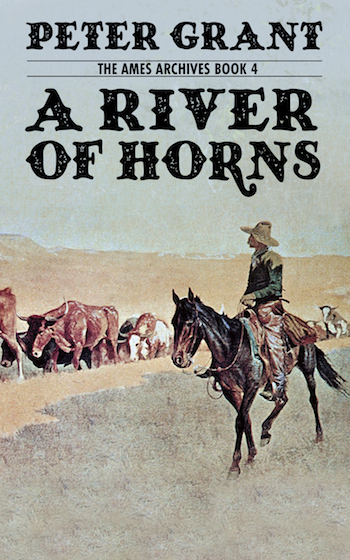
"A River of Horns" is published!


My latest Western novel, "A River of Horns", fourth in the Ames Archives series, has been published in e-book format.  A print edition will follow soon


The blurb reads:

Walt Ames and his Texas partner, Tyler Reese, know that the U.S. Army is bound and determined to push the Comanche and Kiowa tribes onto the reservation for good. Once the Texas Panhandle is pacified, millions of acres of land will become available. They aim to be among the first to set up a ranch there - but that'll take money… a whole lot of money.

How do you raise money for a cattle ranch? By selling cattle, of course! Buy them where they're cheap, sell them where they're dear, and use the profits to bankroll your project. It sounds simple - until storms, floods, fires, cow thieves and stampedes show up. They'll have to buy their cattle in blood, as well as money…

I've previously put two snippets from this book on my blog, here and here, to give you a taste for it.  I hope you've enjoyed them, and I hope you like the book as a whole.  It's based solidly on fact and historical evidence, unlike many Westerns, and tries to stick to the reality of Western life rather than the Hollywood and pulp fiction fantasy that never existed in reality.

As always, please leave an honest review on Amazon.com after you've read the book.  Reviews are the life blood of independent authors such as myself - without them, it's very hard to spread the word about our books.  Thanks!

Peter

Sunday, December 15, 2019

Sunday morning music


It seems only yesterday that we celebrated Christmas . . . but another year has passed, and the liturgical calendar has rolled around yet again.

I don't know about you, but I'm heartily sick of the ghastly versions of Christmas carols one hears in every supermarket and shopping mall (and over far too many radio stations) at this time of year.  As an antidote, here's the Choir of Kings College, Cambridge, with their "Carols from Kings" album.  The track listing (time in minutes and seconds, followed by title) is as follows:

00:00:00 Once in royal David’s city
00:04:41 Rejoice and be merry
00:06:11 Ding dong, merrily on high
00:08:19 What Sweeter Music
00:12:37 O little town of Bethlehem
00:16:17 A Spotless Rose
00:19:25 Heer Jezus heeft een hofken (organ variations)
00:26:44 King Jesus hath a garden
00:30:10 The Lamb
00:33:39 Bogoróditse Dyévo
00:34:55 Infant holy, infant lowly
00:36:43 Illuminare, Jerusalem
00:39:12 While shepherds watched
00:41:54 Quittez, pasteurs
00:45:05 In dulci jubilo (organ prelude)
00:48:06 In dulci jubilo
00:50:46 The First Nowell
00:56:09 Coventry Carol
00:59:17 Personent hodie
01:01:49 O come all ye faithful


Now, why can't they play that in supermarkets, instead of some bimbo bleating at the top of her tone-deaf voice about Christmas without tears, without a single mention of the reason for the season?

Peter

Saturday, December 14, 2019

Saturday Snippet: more hazards on the trail


Following my recent heart attack, I've found my writing activities severely disrupted.  Part of it is the sheer amount of time I have to spend on cardiac rehabilitation classes, seeing doctors, and other related activities.  However, much of it is due to medication issues.  I've been put on one of the most recent anticoagulant/blood-thinner medications, which is doubtless very effective at what it does, but also plain whups my butt!  It leaves me breathless, dizzy (particularly when I stand up too quickly), and exhausted if I try to work too hard.  (That may be intentional, for all I know, to stop cantankerous old farts patients like me from trying to do too much.)

As a result of all that, my writing has suffered.  I think the projects on which I'm currently working will be delayed for up to six months as I battle through the aftermath of this episode.  One ray of sunshine, however, is that I'd almost finished the fourth novel in my Ames Archives Western series.  In the limited time I can devote to writing (including the small hours of the morning while lying in hospital, recovering), I've finished "A River of Horns".


I hope it'll be published in e-book format on Monday or Tuesday next week, God and Amazon.com willing.

It's been a fascinating project to write "A River of Horns". There are so many facts and details about trail driving cattle that people just don't know, or which had become obscured beneath the overblown Hollywood legend and pulp fiction narratives of the cowboy and his era.  I had to research this book very thoroughly indeed, in order to ensure that it's accurate.  I read many of the surviving original accounts of trail drives and cowboys' lives, and learned from all of them.  The incidents I describe fictionally all really happened, in approximately the way I describe them, to trail drives and cowhands in real life.

Even the economics of the cattle business (which I've tried to lay out for readers in an interesting, entertaining way) are true.  For example, many big cattle ranches started out with no land at all!  A man with drive and ambition would hire a few cowhands, even if he didn't have a home to live in.  They'd all camp out on the range, with a cart or wagon for their supplies, while they rounded up unbranded stock (so-called "mavericks").  He'd brand them, gather enough to form a herd, and drive them to market in Kansas or elsewhere;  then he'd come back to Texas with the money he'd earned, and use it to buy the land that would later grow into a major ranch.  Then he'd do it all over again, year after year, until his "cattle empire" had become established.  Some men made good money (and later became ranchers in their own right) by contracting with a number of small ranches and farms to collect their cattle into a larger herd, then drive them to the railhead in Kansas for a fee of a dollar or two per head, plus expenses.

In later years (the 1880's and after), big money entered the picture with the advent of British and northern American investors, who transformed the cattle industry into something approaching what it is today.  However, the first twenty years or so saw individuals who wanted to "make it big" do so on the basis of their own very hard work, gathering and selling cattle to raise money to found the big cattle ranches.  That's what Charles Goodnight, Oliver Loving, John Chisum, Samuel Burk Burnett and others did;  and that's what my protagonist, Walt Ames, and his partner, Texan trail boss Tyler Reese, do in this book.  I hope you enjoy it.

I published an excerpt from this book a few weeks ago.  Here's another, describing how the longhorn's "blood call" could be used to entice wild cattle out of the dense brush in which they lived.  It may sound far-fetched, but it was real, and used in the early days of cattle gathering in areas with thick brush.  (A quick note:  a "muley" was a longhorn without any horns.  They were not desirable in a herd, because they could not defend themselves against bullying by other cattle, which created unnecessary disturbances.)

     Three days later, as the sun was dropping towards the western horizon, Tyler looked around him. The banks of the Pecos River were obscured by dense brush, in some places a mile deep. If any wild cattle were to be found, this was the sort of place they’d choose to hide from their enemies. They would be as good as invisible, and the brush was thick enough to be almost impenetrable.
     “We’ll make a start right here, tomorrow morning,” he said with satisfaction. “Come on. Let’s head away from the brush for a few miles, so we can make camp without alertin’ them with our fires.”
     That evening, one of the ten steers was slaughtered. Before the cook cut it up and prepared it for supper, a bucket of blood was drawn from the big vessels in its neck, then the carcass was skinned. A flap of its hide was cut off and tied over the top of the bucket to prevent spillage, then the hide was folded and set aside.
     “What are they gonna do with that?” a young cowhand inquired, nose wrinkling at the raw, unpleasant smell of blood.
     “You’ll see, young ’un,” a grizzled older hand replied with a tolerant smile. “You’re about to learn what they mean by the ‘blood call’. We did the same sometimes, down on the Neuces River in the old days. It was the only way we could roust some o’ the worst of them ole ladino steers out o’ the thorn thickets.”
     “What’s a ‘ladino’?”
     “That’s a steer that got away young. It’s spent its life livin’ alone in the thick brush, and it knows it’s the boss. It takes sass from nothing an’ nobody, least of all no cowhand. It’s wild, it’s mean, and it’ll kill your hoss, or even you, as soon as look at you. You mark my words, boy – a big ladino will fight a grizzly bear to a standstill, an’ even kill ’em sometimes.”
     “He ain’t jokin’,” another hand agreed fervently. “Don’t ever relax when you’re herdin’ wild brush cattle, and stay clear of their horns. They’ll gut your horse in a heartbeat, an’ rip open your leg from fork to foot if you get careless in the saddle. Friend o’ mine bled to death that way back in ’67, afore we could get him to a doctor. Sid went right through the War without a scratch an’ made it safe home, only to meet up with a killer ladino.” He spat sourly into the fire.
     Sober nods and grunts of agreement from several old hands, and Tyler too, assured the young cowhand that the speakers weren’t joking or exaggerating.
     Tyler added, “Try to keep a way open to get clear, just in case, and keep your gun handy. If one o’ them takes a dislike to you, and you can’t get out of its way for some reason, there’s only one way to stop it. I know we allus say you should never use your gun near cattle, ’cause they’ll stampede at the drop of a hat; but when it comes to fresh-caught, still-wild ladinos, you ain’t got a choice in the matter. In a tight spot, it’s them or you. All those of you who’ve never dealt with wild brush cattle afore, team up tomorrow with someone who has, and learn from them.”
     That sobered everyone. Clearly, this would be no ordinary roundup.
     Tyler rousted the hands out of their bedrolls at four the following morning. No fires were allowed, so the hands had to make do with a cold breakfast of the remains of last night’s supper, without coffee. They mounted their horses and walked slowly towards the brush along the river, one of their number carrying the bucket of blood, another toting the bloody hide. One group of hands drove the nine surviving steers along behind them.
     Tyler halted the group about a mile from the brush, and checked the wind direction. It was blowing out of the west. He positioned the hands downwind from where he’d place the hide and blood, and warned them to move very quietly when the time came. “Form a half-circle as you come up to them, then spread out to surround them as you move them forward. Stay back an’ keep still until you see me make a move.”
     Tyler had the hand carrying the hide spread it, bloody side out, over a convenient bush. The man with the bucket took off the cover and poured the smelly, turgid blood over the hide, so that it spread out on the ground around it. That done, they made themselves scarce while Tyler rode back to get the tiny herd he’d brought along. He and a couple of hands drove them towards the bush and the blood.
     As the first rays of sunrise broke over the horizon, the animals suddenly scented the blood. Their heads lifted, their nostrils quivered, and they began to move faster, showing excitement. They broke ranks and surrounded the hide over the bush, hooking at it with their horns, pawing the red mud beneath it. A steer cut loose with a long, tremulous bawl, and more and more of the cattle took up the refrain.
     “There they go!” Tyler enthused as he and the other hands rode off, stopping half a mile away behind a clump of brush. “Now to see if that fetches more of them.”
     “I’ve got ten dollars that says we’ll see at least fifty come out o’ brush that thick,” an old-timer said.
     “No bet,” Tyler retorted. “That’s why I chose this place.”
     Sure enough, within minutes a shadowy form could be seen hovering just inside the edge of the brush. As soon as the steer was convinced that there were no enemies about, it hurried out of the bushes and over to the group of bawling cattle, adding its voice to the chorus. It was followed by another, then another, then a small group. More and more cattle made their appearance, and the herd pawing and snorting around the hide and blood-soaked earth grew larger and larger.
     “I ain’t never seen or heard tell o’ the like!” a young cowhand whispered in awe as he watched.
     “Hide hunters have,” another replied. “Buffler sometimes do the same thing when one of them is shot. They’ll gather round, beller, and hook an’ paw at it. That’s how some hunters keep a herd together to be shot. They lung-shoot a bull, so the others will gather round as they smell the blood, then shoot as many as they can before something spooks them and they run off.”
     For over an hour, the cowhands watched as the number of cattle grew. The blood frenzy spread among them, causing them to bellow and paw the blood-soaked ground. Cows and calves that were too small to force their way through the throng to the center circled the outskirts, bawling in complaint at being deprived of access to the source of their excitement.
     At last Tyler moved forward. There were well over a hundred cattle there now, and if he waited any longer, some of them were sure to notice the waiting cowhands. Looking around, he saw all his hands begin to follow his example, moving carefully so as not to startle the cattle. Closing in, they formed a ring around them, and began to urge them gently away from the brush towards their camp site.
     At first the longhorns moved slowly, without complaint; but within minutes the wilder bulls realized that something was amiss. They were being pushed further and further away from the thick brush that had until now been their protection and concealment. Bellowing their anger, they tried to break back and get away. Fast-riding cowhands wielding lassos intercepted them, and cattle thudded hard to the ground as their hooves were caught in the flying loops and immobilized. It sometimes took two or three falls before a particularly stubborn steer could be persuaded to stay with the herd.
     When they had reached clear ground, half a mile from the camp site, Tyler had the hands thin the cattle into a narrow procession. He and another man rode ahead, then turned to face inward. As the cattle were driven between them, they pointed to every branded animal they saw, or any branded cow with an unbranded calf. They also picked out every male animal more than about a year old that had not yet been castrated, and all the muleys. The cattle they designated were cut out of the herd and driven back towards the brush, allowing them to escape. When the counting and checking was over, there were sixty-one unbranded cattle remaining, plus the remaining nine head they’d purchased from the rancher.
     Tyler had intended to make two or three gathers before branding, but the size of the first day’s haul persuaded him to change his plans. Fires were kindled, and the animals brought down in turn with ropes. Handlers kept the ropes taut while a red-hot branding iron was applied to the right hip, producing a clear Circle CAR insignia. Hair sizzled and burned as the brand was applied, and the longhorn jerked and bellowed at the pain. If necessary, while it was still distracted, another cowhand quickly removed its testicles with a sharp knife, producing yet more bellowing and struggling. After brushing the brand and wound with pitch as a rough-and-ready disinfectant, the animal was released to rejoin the herd.
     By mid-afternoon, the work was done. The cowhands moved the enlarged herd a few miles along the Pecos to another likely-looking location, and made camp several miles away. The balkiest and most aggressive steer among their recent captures was killed for supper, and its blood and hide appropriated for the morning. Normally only two or three hands would ride night herd over the cattle. However, because of their wildness and recent capture, Tyler allocated six men to every watch of the night. No-one complained, because they understood the need for exceptional vigilance until the cattle grew accustomed to the loss of their freedom. Fortunately, because there were so many hands available, the extra work would not be an intolerable burden.
     They all felt a glow of satisfaction as they ate supper around the camp fire. Tyler admitted, “I never expected to get so many on the first gather. Given luck, I reckon we may come up with a good few hundred head along the Pecos.”
     “And if Jess does the same along the Colorado, we’ll have a decent-size herd when we rendezvous at El Paso,” an old-timer added.
     “Let’s hope he does.”
     “Our hosses are gonna be worn out by then, though,” a cowhand noted. “We only brought three mounts apiece with us.”
     Tyler shrugged. “Yeah, but that can’t be helped. There should be several hundred more waitin’ in El Paso, if Walt’s friend has come through for us. Once we have them, we can rest these hosses for a while.”

I hope you enjoyed that snippet, and the previous one too.  Look for the publication announcement for "A River of Horns" on Monday or Tuesday.

Peter

Friday, December 13, 2019

80 years of MiG fighters


The aircraft design bureau headed by Artem Mikoyan and Mikhail Gurevich, which has gone down in history by the amalgamation of the first letters of their last names as MiG, was formed on December 8th, 1939 - 80 years ago, plus a few days.  Today it's the "Russian Aircraft Corporation MiG" division of United Aircraft Corporation of Russia, and is still going strong.

To celebrate the anniversary, the company produced this short video highlighting several of its most famous designs, from the MiG-1 and MiG-3 fighters of World War II, to the MiG-15 that terrorized Allied aircraft during the Korean War, to the MiG-17, -19 and -21 of the Vietnam War era, to the MiG-29 that was designed to counter the US F-16, to the MiG-31 interceptor that today carries the Kh-47M2 Kinzhal hypersonic ballistic missile.


Some of those MiG's gave me a few gray hairs during my time in the Southern African bush.  I described one such encounter recently.

Congratulations are in order to a very long-lived aviation design bureau.  I can't think of many that have lasted that long.

Peter

"Trouble in the Wind"


Earlier this year, authors Chris Kennedy and James Young partnered to bring to market a trilogy of alternate-history short story anthologies of combat.  They called it "The Phases of Mars".  The first book, "Those in Peril", dealt with the sea and naval combat.  The second volume, "To Slip the Surly Bonds", dealt with aircraft and aerial warfare.

The third and final volume covers war on land, and includes a story by yours truly.  It's titled "Trouble in the Wind", and has just been published.  In less than 24 hours, it's already reached the #1 New Release position on Amazon.com in Science Fiction Anthologies.


The blurb reads:

Eighteen outstanding authors. Sixteen stories of ground warfare that never happened.

Throughout the human experience, historians have wondered, “What if?” What if Sherman had fought for the South in the U.S. Civil War? What if Germany had fought to the end in World War I? What if World War III had actually happened?

Wonder no more, for these questions, along with many others, are answered within the pages of this book ... “Trouble in the Wind,” deals with ground combat that never happened in our world… but easily could have.

The third book in the exciting “Phases of Mars” anthology series, there is something for everyone inside! From fighting Hannibal at the Battle of Cannae, to the early death of Napoleon, to scouting the bush in Angola, “Trouble in the Wind” traces a history of ground warfare…that wasn’t. From warfare in Taylor Anderson’s “The Destroyermen” series…to S.M. Stirling’s “Black Chamber,” this book has it, so come aboard and find out “what if” all of these things had changed history…just a little. You’ll be glad you did!

If you've read the blurb above, and you're familiar with my military past, you can already guess what my story covers!  Yes, it's the Angolan war, and draws together a great deal of fact with a thin gloss of fiction to tell what it was like during those years.  I'd say my story is at least 80% factual, if not more - just rearranged to bring elements together in space and time to cover a particular incident, which never happened, but is very close to incidents that really did happen.  That made it easy to write.  When I received an invitation to participate, I wrote the first draft of my story in only two days, because the subject matter was so familiar to me.  However, the Angolan bush war is relatively unfamiliar to most Americans and Europeans, so I hope it'll be fresh, interesting material for you.

My thanks to Chris Kennedy and James Young for inviting me to be a part of this project.  It was a lot of fun.

Peter

Thursday, December 12, 2019

You trust your local government at your peril


Wendell Phillips said in 1852:

Eternal vigilance is the price of liberty; power is ever stealing from the many to the few. The manna of popular liberty must be gathered each day or it is rotten. The living sap of today outgrows the dead rind of yesterday. The hand entrusted with power becomes, either from human depravity or esprit de corps, the necessary enemy of the people. Only by continued oversight can the democrat in office be prevented from hardening into a despot; only by unintermitted agitation can a people be sufficiently awake to principle not to let liberty be smothered in material prosperity.

Sadly, nothing's changed since he uttered those words.  Two recent reports highlight the necessity of watching over your local government, to make sure it isn't pulling a fast one on you behind your back.

First, an Ohio town has just voted to dissolve itself after its local government secretly passed a tax on residents.

"Free Amelia" PAC founder Ed McCoy said Thursday that Ohio residents' decision to dissolve their village was "bizarre" but warranted.

After 119 years of history, almost 70 percent of the residents of Amelia, Ohio, voted to oust the local government after it secretly passed a 1 percent income tax on all residents and workers. The 5,000 residents who live there will now be split, with half becoming residents of one municipality and the other half becoming residents of another.

... McCoy said it was a fly-by-night decision, adding that some residents said they found out about the tax change from a letter in the mail after the decision was already made. The village council approved the tax increase last year, without public input.

"It kind of passed in the dead of night," McCoy said. "In a special meeting, there was not public input."

There's more at the link.

A tax passed in secret, with no public debate and no prior discussion at all?  I'd think tar and feathers would be more appropriate than dissolution . . . but that's just me.

Second, Portland, Oregon's Planning and Sustainability Commission is up to tricks - and its members are refusing to say exactly what they mean.  Bold, underlined text is my emphasis.

On Nov. 12, the commission narrowly approved a change to the design process language to say, "Provide opportunities to rest and be welcome.”

Oriana Magnera introduced the idea.

"Just one of the realities of Portland right now is that we have a lot of folks who are unhoused who benefit from some of these spaces that provide weather protection," she said.

The Commission Chair Katherine Schultz questioned what impact the change could have.

"What does it mean to rest? Am I providing a place to sleep?" Schultz said.

Members of the commission questioned how this could impact private property and the entire design review process.

"I'm concerned that this is going to become quite controversial," said Jeff Bachrach, a member of the commission and attorney.

"I think for us to put into design review some loaded words that suggest we want some design commissioners to think about people resting for hours, pitching tents, I think we're just putting too great of a burden on design review," Bachrach went on to say.

KATU News reached out to each member of the commission. No one would agree to talk about the proposal on the record, including Magnera.

Again, more at the link.  Note, too, that the Portland City Council also won't talk about the matter - which I find suspicious in itself.

So, I want to build a house in Portland, on my own private property, but the commission responsible for the building guidelines tells me I must - must - incorporate "an opportunity to rest and be welcome" to outsiders, without spelling out what that means.  What if, a couple of years down the line, they tell me that means I have to allow outsiders to pitch a tent and live there for an indefinite period?  That's entirely conceivable, given the vague language being bandied about, and Portland's well-known history of moonbat loony-left social justice proposals.  I have news for them - given a restriction like that, I won't be building!  In fact, I'll probably move somewhere that's more respectful of my rights as a property owner - and take my contributions to city rates and taxes with me, as well as all my economic activity.

Think that sort of thing can't happen where you live?  Think again.  If those holding the reins of power think they can get away with something, they'll try to do so.  It's a disease that seems to go with public office.  There are few, if any towns and cities where that's not the case - and all those I know are that way because the incumbents know their electorate will tar and feather them, and run them out of town, if they try any shenanigans.  Fear like that keeps politicians honest;  and Texas does have certain advantages in that regard.  For a start, many of our local cops would probably be joining in the tarring and feathering!

Peter

If you allow "smart" devices to listen to you non-stop, you're crazy


Yet again, we've been reminded that all these "smart" devices like Amazon's Echo, Apple's Homepod, and Google Home are a security threat to our privacy, and potentially even worse.

... a quarter of Americans have bought “smart speaker” devices such as the Echo, Google Home, and Apple HomePod. (A relative few have even bought Facebook’s Portal, an adjacent smart video screen.) Amazon is winning the sales battle so far, reporting that more than 100 million Alexa devices have been purchased. But now a war is playing out between the world’s biggest companies to weave Alexa, Apple’s Siri, Alphabet’s Google Assistant, Microsoft’s Cortana, and Facebook’s equivalent service much deeper into people’s lives. Mics are built into phones, smartwatches, TVs, fridges, SUVs, and everything in between. Consulting firm Juniper Research Ltd. estimates that by 2023 the global annual market for smart speakers will reach $11 billion, and there will be about 7.4 billion voice-controlled devices in the wild. That’s about one for every person on Earth.

. . .

“Having microphones that listen all the time is concerning. We’ve found that users of these devices close their eyes and trust that companies are not going to do anything bad with their recorded data,” says Florian Schaub, a University of Michigan professor who studies human behavior around voice-command software. “There’s this creeping erosion of privacy that just keeps going and going. People don’t know how to protect themselves.”

. . .

In 2015, the same year Apple Chief Executive Officer Tim Cook called privacy a “fundamental human right,” Apple’s machines were processing more than a billion requests a week. By then, users could turn on a feature so they no longer had to push a button on the iPhone to activate the voice assistant; it was always listening. Deep in its user agreement legalese, Apple said voice data might be recorded and analyzed to improve Siri, but nowhere did it mention that fellow humans might listen. “I felt extremely uncomfortable overhearing people,” says one of the former contractors, especially given how often the recordings were of children.

Ten former Apple executives in the Siri division say they didn’t and still don’t see this system as a violation of privacy.

. . .

The fine print grants Amazon the right to retain and experiment on its voice clips far beyond what Apple does with Siri. By default, the company retains recordings indefinitely.

. . .

This August, Microsoft acknowledged that humans help review voice data generated through its speech-recognition technology—in products including its Cortana assistant and Skype messaging app—which businesses such as BMW, HP Inc., and Humana are integrating into their own products and services. Chinese tech companies including marketplace Alibaba, search giant Baidu, and phone maker Xiaomi are churning out millions of smart speakers each quarter. Industry analysts say Google and Facebook Inc. are likewise betting audio data will greatly enhance their mammoth ad businesses. Internet browsing tells these companies a tremendous amount about people, but audio recordings could make it much easier for AI to approximate ages, genders, emotions, and even locations and interests, says Schaub, the University of Michigan professor. “People often don’t realize what their voice commands reveal,” he says. “If you’re asking about football a lot, you’re likely an NFL fan. If a baby is crying in the background, they can infer you have a family.”

Google Assistant feeds its namesake search engine with queries from a billion devices it’s available on, including Android smartphones and tablets, Nest thermostats, and Sony TVs ... this summer a Google contractor shared more than 1,000 user recordings with Belgian broadcaster VRT NWS. The outlet was able to figure out who some of the people in the recordings were based on things they said, to the shock of those identified. Roughly 10% of the leaked clips were also recorded without these users’ consent, because of devices erroneously detecting the activation phrase “OK, Google.”

There's more at the link.  It's a long article, but well worth your time to read in full.  These companies simply don't care about your privacy, as long as you've clicked on the "I agree" button in their terms of service.  Once you've done that, they're off the hook, no longer responsible for how your data may be misused or abused - and that's their deliberate policy.

I'm astonished at the number of people who just brush off concerns about their private conversations and activities being recorded.  There are all sorts of dangers, and not only to our privacy.  Consider:
  • What if you'd been on one of those "more than 1,000 user recordings" shared with a news station?  How would you like it if a journalist called you to verify that this purchase, or that conversation, or an intimate activity like sex, was, in fact, a recording of you?
  • These companies retain the recordings almost indefinitely - yet almost every day, we see news reports of reputable companies being hacked, and their data stolen.  What happens if intimate recordings of your activities are hacked, and contain enough information to identify you, as in the case above?  Think how much a hacker can extort from you by demanding money in exchange for not posting the recordings on the Internet.
  • Any smart device is also a gateway to everything in your home connected to the Internet.  A "smart speaker" is no exception - and many of them contain video now, not just audio.  Just yesterday, it was reported that a hacker had accessed a Ring video camera and speaker in a little girl's bedroom.  Go read that report - it's spine-chilling.  What if that were your daughter?  Would you want nude images of your 8-year-old, undressing for bed or getting dressed in the morning, spread all over child pornography or pedophilia Web sites?
  • If hackers can penetrate your home wi-fi system through a smart device, they can access all traffic on that network - including your browser activities.  Do you want them to be able to read your payment information when you make a purchase?  A simple Internet search reveals the scale of the problem, and the number of companies trying to make money by offering you security "solutions".

I say again what I said in the title of this piece.  If you allow such "smart" devices to listen to you non-stop, you're crazy!  I won't have one in my home, and I prefer not to spend much time in homes that are equipped with them.  In the latter case, I also won't use their wi-fi, and I'll be very careful what I say and do.

It's not Big Brother watching me that worries me so much as all the sleazebags and low-lifes who make money and/or entertain themselves by doing so.  Go read that little girl's experiences again, and note that it's hardly the first time something like that has been reportedThese devices simply aren't trustworthy from a security perspective.

Peter

Wednesday, December 11, 2019

In memoriam: Marie Fredriksson of Roxette


I was saddened to read of the death of Marie Fredriksson, one of the duo who formed the Swedish pop/rock group Roxette in the 1980's.  I enjoyed their music at the time, finding it a welcome distraction from some of the nastier events taking place in South Africa back then.  Britain's Daily Express reports:

Roxette singer Marie Fredriksson has died at the age of 61. The Swedish popstar co-created Roxette with Per Gessle in 1986 and was best known for her hits It Must Have Been Love, Joyride, Listen To Your Heart and The Look.

Marie died on Monday morning after suffering from a long-term illness for 17 years.

She previously battled a brain tumour in 2002, having been diagnosed after fainting at home.

She was given a 20 to 25 percent chance of survival by her doctors at the time.

At one point the Roxette singer was declared cancer-free, however, she continued having problems with her health as a result of the radiation damage she received during treatment.

On her solo album "The change" from 2004 Marie sang about her experiences from the period.

Swedish newspaper the Express reports: "Marie Fredriksson is most mourned by her husband Mikael Bolyos and their two children.

"It is with great sadness that we have to announce that one of our biggest and most beloved artists is gone."

There's more at the link.

One of the nastier sides of getting older is that one sees so many of the names one knew during one's youth mentioned in the obituary columns.  I guess I won't rate an obituary in any newspaper (I'm hardly famous!), but it's a chilling feeling to know that one will be joining them in the "past due" side of the life ledger in due course.  Uncomfortable.

In memory of Marie Fredriksson, here are three Roxette numbers that gave me great pleasure back in the 1980's and early 1990's. The song "Must Have Been Love" is, of course, from the soundtrack of the very well-known movie "Pretty Woman".


May Ms. Fredriksson's sins be forgiven her, and may she rest in peace;  and may God grant all of us the same mercy at the end.

Peter

The IG report's whitewashing of the FBI is statistically unbelievable


Karl Denninger points out that a statistical analysis of the Inspector General's report on the FBI investigation into President Trump reveals that it's fundamentally impossible.

The IG report, after reading through a good part of it, states that seventeen "errors" were made by the FBI.

May I remind you of an indisputable fact: Errors are randomly distributed.

That is, let's assume you intend to drive at 40mph.  If you make an error you will operate your car some of the time at 38mph, and some of the time at 42mph.  The errors, if they are actual errors, will be randomly distributed around the correct action.  Some of the errors will place you inside the correct action and some of them will be place you outside of the correct action.  Approximately an equal number of errors will fall on each side of the correct action; some will help you, some hurt, but given enough errors there should be an approximately equal number in each direction.

If your speed, as measured at 1 minute intervals, is 40, 42, 45, 43, 41, 40, 46, 50, 42 and 45 mph that is not "error."  You are instead driving with a floor of 40mph; your intent is to drive at no slower than 40mph.

The probability of an error is 50% in each direction.  Therefore half the errors should have been to Trump's benefit.

However, exactly zero of them were to Trump's benefit.

The odds of this being random chance can be computed.

The probability of the first error being to Trump's detriment is 0.5 (50%.)

Each successive "error" is also equally probable to be of either benefit or detriment.  So when the second error occurs for them to both be to Trump's detriment by random chance -- that is, if it's an actual error without motivation or bias, is 0.50 * 0.50, or 1 in 4.

For seventeen "errors" to be all in the same direction is 0.5 ^ 17, or exactly 1 in 131,072.

This is not quite as bad of odds as winning the Powerball but it clowns the claim that such were errors and not intentional acts that evince a predetermined goal or desire.

Indeed in a criminal trial should odds of 1 in 131,072 be established that is almost certainly enough for you to be convicted and sent to prison.  Remember that the standard in a criminal trial is not "beyond question" or "with absolute proof" -- it is beyond a reasonable doubt.

1 in 131,072 does not admit reasonable doubt.

The FBI and Department of Justice did, beyond reasonable doubt, intentionally target Donald Trump and his associates as a candidate and as President for surveillance and did, with corrupt intent beyond said reasonable doubt, intend to harm both him and his associates.

This did not occur due to error.  The manifest weight of the evidence as proved by fundamental, middle-school mathematics, is that this campaign was intentional, it was malicious, and given that it involved knowingly false statements to a court by means of omission it was criminal.

There's more at the link.  Highly recommended reading.

I'm not a professional statistician;  however, I did study the subject as part of my Masters degree in business, for use in analysis and forecasting.  I know enough about it to agree with Mr. Denninger's calculations, and the conclusions he draws from them.

From a statistical point of view, the conclusion is unmistakeable and unavoidable.  The FBI did not make "mistakes" or "errors of judgment":  it deliberately flouted the law and acted against the interests of candidate, then President, Trump at every turn.

If you were wondering what "insurance policy" FBI agent Peter Strzok discussed with FBI lawyer (and adulterous lover) Lisa Page, I don't think you need to look any further.

The question is, will they, and the FBI, be allowed to get away with it?  The IG report suggests that the "deep state" would like to ensure that they do.  Attorney General Barr's comments on that report suggest that they may not - a consummation devoutly to be wished by any and all Americans who value the Constitution and laws of this country, irrespective of their political views.


Peter

Not so fast on the Afghanistan analysis!


The Washington Post recently published a lengthy article headed "The Afghanistan Papers:  A secret history of the war".  It purports to show how the US military lied to the public about the conduct of the war, and covered up important information.

The former Naval officer who blogs as Cdr. Salamander was there at the time, and he has a rather different view.  He's taken the time and trouble to write an extensive essay challenging the errors he sees in the Washington Post article.  I found it intriguing.  Here are a few excerpts from what is, of necessity, a very long essay.

With Craig Whitlock's article out, many are selectively focused on what little they paid attention small attention to for so long - and I'm about to crawl out of my skin.

This will not stand. I will not let what happened to those who served in Vietnam be saddled to those of us who served in Afghanistan.

I will not let "the military lied and lost the war" smear start before we've even drafted the MOVEORD to the Friendship Bridge.

. . .

Whitlock can only write about what he got from his FOIA, but the gaps here are mind boggling.

. . .

So, are we going to play the blame game are we?

We are going to selectively focus on certain time periods and turn a blind eye to the more complicated experience that was/is Afghanistan?

Well, bollocks to that. We all knew this was losable from junior staffers to the 4-star level in '05 on.

Why do you think McKiernan came in with SCHB a few years later?

We briefed the Obama advance team before the inauguration about the surge and SCHB that was already underway and the importance of momentum ... and they pissed it all ways in DEC09.

The article has some great information, but I am left screaming in to the void with the complete lack of emphasis on the Bonn Accords, McKiernan, lead nation construct early on, and more.  There is a lot of self-serving people quoted making excuses for their own self interest - accuracy for history be damned as far as they're concerned.

There's much more at the link.  It's a long article, but filled with first-hand observations (after all, he was there for much of the period under discussion).  In the latter part of the article, where he takes specific points from the Washington Post essay and picks them apart with his responses, it becomes particularly interesting.  Highly recommended reading.

There's an awful lot of blame to go around in Afghanistan, but I suspect more of it is concentrated in Washington D.C. than it is in Kabul.  I think an awful lot of US politicians and diplomats (and even some generals) really thought they could create a US-style democracy in a nation that's been at war with itself, and everyone around it, for the past three millennia or so.  It was never going to work.  (I said as much in past blog articles, for example, this one.)

I think Cdr. Salamander has penned a very useful contribution to any rational analysis of what went wrong in Afghanistan.  I hope others who were there at the time will do the same, to set the historical record straight.  Unfortunately, given the history of almost every country and every army, I don't think we'll learn from those facts . . . and I daresay our descendants will be making the same mistakes, somewhere else.

Peter

Tuesday, December 10, 2019

"Government employees multiplying like rabbits"


That's the title of a thought-provoking article at BizPacReview.  Here's an excerpt.

By 2015, the Bureau of Labor Statistics stated there were 80% more people employed by government in America than those employed in the manufacturing sector. And federal, state and local governments employed about 21 million people. By October, 2019, this number had risen to 24,421,000 government workers, if we include the 1.4 million military employees. Of this amount, 17.3% worked for the federal government, 21.9% worked for state government, and 60.8% were employed by local governments.

The expanding federal government helps to explain why this country is running a federal debt of $22.03 trillion. This is money the U.S. has borrowed and is unpaid, the result of government spending more than it collects.

. . .

Generally, the states that are losing the highest number of residents are the states that are growing government the fastest. And states with fast-growing governments are the ones charging higher taxes, because their residents need to cough up higher payments for Big Government. Plus, more government employees result in imposing more rules and regulations, more government intrusion, more bureaucratic red tape, fatter government pensions, and higher costs. All a net drain on prosperity.

In short, our nation is being swallowed up by the government leviathan.

There's more at the link.

We tend to think of "government workers" as those working for the Federal government;  but, as shown above, there are far more working for local (municipal) and regional (county or State) governments.  They seem to grow like weeds.

I wonder what success might be achieved by an electoral platform, at any level (local, regional or national), where the candidate refused to pay any attention to partisan politics, but instead vowed to reduce government bureaucracy by at least 10% during his/her term in office, and during every term thereafter?  I suspect that'd be a slam dunk recipe for success!

Peter

No, things were NOT better under white rule in South Africa


There seems to be a perennial attempt to insinuate that the only reason things are so bad in South Africa these days is because white supremacist rulers and their policy of apartheid are no longer in charge.  I addressed this at some length in a previous essay (which, if you haven't read it, remains very relevant, IMHO), but there are still plenty of doubters out there.

Now Kim du Toit, another expatriate South African who's now an American citizen, brings his own contribution to the debate.  He concludes:

So there’s no point in reevaluating apartheid:  it was a savagely iniquitous and evil system, and the best thing that can be said about it is that it was no different to any other  tribal system already in existence in Africa — except that it was loudly and proudly unapologetic about its foundation (“Blacks are genetically inferior to Whites”), its goals (“protect the White race”) and intent (“keep the races apart”).

And yes, while apartheid existed South Africa worked better as a country — roads, medical care, electricity generation and distribution, financial systems and the economy all worked well, to the envy of the rest of the continent and even outside Africa.  But it was too evil a system to last, its benefits excluded too much of South Africa’s population and ultimately, its First World efficacy cannot be used to excuse it.

There's more at the link.  Worthwhile reading, for those interested in the topic.  The comments from his readers, and his replies, as well as those on my earlier essay, are also informative - if only to demonstrate that some people just don't get it.

Peter

California's homeless crisis: a musical explanation


We've visited the homelessness crisis before.  It's particularly bad in Los Angeles, but the same problem exists in other Californian cities (e.g. San Diego).

This video may be labeled a "parody", but there's an awful lot of truth in it.


My take on the subject is that as long as government is expected to provide the solution, there won't be one.  Government sees only the opportunity to spend lots of our money, and create lots of new jobs for their bureaucratic drones, while ignoring the reality of the situation.  In fact, it's in their best interests not to solve the problem - otherwise what would they do with all those lovely jobs they've created for themselves?


Peter

Monday, December 9, 2019

Ornithology, not ecclesiology - thank heaven!


A news headline made me sit up in sudden concern last week:


Cardinal with rare abnormality
discovered in central Texas


However, I needn't have worried.  It didn't refer to yet another sex scandal in the Catholic Church!

According to the Inland Bird Banding Association, the bird shows apparent bilateral gynandromorphism, a rare abnormality that causes it to have female plumage on one side of its body, and male on the other.


Phew . . . (wipes brow to remove beads of sweat) . . . a bird, rather than an ecclesiastical rank, and feathers, not vestments.  What a relief, considering my article last week!


Peter

It's the end of the world as we know it - and we feel terrible!


Three articles struck a powerful chord in me over the past few days.  They all approach a central theme from different directions, but their conclusions are very similar:  today's extremists see politics, ideology, and life itself in religious terms rather than secular.  Their beliefs may have nothing to do with any Deity that we might recognize, but they're nevertheless oriented towards a cause that assumes God-like proportions in their eyes.

First, Alma Boykin (a good friend in meatspace as well as cyberspace) compares the attitudes of modern, secular millennialist extremists to religious fundamentalism.

Millennialism, leaning on Richard Landes’ definition and discussion, is an emotional, socially perfectionalist movement with an apocalyptic anticipation that rise[s] out of and then fall[s] back into “ordinary time.” Communism, Nazism, the Ghost Dance, the Millerite movement in the 1830s-40s in the US, the MĂĽnster Anabaptists, all fit this description and pattern. Society has become fatally corrupt, and there are signs that the end is coming, be it the Christian idea of the End Times, or Marx’s rising up of the proletariat against the owners of capital. The goal of the believers is to purify themselves and society so that when the End comes, they are ready for the new world that will arise. Often, they believe that their actions can bring about the coming of the End, or at least their inaction will lead to them failing to reach the better world (or for it to arrive at all – Ghost Dance.)

. . .

So what about a modern Millennial movement? ... Two generations now have been told that there is nothing but the material world, that they have an ineradicable burden of guilt for all the ills of the past, that the Western economic and social system will destroy the planet and all life within 100, or 50, or 25, or 12, or 1 year, and that the End is Nigh. Unless—

Unless society is purified of its sins and shortcomings, unless the old world passes away and a new, perfect, and moral society takes over, one that will usher in a new age of living in harmony with the physical and biological environment, a world where Westerners will at last, perhaps, begin to atone for their sins by supporting and learning from the Global South/ Indigenous Peoples/the previously colonized/ the sexual and racial Other. And there is only a short window of opportunity to bring about this purification and change, before the Apocalypse.

Sound familiar?

. . .

It is a religious movement. We who need to deal with it forget that at our peril, because we can’t use just logic and data to show the error of the movement. It is a response to uncertainty, to predictions of doom, to deep changes in society that people have no good framework for dealing with. They’ve grabbed onto the environment because of “science” and because of a heavy injection of Marxism (itself a Millennial movement and Christian heresy), while being on the emotional support and certainty that goes with their prophecies and predictions. Those of us outside of the movement need to take that seriously, and to really think about what we are going to do when it follows the pattern and collapses back into “ordinary time.”

There's more at the linkHighly recommended reading.

Next, the Z man attributes the effects of leftist extremist politics to the "hive mind" - a collectivist approach of true believers, rather than a rational exercise.  I think his approach can probably be applied just as well to right-wing extremists, because in my experience, extremism always evolves to demand fanatical devotion to the cause from its followers, rather than rational debate and discussion.

The word “resist” is an important clue. When one is on attack, resist is not the word you use to describe your efforts. The word “resist” is always used in the context of defending something from an aggressor. That’s how they came to view the 2016 election. It was an assault on their ideological worldview. Since their sense of self is deeply entangled with that worldview, 2016 was felt like an assault on their person. They feel that they are resisting an intrusion into their most personal of space.

It is this sense of being a victim, that their person has been violated by Trump, that is behind the impeachment rage. These people look at Trump entering Washington in the same way they view a rapist violating them. Since there is no way to make it whole, they can never forgive the violation. Their vengeance is perfectly justified, as they are infinity aggrieved. Trump entered into a zone they view as exclusively theirs, as if he violated their personal space, so he must be resisted at all costs.

. . .

This is why there is no reasoning with these people ... It would be like trying to talk a female grizzly out of defending her cubs. Her instinct to defend is not a rational reaction. It is not the end point of a decision tree. That’s the same thing going on with the impeachment stuff, the subversion, the purging on-line, all of it. This is the reaction of an organism to what it sees as a threat to its integrity. This is how The Hive defends itself.

. . .

Instead of a supernatural supreme being, the god at the center of the Progressive consciousness is the hive mind. Instead of a name, they use names of its manifestation, like “democracy” and “community.” Yet, it is the same sense of devotion and ownership that drives them to defend it. The Left views themselves as defenders of the faith. It is why they are so ruthless and vengeful in defending that which is inside their mental space, like official politics and social media. They belong to The Hive.

Again, more at the link.

Finally, Reason magazine, in a 2014 article, discusses environmentalism as an attempt to "realize a sense of personal control stemming from [the] fear that disorder is increasing in the world."

A reasonable reading of these results is that a lot of environmentalists experience many aspects of the modern world as chaotic and thus seek to compensate for their perceptions of disorder by engaging in ritual behaviors that make them feel like they are exerting more personal control. It is not much of a leap to conclude that by imposing those rituals on others, some environmentalists seek to reduce their dread of disorder even more.

Why call them rituals? Because it is not all that clear that they actually do anything much for the natural environment. For example, the costs of curbside recycling often outweigh purported benefits, and lower organic crop yields mean more land taken from nature. But as Meijers and Rutjens have shown, partaking in such rites is much like reciting the Rosary, in that they, too, reduce participant anxiety.

. . .

Meijers and Rutjens also cannily observe that rapid progress in various scientific and technological endeavors can be framed as sources of disorder. This is precisely how many environmentalists portray biotech crops, nuclear power, synthetic biology, and nanotechnology. Advances in science and technology are constantly remaking entire industries and ways of earning a living. So anxious environmentalists alleviate the stress induced by these perceived sources of disorder by trying to exercise personal control—including activism that, ironically, demands increased external control by government.

More at the link.

When you put all three of these articles together, they have an amazing amount of commonality, don't they?  I hadn't considered the specifically religious implications of such secular approaches and philosophies, but I'll certainly do so from now on.

A "True Believer" may not subscribe to anything or anyone that I'd recognize as a Deity, but to him or her, it/he/she/they probably amount[s] to the same thing.  That calls for a whole new approach to handling their extremist demands - including the realization that dialog is probably a non-starter.  It really is "their way or the highway", as far as they're concerned.  Therefore, a more robust response might be an appropriate starting point, albeit less diplomatic and conciliatory - because it's probably going to come to that in the end, anyway.

Peter