Sunday, September 11, 2011

Painstaking art!


An article in the Daily Mail alerted me to the art of Joe Fenton. (Click the images below for a larger view.)

This is no doodle - it's a huge work of art created with a humble pen by an artist who definitely isn't quick on the draw.


Joe Fenton worked ten hours a day, seven days a week for ten months to painstakingly create his incredibly detailed work.

The Brit, who lives in Brooklyn, New York, drew this intricate and complicated drawing, aptly titled 'Solitude', with a 0.5 mechanical pen on a five metre tall and 2.5 metre wide piece of paper
[about 16½ x 8¼ feet].

He created his artwork by drawing the characters and figures of his imagination on a small scale and then combined it all together on a giant piece of paper by tracing them all.


After ten months he finished it with acrylic and paint.

. . .

Joe's inspirations for the drawing come from early surrealists' Hieronymus Bosch and Bruegel. He is also influenced by the darker and more surreal books from his childhood, such as 'Ratsmagic' by Wayne Anderson.


There's more at the link, including more photographs.

At his Web site, Mr. Fenton gives more details of his work, and provides a link to this video of him producing another very detailed artwork, this one titled 'The Lullaby'. It's a time-lapse photography study of the process of creation.


Interesting!

Peter

Correlation and causation, revisited


I'm dumbfounded at the stupidity of a recent statistical analysis recently reported in a press release from the Association for Psychological Science.

The way some people talk, you’d think that a flat tax system—in which everyone pays at the same rate regardless of income—would make citizens feel better than more progressive taxation, where wealthier people are taxed at higher rates. Indeed, the U.S. has been diminishing progressivity of its tax structure for decades.

But a new study comparing 54 nations found that flattening the tax risks flattening social wellbeing as well. “The more progressive the tax policy is, the happier the citizens are,” says University of Virginia psychologist Shigehiro Oishi, summarizing the findings ...

. . .

The researchers analyzed the relationship between tax progressivity and personal well-being in 54 nations surveyed by the Gallup Organization in 2007—a total of 59,634 respondents. Well-being was expressed in people’s assessments of their overall life quality, from “worst” to “best possible life,” on a scale of 1 to 10; and in whether they enjoyed positive daily experiences (such as smiling, being treated with respect, and eating good food) or suffered negative ones, including sadness, worry, and shame. Finally, the analysis looked at the participants’ satisfaction with their nation’s public goods, from schools to clean air.

The degree of progressivity was measured by the difference between the highest and lowest tax rates, corrected for such confounding factors as family size, social security taxes paid, and tax benefits received by individuals.

The results: On average, residents of the nations with the most progressive taxation evaluated their own lives as closer to “the best possible.” They also reported having more satisfying experiences and fewer discomfiting ones than respondents living in nations with less progressive taxes. That happiness, Oishi says, was “explained by a greater degree of satisfaction with the public goods, such as housing, education, and public transportation.”

. . .

The study, like others Oishi has done looking at connections between economics and personal life, has important social implications. “If the goal of societies is to make citizens happy, tax policy matters,” he says. “Certain policies, like tax progressivity, seem to be more conducive to the happiness of the people.”


There's more at the link.

Three things jump right out at any informed reader:

  1. The factors rated by respondents were subjectively measured, rather than objectively, thereby making this study less than 'scientific' and rather more 'intuitive';
  2. The greater (subjective) happiness expressed by respondents in 'nations with the most progressive taxation' is ascribed to that taxation by the researcher, without any objective evidence that the two factors are related in any way, shape or form;
  3. The researcher proceeds to draw conclusions based on his findings: but since the findings are not objective and are not scientific, they clearly can't be used to justify 'scientific' recommendations for action!


This is a classic example of the 'correlation versus causation' problem in data analysis. The pre-existing political, social and economic beliefs and biases of the researcher(s) clearly influenced this 'scientific' study from the outset, rendering it meaningless from a logical, rational, evidential point of view. If this is an example of the 'science' delivered and endorsed by the Association for Psychological Science, I can only suggest they begin marketing their services to (and to the customers of) purveyors of homeopathy, astrology and palmistry. The credibility of all four 'sciences' will thus be operating at an equal level - along with the credulity of their patients customers!


Peter

Dammit, now they've gone too far!


I'm outraged, horrified and generally discombobulated to read that Heinz have meddled with the recipe of that grand old English institution, HP Sauce. The Telegraph reports:

For over 116 years, HP sauce has been the favoured British condiment.

But now, the age-old recipe has been secretly altered at the request of Government health chiefs.

Heinz, the American company which bought the famous British brand in 2005, has changed the celebrated concoction that includes tomatoes, malt vinegar, molasses, dates, tamarind and secret spices to reduce the salt content.

The previous version of the brown sauce, which has become synonymous with fry-up breakfasts and bacon sandwiches, used to contain 2.1g of salt per 100g. The new version contains just 1.3g.

But fans of the sauce say the small change has altered the whole taste, and they are not happy.

The most famous critic, Michelin-starred Marco Pierre White, said he sent back a meal of sausages and mash at Piers Morgan's Kensington pub The Hansom Cab last week because he thought it was off. "At first, I thought it was the sausages, but it wasn't," he said. "It was the HP, which tasted disgusting. It was definitely dodgy. I had no idea they had changed the recipe.

“I was brought up on HP Sauce in Yorkshire. My old man used to say ketchup was for Southerners and HP was for Northerners. My father would turn in his grave if he discovered they changed the recipe.”

. . .

A Heinz spokesman said: ‘‘In line with changes in consumer tastes, Heinz has long been committed to reducing added salt in recipes in line with Government health targets."


There's more at the link. Over at the Daily Mail, its readers are in revolt too.

... yesterday HP Sauce fans complained that their favourite brand had been left tasting ‘bland’ and ‘disgusting’ after a cut in salt to meet health targets.

Hundreds of readers contacted Mail Online to say the sauce just isn’t what it used to be, saying they were simply sprinkling their own salt on top or switching to other brands.

. . .

Many long-time fans of HP Sauce have complained that the familiar tangy taste has been ruined as a result.

Some, already disillusioned after production switched from Birmingham to Holland, said it was misleading to continue marking bottles as ‘The Original HP Sauce’.

. . .

One [reader], ‘VJF’, wrote: ‘I just improvise, adapt and overcome! Add a touch of salt to the HP, tastes just like I remember!’

Some questioned whether a reduction of just over one-third the amount of salt in a small dollop of sauce was really going to improve the nation’s health anyway.

One, Mark, calculated that the change would cut his daily salt intake by 0.0022g. ‘Absolutely no health benefits at all,’ he concluded.


Again, more at the link.

HP Sauce really is a British culinary institution, in the same way that, here in the USA, hot dogs automatically go on a roll with mustard, or corned beef goes with sauerkraut to make a Reuben sandwich, or fries are dipped in ketchup. It's no wonder that this secret change to the traditional recipe has Britons up in arms. I'm a colonial, not even a true Brit, and I'm outraged by it! I can't believe the idiots at Heinz would mess with my favorite sauce like that! To hell with Government health targets! Leave my HP sauce alone!

As Bugs Bunny would say: "Of course, you realize this means war!"


Peter

Saturday, September 10, 2011

In Memoriam: 9/11/2001


Let us remember, with solemnity and honor, those who died on 9/11/2001, and all those who have fallen in the War on Terror since that time.

I can think of no better piece of music to commemorate them than Allegri's Miserere (Psalm 51). For those who'd like to know more about it, I wrote about it in some detail a couple of years ago. Let this hymn be our prayer for the souls of the dead, and for ourselves as we remember them.


Peter

September 11th, 2001 - ten years later


I'm frankly sickened by the maudlin, saccharine stupidity of so many of the written and spoken remembrances of the tenth anniversary of 9/11.

This isn't the time for sloppy sentimentality.

Ten years ago, the Twin Towers fell.


Ten years ago, the Pentagon burned.


Ten years ago, the heroes of United Airlines Flight 93 fell from the sky, taking terrorists with them to save the lives of others.


For a very brief moment, this nation united in sorrow at our loss, and in determination to punish the guilty. Sadly, that national unity rapidly disintegrated.

So, after ten years . . . how have we done?

From October 7th, 2001 until September 6th, 2011, our armed forces casualties in Afghanistan and Iraq have totalled 4,899 killed in action; a further 1,312 killed in accidents and other losses; and 45,889 injured, both in action and through other causes. Many of those injured will be partially or totally disabled for the rest of their lives. US contractors have suffered many thousands of casualties, killed and injured, as have the armed forces of our allies. The casualties among our enemies are not known with any certainty. 'Guesstimates' I've seen range from a low (almost certainly under-estimated) of 82,000 to a high (almost certainly over-estimated) of 1,120,000. I'd be prepared to accept 250,000 to 500,000 as the best estimate that can be made at this time.

Have these deaths stopped terrorism directed against the United States? No, they haven't. Not even close. Therefore, were they worthwhile? That's a tough question to answer. From one perspective, of course, they can be said to have borne at least some fruit, in that since 9/11/2001, there has been no major successful terror attack inside the United States. However, the number of terror attacks outside our borders, directed against our citizens and our allies, is uncountable. They've occurred on every continent, in dozens of countries, and continue to this day.

On the other hand, the cost to this country has been enormous in other ways. The War on Terror has brought wholesale disregard of previously established civil liberties and constitutionally-recognized rights. This has imperiled (and continues to imperil) the Republic in which we live. The power of the State has been expanded to a formerly undreamed-of extent. It's going to be difficult - perhaps impossible - to restore the Constitution to its former authority so long as terrorism continues to be a threat. Too many of our citizens have proven to be sheep, rather than responsible adults. They either ignore, or simply aren't interested in, the wisdom of Benjamin Franklin:

They who can give up essential liberty to obtain a little temporary safety, deserve neither liberty nor safety.


Such people not only tolerate, but actually demand the curtailment of our freedom in return for the illusion of security. And make no mistake about it: our so-called 'security' is an illusion. Our borders are relatively porous, with hundreds of thousands of illegal immigrants crossing them every single year. For terrorists to conceal themselves among this massive human traffic would be child's play. If they haven't already crossed into this country, you can bet they're planning to do so. Furthermore, they already have strongholds and sanctuaries in South and Central America from which to move against us.

I've predicted before, and continue to predict, that another incident of terrorism will cause mass casualties in the USA in due course. Whether it'll be a bomb explosion, or the disruption of critical infrastructure leading to widespread suffering and death, or an assault on a school such as that at Beslan or Columbine, or a suicide attack on multiple high-visibility targets such as that at Mumbai, I don't know - but I'll stake my life that it'll come, sooner or later. Our enemies are implacable, and their hatred is generations deep. They'll come. Count on it.

Therefore, let us stand firm. This is no time for introspective weeping and wailing. By all means, let us mourn our dead. However, even while doing so, let us gird our loins, and continue to prepare, and be vigilant as we continue the battle against terrorism. It will go on beyond our lifetimes, into the lives of our children and our children's children. Even while we fight that battle, let us also vow to safeguard the liberties, rights and privileges of our Republic, and fight back against those who have encroached upon them in the name of fear and tremulous timidity, masquerading as security. Their cowardice cannot be allowed to prevail.

Finally, in this battle, let us remember the words of the greatest Englishman of the 20th century, one of the greatest of all time.

We have before us an ordeal of the most grievous kind. We have before us many, many long months of struggle and of suffering. You ask, what is our policy? I will say: It is to wage war, by sea, land and air, with all our might and with all the strength that God can give us: to wage war against a monstrous tyranny, never surpassed in the dark, lamentable catalogue of human crime. That is our policy. You ask, what is our aim? I can answer in one word: It is victory, victory at all costs, victory in spite of all terror, victory, however long and hard the road may be; for without victory, there is no survival.


Only in victory will we keep faith with the heroes of United Flight 93, and the victims of the New York and Washington attacks, and all those who have given their lives and their health to defend and protect us since then. Only in victory will we find peace, and (perhaps) a more lasting security. Victory will not come easily, or cheaply: but come it must, or else this republic will cease to exist as we know it, and those of us who love liberty and freedom will perish along with our ideals.

Nothing less than victory is acceptable.

Peter

Doofus Of The Day #520


Today's award goes to the pilots of a commuter airliner flying between Texas and Louisiana yesterday.

Colgan Flight 3222, a Continental Connection flight bound from Houston’s George Bush Intercontinental Airport to Lake Charles Regional Airport, mistakenly landed at the much smaller Southland Field — a freak occurrence that has happened at least two other times in the last 20 years. According to Sam Larsh, Southland Field Airport Manager, it happened twice in the mid 1990s.


A Saab 340 of Colgan Air, operating as Continental Connection,
similar to the aircraft that landed at Southfield, LA


“This is the third time it’s happened,” Larsh said. “An airline pilot is flying by an instrument flight plan and they are supposed to land on runway 15 in Lake Charles. On a crystal clear night like last night (Wednesday), it’s the first runway lights they come upon after being in pitch black between Houston and here.

“It’s an easy mistake to make, but it’s one they probably should never make,” Larsh continued. “It’s only eight miles from our airport to Lake Charles Regional with virtually the same coordinates.”


There's more at the link.

I know both towns, and both airports. They're on virtually the same latitude - one flies over Southland airport on the way in to Lake Charles from the west. I can understand such a mistake being made once, particularly at night . . . but I'm surprised to hear that the same mistake has now been made three times! I'd have thought that after the first incident, pilots on that route would have been warned about the possibility of a mix-up, and be required to double-check their position before touching down. Clearly, that was too much to expect . . .

Peter

A storm that's raged for over 350 years!


It's amazing to think of a weather system so large, so powerful, that it's been active for more than a dozen generations . . . but that's what's been happening on Jupiter. The Daily Mail reports:

Nasa scientists have been able to get a detailed look inside the biggest storm in our solar system, Jupiter's Great Red Spot, which has raged from 200 to 350 years.

Using thermal images gathered from 26ft ground-based telescopes, the Jet Propulsion Laboratory has been able to extract new information about the structure of the storm, reports the Daily Galaxy website.

'This is our first detailed look inside the biggest storm of the solar system,' said Glenn Orton, a senior research scientist at JPL in California, who was one of the authors of the paper.

'We once thought the Great Red Spot was a plain old oval without much structure, but these new results show that it is, in fact, extremely complicated.'


. . .

Sky gazers have been observing the Great Red Spot in one form or another for hundreds of years, with continuous observations of its current shape dating back to the 19th century.

The spot, which is a cold region averaging about -260 degrees Fahrenheit is so wide about three Earths could fit inside its boundaries.

Jupiter's atmosphere has a zig-zag pattern of 12 jet streams which make up its signature pastel-toned bands. Earth, by comparison, has only two jet streams.

The Great Red Spot is sandwiched between two of these jets streams, forcing the winds that power those perimeter winds to deflect around the spot.


There's more at the link, including more (and larger) photographs. Interesting and recommended reading.

Peter

Friday, September 9, 2011

Insidious cat is insidious


Apparently the owner of this cat was being driven batty by the fact that his dog wouldn't stop barking. Trouble was, he could never catch the dog in the act - only hear him. This went on until, one day . . .


I love the way the cat tries to act the innocent when it realizes it's been caught!


Peter

Doofus Of The Day #519


Today's award goes to one 'Clarkerry', who seems to have bats in his belfry about my blogbuddy and bestselling author, Larry Correia. He's accused Larry of being a 'blatant racist' who 'hates white men - but still finds their women hot'.

I've worked with Larry on a major firearms forum for many years, followed by more years of blog-friendship. Anyone further from a racist (except, perhaps, myself) would be hard for me to imagine. I therefore thoroughly enjoyed Larry's response to Clarkerry's insinuations.

As a politically opinionated novelist and blogger, I get a lot of hate mail, of which I only share the best with you guys. This one in particular really brightened my day.

I suppose this is what I get for being a Wise Latino. (a term stolen from Sonya Sotomeyor, since that was around the same time that I was filling out some EEOC worksheets at my Military Industrial Complex job and discovered that Portuguese was legally considered Latino by the Department of Labor).

I remember sneaking across the border (out of California and into Utah) and crossing the desert (I-15, though I stopped in Vegas for lunch) and how hard it was to find work. (I sat in front of Home Depot and waited for somebody to pull up in a pickup and shout “I need two guys that can do tile and a novelist!”) I’ve been taking all of your good jobs and stealing your white women ever since.

Edward James Olmos is going to play me in the movie.

Clarkerry, you’re a friggin’ idiot. The most racist thing I’ve ever written has been about Elves. My last book was about a heroic white guy from Alabama. If I hated white men then A. I probably shouldn’t choose to live in rural Utah. and B. probably shouldn’t be one.

And please do be careful not to catch your hood on fire at the next cross burning, dumbass.


There's more at the link.

To make matters even more amusing, many of Larry's fans (of whom I'm unashamedly one) decided to pile on to the funny. The comment stream to Larry's post is magnificently comic. Go read the whole thing for a good laugh.


Peter

The darker side of BASE jumping and wingsuit flying


In the past I've posted several video clips of BASE jumping and wingsuit flying. I've pointed out that some of the sport's practitioners appear to take insane risks. Well, it seems those risks are taking their toll on one of the sport's most renowned locations. Der Spiegel reports:

BASE jumping is a variation of parachuting, giving adrenaline junkies a buzz that lasts just seconds. But BASE jumpers don't dive out of planes. They jump from tall buildings, bridges and cliffs (BASE stands for Buildings, Antennas, Spans and Earth). And anyone who really wants to experience the feeling of flying comes here to Lauterbrunnen.

The village is a mecca for BASE jumpers. Enormous rock walls soar vertically at heights of up to 1,100 meters. Extreme sports fans come from around the world to enjoy the ultimate high, and there were around 15,000 jumps in Lauterbrunnen last year.


Many locals, however, are not happy about the visitors. Some 28 BASE jumpers have already died in Lauterbrunnen, including a French jumper who fell to his death in June after his parachute failed to open. For the local residents, the BASE jumpers are a plague from the sky.

. . .

Many BASE jumpers wear "wingsuits," full bodysuits with fabric surfaces under the arms and between the legs. This special outfit gives the jumpers momentum in the air. With outstretched arms they swoop down in a nosedive towards the valley floor, resembling a giant bat. The flow of the air creates a noise, a fine swoosh that sounds like a distant jet aircraft.

Everyone in Lauterbrunnen knows this noise. The cliff from which the BASE jumpers leap is immediately adjacent to the village. In good weather, they can see a Batman flying by every minute or so.

Right next to the gondola station is the Stechelberg elementary school, from which there is also a good view of the cliff. At the beginning of July, the schoolchildren were celebrating the end of their school year with a theatre performance, followed later by a buffet on the football field. It was a beautiful day with a bright blue sky -- BASE jumping weather. Once again, the sounds of jumpers in the air could be heard -- and then a shrill scream.

"We looked on as a jumper slammed against the rocks a couple of times. At the end, the man was left lying lifelessly in trees on a slope," says Rahel Charrois. The teacher is still shocked by it today.

Charrois says she has never seen a year go by without an accident. In 2009, a class on a bike trip witnessed a BASE jumper fall to his death. The cost of the thrill is simply too much, insists the teacher. "We teach the children that it is important to be careful when crossing the street. How can we explain at the same time that people go BASE jumping?" she asks.


Anger in the village is growing. Farmers have been complaining about the BASE jumpers for some time because they land in their fields. They can't make hay out of the grass that has been trampled flat. "But the worst part is the deaths," says farmer Mathias Feuz.

Sitting on a stool in his barn, he describes how he once made a deal with two BASE jumpers allowing them to land in his fields along with their friends. He had been close to accepting the sport. But then the two suffered a fatal accident. In all Feuz has been forced to watch seven accidents from his yard, and he can no longer stand it. "I don't want any more people to die on my land," he says.

In Lauterbrunnen, these two worlds are colliding. The locals in this idyllic Alpine community feel like the residents of a death zone. Meanwhile the BASE jumpers are only interested in their next adrenaline rush. Next week, a BASE jump world cup is set to be contested in the Lauterbrunnen valley.

The jumpers have set up a small camp close to the gondola station, the BASE house. Inside the log cabin with a fireplace, Jonathan, a young American from California, is sitting on a plastic stool. He has bloodshot eyes and a scar on his forehead, having just been released from a hospital after he was caught on a tree during a jump in France. A branch pierced his abdomen and ripped into his bladder. The doctors told him that it would not have happened with an empty bladder. So from now on, he will always urinate before a jump, Jonathan says. He has never even thought about quitting.


There's more at the link. More pictures may be found here.

I have to admit, my sympathies are with the locals. If you really want to let it all hang out, risking Mother Nature chopping it off, why not do so in a place where you won't disturb children or cows? Letting that happen in front of others is merely an exhibitionist form of suicide.

Peter

Stopping suspicious vehicles - innovation in action


Back in March this year, the US Air Force launched an "Open Innovation Pavilion", seeking solutions to four technical problems.

The newly launched Pavilion already features more than $100,000 in prizes for novel solutions to four tough challenges facing the U.S. Air Force:

  • The Design and Simulation of an Accurate Shooter-Locator competition challenges innovators to develop a method to detect small arms fire within a fraction of a second and accurately pinpoint its source;
  • The Humanitarian Air Drop challenge seeks novel ways to drop humanitarian supplies into populated areas without danger of falling debris to the people below;
  • The Vehicle Stopper challenge seeks a viable, sustainable, and affordable means of stopping an uncooperative fleeing vehicle without permanent damage to the vehicle or harm to any of its passengers; and
  • The Remote Human Demographic Characterization challenge seeks a system that can determine the approximate age and gender of small groups of people at a distance.


There's more at the link.

The Vehicle Stopper challenge sought "a viable, sustainable and affordable means of stopping an uncooperative fleeing vehicle (small car or truck) without permanent damage to the vehicle or harming any of the occupants." It attracted a great deal of interest. The White House Office of Science & Technology blog reports:

Within 60 days, there were 1,071 people signed up to tackle this problem. Of these interested parties, 119 people provided a wide range of detailed proposed solutions. A team of AFRL researchers evaluated these proposals and one really stood out. The team unanimously judged that this novel idea met all of the requirements.

The solution provider, Dante Barbis, was a retired 66-year-old mechanical engineer from Lima, Peru, and under the terms of the challenge he was awarded $25,000 for the rights to use his idea. The solution consists of a remote electric-powered vehicle that can accelerate up to 130 MPH within 3 seconds, position itself under a fleeing car, then automatically trigger a restrained airbag to lift the car and slide it to a stop. This design overcomes the previous restrictions of having to preposition the system. It is almost universally applicable to multiple scenarios and it is very affordable. AFRL has assigned a team and allocated funding to build and test a prototype based on Barbis’s detailed design. If the system passes all the operational testing, the prototype will be demonstrated to the USAF Security Forces and the design will be transitioned for operational use.


Again, more at the link.

I have to admit, I'm impressed! I'd never have thought of inflating an airbag underneath a vehicle to immobilize it - nor would I have thought of driving what's effectively a remote-controlled model car underneath a moving vehicle to do so. Simple, yet - at least in theory - very effective. Ingenious!

Of course, the fun will start when the remote-controlled car has to be steered underneath the target vehicle on a road full of other vehicles. They'll be traveling in both directions, changing lanes, turning, and so on. Preventing them from squashing the remote-controlled vehicle in the process is going to be interesting . . .

Another approach to solving the same problem has been developed by the Department of Homeland Security. Its SQUID (Safe Quick Undercarriage Immobilization Device) "resembles a cheese wheel full of holes. When open (deployed), it becomes a mass of tentacles entangling the axles. By stopping the axles instead of the wheels, SQUID may change how fleeing drivers are, quite literally, caught." Here's a video of a SQUID prototype being tested.


It's also ingenious, but I'd like to know how much such a high-tech solution costs. I have a feeling it'll be rather more expensive than an airbag attached to a radio-controlled car! It's also restricted to a situation where the target vehicle has no alternative but to pass over it. The remote-controlled car has a better chance of catching up to, and stopping, a vehicle that has greater freedom of movement.

Peter

Thursday, September 8, 2011

Saturn as you've never seen it before


This amazing video was produced by Stephen van Vuuren, who, like me, is a former South African, now resident in the USA. It's a preliminary effort for an IMAX movie he's preparing about space flight, which he describes as follows:

Outside In is a non-profit giant-screen art film that takes audiences on a journey of the mind, heart and spirit from the big bang to the near future via the Cassini-Huygens Mission at Saturn. Currently in production after years of development, Outside In aims for global release late next year.

Composed entirely of still photographs using innovative visual techniques developed by the filmmaker, Outside In stretches the boundaries of the motion picture form. The film will feature powerful music by Ferry Corsten, William Orbit [and] Samuel Barber and melds non-narrative visual poetry & science documentary into a rich experience for audiences.


There's more at the link.

At the Vimeo hosting page for the video, Mr. van Vuuren writes:

This is [a] fly-through of this photograph - photojournal.jpl.nasa.gov/​catalog/​PIA11141 - only a little brightness and contrast has been made to balance the moons with Saturn's body. Do note that several thousand layers of many Cassini photographs were animated to make the fly-through work without any 3D CGI. The saturation is off due to lack of Flash Player ICM support.

This is still a work-in-progress and it's an art film, not a science film, but as new image data comes down I will tweak this shot for improved accuracy.


Here's the video.


That's some pretty amazing editing! If this short clip is this good, I look forward to seeing the full film next year.

Peter

The true cost of ten years of war


In the aftermath of the terrorist attacks of September 11th, 2001, the USA went to war against terrorism and terrorists all around the globe. Afghanistan and Iraq were the two most visible and most costly campaigns, but there were many others. Now, ten years after the attack that sparked the 'war on terror', we're counting the cost . . . in more ways than one. Winslow T. Wheeler, head of the Straus Military Reform Project at the Center for Defense Information, offers this sobering reflection.

The war in Iraq and its costs are inseparable from the wars in Afghanistan, Yemen, Pakistan, the Philippines, Somalia and elsewhere. Indeed, when the Defense Department seeks appropriations for them, it does not distinguish the costs by location; nor does Congress in appropriations bills.

Moreover, the DOD costs are hardly the whole story: add costs in the State Department budget for aid to the governments (such as they are) of Iraq, Afghanistan, Pakistan, Yemen and elsewhere.

Add also the costs to care for the U.S. veterans of these wars. That would include the care already extended and the care now obligated for the duration of these men's and women's lives.

Add to that the expanded costs of domestic security against terrorism.

Add also the interest we annually pay for the deficit spending that has financed the wars.

In short, if all the wars were to end today without a single penny appropriated for military operations, etc. for the upcoming fiscal year (2012), the federal costs already incurred would be from $3.2 to $3.9 trillion. If the wars were to run their course - as currently (and optimistically) estimated by the Congressional Budget Office - the costs (together with additional interest payments for the required deficit spending out to the year 2020) would come to an additional $1.45 trillion.

All that would make a total cost from $4.7 to $5.4 trillion - assuming everything in the future goes according to plan.

See a breakout of these costs in the summary table of Brown University's Costs of War study. Find that table at http://costsofwar.org/article/economic-cost-summary and find there links to the detailed analyses.

In sum, the costs to be incurred are very roughly five times the $1 trillion President Obama has articulated.

Breaking down some of these costs is also instructive.

. . .

There are, of course, other human and moral costs that the Costs of War Study addresses and that others have addressed as well. As the American media cranks it out for the 10th anniversary of Sept. 11, it will eagerly prompt the emotions of the original event. Thinking and reacting that way is precisely how we ended up spending something in excess of $5 trillion and achieved a result that is the solid basis for only an argument - and very little more.


There's more at the link. I highly recommend reading Mr. Wheeler's entire article. It's well worth the effort.

That's the sad reality of America's battles over the past ten years. They haven't achieved a world free of terrorism . . . not even close. Instead, the War on Terror has come perilously close to bankrupting our nation, dividing those in uniform from the society in which they live (which mostly does not understand their sacrifice, and all too often doesn't appreciate it sufficiently), and undermining the civil liberties and constitutionally-recognized and -guaranteed rights that underpin our democracy. It's a sad situation.

Ten years after Japan attacked the USA on December 7th, 1941, this country had defeated not only Japan, but Germany and Italy too (developing and using the atomic bomb in the process); begun to rebuild a shattered Europe via the Marshall Plan; and was busy rebuilding Japan even as we defended democracy on the Korean Peninsula. Ten years after 9/11, our achievements are minuscule by comparison. That says a lot about what our society and our nation have become, doesn't it?


*Sigh*


Another perspective on the War on Terror is provided by Wired magazine's Danger Room, which reports:

The signature weapon of the 9/11 Era is lethal, easily concealable and maddeningly easy to construct. But the greatest danger from the improvised explosive device — what ensures its endurance far from the battlefields of Iraq and Afghanistan — lies in how cheap it is.

The improvised explosive device, or IED, isn’t a bomb. It’s a category of bombs, and within that category, insurgent MacGyvers construct makeshift bombs from whatever they have at hand. The Iraqi insurgency often relied on looted stockpiles of artillery shells or mines, juryrigged together and detonated from a cellphone. In Afghanistan, insurgents can’t similarly rely on abandoned weapons depots for their explosives, so they construct bombs using ammonium nitrate fertilizer, detonated by a fuse or using wooden plates that complete a hidden circuit when a soldier inadvertently steps on it. Insurgent allies in the security services of states like Iran or Pakistan add more sophisticated bomb ingredients or aid with logistics.

The common theme: all the ingredients for the bombs are inexpensive enough to remain in mass production, even when the U.S. attacks an insurgency’s revenue stream. And they’re vastly cheaper than the vehicles they destroy, the gear used to find them, and the troops they maim and kill.

Determining just how expensive they are is difficult, owing to all of the different components in the bombs. But according to the Pentagon’s bomb squad, the average cost of an IED is just a few hundred bucks, pocket change to a well-funded insurgency. Worse, over time, the average cost of the cheapo IEDs have dropped from $1,125 in 2006 to $265 in 2009. A killing machine, in other words, costs less than a 32-gig iPhone.

. . .

It’s also worth mentioning that the number of IEDs in Afghanistan has mushroomed: from 1,952 in 2006 to 5,616 in 2009. All told, since the Afghanistan war began, homemade bombs have killed 719 U.S. troops and wounded 7,448.

. . .

But homemade bombs have proliferated far, far beyond Iraq and Afghanistan. JIEDDO’s 2010 recent annual report records an average of 260 IED attacks every month (.PDF) outside of the warzones in 2010. So far in 2011, there are upwards of 550 IED attacks beyond Iraq and Afghanistan every month. On Tuesday, Nigerian officials discovered a homemade bomb factory near Abuja; on Wednesday, a bomb stuffed into a briefcase killed 11 people and wounded 79 more in New Dehli.

And if the most common types of homemade bombs cost a couple hundred bucks to produce, the U.S.’ measures to stop them — robots, optics, flying sensors — are orders of magnitude more expensive. Explosive ordnance detection teams in Afghanistan use a small robot called a “Devil Pup” to locate IEDs. JIEDDO has paid $35 million for the 300 mini-robots — a little over $116,000 per ‘bot, which can buy about 440 victim-operated bombs.

. . .

... the improvised explosive device is a weapon of mass economic destruction, and its proliferation won’t stop until either its costs rise or the costs of counter-bomb methods drop substantially.


Again, more at the link.

Economics always trumps military hardware and/or skills in the long run. If you can't afford the war . . . you're going to lose. It's inevitable, inescapable and unavoidable.

Peter

Quote of the day


Winner of the Internets today is commenter Ancient Woodsman. Replying to a post on Tamara's blog, he came up with this gem:

And to think that all this time I thought that a 'misanthrope' was merely the transitional stage of a lycanthrope.


Ohh, yeah . . . the snark is strong in this one!

The whole article, and all the responses, are great fun - particularly when one of the moonbats to whom Tamara refers joins in the discussion. To say that he comes across as 'five cents short of a nickel' would be putting it charitably . . .


Peter

Verily, the mind doth boggle . . .


The Washington Examiner reports:

A man is charged with drug offenses after Customs and Border Protection officials found cocaine-stuffed clams in his luggage at Washington Dulles International Airport, authorities said.

CBP officials said 26-year-old David Pocasangre Vaquiz, of El Salvador, was taken into custody after 15 clams containing plastic bags filled with cocaine were found in his luggage after he arrived at Dulles. Pocasangre Vaquiz arrived on a flight from Panama at about 2 a.m. Saturday, CBP spokesman Steve Sapp said.

The clams held 152 grams — or 5.36 ounces — of cocaine, a relatively small amount in a smuggling case, authorities said. The drugs have a street value of about $10,000.

. . .

Authorities said the clams had been opened, stuffed with the cocaine baggies and glued closed.


There's more at the link.

Er . . . um . . . well . . . yes, quite! What can one say, except:

  • It's a good thing the courier was male. A woman, particularly if pregnant, might have contracted pre-eclampsia!
  • He may not have planned to sell them, but to give them away - which would have been a very unshellfish act . . .
  • If he doesn't confess, can he be said to have clammed up - literally?
  • What if someone taking the drug is allergic to shellfish? Will the seller have to include a dis-clam-mer, warning of their tainted transportation?


I know, I know . . . "Don't give up your day job!"


Peter

Is Rick Perry fit to be President of the USA?


During the Republican presidential candidates' debate last night, something happened that worries me. The Washington Times reports:

The scrap between Rick Perry and Mitt Romney may have gotten more attention in Wednesday’s presidential candidates debate, but it was tame compared to the dust-up between Mr. Perry and Rep. Ron Paul, two Texans who apparently have spent plenty of time digging up dirt on each other and aren’t afraid to use it.

At one point when the video cameras weren’t rolling — though the incident was caught by still photographers — Mr. Perry walked over Mr. Paul’s lectern, took hold of the congressman’s wrist and wagged his finger at him.


A spokesman for Mr. Perry said Thursday it was a policy conversation, not a heated exchange.

“The governor and the congressman talked about border security. It was a cordial conversation,” said Mark Miner.

The two Texans, though, lost few opportunities to focus on one another in the debate.


There's more at the link. The photograph is courtesy of the International Business Times, which also covered the incident.

Look at Rick Perry's body language. (Another example of it, during the debate, may be seen here.) It's overtly aggressive, intimidatory and threatening. I know something of body language, and I'm sure those of my readers who also know it will agree - that's not the sort of body language I want to see in a candidate for the Presidency. Gov. Perry's words may not be so overtly aggressive, but 'actions speak louder than words', as the saying goes; and his actions, as displayed in the photographs cited above, concern me.

I urge you to try the 'body language' test on other candidates for any office. Their words may say one thing, but it's an exceptional candidate (or one who's been well trained by experts) who can disguise his or her body language. The latter tends to give away their real attitudes, even if they don't speak about them truthfully . . . and I don't like what I'm seeing about Gov. Perry's internal attitudes, as expressed by his physical demeanor. I've had enough of political bullies, or wannabe bullies for that matter.

Anyone care to comment?

Peter

Wednesday, September 7, 2011

MINE!


Ah, yes. The eternal competition between species for survival . . .


Peter

Images in a bubble


An article in the Daily Mail drew my attention to the photography of Tom Storm.

He's not your typical tourist - preferring to turn his back on some of the world's most stunning landmarks.

But instead of shunning the attractions completely, Tom Storm actually blows a bubble and then photographs the beautiful swirling venue in its reflection.


St. Louis Arch


It has led to a host of incredible dream-like images of New York's Times Square, a windmill in Copenhagen and the Washington Monument.

The Philadelphia photographer developed his technique five years ago while on holiday in Ireland.

He said: 'While roaming around a street fair in Galway I snapped off a few shots of bubbles floating past, and their reflections were huge.

'When I returned home I started looking through what I captured to find this whole world reflected in a single bubble.

'A few months later I was living in Poland and decided to make it a personal mission to try to capture a landmark from every country in the world.

'With the help of a friend, my first deliberate bubble was in Neptune's Fountain in Gdansk.


Neptune's Fountain, Gdansk, Poland


'Part of the mission is to capture the reflections of major landmarks in different countries around the globe. I have so many plans. I've still have a lot of ground to cover with the project.

'The people and places of this world are still very much filled with wonder and adventure and I love to share the wanderlust.'


There's more at the link, including more photographs. On his Web site, Mr. Storm offers many more images, and talks about his inspiration and his work. Recommended reading.

Peter

Doofus Of The Day #518


Today's award goes to the Royal Air Force's Mount Pleasant airbase in the Falkland Islands. It seems personnel there made a costly error.

As many a driver knows to their cost, putting the wrong thing in your petrol tank at the local garage is an embarrassing business.

But when it's military aircraft you're dealing with instead of a Ford Focus - such a mistake can be very expensive indeed.

That's what red-faced air chiefs have discovered after de-icer was wrongly added to £1.5 million [about US $2.4 million] of aviation fuel – rendering it unusable.

The contaminated fuel was stored in a giant tanker at the Mount Pleasant RAF base on the Falklands.


Mount Pleasant airbase (image courtesy of Wikipedia)


Now a multi-million pound clear-up operation has been launched, as the military investigates how the accident happened.

. . .

Following the mistake, understood to have taken place within the last few months, a number of aircraft have had to undergo expensive repairs.

They include two military supply helicopters which have had full engine changes. Officials said this was a 'precautionary' measure and there was no danger of the aircraft failing mid-flight.

They also insisted the Typhoon fighter aircraft, which are stationed on the island in case of an Argentine assault, were not affected.

The fuel will not be thrown away, and will undergo an expensive cleaning process.


There's more at the link.

Oh, well . . . at least, if their fuel's full of de-icing fluid, the aircraft are unlikely to be bothered by cold starts!


Peter

One of the least savory fruits of 9/11


The New York Magazine has been publishing a whole raft of commemorative articles as the 10th anniversary of the 9/11 terrorist attacks draws near. One of them set my teeth on edge. It's headlined "Patriot Act: The kitchen-sink approach to national security". Here's an excerpt.

“Patriot Act” was appropriately overt. Before 9/11, when politicians spoke of “patriots,” they usually meant soldiers. Now prosecutors and the FBI were reaching for the same vanity — that they were the hard tip of freedom — and the same license to pursue enemies without much oversight or meddling. When it was signed into law six weeks after the attacks, the act made it easier to wiretap American citizens suspected of cooperating with terrorism, to snoop through business records without notification, and to execute search warrants without immediately informing their targets (a so-called sneak-and-peek). Privileges once reserved for overseas intelligence work were extended to domestic criminal investigations. There was less judicial oversight and very little transparency. The bill’s symbolism mattered also, signaling that the moral deference previously given to the Special Forces would be broadened until it encompassed much of the apparatus of the American state. Local prosecutors, military policemen, CIA lawyers—these were indispensable patriots too.

The Patriot Act was mostly a Republican project at its origin, but it would have died long ago without the support of Democrats. Liberals were committed enough to the bill that it took Texas Republican Dick Armey to insist that the new privileges of the Patriot Act would indeed sunset, unless the president asked for, and Congress approved, a reauthorization. In 2005, George W. Bush convinced Congress to renew the act, and in 2010, so did Barack Obama — even though the terrorist threat seemed less urgent, and liberal scholars had concluded that the civil-liberties violations in the bill could be resolved with a few modest changes. Dinh’s original worry — that politicians might not be committed enough to renew these laws — now seems misplaced.


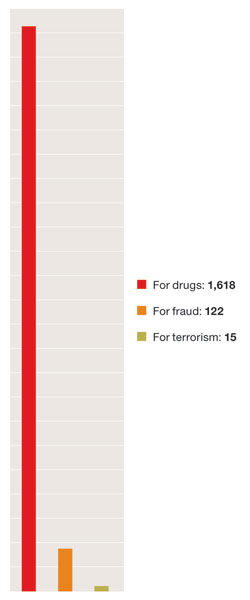
There's more at the link. Perhaps most telling of all is a graphic accompanying the article, showing that of all the delayed-notice search warrants issued in terms of the Patriot Act between 2006 and 2009, 1,618 concerned drug crimes; 122 fraud; and a mere 15 were for terrorism-related offenses. So much for the 'national security' or 'anti-terrorism' credentials of the Act . . .

This is what happens when lawmakers have a knee-jerk reaction to tragedy and terrorism. The Patriot Act may have been well meant, but it's become a catch-all dragnet for crime, rather than the tightly focused anti-terrorism measure it was supposed to be. It's also damaged many of our civil and constitutional rights, perhaps beyond recovery.

It's long gone time this monstrosity was removed from the statute books - forever.


Peter

The French are at war again!


This time, however, it doesn't involve firearms or explosives (at least, not yet). The Guardian reports:

... across the French capital, the summer has been enlivened by a corporate collage contest known as La guerre des Post-it (the Post-it wars). The battle is between presumably underemployed office workers who are devoting large chunks of their days to sticking thousands of pink, yellow, orange and green notes on their windows to recreate pixelated images.


. . .

Young executives from competing firms meet at lunchtime to compare their creations and plan ripostes. "Each time we have to come up with something bigger, wackier, more adventurous," Julien Berissi, 28, a project manager at Société Générale, told TF1 news. His rival, Stephane Heude from GDF/Suez, said the battle had been "very good socially", bringing together workers who would not otherwise have met.


For the time being, Ubisoft – where office manager Emilie Cozette is credited with the opening salvo – is the champion: its latest effort extended over three floors and used more than 3,000 Post-it notes to create a a design so complex it had to be worked out on a computer.


There's more at the link.

The Guardian has a gallery of images of the Post-It creations, and a French Web site, Post-It War, has a whole bunch of them (click on the Archives link there to find them). Some of them are amazingly detailed. Looks like a lot of fun is being had by all concerned.


Peter

Tuesday, September 6, 2011

More rally crashes


I've posted several video clips of rally crashes in the past. Here's another one, which from the look of it mainly covers cars and races back in the 1970's and 1980's.


As a former rally participant myself (although at less breakneck speeds and with rather more circumspect competitors) I have to admit, clips like this make me grateful I never experienced that side of the sport!


Peter

Doofus Of The Day #517


Today's winner is from England.

Most holiday makers taking a stroll around a working harbour might expect to see the odd fish.

But when David Copp came across a fishing trawler moored in Ilfracombe Harbour he took great offence and complained about the “disgusting” smell.


Ilfracombe harbor (image courtesy of Wikipedia)


The 46-year-old was outraged that his children, aged seven and nine, had been forced to endure the sight of 12 crates of dead fish and crabs, piled up on the quayside.

He said the ordeal had left them “quite distressed” and demanded to know why the harbourmaster was not more considerate to tourists.

“There were flies flying around and the smell was awful,” he said. “The ship was just sat there not doing anything, and there were 12 crates of dead crabs and fish just lying there covered in flies.

“It’s not the sort of thing you want to see on holiday, there was a real stench.

“My children were quite distressed by it. These people should be a bit more considerate to the holidaymakers."

Mr Copp called Ilfracombe harbourmaster Rob Lawson to complain about the smell that had emanated from The Lady of Lundy trawler before calling the North Devon Journal to air his woes.

. . .

Mr Copp is understood to have been on a two-week family holiday in the popular north Devon tourist resort when he lodged his complaint, which attracted disbelief from locals.

One said: “Ridiculous. Does he think all his food comes in packets? What did he expect to see at a working harbour?”


There's more at the link.

Gee . . . a fishing harbor with dead fish on the quay, and actually smelling of fish too! Who'd o' thunk it?

Tourists! Grrr!

Peter

"How Israel Cuts Sensor-to-shooter Time"


That's the title of a very interesting article on the Ares blog of Aviation Week. Here's a brief extract.

With its long experience in operating a wide variety of platforms and sensors in combat, Israel now considers the need to fuse information into a coherent, real-time intelligence picture as one of its biggest tasks.

In the cyber-realm — which now has an extensive overlap with intelligence, surveillance and reconnaissance (ISR) — Israeli researchers realize that most information is already available, but the challenge is to detect it in real time and immediately translate it into action.

. . .

The rapid spread of computers and mobile communications in the Middle East, reflected in the recent revolutions, has opened a world of opportunities for Israeli intelligence agencies. “Just imagine how much I can learn about you just by going through your laptop or smartphone,” says Amos Yadlin, former chief of Aman. “This could be compared to the emergence of airpower in the beginning of the 20th century, adding a new dimension of warfare.”

Recognizing that potential, Israeli industries have also diverted significant investments to developing cybertools, with Elbit Systems emerging as a leading integrator, alongside software developers such as Verint and Ness Technologies. “Gathering the information is becoming less and less a challenge,” an industry source tells Aviation Week. “It’s always there and looking at any event in retrospect; you always find you had the relevant intelligence before, but you were not aware of it. What gives you the edge is the ability to locate the relevant information from within the trillions of bytes you’re gathering in real time.”

Elbit is trying to meet this challenge with its Wise Intelligence Technology (WiT) system, which is designed to collect human, signals, imagery and open-source intelligence and translate it into a common format. Relying on that single database, WiT processes, analyses and disseminates the data as a coherent intel product.

. . .

Leading this brand of analysis is Shin-Bet, Israel’s security agency, which began targeting individual terrorists from the air in 2001. The need to triple-verify the identity of a target convinced the agency to bring together, for the first time, signals analysts and human intelligence operators to view a common unmanned aircraft system (UAS) video feed.

The Israel Defense Forces (IDF) then realized that the same method could be effective against rockets and anti-tank teams located in urban areas in Lebanon and Gaza. Because the IDF operates in known arenas, it established several unified fusion centers that are capable of receiving information from all sensors and controlling any available weaponry. Their effectiveness was demonstrated during Israel’s “Cast Lead” operation in Gaza in December 2008 and January 2009, where the average exposure time of a Palestinian rocket team was 90 sec. During this short time, several ISR centers, operating from the brigade level and up, were able to detect a suspected target, confirm it as hostile and direct munitions against it.

“It was completely irrelevant what munitions were used or whether they were fired from the air, ground or sea,” a brigade commander who participated in the operation tells Aviation Week. “With constant surveillance in the air and persistent intelligence gathering from all other sources, we were able to translate any intelligence into action in less than a minute in some cases.”


There's much more at the link. Bold print is my emphasis. It's very interesting and highly recommended reading.

That's a heck of an operational advantage, when you think about it. Take the case of those terrorist rocket teams. They would have known about each other, and how Israel was reacting to them. Now, put yourself in the position of a member of one of those teams. If you know that, from the moment you leave cover to aim and fire your rocket, you've got less than 90 seconds to live . . . isn't that likely to put you off your aim, just a wee bit? Martyrdom complex or not?


Peter

Not your average bathtime!


Being African-born and -raised, this article in the Daily Mail made me more than a little homesick.

This daring British wildlife photographer is shown taking a dip with a herd of wild elephants, who are crossing a river delta in Zimbabwe.

Using a floatation device hidden under his clothes, Chris Weston followed the herd into the tributary of the Zambezi River, capturing images that most wildlife photographers can only dream of.


However, the 44-year-old from Weymouth had spent five weeks gaining the trust of the herd during his time in the Ngamo Game Reserve - which meant he was not considered a threat.

'I was never really in any danger,' explained Mr Weston.

'Although there is always an element of that when working with animals, especially ones this size.

'But it's key to be able to read their body language and the way they communicate with you.'

The seasoned wildlife photographer, who has travelled all over the world to document large mammals, says he wants to capture the personality of an animal in the same way a portrait artist would with a human subject.

'It's not so much getting as close as possible,' said Mr Weston.

'Lenses change the perspective of the way we see things.

'What I like to do is show it as we see it and the standard lens is 50mm which means you have to get relatively close.

'The idea is to give the viewer an idea of the personality of that individual animal.

'In much the same way as you would take a person's portrait, you can't be standing half a mile away with a long lens.

'You have to get close and establish some kind of relationship.'


There's more at the link, including several more (and much larger) photographs. Fun reading.

However, I disagree profoundly with Mr. Weston's assertion that he was 'never really in any danger'. African elephants are wild animals, with all the unpredictability of any wild animal. They can be fine, nine times out of ten . . . but on the tenth occasion, they might just decide to spread you all over the landscape like a thin smear of butter. If you're armed only with a camera, there's not a damn thing you can do to stop them. Nope; I won't be getting anywhere near that close to elephants in the wild. I have far too much respect for them - and for what they can do to me!


Peter