Showing posts with label Product Reviews. Show all posts

Thursday, December 18, 2025

Need meat for long-term storage? Here's a very useful option


A few readers have contacted me asking what sort of meat they should buy for long-term storage and emergency use.  All the usual answers are well-known, particularly a freezer filled with the meat you normally eat:  but in a long-term emergency situation, you may not have power to run your freezer.  That's where dried and/or canned meat comes in.  (Jerky is basically dried meat, of course, although often over-seasoned.)  I also keep a stock of pemmican, as I wrote a few weeks ago.  What else do I recommend?

Some time ago, author and friend Mike Williamson introduced me to Grabill Country Meats in Indiana.  They're an Amish-run company, producing cans of beef, port, turkey and chicken preserved the Amish way, boiled in the can with water and nothing else at all.  The meat tastes delicious and lasts a very long time, so much so that they don't put a "best by" date on the can.  Last Monday I opened a can of pork chunks that I bought from them twelve years ago, and it looked, smelled and tasted just as good as one bought last year.  Delicious!

They sell 13oz. and 27oz. cans in boxes of twelve only.  I make sure we always have some in our long-term storage, simply because I've never found better-tasting, easier-to-use canned meat.  Their cans may seem expensive, but if you work it out on a cost-per-pound basis (particularly considering the quality of their meat), it's not bad.  The larger cans work out considerably cheaper per pound than the smaller ones, of course.  Shipping costs are a bear, but anything heavy has that problem.

So, if you want to keep a few (or more than a few) cans of "emergency meat" around to feed yourself and your family, Grabill Country Meats has my strong recommendation.  Being canned chunks, it can't be roasted or fried, but it makes great stews and soups.  In emergency, it can be eaten cold out of the can with a spoon.  Good stuff.

Peter


Friday, August 22, 2025

Condiment recommendation


While browsing through Amazon looking for a couple of items, I came across their White Wine Jalapeno Mustard.  The combination looked interesting, so I ordered some to try it.

I was amazed.  The flavor combination of this mustard is outstanding, perhaps the best of its kind I've ever tasted.  The jalapeno gives it a burn, but not excessively so, and the white wine helps tame the burn and adds significant flavor of its own.  It tastes a bit like a horseradish mustard, but there's no horseradish in it, and its own flavor adds body and a mellow finish.

So far I've tried it on cold roast beef (in a sandwich), German bratwurst, and cubed goat in a stew.  It's worked with all of them.  If you like mustard, particularly with a strong flavor but not overpoweringly hot, I highly recommend this stuff.

Peter


Monday, March 25, 2024

Great deal on Winchester .22 rifles


If you're in the market for a .22LR semi-auto rifle, CDNN Sports has a great deal for the next couple of days on the Winchester Wildcat.


I like the Wildcat as, basically, a cheaper clone of the very well-known Ruger 10/22.  It even accepts magazines for the latter rifle, including Ruger's 25-round BX.  It's not as customizable as the 10/22, but as a plinker and all-round useful .22LR rifle, it's more than adequate out of the box, without add-ons.  I've used them to introduce disabled students to rifle shooting, with considerable success.  If you'd like to learn more about them, Shooting Times' review is here, and Guns & Ammo's review is here.

CDNN is offering a discounted price, plus on top of that there's a $25 rebate from Winchester - but the latter is only valid until March 26th, so if you want it, you'll have to move fast.  They have three models available;  click each link to take a closer look.


Wildcat with olive drab green stock:  $174.99 after rebate

Wildcat with Truetimber Strata camo stock:  $174.99 after rebate

Wildcat with black stock and Reflex sight:  $199.99 after rebate


I'm not being compensated in any way by CDNN or Winchester for recommending this:  in fact, they don't know I'm doing so.  I just like to pass on to my readers good deals that I find.  I'm certainly going to take advantage of this one for myself, too.

Remember, you have to order by tomorrow to get the Winchester rebate.

Peter


Monday, March 18, 2024

A reminder about a great scope accessory


My recent review of Primary Arms' 3-9x44 scope generated some correspondence with readers.  Among other things, it seems that too few people have heard about the use of a fishing reel attachment tool known as a "Coaster" to make an improvised scope magnification adjustment device.  I wrote about it three years ago.  Here's an excerpt from that earlier post.


 I'm sure many readers interested in the shooting sports are familiar with the "throw lever" sometimes integrated into the power ring (i.e. the adjustment ring to vary the magnification) of telescopic sights.  They look something like this example, sticking up from the power ring of a Swampfox Optics Arrowhead tactical scope.  (Click any image for a larger view.)

Regular hunting- and target-style scopes don't usually have throw levers, but they've become very popular on tactical scopes.  They allow one to adjust the power very quickly with one hand, rather than fiddle with a power ring that doesn't offer easy purchase or a visual or tactile reference when the scope is being held to one's eye.  There are third-party, aftermarket throw levers available, but they can be expensive, and they only fit a limited range of sizes.

I recently came across a fishing accessory, originally designed to attach reels to rods.  It's called a "Coaster" ... They're made by Breakaway Tackle in England, and look like this.

The loop is placed around the fishing rod, over the mounting lugs of the reel:  then the arms are pulled tight through the vice block before the ring is screwed down on the block, its threads engaging the notches on the arms to tighten them further.  It's a bit like a double-ended cable tie.

Some bright spark figured out that the same tool could be used as a throw lever on rifle telescopic sights that lacked such a feature.  Intrigued, I tried it, and found it works like a charm.  Here's how the vendor illustrates it.

I modified that slightly, in that I cut off the arms a notch or so above the ring using cutting pliers, as low as I could manage, as illustrated above.  I then unscrewed the ring and took it off, cut the arms a notch or two shorter while holding the loop and vice block in place, and then reattached the ring and screwed it down moderately tightly (don't over-tighten it, as that will strip the threads).  That put the ends of the arms just beneath the surface of the ring, rather than above it, so they no longer scratched my fingers as I felt for the ring.  I found that a lot more comfortable, and it looked better, too.


There's more at the link, and in a follow-up post where a reader described having a problem fitting the "Coaster" to a very low-mounted scope.

Here's a video demonstrating how to install the Coaster on a scope.


This is a super-useful accessory to put on any scope with a variable power or focus ring.  The Coaster is also much lower cost than some of the made-for-purpose throw rings you'll find if you shop around (it's anywhere from a half to a tenth of their price), and it'll fit just about any scope, unlike some of the others that are restricted to scopes of a particular brand or size.  I've put them on my most-used scopes, and I'm in the process of installing them on the rest as well, for a uniform fit across all my long guns.  You'll find them on Amazon.

Highly recommended.

Peter


Tuesday, February 27, 2024

Worthwhile scope deal


If you have a rifle or two you'd like to equip with a telescopic sight, but can't justify several hundred dollars for most of the offerings currently out there, Primary Arms has a good deal at the moment.  It's for their Classic Series 3-9x44 Rifle Scope, currently priced at just $94.99.


It has a 30mm scope tube, which transmits more light, more efficiently than the typical 1-inch tube used on most lower-cost commercial scopes.  That means using 30mm. mounts and/or rings, of course, which are a bit more expensive, but not too much so.  You'll have the opportunity to buy discounted scope covers and mounts if purchased with the sight, which is useful.  It uses a standard duplex reticle, with no bullet drop compensation or range-finding ability, but for its target market that's probably not a problem.  I intend it for use at up to 300 yards, and out to that range I can compensate for bullet drop and windage by eye.  Any competent rifleman should be able to do so, if he knows his firearm and ammunition.

I've been trying one out, and I'm pretty impressed by it.  It works just fine for cartridges from rimfire to .308 Winchester, and I presume it'll probably suffice for more powerful ones too, despite their heavier recoil.  At its price point it's probably unbeatable value right now.  I own several Nikon ProStaff scopes, which were (sadly) discontinued a few years ago, and always found them to be very good value for money.  Well, this Primary Arms scope is at least as good as them in terms of optics, gathers more light, and costs a lot less than they did.  I don't know how Primary Arms managed to hold this price point, but I'm not complaining!  I just bought a couple more to put on rifles that don't yet have scopes, because with my eyes getting as old as the rest of my body, iron sights are really not an option for me any more.

(No, Primary Arms isn't compensating me in any way to boost their products - they don't even know I'm writing this article.  I just like what I bought, and I like to tell my readers and friends about good deals when I find them.)

Recommended.

Peter


Friday, December 8, 2023

My neck and shoulders feel better than they have in years


Regular readers will know that almost two decades ago, I suffered a severe job-related injury that left me with a fused spine and serious nerve damage in my lower back.  Since then, I've been in pain 24/7/365, and had limitations on movement, ability to lift any meaningful weight, and so on.  Over time, as my spine adjusted to a much more limited range of motion, I began to experience pain and stiffness problems in my neck and shoulders, too.  They've been getting steadily worse.  Chiropractic treatment and massages haven't fixed it, although they can temporarily alleviate pain;  but they're pretty expensive.  I also tried a heating pad for my neck and shoulders, which feels good while I use it, but only produces minor temporary relief - nothing long-term.

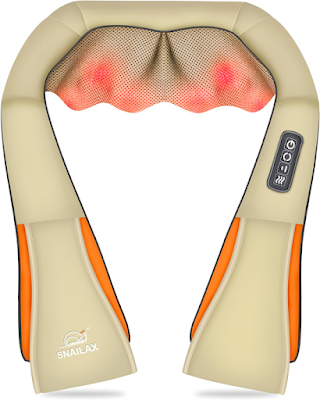
Recently, someone recommended that I try the Snailax Shiatsu Neck and Shoulder Massager.


It's a shiatsu-type massager with a kneading, probing motion, not just a hot pad for the neck.  I use the arm/hand loops to pull it reasonably tight against my neck, which adds to its effectiveness.  I've been using it for almost two weeks now, at 15 minutes per session, and it's made an amazing difference to my neck and shoulders.  Most of the stiffness and much of the pain has receded, and the little that's left is responding well to ongoing (daily) use of the massager.  I expect that given another couple of weeks' use, they'll be negligible;  if I'm lucky, they'll be gone altogether.

I've seldom been more impressed by how well a product works.  After years of enduring increasing pain and restricted mobility in my neck and shoulders, it feels almost miraculous - which sounds like hyperbole, I know, unless and until you've had to endure being locked up solid in that area by muscle and nerve issues.  Those who have will understand my joy at being relieved of that burden.  I'm also able to use it on different parts of my back and shoulders.  It's probably not as good as a full-back massage pad, but as a "problem spot treatment" it works reasonably well.  If you have muscle-related neck and shoulder problems, and haven't been able to find a solution, I recommend this product very highly.

This model is powered by a plug-in adapter, but there's also a rechargeable model if you prefer to use it without a cord attached.  I haven't tried the latter yet, but I plan to.  If it works as well as the plug-in model, it'll be very handy to carry in the car on long trips.  I also plan to try the same company's Full Body Massage Chair Pad.  It won't be able to relieve the area of my spinal fusion - that's pretty much frozen solid - but if it helps the rest of my back muscles I won't complain.  The Shiatsu Foot Massager also looks promising for future reference.  (There are any number of competing products out there, some of which look almost identical to the Snailax versions - typical Chinese practice, where one factory may "pirate" a single design under several different labels.  However, since I haven't tried any others, I can't recommend them from personal experience.  That's not to say they may not be as good, of course.  YMMV.)

The cost of these products may raise an eyebrow or two - they certainly did mine, being on a limited budget.  However, when one compares it to the cost of a massage or chiropractic adjustment, it looks a lot more reasonable.  For example, around here I have to pay $60-$70 for an hour-long back massage.  That's about a third more than the price of the massager - but I can use the latter every day without paying any extra, so the "cost per treatment" plummets.  The foot massager is also less than the price of one massage, while the larger and more complex chair pad costs a little more than three massages - and, again, one can use them as often as one likes.  I hope they'll hold up in long-term use, but in all honesty, even if this neck and shoulder massager stops working after as little as a month, I reckon I'll have had my money's worth out of it.  (Fortunately, thousands of positive customer reviews provide relatively few complaints of it breaking down.). When one is calculating a cost-benefit analysis in terms of pain and mobility (or the lack thereof), it adds a lot more realism to price comparisons.

In general, highly recommended.

(Note:  I paid for my own massager, and have not been compensated in any way by the manufacturer or distributor for reviewing it here or mentioning their other products.  They don't even know I'm doing it.)

Peter


Wednesday, April 5, 2023

Here's a screaming good deal on a small fixed-blade knife


I'm not a knife aficionado in the sense of salivating over a brand name, or this, that or the other fancy feature of a blade.  However, over many years in Africa I came to appreciate simplicity, strength, versatility and toughness in a knife.  We treated our blades hard there.  They were "rode hard and put away wet", to use a Texas phrase, and sometimes broke under brutally hard treatment, or were lost in the heat of the moment.  If a knife could last under that kind of wear and tear, it was valued.  You'll also understand that folding knives seldom withstood such treatment:  fixed-blade knives offered greater strength, and were thus preferred.  I've written about those experiences in earlier articles:


Wilderness & survival tools - price versus quality

Useful information for knife novices


I recently came across a small knife on Amazon that, after testing, measures up to my African expectations.  It's the "Duratech Compact Fixed Blade Knife".  (Click this and any other image for a larger view.)


It's a small knife, designed for neck wear, or perhaps sideways on a belt for inconspicuous carry, or even pocket use.  It's only 6" long overall, with a 3" blade (short enough to be legal almost everywhere - check your state's knife laws to be sure).  Despite that, it's very ergonomic.  I usually don't like small knives, because they're difficult for me to handle (I have large hands - I wear size 2XL gloves).  Nevertheless, this knife doesn't present that problem, thanks to a very well-shaped handle of just the right length and diameter to grasp easily.


The blade is the proper thickness, too, able to stand up to hard use (including batoning smaller logs - I know, I've tried).  It's very sharp, and retains its edge well.  (It cuts tough meat like it wasn't there, better than most steak knives.)  If you want the ultimate concealment knife, the wood grips are attached using Torx screws, so (with the right screwdriver) you can remove them and grasp only the bare full-length tang if you wish (I'd wrap it in something like gaffer tape or skateboard tape, if I were you).  The knife is also light enough (only 2½ ounces) to carry around your neck, underneath your shirt.  You won't notice it's there.


To carry it on your belt, you can superglue a belt/pocket clip to the sheath, or have a leather sheath made.  For pocket carry, the existing sheath is fine, and the knife is small enough to make that possible despite being a fixed-blade unit.

What really surprised me is the value for money this knife offers.  It's only $11.99!  I wouldn't complain at having to pay double that cost or more, because the utility it offers is worth that to me:  but at that price, it's an absolute steal.  Having bought one to try it, I promptly ordered half-a-dozen more.  They'll go into my "lend or give to friends in need" stash, and one will be in my wife's handbag.

I think this may be the best-value-for-money everyday carry knife I've come across in a long time.  It has all the strength of a fixed-blade, but is no larger than many folding knives, and the price is unbeatable.  Highly recommended.

(No, I'm not being compensated by Duratech in cash or in kind for recommending their knife.  I just think this is a screaming good deal, and I'd like my friends to know about it.)

Peter


Friday, November 4, 2022

A strong endorsement for an innovative pet food


If you don't own pets, you can ignore this post.  If you do, then read on.

Friends of ours recently bought a Colorado Mountain Dog puppy.  She's a delight, very intelligent and playful, and is growing up to be a real family asset (she can herd kids as well as animals, to their parents' occasional relief!).  We were struck by her luxurious long hair, and asked what they were feeding her.  They told us about Gentle Giants pet food, which is her exclusive diet, and we were impressed by the visibly good results.  They feed her only the dry food, but GG makes wet food for dogs too.  Best of all, as far as I'm concerned, it's all made right here in the USA using local ingredients, and they list them all.  No toxic Chinese food additives here!

We did some more research, and found that GG makes cat food too, both dry and wet.  We ordered a 9lb dry food bag to test it, and had excellent results.  Both our cats like it, and they eat less of it than they did of their old food with no loss of weight or ill health results.  In fact, I think they're more energetic now.  Our 13-year-old senior cat passed her annual vet checkup this morning with flying colors after a month or two on the new food, and was even more obnoxious than usual (freely translated from growls and hisses, "I hate this place - it's where they stick needles and other nasties in you!").  She was clearly in fine form, to the vet's amusement.

Therefore, I'd like to give an unhesitating Thumbs Up to Gentle Giants pet food for dogs and cats.  We're impressed enough with its results that we're standardizing on it, and recommending it to our friends as well.  It's freely available from the makers via mail order, and it's no more expensive to buy from them than through outlets such as Petco, Chewy or Amazon.  Also, the price is very reasonable, and although you have to pay shipping, buying two or more packs at a time lowers the transport cost per packet, making it much more affordable.  (I just bought two 18lb packs of cat food, and even with shipping added found the combined total cost to be less than a single 17.6lb pack of Royal Canin cat food from the local pet supply store.  I'll take a bargain like that any day!)

(No, I'm not getting any sort of compensation or free product for endorsing Gentle Giants here;  they don't even know I'm writing this.  I just like my readers to know about good products and good deals.)

Peter


Friday, August 6, 2021

Follow-up on those scope power ring levers


A couple of days ago I wrote about the use of a "Coaster", an item of fishing gear, to make an ad-hoc throw lever for a telescopic sight's power ring.  A lot of readers seem to be looking into that, with much success.

However, Tom G. wrote to describe an issue with his extended-eye-relief scope, complete with pictures.


Hi Peter,

I was excited when I saw your blog post about using the Coasters as a scope dial ring handle.  I had seen it before but hadn't kept the link.  I ordered a set and tried to put them on my rifle.  This is a cautionary tale that it won't work for everybody.

My rifle is a Ruger GSR "scout" with a forward-mounted Burris optic.  It has very little clearance between the power ring and the rail.

I painstakingly trimmed down a bunch of the ribs with nippers, then took the whole thing (just the coaster!) to the belt sander and reduced it some more ("trimmed).  The picture "divots" shows that I could not reduce it enough, it still bound up.  The picture "clearance" shows how little room there is.  So now I'm back to square one.  Either I bubba the rail or find another solution.  

But the second one will work on another scope!  

Keep up the writing!

Tom

(Feel free to use this on your blog if you want)


Thanks for writing, Tom, and for sharing your experience with us.

The obvious answer, of course, is to use a slightly higher set of scope rings, to allow greater clearance between the power ring and the rail.  Of course, this may not work for everybody;  it will mean adjusting one's sighting technique to allow for the changed height, which may be less comfortable than before.  I guess there are trade-offs everywhere.  Still, if you want a really low-mounted scope, then I guess that won't allow enough clearance for the Coaster to be usable as a throw lever.  YMMV.

One possible solution, that would be less comfortable than a full-size Coaster but should still be usable, would be to use a regular cable tie instead.  They're thinner than the Coaster.  The "nub" where the ends come together would still offer at least some purchase to turn the power ring more easily.

Peter


Tuesday, August 3, 2021

A really useful accessory for rifle telescopic sights


I'm sure many readers interested in the shooting sports are familiar with the "throw lever" sometimes integrated into the power ring (i.e. the adjustment ring to vary the magnification) of telescopic sights.  They look something like this example, sticking up from the power ring of a Swampfox Optics Arrowhead tactical scope.  (Click any image for a larger view.)


Regular hunting- and target-style scopes don't usually have throw levers, but they've become very popular on tactical scopes.  They allow one to adjust the power very quickly with one hand, rather than fiddle with a power ring that doesn't offer easy purchase or a visual or tactile reference when the scope is being held to one's eye.  There are third-party, aftermarket throw levers available, but they can be expensive, and they only fit a limited range of sizes.

I recently came across a fishing accessory, originally designed to attach reels to rods.  It's called a "Coaster", and is available in single and twin packs.  They're made by Breakaway Tackle in England, and look like this.


The loop is placed around the fishing rod, over the mounting lugs of the reel:  then the arms are pulled tight through the vice block before the ring is screwed down on the block, its threads engaging the notches on the arms to tighten them further.  It's a bit like a double-ended cable tie.

Some bright spark figured out that the same tool could be used as a throw lever on rifle telescopic sights that lacked such a feature.  Intrigued, I tried it, and found it works like a charm.  Here's how the vendor illustrates it.


I modified that slightly, in that I cut off the arms a notch or so above the ring using cutting pliers, as low as I could manage, as illustrated above.  I then unscrewed the ring and took it off, cut the arms a notch or two shorter while holding the loop and vice block in place, and then reattached the ring and screwed it down moderately tightly (don't over-tighten it, as that will strip the threads).  That put the ends of the arms just beneath the surface of the ring, rather than above it, so they no longer scratched my fingers as I felt for the ring.  I found that a lot more comfortable, and it looked better, too.

Customer reviews warn that the plastic may stretch over time, but that's easily dealt with by tightening the ring when necessary.  I've considered using glue on the arms inside the ring, to stop anything coming loose, but so far I haven't needed it.  I'll hold off on the glue unless it proves necessary further down the road.

When attaching the Coaster, turn your scope's power ring to its minimum setting, then move it to its maximum setting, taking careful note of how far it turns from one extremity to the other.  Looking from the rear of the scope, it's usually from about 270 degrees, or west, moving clockwise through a half-circle to about 90 degrees, or east (with 0 degrees being straight up, or north).  Return it to the minimum setting, then fasten the Coaster to the power ring so that it sticks out on the left (west) of the scope at about the 270 degree setting.  When tightened down, it should make it much easier to grasp and move the power ring one-handed between finger and thumb while peering through the scope, moving the ring all the way over to the 90 degree point (east) on the right.  (If your scope's power ring moves the other way, or has a shorter range of motion, simply adjust the initial position of the Coaster to suit.)

If you ever want to take off the Coaster, simply unscrew the ring;  or, if you've glued the ring in place, just cut the plastic loop and the Coaster will fall off.

I'm delighted with how easy the Coaster makes it to move the power ring; and with the arms trimmed to below the surface of the locking ring, it looks good, too.  I've bought enough of them to put one on all my variable-power scopes (buying the twin-pack means they cost less than $6.50 each).  I highly recommend it.

There are competing products out there, but they all appear to be more expensive than the Coaster, so I haven't tried them.  YMMV, of course.

Peter

(EDITED TO ADD:  A reader e-mailed to describe a problem with a very low-mounted scope, where there wasn't enough clearance to allow the Coaster to fit.  Details and a photograph here.)


Tuesday, June 8, 2021

An interesting sharpening stone


I was recently sent for review a free sample of the so-called "AmericaStone", a small ceramic sharpening stone with three surfaces that claims to deburr, hone and polish a blade's edge, and handle serrations too.  There's a demonstration video on YouTube that illustrates it in action.

I've given the Americastone a workout over the past few weeks, on everything from folding knives, to sheath knives, to machetes, and on blades that were smooth, or nicked, or rusted.  It does a good job sharpening them all, but its small size means that it takes a while to get anything but a small blade into sharp condition, and also makes it more difficult to work on nicks and flats in the blade.  A larger, bench version of this stone would help deal with those issues, but at present it's only made in one size.  (Using the Americastone on a machete or axe is an exercise in frustration - tiny tool meets very large blade!  Clearly, it's not designed for such use.  A big, coarse tool such as the Sharpal 216N or Lansky Puck is far more suitable.)

After using the Americastone fairly extensively, I'm in two minds about it.  It works very well at what it does;  but it works slowly, and in the field, one can't always spare the time for that.  If speed is an important factor, most of us would be better served by a pocket sharpener such as those from Sharpal, Lansky or Smith's (which are also a third of the price of the Americastone).  The latter will still be useful as a finishing stone for use at leisure, but not as a primary sharpener under those circumstances.

I should also point out that I was raised in Africa.  We had different priorities there when it came to field knives, as we've discussed before in these (and other) articles:


Wilderness & survival tools - price versus quality

How Survival Knives Are Designed And Manufactured

Useful information for knife novices


I think that, for a rough field environment, the Americastone would not be as useful as a coarser, more general-purpose instrument.  However, for a knife aficionado working at home or in town, who wants to keep his high-quality blades razor-sharp and doesn't mind taking the time and the trouble to do so, it's a useful and highly portable tool.

(Despite the fact that the stone I was sent was a free sample, I didn't allow that to influence my review of it, as you can see for yourselves.)

Peter


Wednesday, May 26, 2021

Here's a screaming good deal on machetes


I'm a big fan of machetes for all sorts of reasons.  They make great gardening implements for some tasks;  when "roughing it", they can clear a trail through brush and vines;  they're very useful around the camp fire, chopping small branches into kindling and even cutting down small trees;  and in a defensive situation, they're a heck of a weapon, scary-looking and intimidating, and inflicting really serious wounds if necessary (and if you know what you're doing with one).  They're a favorite all-purpose tool and weapon in many parts of Africa (in southern Africa, from where I come, they're known as pangas).

A machete is supposed to be a working tool, tough, strong and able to stand up to heavy use.  Sadly, many of those sold in the USA today are relatively flimsy, made of thin, poor-quality metal that won't hold an edge for long, and wobbles in your hand when it hits something solid.  They're light-duty blades, not real machetes.  On the other hand, those made in countries like Colombia, Brazil, El Salvador, etc. tend to be serious machetes - working men's tools.  I've had and/or seen good results with those made by Condor (expensive, but high quality), ImacasaIncolma and Tramontina.  Among US brands, Cold Steel, Marbles and Ontario aren't bad, in my experience.

I was interested to learn that Major Surplus & Survival is offering a 5-machete package for only $19.95.  The illustration they provide is an example, not a guaranteed representation of what you'll get.  Click the image for a larger view.


The photograph is clearly a composite image, and isn't true to size.  To estimate comparative sizes, think of all the handles as roughly the same length, and figure out blade length from that.  Major Surplus describes the package as follows:


Mixed blade lengths and finishes, mixed wood, and plastic handles. Sizes and styles will vary. Sorry, no choices. Satisfaction Guaranteed.


Intrigued (and because I had a couple of friends who were interested in buying some as well), I ordered two of the 5-packs.  They arrived the other day, and to say I'm very satisfied would be an understatement.  All of the machetes in both packs came from South American manufacturers, and were clearly working tools, strong and tough, not for dilettantes.  The shortest blade in each package was 14", and the longest 24".  Each had a long-handled sugar cane cutter (similar to this one), heavy and tough enough to take down small trees;  a long-bladed brush-cutter like the second blade above;  two blades that grow wider towards the tip to lend weight to a swing (one with an angular blade like the top one above, the other with an upswept curve like the fourth from the top);  and a short 14" general-purpose blade.  Four of the machetes were clearly brand-new, while one was lightly used, but still in good condition.  Four had wood handles, and one (the shortest) plastic.

For the price, I don't think this deal can be beaten.  Including shipping, each pack came to about $30, which averages out at $6 per machete - a steal, IMHO, for such good quality.  The package deal can't last forever at that price, so if you need a machete or two (or three, or...) get them while it lasts.  If the shape of some of the blades doesn't suit you, remember, you can re-shape them using a cutting wheel and/or grinding wheel (provided you keep the steel cool, and re-temper it if necessary when you're done).  At this price, a mistake won't break your heart or your wallet.

(No, I'm not being compensated for recommending them, and Major Surplus & Survival don't know I'm writing this review.  Nevertheless, if they continue to offer deals this good, I'll be shopping there again in future.)

Peter


Tuesday, May 11, 2021

Really useful, well made canned food storage


I've written often about preparing for emergencies, and more recently about the threat of inflation.  In both cases, one of the generally recommended solutions is to build up a reserve supply of foods that you eat regularly, so that if the supply is interrupted, or prices get too high to be affordable, you have something to fall back on.  To that end, canned foods are a vital part of emergency preparedness.

For years I've used the cardboard CanOrganizer storage units.  I reviewed them back in 2013.  Sadly, it looks like the company making them is no more - at least, its Web site is defunct.  That's a real pity, because they made a very useful product.  However, in searching for alternative can organizer tools to expand our pantry storage, I came across the Cansolidator series from Shelf Reliance.


They work on exactly the same principle as the CanOrganizer:  you put new cans in on the upper level, and they roll down an inclined ramp, fall down to the lower level, and roll back to the front, where you take them out as needed.  In this way, you're constantly rotating the cans, using the oldest first.

I particularly like the adjustable-width Cansolidator segments.  They can be tailored to the size of the cans they contain, so that no space is wasted.


They snap together very easily (a rubber hammer comes in handy to make sure the tabs are properly seated in the notches), and are stronger than the cardboard CanOrganizer.  I've chosen to build mine in 20"-long units, rather than longer ones, because if I ever have to move them, the extra length and weight would make them unwieldy.

The only complaint I have about the Cansolidator is that it can hold a maximum of ten normal-size cans per segment (slightly more of smaller cans like Campbell's soup, or tomato paste, or whatever).  The cardboard CanOrganizer came in four different sizes, so if you needed a lot of cans of one particular food, you could choose a longer, higher-capacity storage unit for them, and pick a shorter, smaller one for other foods.  The Cansolidator is equivalent to the medium-size CanOrganizer, but offers only the one size.  However, I suppose you can use two segments, side-by-side, if you want to store more than 10 cans of something.  So far, I'm reserving the Cansolidator for foods where I stock fewer cans, and using the longer CanOrganizers for foods more in demand.

I'm not being compensated in any way for recommending the Cansolidator;  in fact, the makers have never heard of me and don't know I'm writing this review.  Nevertheless, it's an outstandingly useful product, easy to assemble, tough enough for all normal use, and very versatile - much more so than wire-shelf products I've tried, which were mostly somewhat unstable when fully loaded.  I've bought two of the six-segment, 60-can-capacity Pantry Plus Cansolidators (as illustrated in the first photograph above), and assembled them into three shorter, 4-segment units (they're very flexible that way).  I'll be buying more if needed.  I highly recommend them if you're looking for a way to organize and/or expand your reserve food storage - something I suggest we should all be doing, what with the hard times that so clearly lie ahead.

Peter


Friday, November 13, 2020

Swampfox Optics' new reflex sights are a big improvement


I've owned one of Swampfox Optics' earlier micro reflex sights, the Kingslayer, for some time.  I found it an adequate performer, but not up to the latest technology from top names such as Trijicon and other manufacturers.

That's all changed with the arrival of Swampfox's Liberty and Justice models.  They're right up to date, equal to the best from anyone else, and perform very well indeed.  What's more, their price is very competitive.  Intrigued, I bought one for testing.  (Note that I bought my own sight from Swampfox, with my own money.  They're not compensating me in any way, in cash or in kind, for writing this review, and have not asked for any endorsement.  I'm merely sharing my impressions with my readers in the hope that others may find them useful.)

As my eyes get older, I find conventional handgun sights harder and harder to use, because I can't focus as sharply as I used to.  These micro reflex sights eliminate that difficulty.  They also work well for those unaccustomed to lining up front and rear sights, and focusing sharply on the front sight while the rear sight and the target are slightly out of focus, or "fuzzy".  That's a skill some find difficult to learn, but with a reflex sight, it's unnecessary.

The Liberty and Justice models are essentially identical, with the exception of the window size.  Liberty has a 22mm window (essentially the width of a Glock slide), while Justice offers a larger 27mm.  The former is easier to conceal when carrying your pistol, while the latter is more useful in competition or hunting, where you want to acquire the dot of the sight as fast as possible.  I focus on defensive use and concealed carry, and found the smaller window of the Liberty model no problem at all in that environment.  Both offer a "shake 'n wake" feature, whereby they shut down after a few minutes without any movement, but automatically "wake up" at the former brightness setting as soon as they detect motion.  That saves battery life, a very useful feature.  (Also, the battery can be replaced without removing the sight, which would require re-zeroing it when it's re-mounted.  That's another useful feature.)

Obviously, it takes practice and training to get used to looking for a dot rather than lining up front and rear sights, but that's just a matter of trigger time.  I found little trouble in adjusting to it;  in fact, I soon found it faster to use than iron sights, and more accurate in rapid fire, which is never a bad thing in defensive shooting.  Here's the first of a series of video clips from well-known shooting personality Colion Noir as he learns to use his pistol-mounted reflex sight.  You'll find more of his videos on the subject on YouTube.


The Liberty and Justice use the same mounting footprint as the Trijicon RMR, which is arguably the current industry standard in micro reflex sights (albeit at double the price of the Swampfox offerings).  The latter's sights will thus mount to any firearm offering RMR compatibility.  I mounted my Liberty sight on a Glock 17 Gen5 with the MOS slide cut, using Glock's RMR mounting plate, and it fit like a glove.  There's also an optional Picatinny rail mount for either sight, to allow it to be used on a rifle or shotgun rail.  I plan to try one on an AR-15 as a backup sight before long.

I also installed Swampfox's Ironsides protective sleeve over the Liberty.  The Ironsides is a metal frame that covers the top and sides of the Liberty sight, so that if it snags against anything, or bangs into something as it's being used, or if you drop your weapon, the sight itself is protected from damage.  I think that's a seriously good idea, particularly if you might have to draw your pistol in a hurry in confined situations like inside your motor vehicle - it's bound to knock against something occasionally.  You can also use the Ironsides sleeve to rack the slide of your weapon against any convenient surface, like a wall or a door, without risking damage to the sight inside.  Those who've done any barricade shooting will really appreciate that.

Here's what the combination of Liberty and Ironsides looks like on a Glock MOS slide, with a raised suppressor-height rear sight to allow iron sight use through the Liberty's window if need be.


There are lots of video clips on YouTube showing such sights in operation.  Here's a short video review of the Swampfox Liberty with the Ironsides frame.  Note the use of the Ironsides frame to rack the slide against an obstacle.


I've used a Trijicon RMR sight, and I find the Swampfox offerings to be just as good.  They're also a lot more affordable.  If you're in the market for a handgun red dot sight, and want something that'll fit a limited budget, I think you could do a lot worse.  I'll be buying more of them, because with my aging eyes, I'm going to need them!

Peter


Wednesday, September 30, 2020

Giving a shout-out to good holsters at a fair price


I'd like to acknowledge a holster company that does good work at reasonable prices.  They're not paying or compensating me to promote them - they don't even know (yet) that I'm writing this article - but I like to let my readers know about good deals, of which this is one.

We The People Holsters is based in Las Vegas.  They make Kydex inside- and outside-the-waistband holsters for most modern handguns, in both basic black and colorful printed designs.  (Why anyone would want a pink camouflage holster I really can't say, but apparently there are some who like them!)  The holsters are well made, and less bulky than some of their competition (which makes it easier to conceal a firearm under a shirt or coat):  and their prices are attractive.  I've bought half a dozen of their holsters so far (for myself and some of my students) at a cost of $47 each, which isn't bad at all.  Those I ordered were to fit three models of Glock pistol, the Springfield XDS, Ruger's SR9C, the S&W Shield 380 EZ and a revolver, and all have been accurately molded to those guns.  They appear adequately strong for normal concealed carry purposes.

I particularly like their holster for Glock pistols with the MOS slide cut (for reflex sights mounted on the slide).  Their OWB model for the Glock 17 is shown below.


I'm experimenting with slide-mounted reflex sights at the moment, and have found that there aren't many affordable and concealable holsters made for them.  The OWB model from We The People is cut well clear of the optic, yet holds the firearm securely (which is the whole point of a good holster).  I'm wearing it as I sit at the computer writing these words, and find it comfortable.

We The People Holsters gets my thumbs up for a quality product at a decent price.  I'll be buying from them again.

Peter

Tuesday, July 7, 2020

Keltec's P17: It's a very good handgun, if you can find one


In April I put up a "first look" article about Keltec's new P17 .22 pistol.


If you missed the earlier article, please read it before continuing, as this review continues from that point and doesn't repeat the same information.

The great thing about this pistol - and it really is a great thing, compared to some of its rivals - is that it's boringly reliable.  Many .22 firearms are very "picky" about what ammunition they like.  Some will shoot well with this round, but not with that one.  The "pickiness" may even be visible among pistols of the same make and model.  Not so with the P17.  I've fired seven different rounds through it so far:
All performed without a hiccup through the P17, which surprised me.  I was expecting at least a few mis-feeds or failures to fire, on the basis of many years' experience with .22LR pistols.  This one didn't even blink.

The P17 also shot relatively "clean".  .22LR rounds are notorious for leaving powder and lead fouling behind them, requiring some pistols to be cleaned after a few hundred rounds in order to continue functioning smoothly.  (That happened to me most recently with a Ruger Mk. IV, which surprised me;  earlier marks had not given rise to that problem.)  The P17 got dirty, sure, but its function never wavered, and its action remained as smooth as ever, even during a thousand-round torture test run over several days without cleaning or lubrication.  That's a good sign.

The sixteen-round magazines (three are provided with the pistol) are a big plus point.  Most .22LR pistols I know are sold with 10-round magazines, and only two of them at that.  There's nothing wrong with that, but it means more frequent reloading in high-round-count usage.  The P17 can shoot 48 rounds to an "average" pistol's 20 before needing to reload its magazines, a 140% improvement over the lower-capacity weapons out of the box.  That's very useful.

Accuracy was fine, well up to industry standards.  The P17 isn't a target pistol with finely-adjustable sights, but it's well up to plinking use, and I wouldn't object to an informal target-shooting competition with it.  The trigger is very controllable, with an easy let-off that makes accuracy easier.  The checkering on the grip isn't anything to write home about, not providing much friction against your hands;  but we're talking about minimal recoil here anyway, so that's not an important factor to me.  Certainly, I've found the gun very controllable through hundreds of rounds.  If you want something with greater friction, you can install a grip sleeve, or add something like skateboard tape to the front and rear straps.

Perhaps the nicest thing about the P17 is its price point.  Its recommended retail price, complete with 3 magazines, is only $199.99!  That's astonishing value for money in today's market.  It definitely vaults the P17 to the top of the list of rimfire pistols I recommend to others.

For another perspective on the P17, here's a brief review from the NRA Gun of the Week channel.


I really can't think of any negatives about the P17.  Keltec has come up with a winner here.  I'll put my name on the list to buy a couple from my local gun shop, when they eventually get them in stock.  The current shortage of firearms, thanks to panic buying following the coronavirus pandemic and George Floyd-inspired riots, means I'll probably have to wait a long time . . . but the P17 is worth waiting for, IMHO.

In case you're wondering, no, I'm not being compensated in any way to do this review.  I value .22 pistols very highly as a training tool, and as a defensive weapon for disabled shooters who can't handle the recoil of anything more powerful (see my earlier article on the subject).  That's why I wanted to review the P17.  Now that I've done so, the two review guns (generously donated by Keltec) will be passed on (free of charge) to two disabled shooters, who need them far more urgently than I do!

Peter

Thursday, April 23, 2020

First look: KelTec P17 pistol


Sitting on my desk as I type these words is a KelTec P17 .22LR pistol.  The company has very generously made it available to me for testing, for which my thanks.  I promise I won't softball the review, either.  As most of you know, I've taught many disabled and/or handicapped shooters to use a handgun to defend themselves, including a number who can't handle the recoil of larger cartridges due to their physical limitations.  They rely on .22LR for defensive use, and on pistols like the P17;  so I'll be testing it to a pretty high standard - namely, would I trust my life to this gun?  If not, I'll say so, and tell you why.  We'll see.

The P17 has all the usual features, plus some that are unique at this price point:  its suggested retail price is only $199.  That's by far the cheapest .22LR pistol that I've seen in gun stores.  Kudos to KelTec for pulling out all the stops to make this a full-featured offering at an irresistible price.


The pistol ships with a threaded muzzle and an adaptor for muzzle devices and/or a suppressor;  three (yes, three!) 16-round magazines (it holds 17 with one round in the chamber, hence its name of P17);  a wrench for removing the muzzle adaptor;  and a safety lock.  The sights are standard rear and green fiber-optic front.  I particularly like the fact that the green fiber-optic strand is embedded inside a traditional square-shaped front sight, so that if one wants to ignore the green dot and carefully line up the top of the front sight with the top of the 'ears' of the rear sight, that's easy to do.  Bonus points to KelTec for that.


I've only fired one quick magazine through the P17 so far.  Accuracy was good, recoil no more than any other .22LR pistol (which is to say, minimal), and handling very easy.  The pistol's frame and grip are made of hard plastic, with a textured pattern on the grip.  It's nicely shaped;  a teensy bit too small for my large hands, but it's not a problem to adjust my grasp to compensate.  I think it should fit most shooters very comfortably.  At only 14 ounces fully loaded, the weight is easily managed.

Here's KelTec's quick start guide to unboxing the P17.


I'm going to put this pistol through an extended test over the next few weeks, including (if I can line up the shooters, the range and the ammunition) shooting a thousand rounds in a day as a "torture test".  If the P17 lives up to its initial promise, and if it proves reliable, it's going to be a game-changer in the entry-level pistol market.  It's at least a hundred dollars cheaper than any comparable pistol I've seen.  It's light and easy-handling enough that the entire family can learn to shoot with it, and seventeen rounds of .22LR hollow-point ammunition is nothing to sneeze at if it comes to defensive use.  (If you doubt that, refer to my earlier article on .22LR as a defensive round, particularly the training routine I recommended there.  Once you've achieved that standard, you'll find the .22LR round to be eminently usable for personal security.)

What's more, .22LR ammunition is still relatively easy and affordable to buy, although it's getting more scarce by the day.  If you don't already have a stash of the stuff, now might be a very good time to buy a few hundred (or a few thousand) rounds to tide you over until the current ammo drought eases.  It's a very useful and low-cost way to keep your skills and training up to the mark.  (If you can afford to buy in bulk, my favorite online dealer, SGAmmo, still has plenty in stock.  I've already got mine, thank you very much!  No, SGAmmo isn't paying me or recompensing me in any way for recommending them.)

I'll have a more detailed review and shooting report in due course, but I'm initially favorably impressed by KelTec's P17.  The company may have a winner here.

Peter

Wednesday, January 29, 2020

Nikon is quitting the riflescope market - and there are some great deals to be had


A few months ago, it emerged that Nikon was planning to quit the riflescope market.  This was sad news, because Nikon has produced high-quality offerings in the mid-range section of that market;  but the company apparently wants to concentrate its efforts on consumer optics such as binoculars, camera lenses and the like.  One can't argue with that tighter focus (you should pardon the expression).

On the other hand, this means there are some great deals to be had on the company's remaining stock of riflescopes, particularly those already in vendor's stocks.  (No, I'm not being paid to advertise them, or receiving any compensation of any nature.  I've just taken advantage of the closeout prices available on Nikon scopes right now, and I'd like my readers to be aware of them too.  Why not share a good thing?)

Being on a fairly tight budget, my interest has mainly been in the company's ProStaff range of economically priced riflescopes, where I've found their value and quality to be particularly good.  I have several of their 2-7x32 scopes (ideal, IMHO, for .30-30 lever-action rifles), and their 3-9x40 scopes (which I like on bolt-action rifles).

Right now there are three particularly good value-for-money scopes available.  The first is the ProStaff P3 2-7x32 with BDC (Bullet Drop Compensator) reticle, which is currently available for just $109.00.  The BDC reticle is shown below.


Basically, you zero it at the appropriate range for your cartridge, then use the circles below the cross-hairs to aim at targets beyond the 'zero range'.  You can calculate probable points of impact for each circle (depending on the ballistics of your cartridge and rifle), then verify them at the shooting range.  This allows you to make accurate shots in the field with minimal fuss about hold-over.  I've found it very useful.  (Nikon has an app for Android or Apple smartphones that is supposed to automate the process, but I haven't found it very helpful.  I prefer to use one of the free ballistic calculators out there, then make my own adjustments using paper targets.)

The second "bargain" ProStaff scope out there right now is the 3-9x40 with BDC Reticle, available at only $109.99.  I think this is an excellent scope for the "average" bolt-action hunting rifle, and great value for money.  The third scope is the Rimfire 4-12x40, also with BDC reticle.  Right now it's just $139.95.  For long-range work with .22LR or .22 WMR, it's hard to beat this scope as a mid-price-range offering.

I have all three of those scopes in my collection, and like them all.  They're every bit as good as most affordable scopes out there, and better than many of them.  I wouldn't call them as good as high-end offerings from Leupold or the like, but then, one pays a lot more for the latter.  I simply can't afford them.  At my price point, the Nikon ProStaff range fits my needs very well.

Peter

Tuesday, September 10, 2019

Hyperbole to the max - but it's a very impressive knife


I came across the Dalstrong Ravenger 9" cleaver on Amazon while searching for something else.


I was struck by the extraordinarily high user rating of this knife - at the time of writing, an average review of 4.8 stars by 244 respondents.  Intrigued, I read some of the reviews, and they persuaded me to take the plunge and order one.  We don't often need a big, heavy cleaver-type knife, but when we do, it's very useful;  and although this one seemed expensive, the reviewers who raved about it made me think it might be worth its price, compared to our bargain-basement part-of-a-cheap-set cleaver that's sat in our kitchen for years.

The manufacturer's description of the knife is so over-the-top it's funny.  Here's the first paragraph, to give you an idea.

The Dalstrong Gladiator Series 9” heavy duty ‘Ravager’ cleaver is a powerhouse tool of ruthless chopping efficiency. Designed for breaking down large cuts of meats and poultry, from pork bones to salmon head to endless pounds of chicken. The screamingly sharp edge also makes it highly proficient at dicing, mincing and chopping tough vegetables and fruits. The blade’s profile with a rounded end and razor-sharp tip gives it the added ability to easily remove skin and get into deep, tight places. At 1.3lbs and 4mm thick at the spine, the knife provides an excellent balance between weight and precision control. ‘The Ravager’ Gladiator Series cleaver will wreak merciless havoc upon all proteins and vegetables which stand before it’s mighty edge.

I was laughing at that . . . until I unpacked the knife.  This thing is a beast!  It's very large, yet extremely well balanced, despite its weight.  A great deal of care and attention has obviously gone into its manufacture.  Dalstrong claims (in the booklet shipped with the knife) that it takes over 35 hours from start to finish to produce it, with polishing and sharpening being done by hand.  Its looks tend to confirm those claims.  It's very well finished indeed.

Hefting it, I couldn't help thinking that it would have been a good backup weapon for Conan the Barbarian.  In fighting knife terms, this would make an excellent smatchet equivalent, perhaps even more lethal than its World War II forebear.  I don't have Conan's bulging muscles or broad shoulders (and he certainly didn't have my belly!), so I won't try a heroic pose with it.  (Besides, my wife would laugh herself silly at me.)  Nevertheless, this could well be described as a cleaver for the heroic age.  (And don't let anyone tell you a sharp cleaver-type blade can't be a very efficient weapon, if push comes to shove.  I've seen some things in Africa . . .  Those of you who've read "In the Heart of Darkness" by David Drake and Eric Flint [part of their Belisarius series, which I highly recommend] will also recall a weaponized cleaver [and weaponized meat stew, too].)

I think this thing will go through a chicken carcass, or a joint of beef, in no time at all.  I can see the average Texan barbecue cook hefting this thing, then calling loudly, "Hold my beer and bring me a steer!"  I daresay it'll reduce a large animal to its component joints in no time at all.  However, it's easy-handling enough that it's not just for large pieces of meat.  It sneered at a big, hard carrot, one that had given me trouble slicing with a regular kitchen knife.  I think it might do very well at skinning pineapples, and even cutting open coconuts for those so inclined.  The more I handle the Ravenger, the more impressed I am by the care and forethought that's clearly gone into its design.  It makes chopping or cutting big or tough, heavy or unwieldy foods so simple that it's amazing.

If the big model is a bit much for your needs, Dalstrong also make a half-size companion blade in the same "Gladiator" series of knives, the 4.5" Mini Cleaver.


I'm impressed enough by its bigger brother that I'll probably add the smaller blade to our kitchen collection as well.  I think both will be the sort of knife one doesn't need often, but when one does, they'll make all the difference to getting the job done quickly, efficiently, and with the minimum of fuss and bother.

Color me impressed.  This knife certainly earns a 5-star review from me.

Peter

Saturday, September 7, 2019

A new favorite deep concealment pistol - Glock's 43X


Over the years I've tested most of the smaller, more concealable pistols to reach the market, with particular emphasis on ease of handling and concealment by partly disabled shooters.  Almost all of them were comparable in terms of magazine capacity, available calibers and cartridges, accuracy, and so on.  My ultimate criteria was always ergonomics;  how well did the pistol fit the hands, grip and physical capabilities of the shooter?  Since there are so many variations in shooters, I couldn't say that any one model was better than another across the board.  My personal choice for several years was Springfield's XDS model, which fit my (rather large) hands better than most others, and proved very manageable in recoil, even in .45 ACP.

(That's not to say that compact and sub-compact pistols don't have problems of their own.  I've written about them before, and my friend Tamara, who's Handguns Editor at Shooting Illustrated, addressed them in this in-depth article.  Recommended reading.)

When the sub-compact Glock 43 (reviewed in-depth here) debuted in 2017, I liked what I saw, but not enough to switch to it from my then-standard XDS pistols.  However, the shooting public bought it in thousands, then tens of thousands, then hundreds of thousands.  By the end of last year it had sold over a million examples, which is pretty impressive in anyone's book.  I was therefore intrigued when Glock built on that foundation to launch two new pistols early in 2019:  the compact Glock 48 (initial review here) and the "hybrid" sub-compact Glock 43X (initial review here), which married the frame of the Glock 48 with the shorter slide of the Glock 43.  The new guns can use all the aftermarket sights, and many of the accessories, already developed for the Glock 43, which is an added bonus.  (Here's a more in-depth comparison of the new models.)

My focus tends to be on sub-compact models for deep concealment, as mentioned above.  I like the Glock 48 very much, and think it's an excellent pistol;  but it's too big for the average pocket.  It's not what I would consider a deep-concealment weapon.  The Glock 43X, on the other hand, is eminently concealable in a pocket (a very desirable feature in Texas in summer, where temperatures over - sometimes well over - 100 degrees Fahrenheit are not uncommon, making the use of cover/concealment garments problematic).  In my favorite pocket holster, the DeSantis Nemesis, it slips right into the front pocket of my trousers, where it's as close to invisible as it's possible to get.  What's more, Glock managed to squeeze an extra four rounds into its grip (which is less than an inch longer than the diminutive Glock 43), so that the gun carries a full ten-round magazine plus an eleventh round in the chamber.  That makes it a much more viable defensive package, IMHO.

The additional length of the grip enables me to get a full three-finger grasp on the gun in firing position, unlike the standard magazines in its competitors, which leave my little finger dangling in the breeze as I bring them up.  The full grasp makes the Glock 43X much easier to control in aimed, rapid fire, almost as easy as the compact Glock 19 or full-size Glock 17 I've carried at other times.  The longer grip also makes it easier to change magazines in a hurry.  I can drop an empty magazine, slap in a new 10-rounder, and slam it home without worrying about trapping the skin at the base of my hand between magazine and gun.  (I don't recommend you try the latter. It's . . . disconcerting, to say the least!)

I continue to think that in larger cartridges such as the .40 S&W or the .45 ACP, the Springfield XDS is a more ergonomic solution than the others I've tried (in my hands, at least), unless and until Glock comes out with a larger-caliber version of the 43X to accommodate them.  However, I'm now satisfied that in 9mm. Parabellum, which has become the de facto standard in mass market pistols today, the Glock 43X is the new king of the heap.  I'm impressed enough that I've bought multiple copies for Miss D. and myself.  It's a very good weapon indeed, and I recommend it.

Our friend Lawdog came up with an interesting "companion product" for the Glock 43X.  Due to past injuries, Miss D. has difficulty coping with the recoil from full-power ammunition.  Lawdog informed us that Hornady makes a "Lite" version of some cartridges in its Critical Defense ammunition line, featuring lighter-than-usual bullets at higher-than-usual velocities.  The combination produces less felt recoil than standard rounds, but is still pretty effective on target.  I've bought a supply of the 9mm. 100-grain round, and we'll see whether Miss D. finds it easier to control.

Finally, what about Glock's earlier Model 26, a shorter, fatter model that also came with a 10-round magazine, but was the same width as the Glock 17 and 19, permitting use of their larger-capacity magazines in the smaller weapon?  I think there's still a place for the 26, particularly for those who want magazine interchangeability (such as police officers, or anyone else who carries the bigger Glocks as a primary weapon and want the smaller G26 as a backup piece).  However, if that isn't a primary consideration, I think the new G43X will probably supplant the G26 in a big way.  It's just that much easier to handle, and more ergonomic.

Peter