Sunday, October 25, 2009

Will cops ever live down the donut meme?


I'm sure readers are aware of memes that take on a life of their own, becoming folklore and accepted truth even when they're not. Such a meme is the story that cops like donuts, and can usually be found in or near a donut store.

The New York Post reported today:

The NYPD's entire fleet of Highway Patrol officers was pulled from their posts and rushed to a Bronx firing range yesterday because of a malfunction discovered with their shotguns, sources said.

The snafu was discovered during a training session at the Rodman's Neck range when NYPD weapon experts found "intermittent" problems with the firing pin that prevented the gun from discharging.

All 75 Mossberg 590A1 shotguns had to be turned in for the older Ithaca 37s.

Officers then had to be recertified to use those guns before they could return to their posts.

Precinct squad cars were sent in shifts to make up for their absence, though the NYPD insisted there was no lapse in patrols.


(Thanks to George M. for e-mailing the link to the story.)

It didn't take very long for a reader to comment:

"They found jelly donut pieces in all the actions."


Ouch! One can't help but laugh, though . . .


Peter

Talk about an extended family!


It seems that a cat and dog in China have taken parenthood further than their species would normally do.

A dog and a cat which have recently given birth in China are taking it in turns to 'childmind' for each other.

Both animals are owned by Gao Shunhong, of Fushun, Liaoning province, who adopted the dog two years ago and the cat one year ago.

"They get along together incredibly well for a cat and dog," he told the Fushun Daily newspaper.

Two weeks ago, the cat gave birth to a litter of two kittens, and three days later, the dog produced a litter of six puppies.


"Both mothers put their cubs together in the same box, and rotate in nursing them," said Gao.

"When the dog is out, the cat will lie down and nurse the kittens and puppies, and when the dog came back, the cat would go out, leaving the nursing job to the dog.

"If both mothers are in, the cubs can get quite mixed up, with the cat nursing the puppies, and the dog nursing the kittens.

"It's really odd - but a great picture of harmony."


All together, now - Awwwww!


Peter

New hearts for old?


Being in recovery from all-too-recent cardiac bypass surgery, this report caught my eye.

Often referred to as the body's 'building blocks', stem cells have the remarkable potential to develop into many different cell types in the body during early life and growth. In addition, in many tissues they serve as a sort of internal repair system, dividing without limit to replenish other cells as they die out.

When a stem cell divides, each new cell has the ability either to remain a stem cell or become another type of cell with a more specialised function, such as a brain cell, a red blood cell or, as Dean learnt, healthy heart cells.

The documentary team examined the cases of three patients with chronic conditions to discover whether, within their lifetimes, they might be cured.

Dean visited Dr Anthony Mathur, from University College London, to witness the world's first trial using stem cells taken from bone marrow. The cells are injected into the muscles of the heart to regenerate damaged tissue.

He also travelled to Minnesota in America to visit laboratories carrying out research to produce new hearts using stem cells.

Although the research has so far been used only to produce a new rat's heart, experts believe the prospects for the future are limitless.

. . .

While researchers have yet to get results in human subjects, scientists at the University of Minnesota have produced new working hearts using rats' and pigs' stem cells.

Dr Doris Taylor, of the Centre for Cardiovascular Repair, has taken a heart from a dead rat and drained it of all its stem cells so that it is nothing more than a lump of protein, a process called whole-organ decellularisation.

She then took stem cells from a live rat and injected them into the inert heart. The stem cells are able to recognise it is a heart and begin working to form new cells, producing a new organ.

She says: 'The main problem of heart transplants is the body rejecting the organ. If all the tissues come from the original patient, there is minimal risk of rejection.'

Dr Taylor thinks that their research could provide new organs within 24 hours for desperate recipients.


There's more at the link.

I hope they get this right! If they do, it'll mean a heck of a lot more hearts available for transplant, and a lot more survivors.

Peter

Saturday, October 24, 2009

Water as you've never seen it before


This slow-motion video is an amazing depiction of what happens to drops of water falling into a pool. I'd never heard of this before.


Amazing, isn't it? Mother Nature can still surprise us.

Peter

Save the planet - eat a dog???


That's what the title of a new book suggests.

The eco-pawprint of a pet dog is twice that of a 4.6-litre Land Cruiser driven 10,000 kilometres (6,210 miles) a year, researchers have found.

Victoria University professors Brenda and Robert Vale, architects who specialise in sustainable living, say pet owners should swap cats and dogs for creatures they can eat, such as chickens or rabbits, in their provocative new book Time to Eat the Dog: The real guide to sustainable living.

The couple have assessed the carbon emissions created by popular pets, taking into account the ingredients of pet food and the land needed to create them.

"If you have a German shepherd or similar-sized dog, for example, its impact every year is exactly the same as driving a large car around," Brenda Vale said.

"A lot of people worry about having SUVs but they don't worry about having Alsatians and what we are saying is, well, maybe you should be because the environmental impact ... is comparable."

In a study published in New Scientist, they calculated a medium dog eats 164 kilograms [362 pounds] of meat and 95 kg [210 pounds] of cereals every year. It takes 43.3 square metres [51.8 square yards] of land to produce 1 kg [2.2 pounds] of chicken a year. This means it takes 0.84 hectares [just over 2 acres] to feed Fido.

They compared this with the footprint of a Toyota Land Cruiser, driven 10,000km a year, which uses 55.1 gigajoules (the energy used to build and fuel it). One hectare of land [just under 2.5 acres] can produce 135 gigajoules a year, which means the vehicle's eco-footprint is 0.41ha – less than half of the dog's.

. . .

Professor Vale says the title of the book is meant to shock, but the couple, who do not have a cat or dog, believe the reintroduction of non-carnivorous pets into urban areas would help slow down global warming.

"The title of the book is a little bit of a shock tactic, I think, but though we are not advocating eating anyone's pet cat or dog there is certainly some truth in the fact that if we have edible pets like chickens for their eggs and meat, and rabbits and pigs, we will be compensating for the impact of other things on our environment."

YOUR PET'S MARK

The eco-footprints of the family pet each year as calculated by the Vales:

German shepherds: 1.1 hectares [2.72 acres], compared with 0.41 ha [1 acre] for a large SUV.

Cats: 0.15 ha [0.37 acre] (slightly less than a Volkswagen Golf).

Hamsters: 0.014 ha [3/100ths of an acre] (two of them equate to a medium-sized plasma TV).

Goldfish: 0.00034 ha [8/10,000ths of an acre] (an eco-finprint equal to two cellphones).


There's more at the link.

Of course, eating dog meat (and cat meat, and other things that we in Western nations regard as beyond the pale) is nothing new to a great many cultures, particularly in the Far East. There are even on-line butcheries offering home delivery of dog meat and cat meat to those with a taste for such foods (although why they call themselves 'Puppybeef' and 'Kittybeef' I haven't yet figured out!) Nevertheless, I think I'll pass . . .

Peter

Was this really a good idea?


I was somewhat taken aback to learn that in Japan, Microsoft's launch of Windows 7 had been linked with Burger King's offering a new menu item: the 'Windows 7 Whopper'.


It's a burger with no less than 7 (yes, seven!) hamburger patties and all the trimmings. To continue the product link-up, it sells for 777 yen, and will be on sale for seven days only. One report claims it allegedly contains 2,100 calories - almost the same as the recommended total daily food intake for a moderately active person!

As Computerworld points out, this might not have been such a good idea.

Given that Microsoft has been criticized for releasing top-heavy, bloated operating systems, this could be one of its worst promotional ideas ever.

The Windows 7 Whopper . . . likely packs enough cholesterol to require immediate surgery for anyone foolhardy enough to try eating one.

Microsoft has made much of the fact that Windows 7 is svelter than Windows Vista, requires less RAM, and can run even on netbooks. So why promote it with such a massive heart-killer?

Worse, still, is that Microsoft's worst critics have accused it of lying. Given that's the case, why promote Windows 7 with a whopper, which is slang for a big lie?


There's more at the link.

Here's a video of a Windows 7 Launch Party at a Burger King in Japan, where a hapless volunteer tries to fit the darn thing into his mouth.


He made it - but only just! No word on whether anyone's actually managed to finish one, including a side order of fries and a drink.

Less than three weeks after coronary bypass surgery, my heart took one look at that video and went into palpitations. I suspect I'll give it a miss!


Peter

Red faces at Scotland Yard


Back in June last year, I reported on a series of police raids on safe deposit facilities in England. Many millions of pounds in cash, drugs, documents, works of art and the like were seized for investigation.

At the time, I was concerned that this action, whilst perhaps justifiable from some perspectives, might also represent 'a wholesale infringement of civil liberties'. Turns out that was a prescient remark, if a report today is to be believed. It's a long article, but I've excerpted a few passages to give you the gist of it.

There was a lot at stake. Never before had the British police been granted a warrant as broad as this. The raids had been made possible under a controversial law, the Proceeds Of Crime Act (POCA), which came into being in 2002 and introduced an array of wide-ranging new powers to seek out and confiscate dirty money - the houses, cars and boats bought by criminals.

However, lawyers watching the police operation unfold were quick to warn that the strong-arming of these vaults and the crashing into each and every box was tantamount to the police having obtained permission to smash down the doors of an entire housing estate.

David Sonn, of Sonn Macmillan Walker, one of the largest criminal defence practices in London, says, 'POCA was never intended for this. No one objects when criminals are caught and their assets seized - but shaking down everyone to get to them is specifically not what lawmakers wanted.'

Aware of the controversy, Scotland Yard went on a charm offensive, with Assistant Commissioner John Yates giving a series of briefings.

'This is a huge operation to tackle criminal networks who we believe are using safe deposit facilities to hide assets,' he reassured the media.

The raids had come after 18 months of scrupulous intelligence gathering that had led detectives to suspect the vault owners were turning a blind eye to the worst kinds of criminality, enabling major villains to conceal, transport and launder their ill-gotten gains, said Yates. Brushing aside concerns about the invasion of privacy, he asserted that 'the majority' of the boxes seized belonged to criminals.

Evidence was soon put on show that seemed to underscore his position. More than £53 million in cash was impounded, some of it stuffed into supermarket bags. Most of the money, said the Met, was 'the proceeds of armed robberies and international drug trafficking'.

. . .

However, by talking to scores of box-holders, none of whom have spoken before, Live has uncovered a different version of Operation Rize, one that shows how the vast majority of those caught up in the raids were innocent. They have had their lives turned upside down over the past 17 months. Many have struggled to recoup their money and possessions, been forced into legal trench warfare with police lawyers and told they must prove how they came by the contents of their boxes.

This is also a story told through secret legal papers, including confidentiality agreements struck with some vault depositors whose cases threatened to topple the entire operation. Although the police told a judge that 'nine out of ten' of all of the thousands of box-holders were probably criminally minded, criminally connected or felons, the paper trail reveals that perhaps only as few as ten per cent of the boxes have any connection to serious crime.

More worryingly, according to eminent lawyers and barristers, Operation Rize has seen the Yard employ unethical tactics, driving a coach and horses through the new POCA legislation, leaving the Met facing a raft of legal actions that could potentially cost taxpayers millions of pounds.

. . .

Many of the clientele were families who had fled turmoil, pogroms, coups and wars and long had a cultural preference for locking away money and jewels, building up a vehement distrust for the integrity of traditional banks. Here, stepping down the spiral staircase at the back to the darkened boxes below, they felt reassured that their most important possessions were safe.

One survivor of Nazi Germany in his seventies told us how he had placed a bag of diamonds there - security if ever he or his descendents needed to run again.

'My wife and I had escaped from Germany with nothing but these gems,' he said. 'She sewed them into our clothing before we crossed occupied Europe, reaching Britain by ship when the jewels were snipped out and locked up.'

There was a rabbi too, Yitzchak Schochet, of Mill Hill Synagogue, who said: 'Safety deposit boxes are supposed to be confidential. The whole situation was very unsettling and an intrusion of privacy.'

Another client, an Indian millionaire entrepreneur with connections to the House of Lords, described how he was 'treated like a convicted man just because I had wealth in cash'.

A Hindu priest described to Live how his family's valuables had been carried in the Sixties from Madhya Pradesh, India, to London 'in a gunny sack'.

Among the possessions seized by the police were elaborate handcrafted bracelets, gold rings set with uncut stones, and a bejewelled wedding tikka ornament to be draped on the forehead of a new bride. 'These items had always been in our family,' the priest said, 'We had cash in there too. But now we had to prove how we bought them and where that money, saved over the years, had come from.'

Under POCA, the burden of proof lay with the box-holders. Finding evidence for wartime treks across Europe, or charting migration stories from the Partition of India and beyond, would cost many of the box-holders tens of thousands of pounds.

. . .

Minutes had been taken of the judge's meetings with Talbot and Ponting. They tell how the Rize plan had been rejected by one senior judge only to be put to a second who was wooed with statistics rather than hard new evidence. Other court documents obtained show that the legal teams preparing their judicial reviews took the 32-page transcript to pieces and in so doing lambasted the whole Rize operation.

'The warrant was extraordinarily broad,' Temerko's team warned, and 'completely unprecedented', representing the widest ever seen by lawyers in Britain, one that on this ground alone was liable to be quashed by High Court judges. The police had only provided the court with 'bare assertions' rather than hard evidence.

A High Court judge was advised, 'The gross interference in privacy outweighed any benefit to the investigation.'

The file concludes: 'This is a remarkable and untenable case of guilt by association' that trampled on rights to privacy enshrined by Article 8 of the European Convention of Human Rights. This guarantees all individuals the right to privacy, barring states from intruding unless serious crimes have been committed.

Siobhan Egan from lawyers Lewis Nedas added: 'The police had also made some bizarre errors.' The POCA legislation barred the seizing of legal papers but they had five crates belonging to Temerko.

The police changed course. They notified Temerko's legal team that they were now acting under the Criminal Justice and Police Act, which allowed such privileged documents to be held.

'However, this law can only be invoked when a written notice has been given to everyone, box-holders and vault owners,' said Egan. Alerted, the police ran around serving the directors of the Park Lane vault and their box-holders with written notices - without realising that the law could not be applied retrospectively, and that the notice had to be handed over 'at the time' of the raids.

On June 4 2009, the Met caved in. Temerko was offered an agreement. In exchange for dropping his Judicial Review, all five crates of his documents were returned 'in sealed police evidence bags', with the police even agreeing to pay his costs, as well as accounting for their own, a combined figure estimated at more than £250,000. In return, the Russian agreed to keep 'the terms of this consent order confidential'. His silence had been assured. The Selts won too. A similar deal was offered to them, their goods returned and costs paid.

Statistics were by now causing the police significant problems. Mark Taylor, a former fraud investigator for HM Customs and Excise, now an associate director of Vantis, an accountancy firm advising families caught up in Operation Rize, kept a tally.

Of the 6,717 boxes targeted by detectives in the biggest raid in the Met's history, just over half were occupied. And of those that were full, 2,838 boxes were now handed back, a figure that represents 80 per cent of the number of boxes seized.

Eight out of ten box owners were provably innocent. Taylor said: 'Of the £53 million in cash that the police took, £20 million has also been given back and £33 million is now being referred to as "under investigation", of which only £2.83 million has been confiscated or forfeited by the courts.'

This figure represents just over five per cent of the total money stored in the vaults, although the Met has 690 ' suspect' boxes that it is still investigating.

That means of the total number of boxes, around ten per cent are being probed for villainy, a long way from the nine out of ten cases the Met surmised they would find while wooing Judge Macrae.

. . .

One goldsmith from north London fought for over a year to get his £40,000 cash and valuables back, then claimed it was not all there. He has now filed an official complaint.

'The police kept saying, "Why have you got all this cash?" and I showed them my books.'

His premises were raided twice, the second time by 20 officers.

'They found nothing because I had done nothing and eventually this summer, everything was returned to me. But £10,000 was gone - and my wife's diamond earrings.'

The Met has strenuously denied all allegations of theft, pointing out that anyone stealing from the boxes would have been caught on camera since officers videoed the entire operation.

Another box-holder who is alleging theft, a wealthy Russian émigré party-planner from north London, who had £64,000 in cash and £250,000 worth of jewellery, including heirlooms from Russia, successfully challenged the police to produce the video.

'I am meticulous,' she said. 'I have a receipt for everything. When I got my box back, £9,000 cash and some smaller items of jewellery were missing - a gold baby's bracelet and an 18-carat gold ring.'

The initial police footage, she claims, had a time code and showed her box being carried to a table. But then the tape was interrupted and when it restarted the footage was being shot from a new camera, at a different angle and without a time code, with real time having moved on many seconds.

She told Live: 'It only takes seconds for a small envelope of cash or a gold ring to be swiped from the table and into someone's pocket. I was staggered.' After failing to get adequate answers from the Met's own Directorate of Professional Standards, her lawyers have gone to the independent Police Complaints Authority, along with 70 other box-holders.


There's more at the link.

Hmm. Warrants obtained through questionable legal proceedings; the failure of police to find what they expected to (and said they would) find; the wholesale disruption of the lives and financial activities of innocent persons; the possible theft of private property while it was under police investigation; heavy-handed tactics that have cost the innocent tens, if not hundreds of thousands of pounds in legal costs, all of which they'll now try to recover from the police (and, ultimately, from the taxpayer) . . . quis custodiet ipsos custodes, indeed?

Peter

Scooter race FAIL!


Here's a few hints for aspiring scooter racers.

1. When trying to pick up and mount your errant steed, it's a good idea to let go of the throttle first.

2. When you've done that, check for obstructions and entanglements.

3. If you do both, faithfully, you won't appear such a total dumbass as the racer in this video clip!


Peter

A skyscraper with a view pew?


This amazes - and delights - me.

It's hard to imagine a more romantic place to marry than All Saints Church in the village of Brockhampton.

Nestling in the beautiful Herefordshire countryside, the arts and crafts style building looks like something from a fairytale, has wishbone arches in the chapel and is one of only a few thatched churches in Britain.


It certainly caught the eye of one Japanese tourist. In fact, the businessman was so swept away by its charms that he has built an extraordinarily detailed replica on the 21st and 22nd floors of a skyscraper hotel 6,000 miles away in the city of Osaka.

. . .

Western-style weddings have become increasingly popular in Japan since the 1980s and are considered more cheerful and fashionable than traditional Shinto ceremonies.

The replica All Saints built inside the Hotel Monterey Grasmere in Osaka is three-quarters of the size of the Grade-1 listed original but otherwise exactly the same as it (except for the setting, of course). The developers took measurements from the original on laser cameras to ensure the replica was perfect.


The Reverend Will Pridie, vicar of All Saints Church, said: 'The replica looks stunning. The attention to detail is quite staggering.

'Even the slightest imperfection and mark on the stone work has been reproduced.

'The stained glass windows are all exactly the same and they've even built a scaled down bell tower with a bell which is rung on wedding days.'

. . .

Japanese couples can now get married in civil ceremonies in the replica church which even includes an exact copy of the church yard and railings which circle the original. It costs up to £8,000 to hire out for weddings compared to £400 in the original.

On the same floors as the reproduced church are photographic studios and restaurants along with a hotel and honeymoon suites.

The developers spent months trying to find the same type of stone to use for the replica church and eventually found a similar one at a quarry in Honshu island. The replica church, which can accommodate up to 60 guests, then took four months to build.

A spokesman for the hotel said: 'It would have been too expensive to import the stone from England but the recreation is loyal to All Saints Church.

'Young Japanese couples love themed weddings and the hot style at the moment is the traditional English church wedding. The ceremonies are civil but the registrar wears a dog-collar and confetti is thrown afterwards. The service is as authentic as possible.

'The church has been block booked since it opened in July and we are already taking bookings for weddings up to the end of next year.'


There's more at the link, including more photographs.

Well, well, well. A replica of a late-19th-century English country church, built 21 floors up inside a Japanese skyscraper! Who'd have thought it possible?

Peter

Friday, October 23, 2009

Doofus Of The Day #284


Our title today goes to a delivery driver in England, for demonstrating that when technology (specifically, GPS and satellite navigation) replaces common sense, this is what happens!


The Daily Mail reports:

You may think anyone with eyes would realise that a 3ft-wide footpath is not the best route to drive a 6ft van down.

Unfortunately, however, far too many motorists seem to have their senses switched off by satnav – and this white van man was no exception.

The dim-witted Asda delivery driver blindly followed his high-tech guidance system into the dense woodland until he inevitably got stuck.

The worker, who was taking shopping to a farm, was met by bemused bikers and mystified walkers near Rossendale, Lancashire.

. . .

Cyclist David Bissett, who witnessed the latest blunder, 32, said: ‘I was amazed it had got down so far and I wondered how it was going to get back out.

‘You can’t fault Asda for reaching the parts that other supermarkets can’t reach.’

The RAC were called out and the vehicle, which had travelled from Asda’s Pilsworth store in Bury, was freed after an hour.

. . .

Edenfield councillor Darryl Smith said: ‘I wouldn’t blindly follow my sat-nav but some unfortunately do. At the end of the day common sense should prevail.’

He added: ‘A constituent alerted me that a minibus taking people to Manchester Airport became stuck in the same spot not long ago.

‘It seems to be one of the unluckiest footpaths in the area at the moment.’


There's more at the link.

I just don't understand drivers who do stupid things like this. Don't they ever lift their eyes from the GPS screen to look through the windscreen, for Heaven's sake? How is it possible that they can blindly follow electronic instructions without looking, now and again, at the real world out there?

*Sigh*

Clearly I don't possess their brand of logic . . .

Peter

Another First World War wreck comes to light


A Swedish company has announced that it's located the wreck of the British submarine E-18, part of the Royal Navy's Baltic submarine flotilla during World War I.


HM Submarine E-18 in September 1915, after passing through the Øresund. (Image courtesy of Wikipedia)


A Swedish news report states:

Together with five other submarines the HMS E18 was sent to the Baltic to support Russia. The vessel was last seen during routine exercises in May 1916, and has since then been recorded as missing without trace.

But with the help of maps detailing the location of mines littering the Baltic Sea bed the expedition, led by the diver Carl Douglas together with the Swedish firm Marin Mätteknik, located the submarine off the coast of the Estonian island of Dagö.

When the HMS E18 was found the submarine's hatch was open which indicates that the vessel was at the surface when it experienced problems.

On board the vessel when it disappeared were stationed 30 British and three Russian seamen.


There's more at the link.

This discovery is of particular interest due to the class of submarine involved. The E-class was Britain's most numerous and most successful submarine design of the First World War, serving from the Baltic to the Dardanelles.


World War I-era diagram showing respective sizes of the first five classes
of British submarines, A through E. (Click the image for a larger view.)


58 E-class submarines were built for the Royal and Royal Australian Navies, in several groups or sub-classes. They were of approximately 800 tons submerged displacement, and were armed with a 12-pounder quick-firing cannon and lighter weapons, plus four or five tubes for 18" torpedoes, one or two at the bow, two on the beam amidships, and one at the stern. Indeed, they were so successful that their design was used as the basis for later submarine classes of the World War II era.


HMS E-11 being launched in 1914, showing a bow torpedo tube.


Several Victoria Cross decorations were awarded to their Commanding Officers, most notably Lieutenant-Commander Martin Dunbar-Nasmith (1915, HMS E-11) and Lieutenant-Commander Courtney Boyle and Lieutenant-Commander Geoffrey Saxon-White, both of whom would win the VC in command (successively) of HMS E-14. Some E-class submarine skippers of World War I would go on to be Admirals commanding the British submarine force and other important elements of the Royal Navy during World War II. Most famous among them was probably Admiral Sir Max Horton, Admiral (Submarines) during the early part of the war, then Commander-in-Chief, Western Approaches from late 1942-1945, in charge of defending British convoys against German U-boats. (This was perhaps the all-time classic application of the old adage, 'set a thief to catch a thief'!)

The Royal Navy's Baltic submarine flotilla operated in Germany's naval 'back yard' from 1915 to 1918 in support of Russia, Britain's ally. It had a total of six E-class and five smaller C-class submarines. It lost only E-18 to enemy action during the war, although two other submarines were scuttled after running aground in the shallow, frequently inadequately-charted Baltic waters. The remaining submarines of the flotilla were scuttled off Helsinki in 1918 to prevent their capture by advancing German land forces, and their crews were evacuated via North Russia to England.

E-18 was commanded for her entire career by Lieutenant-Commander R. C. Halahan. He seems to have been quite a character. E-class submarines weren't equipped with a fully flushing toilet system, relying on buckets instead. As the BBC reports:

E18, which was launched in early 1915, was once bombed by a Zeppelin airship after its captain, Lt Cdr Robert Halahan, surfaced so he could go to the loo on deck rather than in the cramped conditions down below. As such, he was literally caught with his pants down.


Must have been embarrassing! However, E-18 escaped damage on this occasion, only to vanish on patrol the following year.

The discoverers have released this video clip of E-18 on the seabed.


They plan to determine exactly what sank E-18 (from initial examination of the wreckage, the ship appears to have struck a mine), and will prepare a comprehensive report of what they discover. Since E-18 is a declared war grave, I trust they won't disturb her, or the remains of her crew, more than necessary.

Peter

Doofus Of The Day #283


A few weeks ago we saw a gentleman of Romanian extraction get his from a horse he was mistreating. It seems people from that part of the world don't learn too easily . . .


Go, horse!


Peter

Thursday, October 22, 2009

World's longest golf course - by several hundred miles!


Gotta love ingenuity when you see it. Australian entrepreneurs, desperate to make travelers through a desolate region of their country slow down and spend more time there, have come up with a doozy. It looks like a lot of fun, too!

The vast Australian emptiness of the Nullarbor Plain [circled in red on the satellite image below] is famous already as one of the world's most gruelling car journeys.


Now it has become the proud home of the world's longest golf course.

Eighteen holes spread over 1,365 km (848 miles) of outback terrain that can take as long as seven days to play - longer even, if you keep on hitting your balls into the scrubland or suffer the indignity of having them stolen by an errant dingo.

But more of the hazards of playing this mega-course later. Let's deal first with the mega-logistics.

This is a course which favours patient drivers, because you will be spending an awful lot of time behind the wheel.

The idea is that after playing one hole, you drive to the next... and then the next. The problem is that they are often 100 km (60 miles) further down the highway.


So long is the course, in fact, that it is spread over two states, South Australia and Western Australia.

If approaching the Nullarbor Plain from the west, you can tee off in the former gold mining town of Kalgoorlie. From the east, the starting point is the coastal town of Ceduna.

It's a par 72 course, and bright yellow warning signs alert you to wayward wombats and even kangaroos on the way.

The wildlife you will almost inevitably encounter is one of the great attractions of the course. The fourth hole at Nundroo claims to have the largest population of southern hairy-nosed wombats anywhere in Australia - surely a golfing first.

At the Dingo Den hole, there's a resident crow which likes to steal stray golf balls. Not to be outdone, dingoes have started muscling in on the act, as well. It is like a golfing safari.

The Old Course at St Andrews this quite definitely is not. But there are shades of Augusta, Georgia, the home of the Masters.

Just as Augusta has a long-established tradition of naming its holes after the flowers which beautify the course, the Nullarbor Links references its outback landscape - Dingo's Den; Watering Hole; Border Kangaroo; Oyster Beds; Golden Horse; 90 Mile Straight.


The idea for the course came from a group of roadside businessmen, who wanted to slow down motorists as they crossed the mighty plain.

Rather than watch them hurtle down the highway, they preferred them to stop, take in the sights and spend some money.


After a couple of bottles of wine, the germ of an idea was born. "Perhaps we should have a golf course across Australia," said Don Harrington, who was there at the creation.

"From there the embryo was formed - and today, five years later, we're here and we've arrived. That's how it all happened."

. . .

Aside from the distance, the searing heat and the Astroturf greens, there is another drawback of the world's longest golf course.

It is an absolute nightmare whenever you lose your ball.


There's more at the link.

The golf course officially opened yesterday, October 22nd. It has its own Web site, with lots of pictures (including those shown in this article) and loving descriptions of each hole. For example, Hole 12 at Balladonia is named 'Skylab', for the following reason:

Skylab was a space research laboratory constructed by the United States National Aerospace Agency (NASA) when in July 1979 it eventually succumbed to the Earth's gravitational pull, re-entered the atmosphere and landed in fiery chunks around Balladonia.

Skylab served as a laboratory in earth orbit and was used to make solar-astronomical studies, long-duration medical studies of the three-person crew, extensive multispectral observations of the earth, and to conduct a variety of other scientific and technological experiments, such as metallic-crystal growth in the weightless state.

Over the period before its final descent the world had become fascinated over where the doomed station would land. The US President (Jimmy Carter) personally rang Balladonia Hotel Motel to apologise for Skylab falling on them.

For only the second time in its history the National Geographic Magazine stopped its presses to include the story. The local shire ranger (Mr David Somerville) was photographed giving the director of NASA a littering ticket, which received huge international coverage (the council later waived the fine).


A fuel tank from Skylab is on display at the 12th hole, just to set the mood!


To play the course, one purchases a scorecard (for Aus. $50) at either Kalgoorlie or Ceduna (at either end of the course), then plays through, having one's card stamped at a tourist center or local shop near each hole. The instructions advise allowing approximately four days to complete the course, 'depending how quick you want to play'! On completion, you'll be awarded a certificate to prove you've played the world's longest golf course.


Here's a video report on the new golf course from Sky News.


Sounds like a lot of fun, and a very ingenious idea by the locals. I don't play golf, but if I ever get to that part of the world, I'll pay them a visit, share a beer or two (or three), and congratulate them on thinking up such an original plan.

Peter

An X-rated motor car???


It seems a motorist from Huntsville, AL is having problems with his choice of vanity license plate.

For Huntsville resident Scottie Roberson, the letter X -- seven of them, to be exact -- led to more than $19,000 in Birmingham parking tickets.

Roberson said he has been to Birmingham only once in the past five years and left without a ticket. He said city officials told him the tickets were issued by mistake because of his vanity plate -- XXXXXXX.

Roberson, 38, said the plate is an homage to his days of building custom cars, when he was given the nickname "Racer X." He uses seven X's, he said, because seven is his favorite number.

When Birmingham parking patrols find cars without license plates parked illegally or at expired meters, they enter seven X's in place of the plate number, city officials said. The parking citation form calls for a plate number, and the practice is to use X's when no number is available.

. . .

City spokeswoman April Odom acknowledged on Thursday that Roberson had wrongly received the tickets because of the system and said the fines were being dismissed.

City officials are working to change the entry system to keep Roberson from receiving any additional tickets, Odom said.

"Maybe we need to go with nine X's, or maybe we just need to leave that part blank altogether," Birmingham Traffic Engineer Gregory Dawkins said.


There's more at the link.

Sounds like a typical bureaucracy, blowing smoke out of their collective X-haust!


Peter

US Politicians - The Best Money Can Buy


Back on October 15th, I wrote an article titled, 'The Economy: Don't Drink The Kool-Aid'. In it, I pointed out that banks were actively trying to sabotage any attempt to impose greater discipline or stricter standards of conduct on them (point 3), and that both they and the Administration were covering up the extent of the crisis and their culpability (point 5). I predicted they'd succeed.

Am I a prophet, or what?

A key House committee on Thursday approved the most high-profile part of the White House plan to prevent future financial collapse: The creation of a new agency to regulate consumer financial products.

. . .

After more than a week of debate and changes, lawmakers and consumer advocates claimed victory. Most of the financial industry lobbied to kill it, calling it an unprecedented step toward government intrusion on business.

"This bill has now passed a major hurdle and this step sends an important signal to the American people that we will not stand by and allow big financial firms and their lobbyists to mobilize against change," President Obama said in a statement.

However, the bill was watered down in some key areas from the original Obama administration proposal.

. . .

The biggest change was to allow 98% of the banking industry -- some 8,000 community banks and credit unions -- to keep their current regulators when it comes to enforcing new consumer rules.

"That was a compromise I thought was necessary to get the bill out," said House Financial Services Chairman Barney Frank, D-Mass., at a press conference Thursday. "That's the major area where many of us would like to change that."

Another change: lawmakers allowed some special exceptions to allow federal regulators to overrule stronger state consumer protection laws on a case-by-case basis. The original White House proposal called for empowering states to create tougher laws for the banking industry, even if state laws clashed with weaker federal laws -- a reversal from current practices.

Earlier this month, the panel had already agreed that the panel would not have the ability to mandate simple standardized financial products.

Also, several types of businesses, including some originally envisioned as coming under the agency's authority, would not be subject to its rules. Among these are retailers, auto dealers, lawyers, title insurers and accountants.

Even auto dealers' financing products, which help consumers buy cars, have been exempted. Frank said they plan to fight to reinstate that when the bill goes to the floor.

One amendment to the bill that failed to win enough support would have allowed the agency to do a "financial autopsy" on the problem of bankruptcies and foreclosures, to discern whether financial products were the cause. The bill would then have allowed the agency to ban products.

The next step for the proposed Consumer Financial Protection Agency is a vote before the full House.


There's more at the link.

Yep - the deep pockets of big business have done it again. They've been just as active in the ongoing debate over health care. How active, you ask?

In Congress, committee chairmen are known as the old bulls for a reason: it's unwise to provoke them. So it isn't often that you see one get rolled by his own committee — especially when the chairman in question is the formidable and canny Henry Waxman and the issue in question is one that matters a lot to him. But that was what happened on July 31 as the House Energy and Commerce Committee was putting the final touches on health-reform legislation. Waxman's fellow California Democrat Anna Eshoo offered a last-minute amendment that Waxman opposed. Knowing he would lose, Waxman decided to save face with a quick voice vote. But Eshoo insisted on a roll call, which would put every member on record. Waxman snapped at her, "You promised you wouldn't do that!" The final tally was 47-11 against the chairman.

Waxman's loss that day was a big victory for drug companies, which have spent more than any other segment of the medical industry to make sure that they come out winners in the effort to overhaul the nation's health-care system. It's understandable the drugmakers would want a roll-call accounting of who their friends and enemies are, considering the size of the investment they are making on Capitol Hill: in the first six months of this year alone, drug and biotech companies and their trade associations spent more than $110 million — that's about $609,000 a day — to influence lawmakers, according to figures compiled by the nonpartisan watchdog group Center for Responsive Politics. The drug industry's legion of registered lobbyists numbers 1,228, or 2.3 for every member of Congress. And its campaign contributions to current members of Waxman's committee have totaled $2.6 million over the past three years.

The return on that investment has been considerable, both in the House and in the Senate. "We've done very well," says lobbyist Jim Greenwood, a former Republican Congressman from Pennsylvania who was a member of the Energy and Commerce Committee and now heads the Biotechnology Industry Organization (BIO). "We carried a majority of the Democrats and a majority of the Republicans in each of the committees, and by very clear margins."

Whether the broader public is benefiting from the industry's success is less clear. How Greenwood's group has scored decisive early victories on an obscure but crucial health-care provision is a case study in how interest groups are shaping the contours of health-care reform — and why that's not necessarily good news for consumers.


Again, there's more at the link. Bold print is my emphasis.

US politicians . . . irrespective of party or policy, they're the best money can buy.

It's time we kicked out every incumbent who's been in Congress for more than three terms, or in the Senate for more than two, and replaced them with someone who's had less exposure to the corrupting miasma in the Washington air. A plague on all incumbents' houses!


Peter

Doofus Of The Day #282


An automotive pursuit turned into something of a comedy recently. Benny Hill meets the Keystone Cops, perhaps?


And what, precisely, did the driver think he was doing? A Doofus indeed!


Peter

History under the hammer


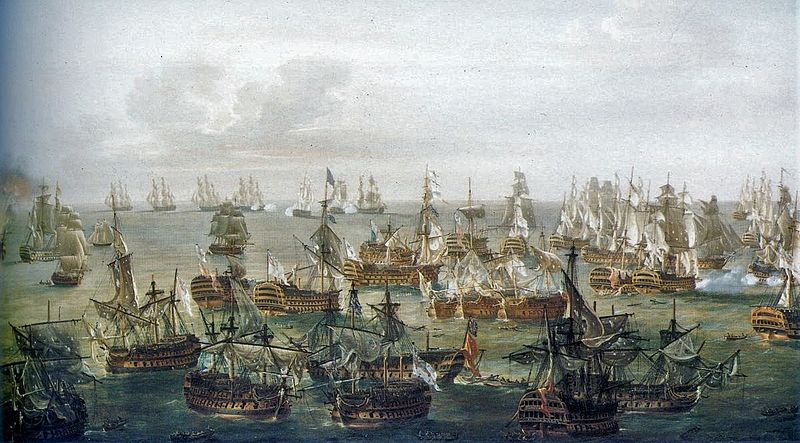
I didn't even know of this flag's existence before today, but I can't argue about its value.

The only surviving Union Jack from the Battle of Trafalgar yesterday sold for a staggering world record of £384,000 [over US $638,000] - nearly 40 times its estimate.

The huge flag, that is littered with holes from shot damage and still has a whiff of gunpowder, flew from the jackstaff of HMS Spartiate at the historic battle 204 years ago.


After the victory over Napoleon's French army, the crew lowered the flag and presented it to Lieutenant James Clephan for his outstanding performance.

Lieutenant Clephan was hugely respected among his men as he was one of only 16 out of 300,000 sailors who were press-ganged into the Royal Navy to rise through the ranks.

The 11ft by 7ft flag remained in his family after his death and was kept in a darkened draw[er] to help preserve it.

His descendants decided to sell it after emigrating to Australia and it was given a pre-sale estimate of just £10,000.

But when it went under the hammer at auction in London today - Trafalgar Day - it was immediately met with fierce bidding, both in the room and from buyers around the world on the phone and internet.

The gavel eventually came down on an anonymous collector's bid of £320,000.

With the 20 per cent buyer's premium paid on top, the total paid for it is £384,000.

This is believed to be a world record for any such Union Jack sold before.

It is not yet clear if the flag will remain in Britain or go abroad.

A spokesman for Charles Miller Auctions, who sold the standard, said: 'We are hugely delighted and thrilled with the price, as are James Clephan's family.

'It is way above anyone's expectations but does reflect the historical importance of the flag and the battle it fluttered in 204 years ago today.'

The flag was made from 31 bunting panels by the crew of HMS Spartiate, which was the last ship in line behind Nelson's HMS Victory as they took on the French at Trafalgar.


Spartiate was actually a French ship but was seized by the British at the Battle of the Nile in 1798.

[One of] Its lieutenant[s] was James Clephan, from Fife in Scotland. He was pressed into the navy 1794 aged 26 and excelled as a seaman.

He was made a midshipman in 1801 and rose to lieutenant later that year for distinguishing himself in the successful capture of the French ship Chevrette.

After Trafalgar he was immediately promoted to first lieutenant and by the time his career in the navy finished he was captain of his own ship.

Mr Miller said: 'The flag is one of the most important, historical items any collector could expect to handle.

'The damage is probably from bullet holes or splinter fragments, but despite all this it is in amazing condition.

'You can still even detect the smell that is ingrained within it.'


There's much more at the link, including a brief biography of Lt. Clephan, one of only a handful of 'pressed men' who rose to officers rank during the Napoleonic Wars, and later to command a warship. Recommended reading.

For historical reasons, I hope the flag stays in England. That 'green and pleasant land' may have degenerated into a Socialist hell-hole, but there are enough Churchillian and Nelsonian Englishmen left there to value such reminders of their nation's once-glorious past.

Peter

Whale foreskin leather seats??? Now that's an SUV!


I have to admit, this is over-the-top, even for the conspicuous-consumption set!

This is the world's most expensive SUV - but with three bottles of the world's most expensive vodka included in the price tag, it actually appears to be a bargain.


The £1 million Dartz Prombron Monaco Red Diamond Edition has gold-plated windows, pure tungsten exhausts, and the speed gauges are encrusted in diamonds.

The seats are not for the squeamish. They are made of one of the softest materials around - leather from a whale's penis.

And, just to send the bling factor right through the roof, this SUV also comes complete with an exterior bulletproof Kevlar coating.


But that's nothing compared to the vodka that comes with it.

The car company has thrown three bottles of Russo-Baltique, the vodka brand it created this year to mark its 100th anniversary, Motor Authority reported.

Last year, a bottle retailed for £790,000. It is not a meant to be drunk, the company's website explains - instead it should be displayed as art.

That's because the bling of the bottle frankly puts the SUV to shame.

According to the Dartz company's website, the flask, a replica of the radiator guard used for the Russo-Baltique cars, is made from gold coins minted between 1908 and 1912. This is around the time the company manufactured its first car.

The flask cap is made from white and yellow gold and contains a diamond-encrusted replica of the Russian Imperial Eagle.

And finally, the bottle itself is made of bulletproof glass 30cm thick - just in case.

The car - and vodka - were produced especially for the mega-exclusive Top Marques luxury motor show in Monaco next year.

The car is made by the company that produced armoured vehicles for Vladimir Lenin, Leon Trotsky, and Tsar Nicolas.


The seats are indeed of 'real whale penis leather,' says a spokesperson for Dartz Kombat.

'It is inspired by the original playboy Aristotle Onassis' yacht Christina O, which had bar stool seats made from sperm whale foreskin.

'Some people have called us crazy because of this, but we think we must make a luxury car till the end.'

Weighing four tons and powered by a V8 engine capable of 450 horse power, the Pombron's maker also claim the car is 'rocket grenade proof'.

'In the past our customers have included Lenin and his revolutionary partner Trotsky,' explains the Dartz spokesperson.

'In fact we are launching a version of this new model in 2012, just for Latin America.

'This will commemorate the fact that Trotsky was killed in Mexico with an ice pick in 1940.

'As such, the Latin version will come with a gold ice axe to mark this fact.'


There's more at the link. Further details may also be found at the manufacturer's Web site.

Dartz has placed this video compilation on YouTube, purporting to show the company's roots in pre-revolutionary Russia (although no satisfactory explanation is given for the ninety-odd-year hiatus in its history . . . I suspect the 'brand name' has been revived by one of the post-Soviet Russian oligarchs looking to make money out of it!).


At those stratospheric prices, I suspect I'll pass - whale-foreskin-leather-covered seats notwithstanding!

(And just where did they find the whale rabbi to provide those???)


Peter

A good idea!


I actually hate to have to say this is a good idea, because saying so speaks volumes about our society . . . but that doesn't make it less true.

A lipgloss that doubles as an anti-rape device has gone on sale to protect women from drink-spiking.

The 2LoveMyLips concept was today welcomed by campaigners trying to prevent 'date-rape'.

The lipgloss, which will cost £9.99 [about US $16.60], comes with special test strips which turn blue immediately when signs of substances such as GHB or ketamine are present.

Businesswoman Tracy Whittaker and partner Tina Dutton created the product and are in discussions with Boots and Tesco.

Ms Whittaker said: 'If a drink tastes funny, or you are suspicious, you dab the ends of the taper into your drink and, if they turn blue, tell your friends immediately and get help from security and the police — it’s that simple.'


There's more at the link.

Drink-spiking, whether or not it leads to anything worse, is endemic in college towns and other 'night life' spots. As a pastor, I had to deal with many young folks who ran head-on into it. I hope this new product will help spread awareness of the problem, and assist victims to seek help before they lose consciousness - and perhaps end up in a situation they'd rather avoid.

The manufacturer's Web site is here. Readers with teenage kids might want to take note of the details, and look for it at local outlets or online.

Peter

Wednesday, October 21, 2009

To protect and serve - until we win!


It seems a police unit in Hungary has something on its mind other than public service.

A town's entire police force has quit in Hungary after winning more than £10 million [over US $16.4 million] in the lottery.

The 15-strong squad in Budaors scooped the jackpot with their ticket on Tuesday and all resigned on the spot.

Police chiefs have scrambled back-up units to the region until more full-time officers can be recruited.


Of course, given that the winnings are probably the equivalent of more than ten years' salary for each of them, I daresay most of us would have done likewise!


Peter