Thursday, June 8, 2023

The food shortages continue...


I'm no longer posting as much about food shortages and other major dangers facing us, partly because many people have simply "tuned out" the subject and don't want to hear any more about it, partly because those who recognize the danger have already at least started to do something to prepare for it.  Nevertheless, it's worth repeating the warning that it's getting worse.

I placed an order with our local butcher last week for a large quantity of brats, made with a South African seasoning recipe.  (His rates for a special order like that are very reasonable, less than two-thirds of his normal retail price.)  This is a butcher with local access to meat, and an extensive operation:  yet, a week after my order, it still isn't complete, because he can't get the right mix of meat in stock to grind it all up and make the brats.  That's partly due to private individuals, like my wife and I, placing orders with his supplier for a quarter, or half, or full cow;  but it's also due to local farmers and ranchers having reduced their herds so sharply over the past year (thanks to drought, and feed and fertilizer costs) that the local slaughterhouse can't get enough meat to handle the demand for it.  That's the first time I've known them to be low on stocks.  It probably won't be the last.  This summer is likely to see much higher prices for beef than before, and pork and other meats are following right along behind them.

Locally sourced vegetables are also in short supply.  That's partly because fertilizer costs are up, and labor costs too;  many people simply don't want the hard physical work involved in raising, harvesting and selling fruit and vegetables.  As a result of these pressures, prices are going up.  We've joined a "community supported agriculture" (CSA) operation, and are paying $20 per week for a mixed box of vegetables and fruit.  I had thought that was a relatively expensive option, but looking at regular vegetable prices in local supermarkets, it no longer appears unreasonable at all.  Most of the latter appear to be sourced from big commercial operations far away, ripened in warehouses and trucked all over the country.  Their quality often leaves something to be desired.

These issues are confirming, yet again, the wisdom of being as prepared as possible for food shortages, whether short- or long-term.  If one can do without the latest, greatest, freshest food, canned or frozen food is a perfectly viable alternative, and may be the only source of supply for some staples.  Other basic needs may also run short, as we've seen all too often over the past couple of years, and deserve attention in our emergency preparations.

As Commander Zero pointed out yesterday, "you can’t control what happens, you can only control your response to what happens".  Go read his words of wisdom.  They're worth your time.

Peter


Distracted driving - nautical edition


Once again, someone uses a cellphone instead of concentrating on their job, and havoc results.


A ship operator, distracted from his lookout while texting on his phone, caused his ship to crash into another, resulting in damages of over $12 million to both ships.

Bunun Queen, a 590-foot-long bulk carrier, collided with Thunder, a 250-foot-long supply vessel, off the coast of Louisiana on July 23. And it was all because of a distracted ship operator, a report by the National Transportation Safety Board revealed on May 22. 

Minutes before the crash, the operator on watch was using his cell phone to make a "personal call," the report stated. The Bunun Queen was heading to the Gulf of Mexico when the crash occurred. 

"The call lasted about a minute; after that, the master used voice dictation on his phone to send multiple text messages, all of which were personal in nature," per the NTSB's report. 

The regulator added that while the operator was preoccupied with his phone, the other members of his team had gone to the ship's mess to have lunch. 

By the time the crew was alerted to the incoming Thunder vessel, it was too late to steer clear of it, resulting in a collision, per the NTSB.

. . .

Bunun Queen racked up damages worth $680,000, while operators of Thunder had to fork out $11.6 million  in repair costs. 

The collision happened "​in good visibility, daylight and fair-weather conditions," the report said.


There's more at the link.

I suppose there's no surprise that the crewman became distracted, or just plain didn't bother to do his job.  Back in my dim and distant past, I volunteered for South Africa's National Sea Rescue Institute, and also had maritime connections through my service in the South African Defense Force.  Almost every time there was a marine accident, somebody somewhere proved to have been preoccupied with something other than their job, and the distraction led to the incident.

I lost count of the number of small craft sailors I heard about who got into difficulty, saw a passing ship, and signaled for help (using radio, flares, flags, and anything else that might be seen by the other vessel) - only to see it sail onward into the distance, unheeding and uncaring.  In many cases, subsequent flypasts by a maritime patrol aircraft revealed nobody on the bridge at all.  The ship was being steered by autopilot, with its radar set to sound an alarm if another vessel came within five miles or so, at which time (hopefully) someone would do something about it.  If your vessel was too small to trigger the alarm . . . sucked to be you.

In a busy traffic lane such as the Mississippi Delta and surrounding seas, I'd have expected any professional seaman to be a lot more attentive to his job, because the number of vessels in the area (not to mention oil and gas platforms, fishing boats, etc.) warrants such care.  Clearly, my expectations would have been wrong . . .

Peter


An eye for an eye in early colonial times


I was sent a link to the story of Hannah Duston, a Massachusetts pioneer, and her adventures in 1697.  I'd never heard of her before.


Hannah Duston was the first American woman to have a statue built in her honor, in 1874. Today, what she did to deserve it might be called, by some, a monument to an atrocity. What did Hannah do? Hannah scalped the ten Indians who had attacked her farm, dragged her from her bed, and burned her house down before taking her captive and killing her six-day-old infant.

. . .

And what of the revulsion one might feel at handling a dead human in this way? Had Hannah’s life prepared her for that? She was certainly used to wringing chickens’ necks, helping with the slaughter of cows and pigs. Further, she must have been rather angry when she scalped the ten Abenaki Indians who had recently been her captors. They had, after all, attacked her farm, dragged her from her bed, and burned her house. They had taken her captive, and almost immediately killed her week-old infant by bashing the infant’s head against a tree because the baby was crying. Having taken her captive, the Abenaki Indians forced Hannah and her aunt Mary to walk many miles north in March while wearing only their nightclothes. And, for all she knew, the rest of her family was dead.

. . .

Hannah and Mary were parceled out to a group whose eventual destination, Hannah was able to determine, was a place called St. Francis in Canada. This smaller group consisted of two warriors, three adult women, and seven children ... Before the band of Indians and captives set out on the next leg of their journey, it was apparently here that Hannah saw her only chance to escape. She observed that, while on the island. her captors had let down their guard and had grown careless. In Hannah’s words later, she reasoned that the Indians believed that the two women were too weak to attempt an escape, especially on an island with the river in flood. Guards were no longer posted at night. Hannah determined that, with Samuel and Mary, she might overwhelm the small band of Indians, particularly if there was added the element of surprise. She related later that she persuaded Samuel to ask Bampico, the only Indian of the party whose name is known, how he killed the English quickly. Bampico pointed to the temple of his head and stated how to strike quickly and kill the victim.

Hannah’s plan was simple, she related later. At night, when the Indians were asleep, she and Mary and Samuel, having hidden some hatchets earlier, would position themselves at the heads of two of the Indians. At the signal from Hannah, they would begin the attack. Only one Indian was to be spared, a young boy. Hannah decided to take him back to Haverhill with her if she could make it back to her home.

It was very late on the night of the 30th March 1697. With only the light from two fires and the Moon, Hannah, Mary, and Samuel stood ready to strike. The sound of the rushing river made for a good cover, and then, at Hannah’s signal, the three captives struck their opponents by sharply bringing the blades down into the temples on the sides of their heads. Suddenly, Hannah related later, all was confusion. After the first blows, Mary and Samuel did not continue to dispatch the Indians; it was Hannah who raised her hatchet again and again. When she was done, and all of the Indians were still, Hannah paused, out of breath, covered in blood.

. . .

Hannah gathered up what food was at hand, and told Mary and Samuel to dress in Indian clothes. She took her bloody hatchet and her dead captor’s flintlock rifle and carried all this to the bank of the Merrimack River, where she packed one of the Indians’ canoes and scuttled the others. Hannah related that they were moving away from the island when she suddenly stopped rowing, turned the canoe around, and returned to the island, leaving Samuel and Mary at the edge of the river in the canoe. Thinking about what the Indians did to her six-day-old infant daughter, Martha, Hannah went back to the scene of the bloodbath, took a knife she found among the belongings of the camp and scalped all ten of the Indians, including six children. Then she found the large piece of cloth that had been taken from her loom in Haverhill and wrapped the ten scalps into the cloth. In the river, she washed her hands, the hatchet, and the knife, and got back into the canoe for the journey south; they traveled only at night to avoid detection and capture.

With Mary and Samuel, Hannah reached Haverhill several days later. Her husband and children were overjoyed to find her and Mary alive. Hannah related the story of Martha’s death, and of her journey with the Abenakis, and she displayed the contents of the bloody cloth. A few weeks later, Hannah, Mary, Samuel, and Thomas traveled to Boston, where they petitioned the General Court for money for the scalps.

. . .

In the Haverhill Historical Society, one can find, in a glass case, the hatchet, the knife, the bloody loom cloth, and a teapot belonging to Hannah. On the walls behind glass are Hannah’s Confession of Faith, and Cotton Mather’s description of Hannah’s capture, escape, and the killing and scalping of the Indians.


There's more at the link.  It's worth reading her story in full.

It was a savage time, and it produced some pretty savage people.  I'm willing to bet that after she returned safely from her ordeal, there weren't many people who would have given her a hard time about anything, ever again, for fear of the potential consequences!


Peter


Wednesday, June 7, 2023

Corn on the cob - a useful tip


On Gab, user BarbC writes:


Saw some folks asking about freezing corn on the cob. Here is the way I've been doing it for many years, after a long time old farmer told me how to get the best tasting frozen corn.

Peel away a few of the outer layers of shuck skins. Trim each end of the cob (see mine in pic). DO NOT blanch the corn. Put the corn straight into freezer bags or vacuum seal them, and freeze.

When you're ready to eat it, put it under running water & remove the shucks & silks. Then boil it for approx 15 minutes. You can also steam it, put on the grill in the shuck wrapped in aluminum foil or even microwave it.

Perfect corn on the cob!! It will taste like fresh picked. I've been doing it this way for many years & its never been soggy or gummy. Please just try it.


That looks like a really useful tip.  I'm going to try it.

Peter


A First World problem causes a Third World problem, and vice versa


This report from the BBC caught my eye.


The recruitment of nurses by high-income countries from poorer nations is "out of control", according to the head of one of the world's biggest nursing groups.

The comments come as the BBC finds evidence of how Ghana's health system is struggling due to the "brain-drain".

Many specialist nurses have left the West African country for better paid jobs overseas.

In 2022 more than 1,200 Ghanaian nurses joined the UK's nursing register.

This comes as the National Health Service (NHS) increasingly relies on staff from non-EU countries to fill vacancies.

Although the UK says active recruitment in Ghana is not allowed, social media means nurses can easily see the vacancies available in NHS trusts. They can then apply for those jobs directly. Ghana's dire economic situation acts as a big push factor.

Howard Catton from the International Council of Nurses (ICN) is concerned about the scale of the numbers leaving countries like Ghana.

"My sense is that the situation currently is out of control," he told the BBC.

"We have intense recruitment taking place mainly driven by six or seven high-income countries but with recruitment from countries which are some of the weakest and most vulnerable which can ill-afford to lose their nurses."

The head of nursing at Greater Accra Regional Hospital, Gifty Aryee, told the BBC her Intensive Care Unit alone had lost 20 nurses to the UK and US in the last six months - with grave implications.

"Care is affected as we are not able to take any more patients. There are delays and it costs more in mortality - patients die," she said.

She added that seriously ill patients often had to be held for longer in the emergency department due to the nursing shortages.

One nurse in the hospital estimated that half of those she had graduated with had left the country - and she wanted to join them.


There's more at the link.

That report was about nurses;  but one could find similar reports about almost every skilled profession in Third World countries.  To many students there, a professional qualification is a ticket to a better life in a First World nation, and they pursue it avidly.  Across the Third World as a whole, I doubt whether even one in three professionals - medical personnel, engineers, architects, computer specialists, whatever - stay there more than a few years after they qualify.  Their skills are in high demand in other countries that offer a better life, and they'll willingly accept lower wages than local personnel in exchange for an immigration visa and the vastly improved living conditions that go with it.

One can't blame them, of course;  but it's devastating many poorer countries, who simply can't afford to educate their brightest and best students, only to lose them to richer nations who can offer them more.  I know that several countries in Africa now make medical students sign agreements that they'll work for at least a certain number of years in their countries of origin after graduation, or lose their student subsidies and be forced to repay them.  This hasn't stopped the problem:  many of those students simply abscond without bothering to go through emigration formalities, then refuse to pay.  Attempts to coerce them by making their parents co-responsible for repaying study subsidies haven't worked, either, because many of their parents are so poor they can't do so, no matter how much pressure is applied.  (Besides, once established overseas, many professionals bring their family over to join them, nullifying such pressures.)

Even churches face such pressures.  The Catholic Church in the USA can't find enough candidates for the priesthood to meet local demand, so it "imports" priests from India and elsewhere to fill the gaps.  I'd estimate that there are currently at least several hundred of them, if not into four figures worth.

On the receiving end of such emigration, there are problems too.  Cultural differences, work ethos, etc. are very different, making it awkward for new arrivals to fully integrate into their professions here.  There's also the problem that professional standards are often not the same.  What might be acceptable treatment, or management practices, or whatever, in the Third World may not be at all appropriate in the First.  I've heard several complaints about foreign doctors from Americans that I'm pretty sure amounted to not much more than cultural differences.  Being an immigrant myself, I could perhaps weigh up the nuances better than those born and raised here.

There's no real answer to the problem.  It's been in progress for a long time, and as long as the First World is richer and more comfortable than the Third, it'll continue.  Sadly, that means a lot of Third World nations will continue to lose their brightest and best citizens to countries that can offer them more, leaving the rest of their citizens to cope with shortages and an infrastructure that's breaking down under the "brain drain".

Peter


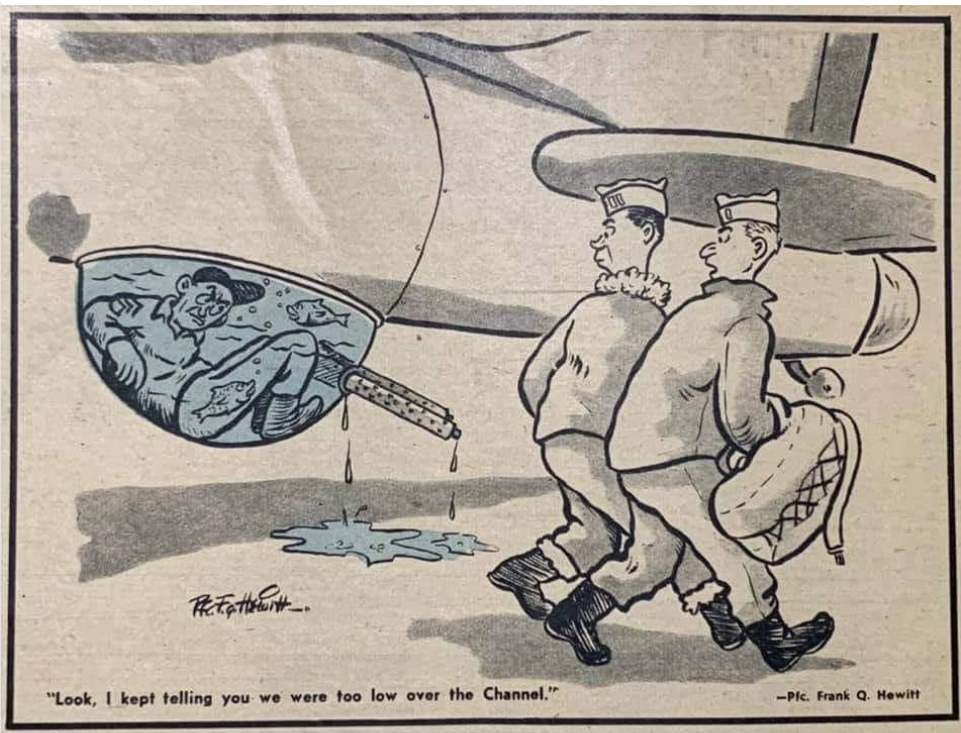
Heh - D-day edition


As you know, yesterday was the anniversary of the D-Day landings in 1944.  On MeWe, user Dave Annis posted this cartoon from the invasion period.  Clickit to biggit.


My father would have laughed out loud at that one (having been an engineer officer in the Royal Air Force at the time).


Peter


Tuesday, June 6, 2023

This one's for Old NFO


Shamelessly stolen borrowed from Bustednuckles:


Peter


Lest we forget


D-day, 1944.


We remember those who gave their lives for freedom on that day.

Peter


A few more thoughts on emergency preparedness


I've had a lot to say in the past about preparing for emergencies (see the sidebar).  With the rapidly deteriorating situation in the USA (economy in tatters, a mass invasion by illegal aliens aided and abetted by the present administration, surging crime figures, food shortages, etc.), I've been paying more attention to what is needful, and also answering questions from some of my correspondents.  I thought you might like to hear about some of the topics of recent discussion.

First, emergency lighting.  We've spoken about the advantages (huge!) of modern LED lights, be they flashlights, headlamps or small lanterns.  I can't recommend too highly that you stock up a few of each, along with batteries for them.  However, in the event of a genuine grid-down emergency or supply shortage, batteries are going to be few and far between.  I suggest working out how many batteries of each size (AA, AAA, C or D cells, etc.) you need to fill every one of your battery-powered appliances, then multiply that by 10 to arrive at a minimum - I stress, MINIMUM - reserve supply for them.  Bear in mind, too, that many batteries are now made in China to far lower quality levels than was the case in the past.  (Example:  Duracell batteries are now not reliable to store for more than one to two years at most.  I find I have to toss all my reserve Duracell packs after that time, because they're oxidizing and their filling is oozing out all over the place.)  Try to find reliable batteries that will last in medium- to long-term storage.  Even those I'd replace after 5 years, just on principle.

Some point out that rechargeable batteries are more economical overall.  I agree - but how are you going to charge them?  If the power is out, you'll have to rely on generators and/or solar chargers;  and fuel for the generators is likely to be expensive and/or in short supply.  I have a few rechargeables (Eneloop is the only brand I trust for long-term reliability at this point), and would like more, but we're on a tight budget (as I'm sure are many of my readers).  What's nice may not be what's affordable.

That brings us to a very economical emergency lighting alternative for domestic and camping use:  candles.  Be very cautious about what you buy here.  Many of the emergency candles offered online are made of cheap paraffin wax, and won't burn for more than 5-6 hours.  You can get tea lights for much less per item, that last just as long if not longer.  Here's an example.


48 household candles, 6 hour burn time:  $27.60 ($0.58 per candle).

200 tea lights, 8 hour burn time:  $29.52 ($0.15 per tea light).


So, for the price of one candle burning for 6 hours, you can buy 4 tea lights that will burn collectively for 32 hours.  Quite a difference in cost per light, no?  Candle holders for tea lights are relatively cheap (I've bought some of these), certainly much cheaper than an equivalent number of candlesticks.  You can stand them on tables, mantlepieces, etc. and get just as much use out of them as you would out of a larger candle.  They also make great fire lighters:  simply save them once they burn down to about half an hour's life left, then light one or two in the fireplace and cover with kindling and wood.  It'll burn up a treat, even if your kindling and/or wood isn't completely dry (just reasonably so).

One area where bigger candles really are useful is in windproof camping lanterns.  One caution here:  candles made of paraffin wax tend to melt it all over the place, making a mess and sometimes causing difficulty in putting in a new candle.  It's hard to scrape that stuff out of confined spaces.  I have a couple of these candle lanterns, and I spent extra to get their beeswax candles rather than the cheaper paraffin wax ones.  Much less mess, much less fuss, and easy to stand somewhere or hang from a support;  and I can carry them around outside if necessary without the wind blowing them out.  They also make a three-candle version that can take the edge off really cold temperatures in a tent or shed or small room.

(A lot of people aren't happy about the fire risk that comes with using open flames.  Yes, there is that risk.  It's real, and it can kill you.  On the other hand, there may be no alternative.  One just has to exercise due care and attention, and not get careless.  That's the way it is.)

(Oh - and don't forget to lay in a supply of matches!)

Next, cutting and chopping gear.  I've spoken before about how the machete is ubiquitous in Africa, far more common than the axe or hatchet.  In North America, it's often the other way around, with axes and hatchets (and, to a certain extent, tomahawks) preferred by many.  There are also so-called "camp knives", 10" to 12" long, fairly heavy in the blade, able to cut small twigs and branches or be batoned through larger ones.  A number of correspondents have been discussing this with me.  They can't decide which tool is best as a "one-size-fits-all" solution.  Frankly, neither can I.

My own experience is heavily in favor of machetes - but not the light, flimsy variety you see offered at gardening stores or Harbor Freight.  I'm used to the heavier-duty African variety, which weigh as much as an axe, and are made from much thicker, stronger metal (as we've discussed in these pages before).  I find them every bit as useful as a small camping hatchet for preparing firewood.  Therefore, if I want to carry an axe, I'll generally go for a larger one, something like a felling axe or a carpenter's axe.  I find most tomahawks are too light and flimsy for sustained use to chop wood or perform other camping duties, and many are over-priced for what you get.  Still, some are stronger than others, and therefore may stand up to the beating an axe has to take.  So far, the only one I've liked enough to buy is Cold Steel's Recon Hawk, which has been well received by customers.  I've added some hockey tape and silicone grip tape to the handle, to make it more user-friendly.  I'm still experimenting with it, but so far, so good.

As for the so-called "camp knives", they tend to be neither fish nor fowl.  They're mostly too big to be used to skin game or prepare food, but too small to serve as a really useful machete.  As for those who insist they'll be great for self-defense . . . guys, think twice about that.  Few if any such knives have cross-guards or quillons to protect your hand against an enemy's blade as you parry it.  If you stop his knife from reaching your body, but its blade slides down yours and amputates a couple of your fingers, you haven't achieved much, have you?

That said, there are some pretty useful camp blades out there.  I own and/or have tested the following, and can thus recommend them from personal experience.  (There are, of course, many others that may be just as good or better;  YMMV.)


Kershaw 10" camp knife ($55)

Ontario bowie knife ($52)

Flissa bolo machete ($30)

Ka-Bar kukri machete ($76)

CRKT Chanceinhell machete ($48)


Any or all of the above will serve you well.  If you're on a tight budget, the Flissa bolo machete is outstanding value for money, IMHO.  The Ka-Bar is good, but I think over-priced;  they're trading on their brand name.

I hope some of this discussion has been useful for you.  I'll bring up the topic again in future posts.

Peter


Monday, June 5, 2023

They taught their kids properly back then


A friend sent me a link to an article titled "Return of the One Room Schoolhouse".  I found it very interesting, particularly because it gave examples of eighth grade final examinations from 1895.  I doubt most of our modern schoolchildren could pass them - in fact, I think most of us adults would have a hard time with them too!

Here, for example, is the Geography exam.


Geography (Time, one hour)

1. What is climate? Upon what does climate depend?

2. How do you account for the extremes of climate in Kansas?

3. Of what use are rivers? Of what use is the ocean?

4. Describe the mountains of N.A.

5. Name and describe the following: Monrovia, Odessa, Denver, Manitoba, Hecla, Yukon, St. Helena, Juan Fernandez, Aspinwall and Orinoco.

6. Name and locate the principal trade centers of the U.S.

7. Name all the republics of Europe and give capital of each.

8. Why is the Atlantic Coast colder than the Pacific in the same latitude?

9. Describe the process by which the water of the ocean returns to the sources of rivers.

10. Describe the movements of the earth. Give inclination of the earth.


All that in one hour?  I'd be very hard pressed to answer that many questions, concisely enough, in that time limit.

Click over to the article to look at the examinations for English, arithmetic and other subjects.  They're interesting and thought-provoking.  Why are modern children taught so much less factually, and so much more about irrelevant, touchy-feely subjects that will do nothing to help them as adults?

Peter


Curiouser and curiouser...


A boat accident on Lake Maggiore in Italy is raising a whole lot of eyebrows.


The story of a boat that sank on Lake Maggiore on 28 May has elements of a spy novel.

Four people tragically drowned on the picturesque and popular lake south of the Swiss Alps.

One was a former agent from Israel's spy agency Mossad, two were Italian intelligence officers and the fourth victim was a Russian woman.

They were among 23 people aboard the small boat that set out to cruise the lake.

. . .

While some reports say the boat ride was an innocent pleasure trip, several major Italian news outlets are reporting that it was a secret work meeting between Italian and Israeli agents.

There is huge interest in the accident and public prosecutor Carlo Nocerino has been tasked with finding out what happened. He says 13 of those on board were Italian agents and eight were Israeli agents. Only the captain, Claudio Carminati, and his Russian wife did not work in intelligence.

. . .

One other aspect to the mystery is that, according to Italian media, the survivors of the disaster seemingly rushed to leave immediately afterwards.

The Italian press reports that the survivors quickly collected their belongings from their hotel rooms and from the hospital where they had received treatment and left.

There is no paperwork about those who received medical treatment.

The Israelis abandoned their rental cars and on Monday they were flown back home on an Israeli plane that picked them up in Milan.

. . .

Of course, with so much of the story remaining uncertain, speculation is likely to continue.

The Carabinieri, Italy's military police, are assisting the investigation. They told the BBC it would examine the boat and the weather conditions - but not what the people were doing on board.


There's more at the link.

At least the FBI isn't part of the investigation.  They'd probably blame the Proud Boys for everything, then allege that the whole thing was masterminded by President Trump to further blacken Hunter Biden's name (as if it were even possible to blacken it any further by this point...).


Peter


Memes that made me laugh 162


Gathered from around the Internet over the past week.  Click any image for a larger view.


Sunday, June 4, 2023

Sunday morning music


Let's have a bit of rock history this Sunday.  How many of you recognize, or remember, this song from 1969?


Yes, it's from what's arguably the first ever "rock opera", by The Who:  "Tommy".  Fifty-four years later, it remains a classic of its kind.  You can read all about it at the link above.

Here's a one-hour live rendition of the rock opera, performed by The Who during their US concert tour in 1989.


It's still a pretty amazing piece of music, considering when it was composed and the then-current state of hard rock.

Peter


Saturday, June 3, 2023

Saturday Snippet: What led to the Russian Revolution


Historian Antony Beevor is renowned for his in-depth investigation of events in the light of modern research and information that often supersedes earlier efforts.  His monumental work, "Russia: Revolution and Civil War, 1917-1921" is extraordinary in the amount of detail it provides, and the depth of its coverage of that period.


I'd read about the Russian Revolution before, but I'd never realized just how bad conditions in that country were prior to the Revolution - in other words, what made Russia such fertile ground for a popular uprising.  The Foreword and first chapter of Beevor's book paint a truly ghastly picture of a nation on the point of implosion, a situation that simply could not continue without a gargantuan upheaval to break free of the existing catastrophe, even if it meant replacing it with a new and greater one.

Here's the opening of the book.  It's not for sensitive readers.


FOREWORD

In January 1902, the Duke of Marlborough wrote to his first cousin Winston Churchill, describing a court ball he had attended in St Petersburg. Marlborough was astonished by the anachronistic grandeur in which the Tsar of All the Russias appeared to be trapped. He described Nicholas II as a ‘nice and amiable man who tries to play the proper part of an autocrat’.

The reception was worthy of Versailles in all its ostentatious glory. ‘Supper was served for nearly three thousand people. The effect of this spectacle of so many people sitting down at the same time is difficult to describe. The scale on which it is carried out can only be estimated when I remind you that there were some two thousand servants in all to wait upon the guests, including Cossacks, Mamelukes and runners [footmen] like those we have heard of in eighteenth century England with huge ostrich-feather hats on their heads. A regimental band is stationed in every room, so as to play the national anthem wherever the Czar may go . . . There was another guard of honour whose duty apparently was to hold their swords at attention for five consecutive hours.’

When Marlborough’s young wife, Consuelo Vanderbilt, asked the Tsar at a subsequent dinner about the possibility of introducing democratic government in Russia, he replied: ‘We are two hundred years behind Europe in the development of our national political institutions. Russia is still more Asiatic than European and must therefore be governed by an autocratic government.’

Marlborough was also struck by the idiosyncrasies of the Guards regiments which dominated the military system. ‘The Grand Duke Vladimir, who is the head of a portion of the army, has the recruits brought up before him. Those men who possess snub noses go into the Pavlovsky Regiment, which was created by the Emperor Paul, who possessed a snub nose.’

Like the court, the Imperial Russian Army was ossified by archaic etiquette, protocol and bureaucracy. Captain Archie Wavell, the future field marshal but then a young officer in the Black Watch, observed when on attachment there just before the First World War that even officers of field rank were afraid of showing initiative. ‘An example of the conservatism of the Russian Army,’ he added, ‘was their custom of invariably carrying the bayonet fixed on the rifle at all times.’ This dated back to an order of Marshal Suvorov in the late eighteenth century after a Russian column was surprised in an ambush and wiped out.

Russian officers regarded it as disgraceful ever to be seen out of uniform. A dragoon captain who quizzed Wavell on the customs of the British Army could not believe that their officers wore civilian clothes off duty and did not carry swords in public. He jumped to his feet, scandalised. ‘But people will not be afraid of you,’ he blurted out. A Tsarist officer had the right to punch any of his soldiers in the face as a summary punishment.

Wavell was not surprised that the Russian intelligentsia regarded their rulers ‘as bureaucratic oppressors; they mistrusted the police and despised the army’. After the humiliating disasters of the Russo–Japanese War of 1904–5 and the massacre of Father Georgy Gapon’s peaceful protest march to the Winter Palace in January 1905, respect for the regime and the armed forces had disintegrated. ‘Russia swung to the left overnight,’ wrote Nadezhda Lokhvitskaya, under her nom de plume of ‘Teffi’. ‘There was unrest among the students, there were strikes among the workers. Even old generals could be heard snorting about the disgraceful way the country was being run and making sharp criticisms of the Tsar himself.’

*

In exchange for its great privileges, the nobility was supposed to provide its sons as officers for the army and the bureaucracy in St Petersburg. The 30,000 landowners were meanwhile expected to maintain order over the countryside through local ‘land captains’.

The liberation of the serfs in 1861 had done little to improve their desperate lot. ‘Our peasantry lives in horrible conditions, lacking properly organised medical care,’ wrote Maksim Gorky. ‘Half of all peasant children die of various diseases before the age of five. Almost all the women in the village suffer from women’s diseases. The villages are rotting with syphilis; the villages have sunk into destitution, ignorance and savagery.’ The women also suffered from the violence of their men, usually when drunk.

Any idea of the sturdy Russian peasant forming part of an irresistible military steamroller was an illusion. Roughly three out of four young peasants were rejected in peacetime on the grounds of ill health. Officers complained of the quality of conscripts arriving during the First World War. In the Second Army, a report stated, ‘It is deplorable and quite common that lower ranks inflict wounds on themselves to avoid combat. There are also a lot of cases of surrendering to the enemy.’ It described them as ‘just ordinary muzhiks . . . They stare in front of them in an indifferent, stupid and gloomy way. They are not in the habit of looking back cheerfully and merrily into their commander’s eyes.’ Evidently, the Russian peasant in uniform adopted the tactic which the British Army used to define as ‘dumb insolence’.

*

Even enlightened members of the gentry and aristocracy feared the ‘dark masses’ and their occasional explosions of terrifying violence, like that of 1773 led by Yemelyan Pugachev. Aleksandr Pushkin described it as ‘Russian revolt, senseless and merciless’. In the wave of unrest and manor-burnings in 1905 which followed the disasters of the Japanese war, the only hope of landowners was to appeal to the local governor to call out troops from one of the many garrison towns.

Karl Marx’s notorious remark in the Communist Manifesto about ‘the idiocy of rural life’, with its implication of credulity, apathy and submission, was also true beyond the peasant village. Small provincial towns could be almost as stultifying. Satirists such as Saltykov-Shchedrin and Gogol peered beneath the murky surface of the stagnant pond. It was Saltykov, ironically a favourite author of Lenin, who also invoked ‘the devastating effect of legalised slavery upon the human psyche’, a phenomenon common to both Tsarist and Soviet eras. Leon Trotsky blamed the mental straitjacket of the Orthodox Church. He argued that revolution could never come until the people broke with ‘the icons and cockroaches’ of Holy Russia.

Attempts at land reform achieved results only in certain areas. Unlike that great magnate of the nineteenth century, Count Dmitry Sheremetev, who owned 1.9 million acres (763,000 hectares) with approximately 300,000 serfs, most estates were small and impoverished. Even if they had wanted to, very few landowners could afford to improve housing conditions or introduce the most basic form of mechanisation. Instead, many were compelled to sell or mortgage their properties. Relations became increasingly artificial and tense. The poorer peasants remained victims of illiteracy, which meant that they were exploited by both village elders and corn merchants, and also mistreated by many landowners, still resentful of their loss of power. As a result, obsequious tenants, bowing to their noble masters, would take any opportunity to cheat them as soon as their backs were turned.

Migration to the cities accelerated the growth of the urban working class, the proletariat which Marxists saw as the vanguard of the revolution. From little more than a million inhabitants at the turn of the century, the population of St Petersburg rose to more than 3 million by the end of 1916. Conditions in factories were appalling and dangerous. Workers were regarded as expendable by the owners since so many peasants were waiting to take their place. There was no right to strike, and no compensation for dismissal. In the case of any dispute, the police always sided with the factory owners. Many saw it as serfdom in the city. The workers slept in galleried barracks, doss-houses and tenements amid squalor and disease. ‘There are no sewage systems in the cities,’ wrote Gorky, ‘there are no flues in factory chimneys; the open ground has been poisoned by the miasma of rotting refuse, the air – by smoke and dust.’ In such overcrowded conditions, tuberculosis and venereal diseases spread alongside occasional epidemics of cholera and typhus. Life expectancy was as low as in the poorest villages. The only freedom lay in the lowest circle of hell inhabited by the lumpen proletariat of the unemployed – a subterranean world of child prostitution, petty theft and drunken fights, an existence worse than anything depicted by Dickens, Hugo or Zola. The only disaster which could make life even worse for the poor in Russia was a major European conflict.

The Suicide of Europe 1912–1916

The pace of industrial growth in Russia before the First World War produced a heady over-confidence among its ruling classes. The disastrous conflict with Japan just under a decade before was forgotten. The war party in St Petersburg became more vociferous, demanding an attack on Turkey after it closed the Dardanelles in 1912. Even the formerly cautious foreign minister, Sergei Sazonov, was outraged at the way Russia had been treated by the German and Austro-Hungarian Empires over the First Balkan War. So, when Vienna issued its ultimatum to Serbia following the assassination in June 1914 of the Archduke Franz Ferdinand in Sarajevo, Sazonov asked the chief of the general staff to prepare the army for war. He told the Tsar that if Russia failed to support its fellow Slavs in Serbia, it would constitute a fatal humiliation. Nicholas II felt obliged to concede to the calls for the first stage of partial mobilisation, but then army commanders insisted that if Russia mobilised against the Austro-Hungarian armies, Russian forces would have to mobilise all along the central and northern fronts against the Germans.

The imperial family’s counsellor and faith healer, Grigory Rasputin, was absent from the capital. That fateful summer, he had returned home to Siberia, where he received news of the rush to war in a telegram from the Tsarina. He set out immediately to send a reply to advise the Tsar to resist the pressure, but a peasant woman waylaid him, stabbing him in the stomach. She was a follower of Iliodor, a former priest who had turned against him, denouncing him as a lecher and a false prophet. Rasputin nearly died and was incapacitated in hospital. When he regained consciousness and heard that mobilisation had been ordered, he insisted on sending the telegram which warned that war would destroy both Russia and the Romanovs. This final chance of persuading the Tsar to stand up against the belligerents all around him arrived too late, but it would probably have made little difference.

The fear of the Russian general staff that the Central Powers could mobilise more rapidly was not the main factor in the escalation to war. That had come from the Austrian determination to crush Serbia before the major European powers could step in. Germany refused to stop them. General Helmuth von Moltke, the chief of the German general staff, even urged the Austrians to ignore any plea for moderation from his own government and push on with their attack. Diplomacy and royal connections stood little chance. War was indeed too important to be left to the generals, as the French prime minister Georges Clemenceau was soon to observe.

*

Once war had been declared, things could only go from bad to worse for the ‘grey mass’ of Russian peasant-soldiers. Altogether 15,300,000 men would be called up into the army and navy. After the defeat at the Battle of Tannenberg and then the infamous ‘Great Retreat’ in 1915, following the German victory of Gorlice-TarnĂłw (just southeast of KrakĂłw), bitterness and suspicion of treason at court set in among officers as well as soldiers. Talk of ‘the German stranglehold’ soon began, partly because so many generals had names of Teutonic or Scandinavian origin. But most cursed the German Tsarina and her camarilla dominated by their Ă©minence grise, Rasputin. The dissolute monk interfered with shameless corruption in appointments once the Tsar unwisely decided to assume the supreme command of the armies at the Stavka, the supreme headquarters in Mogilev.

Trench life for Russian soldiers along the whole front running through the Baltic provinces, Poland, Belarus, Galicia and Romania was an inhuman experience. ‘Having dug themselves into the ground,’ wrote Maksim Gorky, ‘they live in rain and snow, in filth, in cramped conditions; they are being worn out by disease and eaten by vermin; they live like beasts.’ Desperately short of ammunition, many lacked boots and had to resort to bast shoes made from birch bark. Casualty clearing stations at the front were almost as primitive as in the Crimean War.

Attempts to modernise failed disastrously. ‘The most recent technological development has finally reached us,’ Vasily Kravkov, a senior doctor on the staff, wrote bitterly in his diary. ‘That is to say 25,000 gas masks for our corps. They had been tested by the supreme commission chaired by our top “pasha”, the Duke of Oldenburg. I carried out a sort of test by putting gas masks on my medical orderlies. Two minutes later they started to suffocate. And we are supposed to equip everyone in the trenches with that stuff!’

Army censorship departments could have had little illusion about the state of morale at the front on reading soldiers’ letters home. Many complained of being hopelessly outgunned by the German artillery and of the utterly callous attitude of officers towards them. Men were either brutalised or traumatised by what they saw. ‘Corpses are still lying there,’ wrote one in a letter. ‘Ravens have already eaten their eyes and rats are crawling on the bodies. Oh my God, this terrible sight can neither be described or imagined.’

Another wrote about a mass grave which officers had ordered them to dig and fill with their own dead. ‘We collected the bodies from the battlefield, dug a hole that was 30 fathoms long and 4 fathoms deep. We laid them in there, but as it was late, we covered half of the hole with earth and left the other half until the morning. We placed a sentry and it turned out that one of the dead clambered out of the hole at night and was found sitting on the edge of the grave, while some others had been turning, because they hadn’t been killed, just wounded and shocked by explosions of heavy shells. This happens quite often.’

Intense resentment was caused by the contrast in conditions between officers and men. Many officers retired each night to the warmth and relative comfort of peasant izbas behind the front, while their soldiers and sergeants were left in the cold and squalor of the trenches. ‘The ordinary soldier leading the attack for the Motherland is paid 75 kopecks [a month],’ one conscript wrote home. ‘The company commander coming on behind is paid 400 roubles, and the regimental commander who is even further back gets a thousand roubles . . . Some have nice dishes and alcohol and prostitutes under the flag of the Red Cross, while the others are starving.’

The idea that Red Cross nurses were there for the sexual convenience of officers alone was almost obsessive, yet there was a basis of truth. Dr Kravkov, the head of medical services for a whole army corps, recorded how a colleague of his was dismissed. ‘It was very simple. The doctor displayed too much tact and did not succumb to the demands of the headquarters clique to set up a brothel using his nurses . . . This was not unfamiliar to me. I saw this at the Tenth Army and it was one of the reasons for my escape from there.’

Officers offered hard-up women students in Odessa hundreds of roubles for nude pictures of themselves: ‘Please write to me if you are ready to be photographed one more time, with more details,’ wrote one young officer. He then told her that if she visited the regiment she could earn up to a thousand roubles.

While officers cavorted, ordinary soldiers were not allowed to see their wives, even in areas far behind the front. Evdokiya Merkulova, the illiterate young wife of a Cossack in the 9th Independent Don Sotnia did not know the regulations and went to visit her husband in early December 1916. She had the courage to make a formal complaint afterwards about her treatment by his squadron commander. ‘Commander of the sotnia Mikhail Rysakov soon learned about my arrival,’ her dictated testimony ran. ‘I don’t know why, but on 5 December he ordered the sotnia to form up on parade and made me lie face down in front of them. Two Cossacks were ordered to roll up my skirt and undershirt and hold my arms and legs. The commander ordered my husband to whip me fifteen times on my naked body. He personally controlled the execution of the punishment and threatened my husband, saying that the strokes should be applied with full strength, and on the skin rather than clothes. My husband was afraid of his chief and administered bloody strokes that are still healing. I was then sent back across the Don with an escort.’

As cannon-fodder, the peasant-soldier hated the war, the mud, the lice, the bad food and the scurvy. Dr Kravkov despaired of their diet. ‘Another delivery of foodstuffs has arrived, this time from Orenburg,’ he noted in his diary. ‘It consisted of 1,000 poods of hams and sausage, all of it rotten! The whole of our mother Russia is rotting away.’

The rainy season came in October 1916 with a vengeance which disturbed Kravkov. ‘Dr Tolchenov, whom I had dispatched to the positions to investigate the sanitary conditions, gave a hair-raising report on the horrible situation in which our unfortunate soldiers are living: in mud that reaches up to their waist, with no shelter from bad weather, with no warm clothes, hot food or tea.’ Two weeks later he wrote: ‘We received reinforcements, boys that are green behind the ears. They were sent into a bayonet attack on the following day . . . It was a stunning scene when many of them, who did not want to die, cried out in despair: “Mama!”.’ The military authorities suppressed news of mutinies which were ruthlessly put down.

That winter in Petrograd, criticism of the government did not come just from liberals and the Left. Arch-conservatives, such as the politician Vasily Shulgin, were appalled by the irresponsibility of the rich, indifferent to the fact that Russian casualties were running at twice the rate of their German and Austro-Hungarian enemies. ‘And here we are,’ he wrote bitterly, ‘dancing the “last tango” on the breastworks of trenches choked with corpses.’ Shulgin was infuriated by the rumours and conspiracy theories which ran around the capital’s salons, especially the ‘chatter about treason’. He blamed the leader of the Kadet Party, Pavel Milyukov, for his sensational speech when the State Duma reconvened on 1 November. Milyukov’s savage attacks on the Tsar’s ministers astonished those present because he was usually so moderate. Now, he openly denounced ‘occult forces fighting for the benefit of Germany’. To great cheers, after each example of incompetence he hammered in the rhetorical question: ‘And what is this? Stupidity or treason?’

The pervasive corruption in the capital shocked idealistic young officers at the front. ‘Everyone knows that all kinds of swindlers at the establishment of Grand Duchess Maria Pavlovna arrange safe positions in exchange for bribes,’ a young cavalry officer in the Seventh Army wrote to his fiancĂ©e, who wanted to secure a post for him in the rear. ‘But I implore you to not bribe anyone. I want to live and die a nobleman.’

Even firm supporters of the monarchy despaired. The Tsar’s obstinacy stemmed almost entirely from a weak nature. Against all advice, he had insisted on taking over as supreme commander from his cousin, the immensely tall Grand Duke Nikolai Nikolaevich, after the disastrous retreats of 1915. Wavell considered the Grand Duke ‘the handsomest and most impressive man I have ever met. He had no great brain power or book knowledge but was full of common sense and character.’ His nephew, Nicholas II, unfortunately lacked both qualities. ‘Autocracy without an autocrat is a terrible thing,’ observed Shulgin.

One of the main reasons the Tsar immersed himself at the Stavka in Mogilev was that he preferred to be surrounded by loyal officers rather than critical politicians. He left the administration of the country to the Tsarina and Rasputin and resolutely refused to appoint a government of ministers from the Duma. Yet his presence at the Mogilev headquarters remained purely symbolic and his entourage made sure that any tours of the front were carefully managed.

‘General Dolgov’s chief of staff told us at dinner, without a trace of irony, about the preparations for the Tsar’s visit,’ Dr Kravkov noted in his diary. ‘All the soldiers were brought back from the trenches, and the night was spent dressing them in brand-new uniforms and equipment. All the artillery was ordered to open fire at the moment the royal visit began, and as he put it, “a true battle scene was staged”. The Tsar was happy and thanked them all, and our brave warrior was decorated with the St. George’s Cross for his successful staging.’

In that winter of 1916, nobody at Mogilev dared tell the Tsar of the rumours in Petrograd. Revolutionary pamphlets about Rasputin had started to appear, such as ‘The Adventures of Grishka’, hinting at orgies with the Tsarina and even her daughters. These pornographic fantasies were reminiscent of those other caricatures more than a century earlier in Paris against Marie Antoinette and the Princesse de Lamballe. Inevitably, such grotesque stories turned Rasputin, the supposed peasant-debaucher of grandees, into something of a folk hero.

Rasputin’s murder on 17 December by Prince Feliks Yusupov, Grand Duke Dmitry Pavlovich and Vladimir Purishkevich, the leader of the anti-Semitic Black Hundreds, increased the impression of aristocratic corruption in the capital. The idea of Yusupov using his wife Irina, the beautiful niece of the Tsar, as bait for the lecherous monk added a salacious twist to the drama. The public’s imagination was gripped above all by the difficulties the conspirators had in killing Rasputin, with poisoned cakes and several revolver shots, then finally disposing of his huge body through an ice hole below a bridge so that it was not found for two days.

The profound cynicism which developed in the rear created a dangerous apathy. An officer called Fedulenko, back from the front, was invited by his colonel to a lunch. ‘Two Guards officers were sitting next to us,’ he recorded. ‘They began to talk about Rasputin; I was shocked by their talk.’ They repeated gossip about the Tsarina and Rasputin and said that the Tsar was a weakling. ‘As I was returning to Oranienbaum with the colonel afterwards, I asked why such a filthy thing was allowed, why these two young men who were shaming their Emperor had not been stopped. They had been talking in Russian right in front of the servants who could understand them.’ The colonel made a gesture of resignation with his hand. ‘Ah,’ he said. ‘The downfall is already beginning. A horrible time lies ahead.’ Dr Kravkov had no doubts at all. ‘Whatever the outcome of the war, there is going to be a revolution.’


I haven't finished the book yet;  its length and density of information make it something I pick up from time to time, read a chapter or two, then set it aside while I do other things.  I'm learning a lot from it, particularly considering the dire poverty currently existing in many Third World nations.  That's what's driving much of the illegal "emigration" from such nations to the First World;  sheer desperation to live a better life, at almost any cost.  Instead of fomenting revolution at home, those wanting better are trying to find it in other countries - but their sheer numbers are destabilizing those countries in the process, creating conditions ripe for revolution in them, too.

Food for thought.

Peter


Friday, June 2, 2023

Two useful tips for lower-cost defensive handguns


Eaton Rapids Joe points out that Turkish-made handguns - already available in US gun stores at relatively affordable prices under brand names such as Canik, Girsan, SAR, and others - may be cheaper in future thanks to currency exchange rate fluctuations.


The Turkish Lira just experienced a very sharp decline in value relative to other, benchmark currencies like the US Dollar (which isn't doing all that whippy in absolute terms). The big banks looked at the numbers and deduced that Erdogan gamed the economics to the detriment of the long-term, Turkish economy to get re-elected.

The momentum and the reserves of gold and harder currencies is not in Turkey's favor. Nor is the portfolio of products they can offer on the world market and most especially in those markets denominated in hard currencies.

Turkey exports some very competent, very economically priced firearms to the United States.

For example, this article highlights six, very competent handguns currently imported from Turkey.

If you are in the market for a handgun, and you can be a little bit patient, you might find some of these available at very attractive discounts. These are not be the "coolest" handguns, or the lightest, or the easiest to conceal, or the ones that the high-end IDPA or USPSA high-speed-low-drag competitors are using. But they are likely to be exceptionally durable and their extra mass will make them easy for novices to shoot...and to enjoy shooting them.

This may be a strategic opportunity if you have some family members who lack a handgun or shotgun.


There's more at the link.

Furthermore, Commander Zero field-tests a couple of the Glock-compatible (but much lower cost) Dagger pistols from Palmetto State Armory, and finds them impressive.


The Dagger shot very well. No failures of any kind, seemed as accurate as any other Glock, and even fit into the rather snazzy new Safariland 6390RDS ALS Glock holster I picked up.

The Dagger shot as well as the Glock, and fit my hand a little better. I don’t really have any complaint about it. I’d have to put a lot more ammo through one before I would stand on stage and declare it the equal of the Glock or that it was a perfect analog of a Glock. But….a lot of parts do interchange.

What’s the role of it in my world? Well, IF it has the reliability and durability of the Glock, then  it would make a no-brainer choice as a secondary or tertiary backup gun to someone who is invested in Glock logistics. If it takes Glock mags, Glock parts, Glock holsters, Glock sights, and Glock accessories, but is half the price of the Glock, then why wouldn’t you pick up a couple?

PSA has these things on sale…sometimes as a package deal. Let me see if I can find a recent one….Thats a pretty-much-as-good-as-a-Glock pistol and five standard Magpul mags and five happysticks for $370. For perspective, thats approx. $125, dealer price, of mags making the gun itself approx $245. That is a bargain no matter how you look at it.

. . .

I’ll be shooting these things more in the coming weeks, but so far I like what I see.


Again, more at the link.  (PSA has some pretty good deals on AR-15 and AK47 clones as well, and I can verify from personal experience that their quality of manufacture and assembly is usually very good.)

Useful information for those needing a handgun, but hampered by limited funds.  I have enough handguns to last me the rest of my life, but others may not be so fortunate.

Peter


How a Navy pilot got his callsign


Navy pilots are famous notorious for having "meaningful" callsigns, sometimes scatological, usually funny, and often referring to some past incident that was less than professional and/or successful.  One pilot recounts how he got his callsign - an acronym referring to a (very) nasty personal accident.  (Sensitivity alert:  the narrator is merciless in describing his plight, and doesn't mince his words!)


I had been flying night flights every night for the past few weeks up to this point, and it was taking its toll on me. Landing a jet on a carrier at night is truly terrifying. Everything is controlled with your fingertips; the glideslope, the lineup control, and the angle of attack of the aircraft. My legs were shaking after every “trap,” or landing, so I needed my body to be in tip-top shape. That’s why, on this particular night, I was happy to see that it was surf-n-turf night in the wardroom. Steak and lobster usually signifies that bad news is coming, but I was fat, dumb and happy, and ready to eat some good shellfish. 

I scarfed down a tail and a steak, and when I got up to the ready room to brief, I figured: “It’s a late flight, I’ll have myself a cuppa coffee.”

. . .

When we were finished briefing, I began to realize that I had what I lovingly refer to as the “bubble-guts.” I went to the bathroom and got the demons out of me before walking on the jet.  But when I entered the aircraft, the coffee kicked in.

I’ve always had a complex relationship with coffee. I am addicted to the taste. I love it black, or with cream and sugar — whatever. But sometimes it takes its revenge, and tonight was one of those nights. As soon as I sat in the seat I had to pee. Doing this in the jet is fairly easy. Simply pull out an “AIRCREW RELIEF BAG” or “piddle pack” as we call it, do your business into it, roll it up, put it in your bag and go. It has little gel beads that absorb moisture and turn it into a margarita of sorts, and there’s no mess. We lined up for the catapult shot, did our checks, held on tight, and the shot hit hard. As soon as we started accelerating at about three times the force of gravity, I felt something move in me. When I took the controls I immediately had the thought that this might be a long hour and a half.

. . .

I leveled off at 30,000 ft and set autopilot so that the two of us could practice button-pushing while being “heads-down” in the cockpit. As soon as I set the autopilot I had to pee again. Boom, done. Move on. Ten minutes later – pee. At this point my guts started bubbling again. I stopped looking at the displays, put my sweaty hands on the handles on the canopy rail, and tried to sit as still as I could. This was only about half an hour into the flight. I didn’t tell my WSO anything. I pulled out another piddle pack to do my business again, but this time there was another force at play. Just to the south of where I was aiming, a monster was trying to get out. I couldn’t isolate the valves; nothing came out of either. My stomach roiled while I was trying to contract one side and relax the other. Finally I said over the internal communications: “Dude, I think this might be the night. I have the bubble guts and I need you to put your mask on.” A firm “Okay bud do what you need to do” gave me confidence that, while it certainly felt like the end of the world, we were in this together.


There's more at the link.  Go read it for the gory glutinous details - and the callsign that resulted.


Peter


Thursday, June 1, 2023

Spongebob - perhaps not so innocent as he seems?


I was surprised to read Vox Day's comments about rumors that the Spongebob Squarepants children's TV character may have pedophile influences in his background.  It looks like the address on Spongebob's driver's license is located on Little Saint James Island in the American Virgin Islands - the island formerly owned by the infamous sexual predator, Jeffrey Epstein.

I highly recommend clicking over to Vox's blog post and reading it for yourself, then verifying it via Google Maps.  It checks out - at least, it did for me, five minutes ago.

Vox advises:


At this point, all children’s shows need to be considered intrinsically suspect. Just as all media “fact-checks” need to be considered inherently false.


True dat.


Peter


Prophetic words from Václav Havel


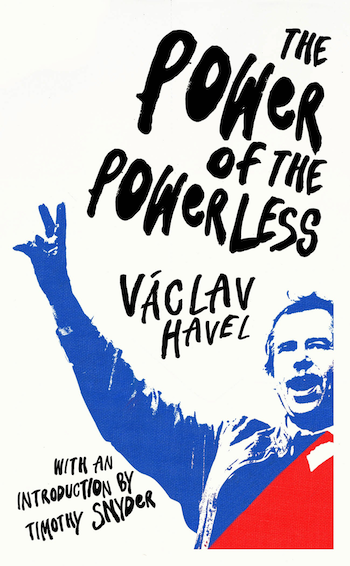
Many readers will recall Václav Havel, a dissident anti-Communist leader who became President of the Czech Republic after the fall of the Soviet Union.  He was widely respected.  He was also a best-selling author, one of whose books was titled "The Power of the Powerless".  Published in 1985, it became a rallying cry for anti-Communist movements throughout the Warsaw Pact, and is regarded to this day as a seminal work of political philosophy.


Wikipedia says of the book:


The essay dissects the nature of communist regimes of the time, life within such a regime, and how by their very nature such regimes can create dissidents of ordinary citizens. The essay goes on to discuss ideas and possible actions by loose communities of individuals linked by a common cause, such as human-rights petition Charter 77.

Officially suppressed, the essay was circulated in samizdat form and translated into multiple languages. It became a manifesto for dissent in Czechoslovakia, Poland, and other communist regimes.


There's more at the link.

Havel's book remains an inspiration to those trapped in an undemocratic, dictatorial society that brooks no dissent.  Since the politically correct forces in the USA are increasingly turning this country in that direction, we can learn a lot from his wisdom.

Andrew Torba, head honcho of the social media network Gab, agrees.


As I read the essay I was captivated by Havel’s description of what it was like to “live within the lie” of the Communist regime in Czechoslovakia. The parallels between his descriptions of the people, the culture, and the political system of his time were all too familiar to what American right wing dissidents are witnessing and experiencing today.

“The post-totalitarian system touches people at every step, but it does so with its ideological gloves on. This is why life in the system is so thoroughly permeated with hypocrisy and lies: government by bureaucracy is called popular government; the working class is enslaved in the name of the working class; the complete degradation of the individual is presented as his or her ultimate liberation; depriving people of information is called making it available; the use of power to manipulate is called the public control of power; and the arbitrary abuse of power is called observing legal code; the repression of culture is called its development; the expansion of imperial influence is presented as support for the oppressed; the lack of free expression becomes the highest form of freedom; farcical elections become the highest form of democracy; banning independent thought becomes the most scientific of world views; military occupation becomes fraternal assistance. Because the regime is captive to its own lies, it must falsify everything.”

Sound familiar?

Havel even accurately describes the phenomena of President Trump and the unfortunate outcome of his attempt to “drain the Swamp,” which ended with him “losing” in a rigged election and becoming a vaccine salesman on behalf of the Swamp itself.

In any case, experience has taught us again and again that this automatism (the Regime) is far more powerful than the will of any individual; and should someone possess a more independent will, he or she must conceal it behind a ritually anonymous mask in order to have an opportunity to enter the power hierarchy at all. And when the individual finally gains a place there and tries to make his or her will felt within it, that automatism, with its enormous inertia, will triumph sooner or later, and either the individual will be ejected by the power structure like a foreign organism, or he or she will be compelled to resign his or her individuality gradually, once again blending with the automatism and becoming its servant, almost indistinguishable from those who preceded him or her and those who will follow.”

Perhaps one of the most stunningly accurate things Havel describes is the Communist society’s utter lack of morality.

The profound crisis of human identity brought on by living within a lie, a crisis which in turn makes such a life possible, certainly possesses a moral dimension as well; it appears, among other things, as a deep moral crisis in society. A person who has been seduced by the consumer value system, whose identity is dissolved in an amalgam of the accoutrements of mass civilization, and who has no roots in the order of being, no sense of responsibility for anything higher than his or her own personal survival, is a demoralized person. The system depends on demoralization, deepens it, is in fact a projection of it into society.

So what is Havel’s solution to this madness?

Not politics. He mentions several times that it’s useless to participate in a rigged political system with fixed outcomes. Instead, he calls for the same thing I am calling for right now: the formation of a parallel systems.

There can be no way around it: no matter how beautiful an alternative political model may be, it can no longer speak to the ‘hidden sphere,’ inspire people and society, call for real political ferment. The real sphere of potential politics in the post-totalitarian system is elsewhere: in the continuing and cruel tension between the complex demands of that system and the aims of life, that is, the elementary need of human beings to live, to a certain extent at least, in harmony with themselves, that is, to live in a bearable way, not to be humiliated by their superiors and officials, not to be continually watched by the police, to be able to express themselves freely, to find an outlet for their creativity, to enjoy legal security, and so on. Anything that touches this field concretely, anything that relates to this fundamental, omnipresent and living tension, will inevitably speak to people.

Abstract projects for an ideal political or economic order do not interest them to anything like the same extent–and rightfully so–not only because everyone knows how little chance they have of succeeding, but also because today people feel that the less political policies are derived from a concrete and human ‘here and now’ and the more they fix their sights on an abstract ‘some day,’ the more easily they can degenerate into new forms of human enslavement.


Again, more at the link.

I have to agree with Mr. Torba.  As our various government structures become increasingly ideologically hidebound to a Left-wing, socialist, even Communist diktat, so we are less and less likely to be able to influence them through elections and other democratic processes.  They ignore our will and seek only to impose their own.  "Government of the people, by the people and for the people" has all but ceased to exist in these United States.

I think Mr. Torba is quite correct to suggest that we draw inspiration from Mr. Havel's wisdom.  If you haven't read "The Power of the Powerless", I highly recommend it.  See also Mr. Havel's life, to learn how he endured under and triumphed over Communist dictatorship in his own country.  I think we can all learn useful lessons from his example.

It's also worth reading Mr. Torba's ideas about setting up parallel institutions, as he's discussed on Gab from time to time.  If we refuse to participate in the structures set up to control us, and instead "vote with our feet" by supporting people and businesses and entities that share our values, we proclaim our independence every day.  That's well worth doing.

Peter


Errrr... oops?


It's all very well to tow a stuck vehicle back onto the road . . . provided that other road-users can see what's going on, and avoid problems.

Cyclists tend to keep their heads down, rather than up and looking around.  This becomes a problem.  Twitter user AnarchyDreams shows us how.  Click over there and see for yourself.

Errrr... oops?


Peter