Friday, December 5, 2008

A whole new level of conspicuous consumption


Following my plea for those caught up in recession (see the post below this one), I'm rather sickened to read about the conspicuous consumption of cellphones.

To me, a cellphone is a utility item. I carry one when traveling, for the sake of keeping in touch with my friends, and for use in emergency. The cheapest one available is fine. I don't need bells and whistles. That's even more the case when I reflect that the technology changes so fast that whatever I buy today will be obsolete in two to three years time, and will have to be replaced.

However, that clearly hasn't stopped some folks with more money than sense from investing in 'jewelry-grade' cellphones. I can't believe that they spend this much money on something that'll have to be replaced so soon . . . but then, maybe I'm not used to moving at such rarefied levels of affluence.

Here's the Tag Heuer Meridiist, priced at a mere $3,900:


At a similar price level, there's the entry-level Vertu phone:


This one can get much, much more expensive, though, as we'll see later on.

Moving up-market, there's the Dior, a snip at $22,000 or so:


Starting at $23,500 and running all the way up to about $150,000, we have the Swiss-made Goldvish:


And then we come to the ne plus ultra of them all, the Nokia-based Vertu, heavily embellished by Boucheron in Paris. There are several models available. Prices range all the way up to a staggering $1.5 million or so for this one:


I was tempted to post this article as another in the 'Doofus Of The Day' series, but that seemed unjust to me. Even our most stupid Doofi are unlikely to blow their money on bling-bling like this! It boggles my mind that people are apparently willing to pay such outlandish sums for something that'll be obsolete in a year or two, and serves no purpose whatsoever other than to be a glittering target for every thief within range who sees you use it.

Sheesh . . .

Peter

People and pets in recession


I've been saddened to read many reports about families abandoning their pets because the breadwinner(s) has/have been laid off, they've lost their home, and they can't afford to keep the animal(s) with them and/or the temporary housing they're using doesn't allow them.

The latest report is that exotic birds such as cockatiels, macaws and others are now being found abandoned in foreclosed homes, because many animal shelters don't have facilities to take them.

Friends, here's a thought. This Christmas, if you have even a few dollars to spare, how about giving two extra gifts? The first would be to those organizations trying to help the suddenly homeless, like the Salvation Army, or a local food bank. The second would be to the local animal shelter of your choice? I suggest one that tries to be as helpful as possible, rather than one that simply euthanizes any strays or abandoned animals that come in: but that's your call. To locate those in your area, simply do an internet search on 'Animal Shelters' plus your zip code. That'll bring up a list of names.

Maybe, this Christmas, we can spare a thought for those families who can't celebrate, and for some of their animal friends who are suffering right now. The poor animals don't understand why the people they loved have abandoned them. Both need our help.

Peter

Thursday, December 4, 2008

Doofus Of The Day #114, #115 and #116


It's been a bumper day for Doofi!

Doofus #114 is a collective award to the geniuses (genii?) at Ralph, a men's magazine in Australia, for a promotional stunt that seems to have gone astray.


More than 130,000 inflatable breasts have been lost at sea en route to Australia.

Men's magazine Ralph was planning to include the boobs as a free gift with its January issue.

The cargo is worth about $200,000, which is another blow for publisher ACP's parent company PBL, which is already in $4.3 billion of debt.

A spokeswoman for Ralph said the container left docks in Beijing two weeks ago but turned up empty in Sydney this week.

The magazine has put out an alert to shipping authorities to see if they have the container, but if they don't turn up in the next 48 hours it will be too late for the next issue, she said.

Ralph editor Santi Pintado urged anyone who has any information to contact the magazine.

'Unless Somali pirates have stolen them its difficult to explain where they are,' Pintado said.

'If anyone finds any washed up on a beach, please let us know.'


I have news for thee, Santi, old boy. I think Somali pirates would want a more lucrative cargo than fake boobs! What I want to know is, what will be the reaction of other mariners when they come across thousands upon thousands of floating boobs, miles from land? Will they suspect a mermaid mammary massacre?

Doofus #115 is Janos Jakab of Rumania.


There's drug mules... and then there's drug mules.

A Romanian smuggler appeared to be taking the term literally with this getaway vehicle.


Janos Jakab was nabbed trying to outrun border police with £300,000 loaded on to this horse and cart.

Police challenged Jakab as he crossed Romania's northern border with the Ukraine carrying nearly 100,000 packets of cigarettes and tobacco.

After what was described as 'a short chase', police overtook Jakab, arresting him and confiscating the cart.

A spokesman for the local border police said: 'In general smugglers are becoming more and more sophisticated in their methods of getting contraband across borders.

'But this case proved the exception to the rule.

'We have a fleet of high-powered vehicles that can chase down the fastest cars,' he added.

'Outrunning our officers was never a possibility - even if he had a thoroughbred racehorse strapped to his cart.'


I guess so! Maybe he thought that no policeman in his right mind would suspect a smuggler of using so old-fashioned a conveyance. Be that as it may, he's well and truly nicked.

Doofus #116's crime also involved a horse, although in a less salubrious manner.


To be convicted of performing sex acts on a horse once may be considered misfortune. Being convicted of it twice – with the same horse – looks a lot like carelessness.

But that's what just happened to 46-year-old Leeroy Le Gallais, who was jailed for three years yesterday after admitting molesting the horse in a stable in Guernsey.

Le Gallais was already on probation after being convicted of performing sex acts with the horse, named Calico, last year. On that occasion, he had been caught after he left his underwear in the stable.

This time round, Le Gallais told the court: 'I had a few beers, I went to the stable and interfered with the horse.'

His crime was found out after Calico's owner noticed that a blanket and a mounting stool in the stable had been moved, and the horse was showing signs of stress. Police suspected Le Gallais, who confessed.


Er . . . a rapscallion with a stallion, perhaps? Or could he be accused of Muffin' the Mule?


Peter

Weighing art in the (fish) scales?


I'm somewhat bemused by a French artist who creates pictures featuring bizarrely clad fish heads.


This artist must have the smelliest studio in the world, judging by her pungent art materials.

But Anne-Catherine Becker-Ech­ivard has certainly turned heads with her unique scaled-down depictions of everyday life.

Inspired by the silent movies of Charlie Chaplin and Buster Keaton, the Frenchwoman uses fish heads on models to address topics ranging from Aids to repression.

'Fish are a great method of communicating my opinions on this world,' says the 37-year-old, who lives in Berlin.

Since she fell in love with the humble mackerel and sardine 11 years ago, Ms Becker-Echivard has gone on to create a school of art that has left critics open-mouthed.

For each work, she starts fishing around for a topical idea, often gleaned from the radio or a newspaper. She then takes a blank sheet of paper and starts to fillet with ideas before visiting the vast Rungis food market in Paris.

Ms. Becker-Echivard's mother then joins in to make the costumes during a creative process that can last up to three months.

'It is meticulous work which takes time,' she explains. But, despite the serious topics, she does not take herself too seriously.

'Using fish can be a very obviously silly way of expressing a variety of emotions,' she admits.

But, rather ominously, she adds: 'There is a little of me in each of my projects.'


Um . . . er . . . OK. I'll take your word for it!

Some examples of her art follow. Fish in a factory:


Fish surgeon at work:


Fish with a bone to pick:


Fish with a beer:


Fish in a Chinese toy factory:


Interesting . . . but rather perishable art, one would think? I'm sure that after a few days on display, they get a bit whiffy, to put it mildly!

(On the other hand, I shouldn't carp about such things, should I?)


Peter

How to get kids interested in space


This is very clever thinking on someone's part!

A team from Churchill College, Cambridge, England, has hit on the idea of getting schoolkids involved in space-related experiments. The kids seem to be having a blast, and it's certainly holding their interest in a subject that many find boring.


It's not often that Britain can claim a win in the space race. But these teddy bears drifting nearly 20 miles above Earth have become the first soft toys to take part in extra-vehicular activity (to use correct NASA jargon) at such an altitude.


The soft toys MAT and KMS were named after the first initials of the pupils who helped make their space suits.

Along with their two intrepid colleagues, they were strapped to a beam attached to a foam-padded box containing instrumentation and cameras on Monday.

After rising to an altitude of around 100,000ft, a webcam caught their 'space-walk' for posterity before the helium balloon burst.

They then fell to Earth before a parachute opened automatically to provide a soft landing.

During the 2 hour 9 minute flight the radio on board broadcast the location of the craft to a chase team on the ground.

The team predicted the landing site using wind speed data and arrived in time to watch the teddy bears parachute safely back to Earth in a field four miles north east of Ipswich.

They landed just 50 miles from their launch pad by Churchill College in Cambridge.


During ten previous experiments, half have ended up ditching in the North Sea. One disappeared over Scandinavia before washing up on the coast of Denmark.

The teddy bears had to endure temperatures of -53C but had special spacesuits made by school children from the nearby Parkside and Coleridge community colleges. This stopped them from freezing solid on their epic trip.

Temperature sensors were stuck to the teddies' chests and connected to a laptop which allowed 'mission control' to measure the extremes of temperature they experienced.

But the mission, led by aerodynamics student Henry Hallam, 21, had a more serious purpose than giving the teddies the ride of their lives.

The aim of the experiment was to monitor weather conditions in the stratosphere and determine which materials provide the best insulation against the freezing temperatures experienced on the flight.

Mr Hallam said: 'We asked the children to build the space suits for the teddy bears and we monitored the temperatures inside and outside the suits. It was great to involve these young people so they can learn about physics in a different and exciting way.

'The project was all about applying science into the real world. I think it's taught them a lot about running a real experiment.'

Thia Unsworth, 12, from Parkside College, helped to design the spacesuit for M.A.T.

She said: 'It was unbelievable to see the balloon take off and it's incredible to see the pictures of the teddy bears in space.

'I've always loved science before, but I now understand how it helps in the real world.'


Classmate Sam White, 13, helped programme the camera to take pictures in space and let go of the balloon on Monday.

He said: 'It was amazing to see it go up so quickly.'

The student-run Spaceflight society is working towards reducing the cost of sub-orbital spaceflight.

They have launched several payloads to near space on high-altitude helium balloons and are designing a system to launch a rocket from a balloon platform to out space for under £1,000 a go.


That's great! I can't think of a better way to keep the kids interested, and show them how science is a subject with real-world application. Well done to the teachers concerned. We need more like them!

Peter

An update on small handguns for self-defense


My article yesterday on this subject has drawn a number of comments, both here, and through other channels. I'd like to address some of them tonight.

First, a number of correspondents took me to task for not including the CZ Rami pistol in my list of recommended firearms. Mea culpa! Yes, the Rami's reported to be a very fine little pistol.


My only excuse is that I've never fired one (or even seen one, as far as I know). I used the larger CZ-75 pistol for some years, and it gave me excellent service. I'm sure the smaller CZ pistols share its high quality. CZ's Web site is here.

Other correspondents have questioned why I didn't include the Makarov pistol or its 9x18mm. round in my recommendations. There are two reasons. First, as far as I'm aware, no-one markets a new-production pistol to the civilian market in this caliber. The only weapons available are military-surplus pistols, made in numerous countries to varying standards of quality. One can find some in very fine condition: but many that I've seen and tested were worn, with lousy sights, and a trigger pull so heavy and gritty it's guaranteed to give even Goliath a case of carpal tunnel syndrome before long! Furthermore, ammunition in this caliber suitable for self-defense is not commonly stocked by most dealers. One can order it over the Internet, of course, but for new firearms owners who aren't into the whole 'gun scene', that's not something they'll know much about. On balance, therefore, I don't recommend this round or firearm for the average gun owner.

Several respondents asked why I hadn't recommended smaller models of the world-famous 1911 auto pistol design by John Moses Browning. There are three reasons. First, the small 1911's are notorious for having functioning problems. Some don't, sure . . . but many do. Second, they're usually considerably heavier than a polymer- or alloy-frame pistol from other manufacturers. Third, their single-action design is very fast and effective for a trained shooter, but not so much for one who doesn't train or practice as often as he or she should. Just look at the 1911's accident record in the US Army, where unpracticed soldiers frequently shot holes in themselves! That was one reason for the 1911's replacement (although I, like many others, regard the current 9mm. pistol as a backward step, for many reasons). Therefore, I haven't recommended the smaller 1911 pistols for the average shooter.

Some shooters asked why I hadn't recommended calibers such as the .44 Special. I agree that it's an excellent caliber, and I like it. However, for the sake of simplicity, I stuck with the common police calibers as a general recommendation, and pointed out that if your chosen round was smaller (in caliber/diameter) or of lower power than these, it probably wouldn't be a good choice for self-defense. Since the .44 Special is neither smaller nor of lower power, and is at least as good as the .45 ACP 'on the street', I'd carry one for my own defense with great comfort.

Some asked how the .380 ACP could be equated to the .38 Special, given the latter's considerably heavier bullets. It's a matter of bullet energy. In standard-pressure loads (i.e. no +P or high-pressure loads), the two rounds are usually within about 10% of one another. Let's compare three rounds from the same manufacturer, Hornady, as an example. Their standard-pressure 125gr. jacketed hollow-point .38 Special load is rated at 225 foot-pounds of energy at the muzzle. In the same caliber, their 140gr. JHP load (also standard pressure) is rated at 199 foot-pounds. Their 90gr. JHP load in .380 ACP is rated at 200 foot-pounds. You can see that the energy figures for these cartridges are very similar: hence, their approximation for defensive use, albeit at the lower end of the acceptable-performance scale.

Other than those questions, many say they've found yesterday's article helpful. I'm glad you do, and I'll try to prepare an article dealing with ammunition selection for future publication.

Peter

Wednesday, December 3, 2008

Doofus Of The Day #113


Today's Doofus award goes to Jerome Haggins, from Florida.


When robbing six men at gunpoint, it's not a good idea to put the pistol down on a table to remove a bracelet from a victim.

The predictable result is a former victim holding the gun and calling police.

That's pretty much what the Tampa Police Department says happened about 11 a.m. Saturday when Jerome Haggins walked into a residence at 1801 1/2 N. Nebraska Ave.

Haggins pointed the pistol at the six men inside the residence, ordered them to the floor, then told the victims to hand over their wallets and jewelry and take their clothes off, police said.

A piece of jewelry proved to be the undoing of any robbery plans Haggins harbored, police said.

Detectives said Haggins threatened to kill a man who didn't hand over a bracelet. Haggins put the gun on a table and snatched the bracelet, police said.

A victim quickly grabbed the gun and held Haggins until officers arrived, police said. The pistol turned out to be stolen, police reported.

Haggins, 42, 2802 E. Lake Ave, Tampa, was charged with six counts of armed robbery, a felon in possession of a firearm, and possession of a stolen firearm, police said. He also is charged with being a felon in possession of a firearm for each round of ammunition he had.

He is in the Orient Road Jail with no bond.


I'm sure the cops are delighted to have to deal with criminals of Mr. Haggins' caliber. It makes their lives so much easier!


Peter

Small handguns for concealed carry and home defense


(EDITED TO ADD: I've posted an update here to follow this article. After you've read this, please click the link (repeated below) to go to the update.)


Following my series of articles on firearms for home defense, which concentrated on a low-cost, effective weapon for that specific environment, I've had a number of queries and e-mail conversations with some readers. They asked specifically about handguns, rather than long guns, and raised a number of points.

Specifically, the discussions resolved to the following issue: what handgun is suitable for use both in the home, and for concealed carry in all seasons?

The following restrictions were agreed among all respondents:


  • The handgun could not be so large and/or heavy that it could not be easily concealed, even beneath light summer clothing;
  • It had to be small and compact enough to carry in a pocket or handbag, as well as in a holster, because not everyone wore clothing suitable to conceal a holster;
  • Because cost is an issue for many people, it couldn't be too expensive;
  • It had to be in a caliber sufficiently powerful for defensive use;
  • It had to be of quality manufacture and very reliable. Since its owners might have to stake their lives, and the lives of their loved ones, on this weapon, it couldn't be something 'cheap and nasty' that might malfunction at the critical moment;
  • It had to be useful in the home, and in the car, and on the street. Many respondents said frankly they couldn't afford different guns for different purposes, and so wanted a 'one-size-fits-all' approach.


In this article, I'll try to respond to these points, and offer suggestions. However, before I do so, they raise a number of problems that must be addressed.

First, a handgun is inherently more difficult to shoot well than a long gun (rifle or shotgun). The sight radius is much shorter, there's no shoulder support for aiming and to absorb recoil, and a great deal more practice is required to obtain and maintain competence with a handgun. Where one can become reasonably proficient with a shotgun or low-power rifle (like, for example, a lever-action .30-30 deer rifle) with the expenditure of one to two hundred rounds, one will need five hundred to a thousand rounds to achieve even a basic competency with a handgun. It's even more difficult to achieve this on one's own. To attain competence in defensive shooting with a handgun, one will usually have to attend at least one shooting school, preferably more than one. This can get expensive - but, for most shooters, it's indispensable.

Second, handgun skill is very perishable. It takes more practice to maintain it than skill with a long gun. Therefore, unless a person is prepared to put in the required practice, in terms of initial and ongoing time and effort, third-party training, and expenditure on ammunition (ideally, several hundred rounds per year), a handgun is not a good choice for defense. A long gun will be simpler, easier and cheaper to learn and use effectively.

There are two ways to reduce expenditure on ammunition for training. One is to reload your own, although this is normally only practicable for those who shoot a lot, enjoy it, and can invest their time and money in the necessary equipment. The other is to buy a rimfire [.22] weapon, or a rimfire adapter for one's primary weapon, to use for practice. .22 ammunition is vastly cheaper than centerfire. For example, this afternoon I went shopping at my local Wal-Mart. A box of 100 rounds of Winchester 9mm. Luger practice ammunition was $19.97. A 'brick' of 500 rounds of Winchester .22 Long Rifle ammunition was $14.95. That's an approximate cost per round of 20c and 3c, respectively. Clearly, it's a lot cheaper to shoot .22 rounds than heavier calibers!

Rimfire adapters are available for several pistols, typically costing $200-$300. An Advantage Arms conversion kit for Glock pistols is shown below, both in its case, and mounted on a Glock 26, replacing the original slide and barrel assembly. Other suppliers offer similar kits for different models of pistol. (Click this and all images for a larger view.)


Such an adapter has the advantage that one is using the frame and trigger of one's defensive weapon, so there's minimal difference in handling the weapon with either a rimfire or centerfire slide and barrel (except, of course, for the recoil).

Alternatively, a complete rimfire pistol or revolver can be bought for a reasonable amount of money, typically $300-$400 new, or less used. Two that I recommend are the Walther P-22 pistol:


or the Taurus Model 94 revolver:


Both are much the same size as a comparable centerfire handgun, such as the Glock 26/27 or Smith & Wesson 642. I can buy either rimfire handgun locally for $320-$330. That much money will buy you only 16½ boxes of the 9mm. ammunition referred to above. However, shooting the same quantity of .22 Long Rifle ammunition will cost you less than $50. The savings soon pay for the separate rimfire gun! Obviously, the low-power rimfire ammo doesn't have the same recoil as the heavier centerfire rounds, but you can fire enough of the latter to remain familiar with them.

The third problem is that smaller handguns are more difficult to shoot well than larger handguns. A good example may be found in the Glock handgun series. The Glock 17 is a full-size handgun; the Glock 19 is a compact version; the Glock 26 is a sub-compact, highly concealable version; and the Glock 34 is an extra-long-slide competition version, with the same frame and grip as the Glock 17. Here are all four in the same picture (photograph courtesy of Ken Lunde). The top row, from left to right, shows the G17 and G34; the bottom row, left to right, the G26 and G19.


Here are the G17, G19 and G26 laid on top of each other, in that order from bottom to top. The longer slides and grips of the full-size and compact models are clearly visible beneath the much smaller sub-compact model.


Obviously, one's hand can grasp the full-size grip of the G17 or G34 better than the slightly shorter grip of the G19, and any of those three better than the severely abbreviated grip of the G26. That, plus the longer sight radius of the larger models, makes it easier to shoot them more accurately than the small G26. On the other hand, the latter's shorter grip and slide make it much easier to conceal than its larger siblings. If concealment is a priority, one has to live with the disadvantages of smaller size.

The fourth problem is that safe handling of a handgun is inherently more difficult than a long gun. Remember the Four Rules of gun safety, that we discussed last time?


1. All firearms are always loaded.

2. Never point the muzzle of a firearm at anything you are not willing to destroy.

3. Keep your finger off the trigger until your sights are on the target.

4. Be sure of your target and what is beyond it.


Under US law, a rifle must have a barrel at least 16" long, and a shotgun, 18", unless it's specially registered with the authorities as a short-barreled weapon. A barrel that long is much easier to keep in one's field of view, and one can be constantly aware of where it's pointing. This makes violations of Rule 2 much more difficult. However, a handgun barrel is typically only 2" to 6" long. It can easily be outside one's field of vision, and one can thus point a handgun at another person or vulnerable object much more readily - and inadvertently - than a long gun.

This applies to one's own safety as well. There are any number of firearms owners who've shot themselves by negligently pointing their handgun at a portion of their own anatomy while handling it without due care and attention. In the most recent example of which I'm aware, just last week, a police chief in Middletown, Ohio shot himself in the leg. It's a never-ending risk. One must be constantly aware of, and apply, the Four Rules if one's to avoid such dangers.

OK, we've discussed the problems. Let's have a look at the intended purpose of this handgun. It's a defensive weapon - not a target-shooting or hunting device. That means it has to fulfil a basic purpose: to inflict enough damage on an attacker to make him stop his unlawful assault on you. He may be hopped-up on drugs, drunk as a skunk, or mentally 'not all there', any of which may mean that he'll feel less pain or suffer less reaction to your shots than a normal person. In such a situation, you want to clobber him with the most powerful round that you can control. A light, weak, relatively ineffective round simply can't be relied upon to save your life.

Remember, too, that we want to stop our attacker. We aren't worried about whether or not we kill him in the process, just so long as he stops attacking us and we succeed in saving our lives, or the lives of our loved ones. Any bullet can kill. There are verified cases of the lowly .22 Long Rifle rimfire round killing an elephant, after penetrating a major blood vessel and causing the beast to die from blood loss over an extended period. However, no-one's saying that if the elephant had located the shooter, he wouldn't have been fully capable of stomping him flatter than the proverbial pancake before expiring!

Incapacitation of an attacker may occur through one (or more) of four mechanisms.


  • The central nervous system can be shut down, preventing nerve impulses from reaching the limbs. A shot to the brain or spinal cord can accomplish this: but those organs are 'armored' beneath layers of bone, and are also relatively small targets. It's not easy, in the heat of a fight, when both you and your opponent are moving, to hit them.
  • The blood supply can be drained, preventing oxygen reaching the muscles and the brain. This typically takes time. Even if an attacker is shot through the heart, or through the major blood vessels immediately above it, he may keep moving for twenty to thirty seconds. That's long enough for him to stab you multiple times, or beat your head level with your shoulders using a baseball bat or other club. This is generally considered by the cognoscenti to be Not A Good Idea.
  • The bone structure of the body can be broken down. If an attacker's thigh-bones or pelvis are broken by your bullets, he's not going to reach you. I don't care if he's Superman in disguise: without the support of the skeleton, he won't move very far or very fast. On the other hand, a flesh wound, or a fracture in a minor bone, may not even slow him down.
  • Finally, there's a psychological and/or physiological reaction to being shot. I put these together for good reason, because they both work in and through the brain. The psychological reaction can be horror at the sight of his own blood, or the sudden awareness that he might be facing death, or something like that. The physiological reaction is, of course, pain. If he's hurting badly enough, and every movement causes him further pain, that's a strong disincentive for him to continue attacking you. (However, bear in mind that if your attacker is hopped-up on drugs, or mentally disturbed, he may not be capable of thinking straight or feeling much pain - so don't rely on this reaction alone to stop him!)


To achieve any or all of these effects, one's bullets must be of sufficient power to penetrate to bones and internal organs and blood-vessels; sufficiently damaging to break bone, or cut open organs and blood vessels, once they get there; and cause sufficient pain and disruption to the attacker's physical systems to disrupt and terminate his attack. That means that the lighter, feebler calibers simply can't be trusted to do the job.

There are various schools of thought arguing velocity versus diameter, or bullet energy, or bullet shape, or other factors, as being determining factors in how effective a round may be for defensive use. I don't propose to waste time going into them here - I'll probably do another complete article on bullet and ammunition selection. For now, I'll give you a simple, very basic test. The police in the USA face armed opponents as a routine matter. They have to rely on a handgun to protect the public they serve, and to save their own lives if necessary. That being the case, what handgun calibers do the police carry on duty to get their job done? What have they found to work 'on the street'?

No matter where you look, at local, State or Federal law enforcement agencies in the USA, you'll find that four pistol rounds and two revolver rounds completely dominate the scene, to the virtual exclusion of all others. In pistols, they are 9mm. Luger (also known as 9mm. Parabellum); 357 SIG; .40 Smith & Wesson; and .45 ACP. In revolvers, they are .38 Special (usually emphasizing so-called "+P" or high-pressure ammunition) and .357 Magnum.

That's it. If your preferred caliber is smaller or less powerful than those six, the odds are pretty darn good that it's not powerful enough to get the job done. The only possible exception is the .380 ACP round, which is (on paper, at least) roughly equivalent to the .38 Special in performance. I personally don't trust it for primary defensive use, but there are a number of good handguns available in that caliber, and many people have decided that their light weight and low recoil make them suitable carry weapons. I wouldn't do so, but it's your choice. I'll reluctantly add .380 ACP to my list of acceptable defensive calibers on that basis - but rest assured that I'll carry something more powerful myself!

I'll add another caveat to that. I worked as a prison chaplain, both part-time and full-time, for over a decade. During those years I saw a large number of bullet scars on the bodies of incarcerated felons as they played football or other games, taking their shirts off to do so. I took the opportunity to speak with many of them about their wounds. The number who'd been shot with 9mm. or .38 Special rounds, or lesser cartridges, and recovered, was quite high. Those shot with .357 Magnum, .40 S&W or .45 ACP were relatively few - largely because fewer of them had survived wounds from those calibers.

That tells you a lot, right there. 9mm. and .38 Special are marginally effective rounds. They'll get the job done, if you put them in the right place: but a bigger, more powerful round will probably do a better job, and do it more quickly, all other things being equal. That's why I prefer to carry .357 Magnum or .40 S&W or .45 ACP handguns, if at all possible.

Another factor for consideration is that, virtually without exception, law enforcement agencies issue hollow-point ammunition to their officers. This is for two reasons. First, such ammunition causes more damage in the body of the felon, and is more likely to cut through organs and blood-vessels. Second, such a bullet is less likely to over-penetrate the body of the target and endanger innocent people behind him, because it slows down more rapidly. Those are pretty good reasons for you to carry hollow-point ammunition as well. The high-quality ammo offered by all the top US manufacturers (Remington's Golden Saber, Winchester's Ranger and SXT, Speer's Gold Dot, and Hornady's XTP and TAP/FPD ranges) is pretty good, and it's hard to say for sure whether any one brand is better than another. I'll carry any of them with confidence.

If you want a quick-and-easy rule of thumb, find out what your local PD or Sheriff's Department use, and buy the same brand of ammo in your caliber. This has an added advantage. If you have to shoot Joe Scumbag to stop him assaulting you or raping your wife, he may later try to sue you, alleging that you deliberately used brutal flesh-ripping blood-sucking inhuman torturing bullets on his miserable carcass. If that happens, you can politely point out to the Judge and jury that you were using precisely the same ammunition as your local law enforcement agency(ies). If it's good enough for them, why shouldn't it be good enough for you? If they can legitimately use it in their (and your) defense, why can't you do the same?

Another thing. If you're carrying a pistol, it has to be able to reliably feed your defensive ammunition. If it jams after a round or two, you could find yourself in a world of hurt! I apply Massad Ayoob's 200-round test to any carry gun and ammunition: namely, that gun, and the magazines I use in it on a daily basis, have to feed and fire 200 rounds of my chosen carry ammunition without a single malfunction of any kind. If they experience even one failure, the 200-round test starts all over again. If they malfunction more than two or three times, I discard that ammunition from my carry rotation and choose another brand, putting it through the same 200-round test. If that gun and its magazines fail that test with two or more different brands of ammunition, I discard them, and buy something more reliable. I can't recommend too strongly that you follow the same testing procedures. After all, it's your life at stake!

(A revolver, of course, isn't as ammunition-sensitive as a pistol. It doesn't have to feed the round from a magazine into a firing chamber before each shot. However, revolvers have other mechanical issues, so it's not a bad idea to put several hundred rounds through any carry gun, pistol or revolver, without any malfunctions, before deciding to trust your life to it.)

Well, after all that, what about the handgun itself? Here, I'm afraid all I can do is list most of the handguns of which I'm aware that meet the criteria with which we began this discussion. The requirement to carry them in a pocket, if necessary, means that full-size and mid-size handguns are excluded from the list below. If you don't plan on carrying your gun in your pocket, by all means look at larger weapons - they'll be easier to control.

In the table below, sorted in alphabetical order by manufacturer, you'll find a list of handguns that are likely to meet your needs, in appropriate defensive calibers, and in sizes small enough and weights light enough for concealment beneath almost any clothing, in any weather. Click the table for a larger view.


Those handguns marked with a ++ symbol before their names are weapons that I've owned personally, and can therefore recommend from my own experience. The others aren't necessarily inferior - it's just that I won't actively recommend a gun unless I've had a good deal of experience with it. YMMV. Also, this list is not exhaustive. For example, Smith & Wesson and Taurus make literally dozens of different models of revolvers, similar to those shown in the table. I've simply chosen the most common and the lowest-cost, based on their MSRP figures. You can look on their Web sites (linked below) for more information. Finally, there are some manufacturers not listed because their quality is abysmal, and I don't regard their products as sufficiently reliable for defensive use. I won't give their names here, for legal liability reasons, but if a manufacturer's name isn't on that list, you might want to find out why not. Talk to other (experienced) shooters to get an idea.

There are many smaller handguns in minor calibers that aren't on this list. Remember what I said above - there are only so many effective defensive calibers. I do not use and will not recommend any primary defensive weapon in a caliber smaller than .380 ACP (in pistols) or .38 Special (in revolvers). That's why there are none of them listed in the table. Personally, I won't use .380 ACP either, preferring 9mm. Luger as a minimum pistol caliber, and carrying something still larger if given a choice. Also, you'll notice I haven't listed any snub-nose revolvers in .357 Magnum. That's because the recoil of this cartridge in a small revolver is almost unmanageable, except for very proficient and experienced shooters. I don't recommend it in that platform for the average shooter.

The MSRP, or Manufacturer's Suggested Retail Price, is a bit higher than the actual 'street price' of most of these guns. You should be able to buy most of them for at least 10% less than the quoted figure, sometimes as much as 20% less.

As for choosing one: I suggest that you go to a gun range that rents handguns, and ask which of these they offer. Ask your shooting friends if you can try their guns. Try as many as possible before buying. Pick one that you can control in accurate, rapid fire (bearing in mind that training and practice will improve your skills), and, if possible, pick one for which a .22 adapter is available, for low-cost and more frequent practice. If an adapter isn't available, consider a second .22 handgun of similar size, such as the Walther or Taurus models mentioned above.

To learn more about the specific weapons listed above, here are links to their manufacturers' Web sites, where you'll find more information.


Finally, a few words on methods of carry. A holster, attached to your person, is by far the best way to carry a handgun. It's far more secure there than in a pocket or purse or handbag. Remember - a thief will often try to snatch a handbag or purse. If your gun's inside it, you've just been left defenseless as well as victimized! If you can't carry your gun in a belt or shoulder holster, at least try to do so in a pocket, where the gun's still on your person and less vulnerable to theft.

About pocket carry. Many pockets in modern clothes are too shallow to properly conceal a handgun. That's not a major problem. Simply cut open the bottom of the pocket, attach an inch or two of extra material, then sew it closed. That'll make almost any pocket deep enough to take a handgun.

Also, if possible, keep other items out of the pocket containing your handgun. That prevents things getting tangled up with it. There's nothing worse than having to draw your weapon in a hurry, to save your life, and having a wallet, or keyring, or tube of lipstick, or something else come out attached to it!

Finally, consider using a pocket holster. I always do, usually something in the DeSantis Nemesis range, which I particularly like (although there are many other good ones out there). These will keep the gun vertical in your pocket, easy to grasp in a hurry and draw smoothly, and will prevent anything getting into the trigger guard and perhaps causing an accidental discharge. They're a very worthwhile investment.

I hope this discussion has helped you. If you have any questions, feel free to e-mail me (the address is in my profile). Please refer to my earlier articles (linked in the first paragraph of this one) for discussion of safety issues and other points.

Peter

(EDITED TO ADD: I've posted an update here to follow this article. Please click the link to go to the update.)

The best of Hubble, for Advent


Alan, of the Big Picture Web site, part of the Boston Globe, has started a fascinating Advent Calendar. He writes:


As we head into the traditional western Holiday Season, I'd like to present this Hubble Space Telescope imagery Advent Calendar. Every day, for the next 25 days, a new photo will be revealed here from the amazing Hubble Space Telescope. As I take this chance to share these images of our amazing Universe with you, I wish for a Happy Holiday to all those who will celebrate, and for Peace on Earth to everyone.


Thanks, Alan!

The first pictures are pretty spectacular, and make my mouth water for what's coming in the days ahead. For example, here's just one (of five) versions of the December 1st picture, the star V838 Monocerotis (click for a larger view):


Wonderful! I highly recommend that you bookmark the Big Picture's Advent Calendar page, and drop in there every day until Christmas. It promises to be a visual treat.

Peter

A puzzle I wouldn't mind having!


A garbage collector in Lincoln, England, might be up to $15,000 richer - if he can sort out a heap of waste paper.


Mr Hill, 43, found himself with the ultimate jigsaw when he discovered a carrier bag stuffed with cut £10 and £20 notes while he was emptying litter bins in Lincoln town centre.


He handed the bag to police but officers have been unable to link the stash to any crime. They have now handed it back to him after a six-month investigation.

The Bank of England says it will give Mr HIll, a council worker of Gainsborough, Lincolnshire, a new note in exchange for each one he can piece back together.

But the notes' serial numbers and other elements have to match. Shortly after he found the money, Mr Hill said: 'I was gutted when I looked in there and saw it all cut up.'

He has yet to comment further on how he is getting on with his mammoth puzzle, or how he is going about it.


Detective Constable Nick Cobb, who led the investigation for Lincolnshire Police, said: 'Following extensive inquiries, there was no evidence that the money was stolen or linked to any criminal activity.

'This was a very unusual case and despite our inquiries the circumstances of why and how the money came to be torn up and put in the bin remains a mystery.'

Shortly after Mr Hill found the money in a bin in Lincoln's Central Market a second bundle was found by the Barge restaurant a short distance away.

The bags are thought to have been binned between early evening on May 7 and late morning on May 8. The exact value of the cash is unknown but it has been estimated at £10,000.

A spokesman for the Bank of England confirmed the institution would reimburse the cash if each note had two matching serial numbers and the cashier's signature.


Why do I get the feeling Mr. Hill will be spending the next few weeks at home, frantically sorting through piles of scraps of paper and calling loudly for fresh supplies of tape?


Peter

Tuesday, December 2, 2008

Funny advertisement


I was sent the link to the clip below by a friend. It shows three advertisements for a chocolate bar by the name of JAPP, clearly not something we know in the USA. From the bits and pieces on screen, it looks to be a Scandinavian brand.

Anyway, the advertisements made me smile, so I thought you might enjoy them too.


I suppose they're supposed to indicate that JAPP chocolate gives you strength - but, judging from the commercials, might it also be said to produce a certain loss of judgment?


Peter

Taming a hurricane?


Having just been through Hurricanes Gustav and Ike down here, I'm very interested indeed to read a new theory, described in 'New Scientist', of how hurricanes might be 'tamed' at last.


Each year, hurricanes or typhoons may cause billions of dollars' worth of damage and a large number of fatalities. It would be hugely significant if we could find an effective way of reducing the destructive power of these storms, which convert heat energy from warm oceans into damaging kinetic energy in the atmosphere.

Now Arkadii Leonov at the University of Akron in Ohio says that the complex air flows and other atmospheric "machinery" that produce this prodigious power are surprisingly delicate.
Supersonic solution

In a patent application, Leonov and colleagues say that they can put a spanner in the atmospheric works by flying supersonic jet aircraft in concentric circles around a hurricane's eye, the calm area around which the storm rotates.


The idea is that the sonic-boom shockwave would dramatically raise air pressure in the eye, disrupting the upward flow of warm air that drives the hurricane.

But how many planes would you need? Sonic booms spread out as they travel away from an aircraft, so even a small number of relatively small aircraft could do the job, say Leonov and colleagues.

"Two F-4 jet fighters flying at approximately Mach 1.5 are sufficient to suppress, mitigate and/or destroy a typical sized hurricane/typhoon," they claim in their application.


Well, well, well! I'll be interested to see whether this works in real life. There's only one problem that I can foresee - that of getting volunteers to fly their aircraft into and through the hurricane for a few hours! If it doesn't work, the hazards to the aircraft (and their pilots) will be very real.

Peter

A 'miracle cure' for strokes?


A German man has made a remarkable recovery from a double hemorrhagic stroke after a revolutionary new treatment.


Doctors have used a revolutionary stem cell treatment to restore the power of speech for a stroke victim.

Walter Bast also regained the use of his right arm after the operation to place a 'teabag' of drug-producing stem cells in his brain.

Speaking a week after the operation - the first of its kind in the world - he said: 'I feel a lucky guy.'


If further trials prove the treatment's worth, it could be on the market in as little as five years, providing fresh hope for the 45,000 Britons each year who suffer a haemorrhagic stroke, where a blood vessel in the brain bursts.

Currently, the only treatment option is surgery, which has a variable success rate.

Half will die within a month and just one in 20 patients will recover to the extent of Mr Bast, a 49-year-old mechanic.

British experts described the operation as 'very promising'.

The CellBeads treatment is the brainchild of scientists at the British medical technology firm Biocompatibles International, based in Farnham, Surrey.

At its centre is a teabag-like sachet filled with tiny capsules, each containing around a million stem cells.

The stem cells, taken from bone marrow, have been genetically engineered to make a drug that protects brain cells from dying.

This lets the cells rejuvenate and repair the damage done by the stroke.

The stem cells are encapsulated in beads to hide them from the immune system and ensure they are not rejected by the body.

Enclosing everything in the 2cm square 'teabag' ensures the surgeon can easily remove it at the end of the treatment period.


Mr Bast, who lives near Bremen in Germany, agreed to be the first to test the operation after suffering two strokes in quick succession.

Doctors at the International Neuroscience-Institute in Hanover left the teabag in his brain for a fortnight while the stem cells pumped out the drug, known only as CM1.

Now, six weeks after surgery, Mr Bast's body has returned almost to normal.

His surgeon, Professor Thomas Brinker, said: 'We see a recovery as good as this in only the minority of patients, so it is an encouraging start. It is important that we found no side-effects.'

Dr Peter Stratford, of Biocompatibles, said a one-size-fits-all treatment could be stored in hospital freezers ready for use when required.

If effective, it could have a huge impact on patients' quality of life and save the NHS billions.

But stem cell scientists cautioned that many safety and ethical hurdles would have to be crossed before the treatment was accepted for widespread use.


That's remarkable! Let's hope they can go on to perfect this treatment. I've had to work with stroke victims on many occasions. While not all are hemorrhagic strokes, if they can be healed this quickly and (hopefully) permanently, that'll still reduce the number suffering long-term effects by a third or more.

Peter

Larry's book is taking off!


You'll recall my mention of my friend Larry Correia's book, 'Monster Hunter Nation', some months ago.


Having successfully self-published his book, I'm delighted to report that Larry's been picked up by Baen, one of the top publishers of science fiction and fantasy in the USA. They'll be publishing MHN commercially next year. Well done, Larry!

He's now asking his fans and readers to help with pre-orders for his book on Amazon.com. This helps to push it up in the rankings, and establish its success. Since he has two sequels already in preparation, the success of the first volume is essential to getting them published as well.

Since I'm among the legion of his fans, I'm certainly hoping for his success. If you haven't read the book, there's a sample chapter on his Web site.

I'm certainly going to support Larry, and I'd like to ask all of my readers who enjoy science fiction and fantasy books, and who'd like to see a new (and very talented, IMHO) author succeed, to do the same.

Peter

Monday, December 1, 2008

If this doesn't break your heart, I don't know what will!


I'm appalled to read of a tragedy in Papua New Guinea.


Frustrated women in Papua New Guinea's Highland region are killing their male babies to end a tribal fight that has warred for more than 20 years.

Two women from the Eastern Highlands told PNG's National newspaper of the slaughter during a three-day peace and reconciliation course in the region's capital, Goroka.

Rona Luke and Kipiyona Belas, each from two warring tribes, said the male infanticide reduces the cyclical payback violence infamous in Highlands tribal fights.

If women stopped producing males their tribe's stock would go down and this would force the men to end their fight, they said, choking back tears.

"All the women folk agreed to have all babies born killed because they have had enough of men engaging in tribal conflicts and bringing misery to them," Ms Luke said.

The women could not give a figure on how many male babies had been killed in the cull.

Ms Belas said getting food was hard as husbands kept fighting and mothers and children were left to fend for themselves.

The Salvation Army is working with various tribes to bring peace to the warring groups. One particular fight continues after starting in 1986 over sorcery claims.


I've witnessed tribal violence at first hand (often, and very bloodily) in Africa. It's endemic to such societies, and sickening in its brutality. Even so, to have women deliberately kill their children in order to bring an end to it . . . can you spell 'desperation'?

Thank God, dear readers, that we don't live in such a society. Spare a thought, and a prayer, for those trapped in such a hopeless situation - and for the souls of those poor children.

May Almighty God have mercy on their souls, and on their mothers.

Peter

Some amazing storm clouds


The Daily Mail reports on some amazing clouds photographed over Greenland. Click the pictures for a larger view.


These incredible photographs look more like a scene from the end of the world than a winter sunrise.

The dramatic pictures were taken in north west Greenland by British Arctic photographers Bryan and Cherry Alexander.


The award-winning photographic pair were staying in the Inuit community of Qaanaaq, about 800 miles from the North Pole, when the apocalyptic cloud colouring began over Inglefield Bay.

'It was just before dawn, around 10am, when an Inuit friend of mine whose house I was staying in came to my room and suggested that I take a look at the sky,' Mr Cherry said.

'I went outside and was stunned by the beautiful and dramatic cloud formation. I just couldn't believe my eyes. I have worked in the Arctic regularly for the past 37 years and I had never seen the sky like it.'


The pictures show a thin layer of medium-level cloud that has been pummeled by winds churned up between the glaciers below.

'You often see clouds repeating the shape of the ground below,' a spokeswoman from the Met Office said.

'The wind comes in from one side, is lifted up over the mountains and hits the clouds before coming down again. It's a dramatic example of what is known as an orographic effect.'

The angle of the rising sun helped to highlight the different colours and intricate patterns.

'It looked apocalyptic and like a scene from one of the Lord of the Rings movies,' Mr Cherry said.


'Because of the northern winter, the sun rises later and later the nearer you are to the North Pole. That's why even though the pictures were taken at dawn, it was actually ten in the morning.

'Just about everybody in the village was amazed, including an elderly Inuit hunter who told me that he had never seen anything like that before in his life.'


Wish I'd been there to see them!

Peter

The tragedy of Steve Biko


On December 2nd, 1977, a South African magistrate ruled that the Security Police bore no blame or responsibility for the death of Steve Biko while in their custody.


This was despite a pathologist's findings concerning his injuries, which included five major lesions to the brain, a scalp wound, an inner cut on the upper lip, and abrasions and bruising around the ribs. Despite such evidence, the police claimed that Mr. Biko died as the result of a 'hunger strike'. It was only many years later that the truth would emerge.

The magistrate accepted the Security Police's tale of how Mr. Biko had been injured, which was that he had 'gone berserk' while being interrogated by five of their members, and suffered his injuries during 'their attempts to prevent him hurting himself'. They explained his brain lesions by asserting that he'd 'fallen on the floor and bumped his head'. The magistrate made no comment - or adverse finding - about their admission that following his injuries, Mr. Biko had been stripped naked, wrapped in a blanket, thrown into the back of a Land-Rover pickup, and driven more than 750 miles from Port Elizabeth to Pretoria, without medical care or check-up.

This was, of course, a travesty of justice - not that justice had any part of what happened to Mr. Biko. The then Minister of Justice, Mr. Jimmy Kruger, stated openly, Biko's death 'leaves me cold'.

Mr. Biko founded the Black Consciousness Movement (BCM) in South Africa, which was fiercely critical of that country's policies of apartheid and tried to mobilize the Black population to resist them. He was accused of several criminal offenses, but never convicted of any in a fair trial. The authorities killed him rather than bother with that.  I have no doubt at all that he was, indeed, guilty of offenses that can only be properly described as 'terrorism'.  In those bleak days, many were guilty of such things, on both sides of the political equation.  Nevertheless, the way to deal with such breakdowns of law and order is to reassert the supremacy of the law - not to further desecrate the rule of law by acting outside it, which is what the so-called 'forces of law and order' did in Mr. Biko's case and in many others.

The BCM was almost destroyed by Security Police action against it at the time of Mr. Biko's arrest. Hundreds of its leaders were arrested, and many jailed for long terms. Ironically, the police action against it probably saved many of its leaders from far more permanent reprisals by elements of the African National Congress (ANC), which now forms the government of South Africa. The ANC didn't want or tolerate rivals for its leadership of the 'struggle'.

In the early 1980's, elements of the ANC launched a series of savage attacks against the Pan Africanist Congress (PAC) in the Eastern Cape, which was also the center of the BCM's activities. The ANC didn't want any effective internal rivals for power. The PAC virtually disintegrated under the onslaught, and is to this day a pale shadow of its former self. (The security police, of course, sat back and enjoyed the fun. Since they regarded both the ANC and PAC as enemies of the State, it was very much to their advantage to let their enemies eliminate each other. The fact that innocent people were caught in the crossfire bothered them not one whit.)
The death of Steve Biko was a momentous occasion in the political history of South Africa. It occurred less than a year after the Soweto riots of 1976, and galvanized anew the protest against apartheid by the Black people of the country. It would be remembered, and become a rallying-cry against racial oppression.

If justice is to be a reality, it must be justice for all. Mr. Biko received none.


Peter Gabriel recorded his famous song, 'Biko', as a protest against his death. However, perhaps the most haunting tribute was 'Asimbonanga' by Juluka, a South African group, in 1987. They sang of Nelson Mandela, then still in prison, and Steve Biko, long dead, as well as others who died. Here it is, performed live in 2007, with a guest appearance by Mr. Mandela.


Chorus : (2x)

Asimbonanga (We have not seen him)
Asimbonang' uMandela thina (We have not seen Mandela)
Laph'ekhona (In the place where he is)
Laph'ehleli khona (In the place where he is kept)

Oh the sea is cold and the sky is grey
Look across the Island into the Bay
We are all islands till comes the day
We cross the burning water

Chorus :
Asimbonanga (We have not seen him)
Asimbonang' uMandela thina (We have not seen Mandela)
Laph'ekhona (In the place where he is)
Laph'ehleli khona (In the place where he is kept)

A seagull wings across the sea
Broken silence is what I dream
Who has the words to close the distance
Between you and me

Chorus :
Asimbonanga (We have not seen him)
Asimbonang' uMandela thina (We have not seen Mandela)
Laph'ekhona (In the place where he is)
Laph'ehleli khona (In the place where he is kept)

Steve Biko

Chorus :
Asimbonanga
Asimbonang 'umfowethu thina (we have not seen our brother)
Laph'ekhona (In the place where he is)
Laph'wafela khona (In the place where he died)

Victoria Mxenge

Chorus :
Asimbonanga
Asimbonang 'umfowethu thina (we have not seen our brother)
Laph'ekhona (In the place where he is)
Laph'wafela khona (In the place where he died)

Neil Aggett

Hey wena (Hey you!)
Hey wena nawe (Hey you and you as well)
Siyofika nini la' siyakhona (When will we arrive at our destination)

Chorus :
Asimbonanga
Asimbonang 'umfowethu thina (we have not seen our brother)
Laph'ekhona (In the place where he is)
Laph'wafela khona (In the place where he died)


I remember the time of Mr. Biko's death . . . and I still mourn for him and so many other leaders, murdered before their time. Some were my friends.

South Africa might be a very different place today, with far fewer problems, if they'd lived.

Peter

More interesting animal stories


There are three of them that caught my interest today.

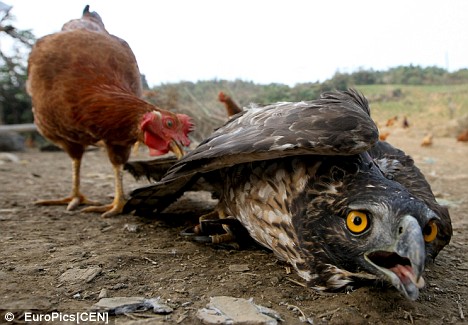
First is a report from China, where farmers are forbidden to kill eagles preying on their chickens - so they're trying a little home-brewed aversion therapy instead!


Chinese farmers are trapping eagles and other birds of prey and throwing them into poultry pens so that the chickens can wreak their revenge on them.

The farmers say the trussed-up eagle is so frightened of poultry after the experience that they never return to hunt them.

Farmers have complained for years about eagles stealing their chickens but face fines or even jail if they kill the birds.

So instead they have come up with the idea of catching but not killing them to avoid incurring any penalties.

They say after the trussed-up birds is freed it never returns - while the chickens also learn self defence against the birds of prey.


Farmer Xiao Wu of Huaxi Village at Lin’an said: 'Those eagles have eaten nearly 300 chickens over the past three months, and now I catch them with a trap and let the chickens get revenge.

'Free range chickens get the best price, but the chickens are always the target of the eagles. I tried every other means to drive the eagles away, including scarecrows, bamboo sticks, even firecrackers.

'But they would always return. Now when they see their colleagues on the ground being mobbed by chickens they stay away. And the chickens are learning to be brave enough to drive away their attackers.'

The farmers bind the eagle’s claws and wings and leave them on the ground as the chickens exact revenge.


It seems rather cruel to me . . . but if I were in those farmers' shoes, I guess I'd see it differently.

The second story concerns children that only a mother could love.


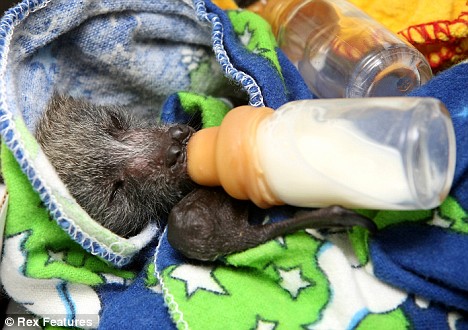
A wildlife centre is struggling to cope with an influx of 300 baby flying foxes who were ripped from the trees during heavy storms, forcing their mothers to abandon them.

Wildlife carers at a bat hospital in Queensland, Australia are struggling to find enough fruit to feed them and urgently need extra people who could help feed the creatures who need nourishment every four hours.

'We have so many baby bats on our hands that we've hardly got enough food to go around,' said carer Trish Wimberley.


'Normally, female flying foxes will go to the ends of the earth to save their babies, so it goes to illustrate how bad the storms were.'

Residents from the Canungra area, where there are large bat populations, have been bringing in the youngsters daily after finding them on the ground.

Most are suffering from hypothermia and deydration. Many have been attacked by swarms of flies.

So many have been brought into the centre that Miss Wimberley and her colleagues have been hunting for human foster families and ensure they are fed baby formula and fruit - and kept warm.


'We've found an ideal way of keeping them warm is to wrap them in yellow duster cloths,' said Miss Wimberley.

'They are very demanding. We have to ensure that they are fed every four hours, so anyone willing to take them in will have to be prepared for a lot of lost sleep.'

The bats range in ages from one to four weeks and are fed baby formula from tiny baby bottles.


I'm not sure whether I'd enjoy having those things hanging around my living-room! Besides - what if they took a liking to the place, and decided to stay on as adults?

The third animal story is about - of all things - a trumpet-playing walrus!


It's not often you see an animal blowing its own trumpet - but Sara is not your typical walrus.


The flippered, whiskered creature is delighting audiences with her human-like skills, playing the trumpet, blowing a whistle, or simply adopting the universal expression for 'I'm bored, get me out of here'.


Sara is one of the star attractions at the Istanbul Dolphinarium in Istanbul, Turkey, which opened its doors today.

Her Russian trainer Sergiy has trained her to perform a range of tricks and treats, and she is said to enjoy the attention from delighted audiences.


I found this clip of Sara on Youtube.


Sara certainly looks happy . . . but I have to wonder on seeing performing animals like this. How are they trained? Are they treated humanely? Are they really content to be confined, and perform on demand?

Having grown up in Africa, where the animals were wild, free and sometimes very dangerous (because they knew it was their land, not ours!), I think I'd rather see them free.

(Oh - and I simply have to ask - where's Sara's bucket?)


Peter