Saturday, December 18, 2021

Saturday Snippet: The early days of air mail


Dean C. Smith was an American aviation pioneer, one of those responsible for setting the standards for the nascent U.S. Postal Service's air mail service.  He also flew in Antarctica with the Byrd Antarctic Expedition of 1928–1930.  Later, he served as an executive with a number of American aircraft companies during and after World War II.

He wrote about his early flying years in an amusing and entertaining memoir titled "By The Seat Of My Pants".


Here are some of his stories of the early days of flying air mail in America.  It's mind-boggling to think that some of the pilots who flew these missions lived to see the Space Age and men on the moon.  What a contrast!


I asked around about a flying job, any flying job at all. If you were really desperate, I learned, there were two “last resort” jobs. You could get on as test pilot for Doctor Christmas, flying the Christmas Bullet. Doctor Christmas had had three test pilots, his Bullets had made three flights, and the boys had chipped in for three wreaths. But Doctor Christmas paid a hundred a week—not bad while it lasted. Or you could join the Air Mail.

What was so dangerous anyway, I demanded, about flying the mail? True, the Air Mail was all cross-country flying, much of it over hilly, rough terrain. True, too, the planes, mostly DH-4’s and a few Curtiss R’s, all war surplus, had to go in and out of small and unimproved fields instead of military airdromes. Worse, there were only a few mechanics who knew a sparkplug from an aileron, and it was about even money that the pilot would have an engine failure on any given flight.

But worst of all there was the attitude of the Post Office Department. A pilot had to try to get through, regardless of the consequences; he couldn’t cancel without giving it a try. Three or four of their pilots, it seemed, had learned to fly some pretty bad weather; and if those pilots could get through, the P.O. brass figured that the others should do the same. This was not a callous attitude on the part of the Department. It was necessary if effective flying carriers were to be developed, but it did make for short-lived air mail pilots.

I turned to Pop Anglin, who had led the mail pilots’ strike a few months back, when they had rebelled against orders to take off regardless of weather. Although the pilots had won the strike, Pop shook his head solemnly. But he gave me the telephone number of D. B. Colyer, manager of the Post Office Air Mail Service, which had its headquarters at College Park, outside Washington.

Colyer seemed delighted at the prospect of hiring a pilot. He asked if I could fly a De Havilland. I said I’d never had any trouble with the plane. That was true enough since I had never flown one. He told me to hustle down and he would pay the fare.

Even though everyone considered the Air Mail the next thing to suicide, you could at least be comfortable while life lasted. A mail pilot started at $2400 a year; he would get a $200 raise after he logged each fifty hours until he was making $3,600. If assigned to multi-engined planes like the Martin Bomber, he would get still another $100 a month. This added up to good money. This was my rationalization. Besides, what choice did I have?

College Park seemed a most unpretentious show to be the headquarters of the Air Mail Service. There were three or four shack-like wooden hangars, a hut for an office, and an exceedingly small, badly rolling, sod field. I was yet to learn that this was a sumptuous airdrome as compared with the typical Air Mail field. I located D. B. Colyer. As soon as the southbound got in, he told me, the pilot would check me out in a Jenny. If he gave me an O.K., they would put me in a DH, and see what I could do. And if I then got down in one piece, I would be in business. A mechanic showed me the layout, as I quizzed him anxiously about the switches and valves on the DH.

The incoming pilot took little time to check me out. He hustled me into the front seat of the Curtiss trainer, had me take off, make a quick circle of the field, and land. That was all. He gave Colyer a breezy O.K. and was off.

The De Havilland was a challenge, more psychological than actual, but enough to make me nervous as I climbed in for my first flight.

When I was introduced to the JN-4 I had been impressed with the throb of its 90-horsepower engine. The DH had a Liberty engine of 400 horsepower; its roar made the ground shake. But the mechanic’s lesson proved invaluable, and I carefully followed his instructions. Once clear, I taxied to the corner, pointed the plane the long way of the field, and gave her the gun before I had time to change my mind. The plane took off easily. After a few maneuvers, I knew I was flying the plane instead of the plane flying me, and I started getting a boot out of it.

There was an exhilaration to flying an airplane in those days: their slow speed and light wing-loadings allowed short turns, sharp dives, and quick pull-outs that are impossible in faster planes. We did not rely on gauges and indicators; we flew by feel, noting the control pressures on our hands and feet, the shifting weight of our bodies, and the pitch of the singing wires. I was careful with my first few landings, bringing the DH in flat, with a bit of power until I got over the fence. After a dozen landings, I taxied in to find I had become a mail pilot. This was in April, 1920.

The Air Mail operation, initially flying from Washington to New York, had been extended by a route from New York to Chicago and very recently as far as Omaha. After several days at College Park, I was given a permanent assignment based at Bellefonte, Pennsylvania, whence I was to fly to Cleveland. Bellefonte lies at the heart of the Allegheny Mountains, in central Pennsylvania. I checked in with a Mr. Tanner, the field manager, and asked him what I was to do. So far as he knew, he said, I had only to fly back and forth to Cleveland. Never having been to Cleveland, I asked him for maps. He smiled. There were no maps. Sometimes on his first trip a pilot would fly behind someone who knew the run.

When Max Miller, the senior pilot of the whole Air Mail Service, showed up, I asked him how to get started. Rand McNally road maps, he explained, were useful, but they didn’t show the landmarks I would use most in flying the run, such as the shape and layout of the towns, the distinctive appearance of the hills and valleys, where the low places were that let you work your way through weather, and the location of possible landing fields. After I came to know my run, Miller said, I’d fly to Cleveland the way I’d walk to the drugstore; I’d know the way.

Miller and I picked up maps of Pennsylvania and Ohio. Then he began to talk. He kept on talking for a long time. From the field here at Bellefonte you head west through the gap in the ridge. Climb as you veer a bit north, passing over the center of this railroad switchback up the side of Rattle snake Mountain, then due west again to clear the top of the ridge at, say, 2,200 feet. After about ten miles you hit the railroad again at Snow Shoe—look sharp, it’s only four or five houses—then follow the railroad on down the other side of Rattlesnake to the valley where you pick up the West Branch of the Susquehanna River, winding along to the town of Clearfield, which you will know by three round water reservoirs just south of town.

Next, you have to get over about thirty miles of plateau to Du Bois. This is pretty high, about 2200 feet, but it is fairly smooth on top and there is a white gravel road cut through the trees straight to Du Bois. As you come into town, you will see the railroad to your right and just south of the railroad a piece of flat pasture you can land on in a pinch. Then the highway leads you for fifty miles through Brookville to Clarion. Each of these towns has a half-mile racetrack.

The one at Clarion is half full of trees, but the one at Brookville is clean and hard, and it’s the best emergency field from here to Cleveland: as soon as you land you will be met by a girl named Alice Henderson, driving a big Cadillac, who will be pleased to look after you. After Clarion, the country gradually gets lower until you cross the Allegheny at Greenville, which you can identify by a big S bend in the river. From then on it’s clear sailing.

And so he went on, naming towns, hills, rivers, roads, factories, racetracks, all the way to Cleveland. The airfield was in East Cleveland, at the Glenn L. Martin plant. It was easy to find, just a quarter of a mile from the lakeshore—or so Miller assured me.

I had expected to make my first trip escorted by one of the Cleveland pilots. But within a few days the westbound came in and there was no pilot except me available to take it on to Cleveland. The weather was far from promising; it had been raining off and on all day, and low clouds were barely clearing the ridges.

However, no one seemed concerned as they transferred the mail to my DH and warmed up the Liberty, so I took off and headed west through the gap in the first ridge. Max’s instructions proved a great help. I made it over Rattlesnake Mountain and followed the river to Clearfield without much trouble. Opaque veils of cloud forced me to twist and dodge my way between them as the squalls grew heavier.

By the time I reached the slope leading up to the plateau, the clouds were so solid that I had to circle back. I hated to give up. Over Clearfield again the sky looked brighter to the north, so I blithely headed that way, happily ignorant that I was flying over some of the wildest country in Pennsylvania, high and rugged, with few houses and no fields for fifty miles around.

I was able to work my way west by heading for openings between the clouds, zigzagging from one to another. I knew I was north of the course, but not how far north; I knew I was working west, but I couldn’t guess at what rate. I was amazed to find I was barely clearing the trees, although the altimeter showed close to 3,000 feet above sea level. The terrain was rushing at me with relentless speed. After a long half hour, the rain eased a bit and the clouds rose. I relaxed a little. I was showing them that a rookie could get through.

Just then, the engine stopped cold. As a rule when an engine fails, it will give some warning. The water temperature will rise, or the oil pressure will drop, or there’s a knocking or clanking. Even if it is only a minute or two, it gives the pilot a chance to look around and head for a field or open place. However, when the timing gear in a Liberty engine fails, one second it is roaring along even and strong, and the next there is a tremendous, loud silence.

I quickly twisted all the knobs and gadgets in the cockpit, but there was no response and the engine stayed dead. While my hands were trying to restart the engine, my neck was stretching and my eyes searching for some sort of field to land in. I was surrounded by heavily forested, sharply rolling hills. To my left was a cuplike basin with a small clearing. It was downwind, but my gliding radius didn’t allow much choice. I went for it.

To reach the clearing required a sharp, almost vertical S turn, first left, then right, while killing just enough speed and altitude to land, downwind, and still miss a nearby cliff. I can even now feel the rain slanting in my face and see that open space rocking and swinging in front of me as I pulled out of the turn. One thing I could not know: the clearing was choked with brush and weeds, hiding a three-foot ledge of rock directly in front of my landing spot. The ledge slammed into the undercarriage as I hit.

The plane snapped like a popper on the end of a bullwhip. I was catapulted into a long head-first dive, like a man shot from a circus cannon. Fortunately, I landed in the brush and rolled to a stop in a sitting position. The padded leather ring that rimmed the cockpit hung from my neck like a lei. I was still holding the rubber grip pulled loose from the control stick. My seatbelt lay across my lap. I felt around to determine that I had no broken bones. The wreckage of the plane was piled in a heap, like crumpled wastepaper.

Except for this lone field, the place appeared to be a wilderness of trees. After some exploration I located a little-used path and started to follow it. It meandered along for about half a mile and turned onto a dirt road that I followed downhill for perhaps another mile before I came to a small cabin. Sitting on a bench before the cabin were an elderly man and woman, barefooted and dressed in work clothes. They smiled and waved.

My first impression was astonishment at how clean they were, their scrubbed faces glowing above the faded calico and denim. I told them about the accident and about my mail pouches, which would have to be taken to a railroad station. They assured me that the rural mail carrier would be along shortly with his horse and rig and would willingly help me. The couple were very solicitous. Almost apologetically the wife brought out a big bowl of tiny wild strawberries, a jug of clotted cream, and a loaf of fresh home-baked bread.

Sure enough, the mail carrier came along in due course, with a sturdy mare pulling an old-fashioned hack. The old man and the mail carrier helped me bring the mail sacks down to the road and load them in the hack. Luckily there were only three or four sacks, hardly a hundred pounds. Westbound airmail was expensive that day.

After my thanks and goodbyes, we drove about ten miles to Pithole, a little town on the railroad, where the stationmaster accepted the mail shipment. I used my Post Office travel commission to get a train ticket to Cleveland. It was quite a trip, my first flight with the mail. I was beginning to understand why the boys at the Flying Club had given me a farewell party.

On arrival in Cleveland from the forced landing at Pithole, I was surprised to hear little comment about my accident. Engine failure, forced landings, and crack-ups were so common on the Air Mail that, so long as the pilot was not killed or seriously hurt, no one gave them another thought. Teams of mechanics, ready for repair and salvage operations, were constantly busy.

. . .

This was still before the days of instrument flying, of radio beacons, and even of weather reports. If a pilot got caught in clouds or fog and lost sight of the horizon, it was not long before he fell, because he was out of control. When the clouds were low, you had to fly close to the ground, close enough to see it; the lower the clouds, the lower you flew, dodging steeples and jumping trees and telephone lines. In the hilly country of the Alleghenies, the pilots sought the low places, passes that would lead them from valley to valley, twisting their way through mountains. The more experienced pilots became extremely skillful, learning the country in precise detail.

Initially we had no en-route weather reports. If it was thick at the take-off, the field manager might telephone through to the destination and inquire how it was there. The replies were limited to such whimsy as “Sunshine and flowers; tell him to come ahead” or, “Pea soup; better cancel.” In doubtful weather, there were some key spots to check along the route, usually in the mountains. After a time we tried calling up farmers who lived near these places and asking about the weather. It proved useless. If the weather was good, they could tell us; but when it was not, their replies were vague. A typical interrogation might go:

“Is it raining?”

“Yup. Pouring.”

“How far can you see?”

“I can see as far as the next man. I don’t wear glasses or anything.”

“What I want to know about is the clouds. How far up can you see now?”

“I don’t know, it’s pretty foggy; about a mile, I guess.”

“Foggy, and you can see a mile straight up! Then the mountains should be all clear, are they?”

“How can I tell? They’re all covered with clouds.”

We gave up these haphazard inquiries and made a survey. Specific farmers were on call, located near a mountainside. Specific objects or landmarks were selected at different elevations; the farmer would report the farthest object he could see. This did prove useful—that is, when we could reach the farmers.

The next step was to employ local people at selected spots to wire us daily weather reports. It was about this time, too, that we started using the terms “ceiling” and “visibility” to describe aviation weather. I think it was probably in 1921 or ’22 that the Air Mail Service leased telegraph wires along the route, expanded the number of reporting stations, hired trained observers, installed radio stations at the main fields, and formed the nucleus that has expanded into the vast aviation weather service of today.

In my earlier days I doubt if the number of completed trips averaged much over 50 per cent. There was hazard enough to suit the most avid adventurer. Not all the forced landings were in fields; there were frequent crack-ups, some of them grim. The years 1920 and ’21 were the worst in the history of the Air Mail. In 1920 we had five fatal crashes, killing nine, a fatal crash for every 130,000 miles flown.

In 1921 there were twelve fatal crashes, killing fifteen, with the average 104,000 miles flown per crash. As a pilot could expect to fly sixty or seventy thousand miles a year, his life expectancy would hardly make him welcome in an insurance office. I remember when Brooks Brothers refused to give me a charge account because my profession was too risky.

By the end of 1921 the record began to improve. Men like Luther Harris and Richard Ingalls, mechanics in name but with the capacity of inventive engineers, devised scores of changes in the Liberty engine that vastly improved its reliability. Weather reporting was in force and parachutes came into use. The surviving pilots had learned something about bad-weather flying and were able to pass some of this knowledge on to new pilots. Fatalities were reduced until, at the end of the Post Office operation in 1927, the Air Mail had averaged but one fatal crash per half-million miles during its history.

. . .

I believe that each surviving Air Mail pilot will tell you that at least once, early in his mail career, he had a brush with death that put the fear of God in him and made him acutely aware thenceforth that even the simplest error in judgment or a few seconds of carelessness might put his life in forfeit. Once a man got past that point safely, his chance of becoming a true professional pilot was much enhanced. I know that my ordeal marked a change in the quality of my work: I became not so much a more cautious pilot, for timidity has its dangers too, but a more thoughtful, careful one.

I was flying east out of Omaha in rainy, dirty weather, trying to make my way through the rolling country beyond Council Bluffs. The clouds were scraping the tops of the low hills. By ducking down into the hollows between the hills it was possible to see a little ahead, but in pulling over the higher rolls the fog would thicken and the ground dim, even with my wheels almost brushing the grass. I knew that in just a few miles I would reach a draw with a railroad in it that was two or three hundred feet lower than the terrain I was in, so I allowed myself to push on farther than I should have.

As I went over one of the low hills the ground faded completely from sight, but I quickly eased the plane down and made it into the next hollow, where I was able to see a little. The hill ahead came at me fast, and instead of turning I was teased into climbing its slope. Again the ground faded from sight, but this time for more than a few seconds. When I eased back down, feeling for the next little valley, I did not see the surface until I banged into it. The wheels evidently hit on a smooth grass field, for the plane, instead of crashing, bounced. Instinctively, I pulled back on the stick, the plane shot up into the fog, and when it leveled off at several hundred feet I was completely in the soup.

While I still had a sense of orientation I tried to make a blind turn, and then leveled off again in what I hoped was the direction back. I turned, but a turn causes the compass to spin and swing; it takes some time before it can give a course indication. I now had no choice but to attempt to fly blind, locking the rudder in neutral, holding the stick in my fingertips, feeling the wind on my cheeks, and watching the airspeed indicator. In this manner, I was able to get the plane under some control and ease it down little by little, until my altimeter read that I was as low as I had been before.

But I was unable to see anything of the ground, and the fog pouring back through my wings remained as thick and opaque as wet cotton. I dared not let down any lower or I would be bound to fly into the side of a hill, so I started to climb, mostly in desperation, for there was only a forlorn chance I could ever get on top of this type of weather.

Now followed a long period of fighting to keep control of the plane while all the time my equilibrium became steadily more confused. I succeeded in climbing to 8,000 feet; then the plane began to get more and more out of control. It lost altitude until I was back down to 5,000 feet. By this time, I felt I had been milling around in the clouds for an eternity, and found myself wondering why I did not run out of fuel.

At last I fell.

The plane stalled and whipped off into a spin, although to my bewildered senses it did not seem to be spinning down, but impossibly up and to the side.

I cut the throttle and held the plane in the spin for a few seconds to be certain I was in a known condition and to force my mind to reorient. When I broke the spin, I couldn’t pull out level from the resulting dive. By the time I got the wires to stop screaming the plane promptly stalled again. The plane floundered through the dark muck in a series of stalls, spins, dives, and pull-outs. I struggled and fought with it all the way down, working with desperate concentration, but that little corner of my mind that detachedly views such things said, “My friend, you are a dead duck.”

The altimeter needle was dropping fast, and I knew I was low as I tried to recover from the fifth or sixth stall and spin. If I’d been in a Jenny I would have let it spin in, but a crash in a full spin in a DH-4 was almost always fatal, so I continued trying to right the plane. The wires were screaming from what seemed a full dive and I was pulling back hard to get the nose up when the tops of trees came flashing by, just below my wings. I was almost level. I rammed the stick forward to hold the plane there, cut both ignition switches, and coasted ahead, expecting to hit but not knowing what.

The plane slid out under the deck of cloud to show me I was only fifty feet high—and over cleared land. We rolled to a stop, the propeller dead. After some minutes I began to tremble. I climbed out of the plane and had taken but two steps when my legs gave way.

. . .

Another danger was the cold. For the first winter or two, I was on the mail, we had no heat in our planes, the windshields were poor, the cockpits had unsealed holes, and we suffered real physical distress.

We had huge bearskin-lined flying suits, sheep-lined boots, fur-lined helmets, and mittens. But they were not enough. I used to have sections of newspapers stuffed inside my suit for more adequate insulation of the upper part of my body. Often, after I had been out an hour or two, I would already be so cold that tears would run down my cheeks. Under such painful conditions a pilot was obviously not capable of exercising his normal judgment.

. . .

I took the regular flight out of Chicago, leaving at dawn. The weather was fine except for a brisk headwind; to avoid the wind I flew just above the treetops and was droning along happily when the engine quit. One second it was throbbing along steadily, the next there was silence—a most depressing silence. The one clearing in sight was dotted with a herd of cattle. The landing would have to be downwind. I made a steep turn that finished in a sideslip, then went into a skid to kill the speed; I was in a dead stall coming over the fence, angling for a lane that would miss all the cows. Too late, an amiable-looking cow walked in front of the plane. The wingtip caught her fair amidships, the impact pinwheeling the plane end over end, wings, nose, and tail all breaking off as we went around, until there was little but me and the cockpit left when we came to rest. I stood up, quite unhurt; the cow did too. But the cow was lopsided, caved-in on one side and pushed out on the other. She gave one reproachful moo, then lay down and died.

Soon there were people and help and excitement. The farmer started to bewail the loss of his cow. Although as a farm boy I would have called it a scrub heifer worth thirty or forty dollars, he insisted it was fine, blooded stock and had been bred to the best bull in the state of Iowa. He later tried to collect $800 from the Post Office Department.

Passers-by helped me to get the mail to the town of Montezuma, where I turned it over to the railway mail clerk. Although I realized I should report to someone, I hardly knew how or to whom. A long-distance telephone call seemed an expense without reason. I sent a telegram instead to the Superintendent of Air Mail, trying to keep it short. It seemed to me to cover the incident. It read: “On Trip 4 westbound. Flying low. Engine quit. Only place to land on cow. Killed cow. Wrecked plane. Scared me. Smith.”

. . .

People often asked me why I liked being a pilot, why I flew the mail and took such chances of getting killed. I would try to explain, but never could find the words to explain it all. I knew that I could fly and fly well, and this skill set me apart from the run of the mill. I certainly had no wish to get killed, but I was not afraid of it. I would have been frightened if I had thought I would get maimed or crippled for life, but there was little chance of that. A mail pilot was usually killed outright. Then, too, sometimes I was called a hero, and I liked that.

One of the most rewarding things about a mail pilot’s job was the high pay and the high percentage of leisure time, which made for a merry life, even if indications were that it might be a short one. As a normal thing we worked two or three days a week, five or six hours a day, plus standing reserve perhaps one day a week, which only meant keeping the field advised how they might reach us. I spent my time as unproductively as possible: learning to play golf, chasing girls, reading omnivorously and indiscriminately; investigating dives and joints in the area; and—an interest that has remained with me ever since—trout fishing.

But what I could never tell of was the beauty and exaltation of flying itself. Above the haze layer with the sun behind you or sinking ahead, alone in an open cockpit, there is nothing and everything to see. The upper surface of the haze stretches on like a vast and endless desert, featureless and flat, and empty to the horizon. It seems your world alone.

Threading one’s way through the great piles of summer cumulus that hang over the plains, the patches of ground that show far below through the white are for earthbound folk, and the cloud shapes are sculptured just for you. The flash of rain, the shining rainbow riding completely around the plane, the lift over mountain ridges and crawling trains, the steady, pure air at dawn take-offs, and the smoke from the newly lit fires in houses just coming to life below—these are some of the many bits that help pay for the tense moments of plunging through fog, or the somber thoughts when flying cortege for a pilot’s funeral. It was so alive and rich a life that any other conceivable choice seemed dull, prosaic, and humdrum.

. . .

On one trip, when I had flown out of such a night into the flame of an autumn dawn, as I neared Chicago the quilted floor of fields and roads was marred by increasing patches of white fog, lying innocently here and there in shallow pools. There was enough visible ground to find my way until I was within a mile of the field, but then all was covered, and the fog stretched solid to the east. The fog was fairly shallow, for I saw the mark of smoke, puddled in the white, from the tall smokestack that sat just west of the flying field.

Circling over, I could just make out the circle of the stack’s tip. Using it as a marker, I could line up with the runway, but when I glided down I could not even see the tips of my wings, and I had to push open the throttle and pull back on top. Circling, I saw that my propeller wash had made a gouge in the top of the fog as the plane dipped in, like a scoop taking ice cream from the top of a can. This gave me an idea: perhaps I could dig out enough fog to see the end of the runway.

It took a long time. I would dip in, then hold the plane’s nose up in a near stall and jazz the engine to send the wash burning behind at a downward angle. After nearly an hour of circling and dipping, I had dug out a ragged trough about three hundred feet deep and could just see the end of the runway at its bottom. Touching down took care, for I had to start the glide beyond the edge of the hole, be blind for a moment, then have a few seconds to set the plane on the runway before I was blind in the fog again.

A DH does not roll far on landing, the Maywood runway was broad and long, and the landing came off just fine. But the fog was so dense I could not see to taxi; men had to come out and guide me to the hangar.

To those on the ground my many circles and dips had sounded as though I was lost in the fog and desperately trying to dive into the field, although no one could understand how I could keep flying in the horrible muck. Dick Ingalls almost worked himself into a heart attack repeatedly climbing the beacon tower to point its beam in hopes it would help me land, then, when he heard the throttle open and the plane start coming his way, frantically scrambling down in fear it would hit the tower. In the hangar, held from taking off by the fog, were the Army round-the-world fliers and their planes, just completed circling the globe and about to start a welcoming tour. They were, I believe, deeply impressed by the weather they saw the Air Mail come through. I did not explain how I had dug my way in.

. . .

Sometimes when the weather was bad but still hopeful, we would hold the mail at Hadley. At night this could make for quite a wait. The main crew and the usual knot of spectators would have gone home; for the pilot there would be nothing to do. We had no lounge or reading room, no place to rest. The pilot could lie on a canvas cot out on the hangar floor, or he could walk a mile down the road to a farmhouse where he could get a bed at a dollar for the night or day. The cot in the hangar was the private preserve of a cat with a highly developed and aggressive sense of private property. At the farmhouse there was the farmer’s wife, more cooperative than the cat about sharing the bed, but far less attractive.

. . .

Today, the vital role of the Post Office Department Air Mail Service in aviation’s history seems virtually forgotten, yet its gallant efforts gave genesis to our present vast system of civil air. Ask the man in the street about the Service and if he remembers anything at all he is apt to mention the famous airmail cancellation when the Army flew the mail with such unhappy results. Yet this happened in 1934 and was concerned with the mail-carrying contracts of the airlines, long after the pioneering I have told about here.

The Service was in existence for less than a decade and was never in any sense large. When I joined the Air Mail in 1920 there were perhaps twenty pilots employed by the Post Office Department. There were forty-three pilots when the Service ended in 1927. During its brief history forty-three had been killed and twenty-three more had been seriously injured.


Those were the days of the pioneers, all right.  It's sobering to think that a letter sent by air mail during the years following World War I bore a price not only in stamps, but also in blood.

Peter


Friday, December 17, 2021

Food: higher prices, more shortages - and it's not just inflation


Last month I published an article titled "Remember those warnings about the food supply?"  In it, I noted:


The fertilizer market is currently incapable of supplying enough product to meet demand - and that may affect next season's harvest quite appreciably, not just in the USA, but worldwide.


Now the Wall Street Journal warns that "Surging Fertilizer Costs Push Farmers to Shift Planting Plans, Raise Prices".


Escalating costs are leading some farmers to shift acres toward less fertilizer-intensive crops, like soybeans, while others said they plan to cut back on their overall fertilizer use, potentially reducing future harvests.

Lower grain production could translate to higher prices for farm commodities like corn, analysts and farmers said. They added that higher costs for such commodities would further inflate prices of pantry staples like cereal and cooking oil, as well as beef and other meat, because producers rely heavily on grain to feed livestock and poultry … Fertilizer is typically among farmers’ biggest expenses each year, and higher prices threaten what has been a banner year for many growers.

. . .

The rise in fertilizer costs is partly fueled by elevated natural gas prices, a key ingredient for nitrogen-based fertilizers, as well as by severe storms in the U.S. that disrupted fertilizer plants earlier this year and a move by China this summer to ban exports of phosphate, a major fertilizer component. Some farmers also blame fertilizer companies for the rising prices.

. . .

The potential for higher fertilizer costs to cut into production of corn and other crops could fuel continued food-price inflation. Food costs have already climbed this year as companies have passed along higher labor, transport and packaging costs.


There's more at the link.

We're already seeing the effects of the "food crunch".  Fellow blogger Sgt. Mom at Chicago Boyz notes:


Considering how the price of groceries and everything else is inflating, and how supply-chain issues are leaving unexplained and erratic gaps on store shelves, this indeed might be the last year that we can do the fudge assortments [as Christmas presents]. Butter, cream, chocolate, sugar – all those good things will certainly be more expensive next year. The prices for meat, especially for beef and bacon have all but doubled in the last few months alone. Looking ahead and considering the credible news sources available to me, makes me wonder if grocery store shelves might eventually look like those in Venezuela – bare of anything at all, or like those in Soviet Russia, years ago?

Food austerity looms on the horizon like an oncoming storm-cloud. In the near future, we may not be able to afford certain items, or they aren’t available at any price. We had a taste of what serious shortages might look like, last year during the first weeks of the Covid panic, when shelves of canned goods were practically stripped bare, as was the bakery and fresh meat section, while shoppers waiting impatiently for milk and eggs to be restocked. We worry, and not without reason, about what will happen in the coming year. I can’t see how things can improve, economically and politically, although living in Texas may shelter us from the very worst that can happen.

It has been very nice, living in a world where ordinary, working-class people like my daughter and I can afford to give away a nice edible gift of home-made treats, much less be able to eat protein like eggs and meat for supper five nights out of seven. I wonder if we are living in the last days of the golden era that was an era of plenty; plenty of food, cheap gas, inexpensive luxuries. What a piece of work are our ruling class, that they would cheerfully consign regular citizens to a bleak, cold and deprived future.


Again, more at the link.

I'd say her apprehension is fully justified.  It's why I've increased our own emergency supplies and reserves of food, even taking on additional credit card debt in order to ensure that we've got at least some additional food security.  That's also why more and more consumers, those who can see what's coming and the early effects already visible all around us, are changing their shopping habits right now.  They're buying as much food and other everyday needs as possible, so as to ensure that in future, in a high-inflation environment where everything costs more as time passes, they'll have at least some of them on hand rather than being forced to buy what they may no longer be able to afford.

I respectfully suggest that we should plan our budgets - and our pantries - so as to have at least thirty days of food on hand at all times.  That needn't include luxuries, but it should include a nutritionally adequate, balanced diet for every member of the household for at least that long.  If our budgets can stretch to a three-month balanced food supply, so much the better.  As for the longer term, very few of us can afford (or have the space to store) a full pantry sufficient for a more extended period;  but we can often find or make space for basic foodstuffs like dried beans, rice, etc.  They may not be very appetizing, but they'll last a long time, and beans and rice together make a complete protein that's adequately nutritious.  The way things are going, supplies like that might just come in handy . . .

Peter


"Perverts and fetishists psychologically manipulating and abusing children"


That's what fellow blogger J. Kb, writing at Gun Free Zone, calls aggressive recruitment and propaganda campaigns by California teachers to persuade children that they're either gay and/or transgender.  His conclusion:


Let me be clear, this is not teachers helping troubled kids.

This is perverts and fetishists psychologically manipulating and abusing children.

This is groomer behavior.

For a long time the LGBT community swore up and down they were not child molesters out to get your kids.

As it turns out the activist LGBT community really is out to get your kids and turn them into abused gender-confused sexual playthings.

This is coordinated and orchestrated evil.


There's more at the link.

Reading the articles to which he links to provide evidence, I can't disagree with a word he says.  This is evil, pure and simple.  The trouble is, those who engage in it don't regard themselves or their actions as evil.  They've abandoned conventional "morality", regarding it as old-fashioned and themselves as above its restrictions.  They probably truly believe that they're right to do what they do, and right to encourage the children under their care to explore alternative sexuality and life choices.

When you're dealing with people like that, "true believers" who regard their actions and choices as "normal" and justifiable, there's no common ground on which to negotiate.  They'll regard you as a hopeless stick-in-the-mud, and see their duty as being to "liberate" your children from your "malign influence".  People like me, on the other hand, see things precisely the other way around.  We intend to "liberate" our children from the malign influence of teachers like that - and we're willing to do so by any and all means necessary.

I suggest that to put our kids into public schools today, knowing in advance that they're going to be subject to such pressures, is nothing more or less than child abuse.  They deserve better, and we owe them better.

I further suggest that allowing such teachers to remain in office, knowing in advance what they're going to try to do to all the children in their care, is also child abuse.  Any means necessary to do so are, in my opinion, justified.  The authorities and the law may disagree . . . but they're not the ones responsible for "training up a child in the way he should go".  I wish there were more parents who would observe that precept - and teachers, too.

J. Kb.'s final observation:


California is in desperate need of house cleaning with woodchippers.


It's hard to disagree.


Peter


Creepy!


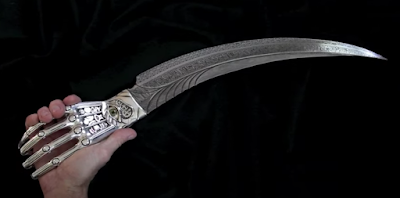
I had to laugh - and suppress a shiver - when I read about a new knife (actually, more like a short sword) from Jean-Marc Laroche, a French knifemaker and artist.  The hilt (perhaps "handle" would be a better term) is his creation;  the blade is from Swedish knifesmith Roger Bergh.


(Click to enlarge)


Blade magazine reports:


French knifemaker/artist Jean-Marc Laroche refers to his latest creation—this issue’s cover piece—as “The Living Knife.” Since it has a “hand” for a handle with “fingers” that close, an “eye” and an overall lifelike appearance, who are we to argue? As you grab the handle, the “fingers” actually grab back so that it’s hard to tell who’s holding whom. And, as the fingers grab your hand, the “eye” opens. The hand also is embellished with gears in the Steampunk style.

The Living Knife is indeed a most unusual creation—but then Laroche has been making otherworldly pieces for over two decades. Even by his standards, though, this one takes his knife art into uncharted territory.

“It was from the cinema of fantasy films that I drew my inspiration,” he notes. “It took me 12 years to implement my idea, six months to carry it out and a fair number of technical difficulties had to be overcome.

“Yet here it is, like a cunning thing from another time that a mad inventor out of the 19th century would have dreamed up. This biomechanical being activates its workings to move its fingers; it seizes control of the situation with its eye’s intelligence.”

The Living Knife is an assembly of mechanical parts, the prototype having been made in resin. A few rare versions in bronze, gold and silver are in the process of being forged.


There's more at the link, including a brief look at some of the artist's other creations.

Here's a video showing how the knife works.


You'll find more videos from Jean-Marc Laroche at his YouTube channel.  The man obviously has a unique vision of knives as art.

Personally, I find the thought of a knife that grabs my hand in return when I grab it to be more than a little creepy - but then, I'm old-school like that!


Peter


Thursday, December 16, 2021

A nurse reader describes the state of her hospital


We've heard plenty of horror stories about the state of US hospitals at present, both from the perspective of COVID-19 and the state of health care in general.  A reader who's a nurse wrote to me this week describing conditions at her hospital.  She gave me permission to share her message, provided she was not identified in any way.


There are no inpatient beds; we're swamped.

Last weekend, we were holding 16 admissions on gurneys in our ER that there were no beds for upstairs. Some KungFlu, some other stuff. The biggest problem is that admin never replaced the staff they laid off during the lockdown. We are running with skeleton crews in ER and inpatient units, and just waiting for a Sentinel event. We're usually taking 4 patients each in ER; now we have 6-8. Inpatient is worse; I recently handed off a patient getting blood (vitals every 15 minutes) to a nurse who already had 9. I felt so bad for him, but there wasn't anything I could do.

Plus, they cut our housekeeping staff, and now nursing has to clean all the rooms as well.

And they cut our respiratory therapists by half, so when we get a patient in respiratory distress, good luck finding an RT for breathing treatments.

And, I discovered, there are no ambulances to transport between facilities anymore either - we used to have them in house, to take patients to other hospitals, or back to the nursing homes. Now they wait for hours, taking up ER beds.

And, most of our security guards have quit, they won't say why. This is particularly concerning to me, as the level of incivility right now is off the charts. I found out that a drug seeker who shoved me into a wall the last time I had her, brought a gun with her the following week. And the medical director insists that we can't ban her bc it would be rayciss, and she has sickle cell, so acting out is how she shows she's having pain. Ugh.

I just don't know where the employees have gone.

Which leads me to night before last, when one of the hospitalists (not local) came to see a covid admission I was holding in the ER. He said he was sick of covid.

I tend to keep to myself at work, but I just smiled and said, but we're only 18 months into two weeks to flatten the curve!

This pissed him off. Then he read her chart and found out that she was not vaxxed, stood at the nurses desk outside her room, and started on a rant about people who won't get vaxxed, and how they shouldn't be allowed to even come to the hospital, and how people like YOU (me) are making the pandemic all about politics, and how great Biden and Fauci are. (I never brought them up.) Then he segued into a bunch more rants about how whypeepo in jacked up pickup trucks with their American flags make him uncomfortable, and how the American flag is a symbol of oppression…

He went on for SO long, and was so loud, that I just left and started going into random patients' rooms to check on them. Came out, still ranting. He stood there shouting for so long that the patient actually got up and left. I really hope she went to another hospital.

When the doctors are driving patients away bc of their race and vacc status…


I'd be interested to hear the reactions of other nurses to her comments.  Is your institution as bad, or worse, or better?  Paging Aesop…

Peter


The Salvation Army learns the meaning of "Get woke, go broke"


I've long been a supporter of the Salvation Army when it comes to effective, realistic, practical disaster relief and help to the poor.  For decades I've donated to them in preference to the Red Cross or other mammoth, overly bureaucratic relief organizations, and I've recommended them to my readers in these pages.

No longer.

When it came out, last month, that the Salvation Army was circulating a "guide" titled "Let's Talk About Racism", I immediately smelled a rat.  After seeing so many organizations infiltrated by secular-humanist "woke" philosophies, I hoped against hope that the Salvation Army had been able to resist their encroachment.

Sadly, the truth proved to be even worse than I'd feared.  Despite their protestations about being "misunderstood" and their immediate withdrawal of the "guide", it was clear that at least part of the Salvation Army's leadership had been seduced by the theoretical as opposed to the theological.  They had lost sight of the eternal truth that a Christian church's primary, overriding duty and responsibility is to proclaim "Jesus Christ, and Him crucified", rather than any other message (particularly secular ones).  In proclaiming the former, the latter are automatically addressed, albeit from a radically different perspective to the world's answers.

As Sundance notes:


If you wanted to completely destroy the guiding mission of a charity, the Salvation Army is showing everyone exactly how to do it.

I’m not sure what qualifications or prisms others use, but myself, as a donor, I want to see my money used by a charity in such a way as to care for people who are in the most need – and that has absolutely nothing to do with race or any other qualification.  I am literally stunned by the intent of the Salvation Army in this mess, and their cleanup effort is even worse.

This is one of the biggest disappointments of the year, and yet, again shows that organizations can lose their entire purpose by following leadership making stupid decisions.


There's more at the link.

(Tragically, the Salvation Army finds itself in good company.  Many mainstream Christian denominations have done as badly, or worse.  To name just one example, look at how the hierarchy and leadership of the Catholic Church have effectively abandoned the faithful over the past twenty years or so in connection with the clergy child sex abuse scandal and other issues.)

Now the Salvation Army finds itself desperately short of funds and other contributions.


The Salvation Army is facing a shortage of toys and donations ahead of the holiday season, and urge communities to find a way to help.

The nonprofit reports it gets 75% of total annual donations during November and December, and they are once again in need of support ... "There are many reasons why both financial and toy donations are down this year, not the least of which is likely pandemic fatigue and concerns about employment and the future," said Colonel Cindy Foley of the NW Salvation Army Division. "We are actually trying to provide food, shelter, toys and clothing to double the number of families we served last Christmas, and in the midst of the growing need we are seeing fewer people donating at our virtual and physical kettles."


Again, more at the link.

Surprise, surprise!  What else did the Salvation Army expect?  If you, in so many words, accuse your most dedicated supporters of racism, why are you surprised when they withdraw their support?

The Salvation Army should have read their Bibles more carefully before deciding to step away from Scripture and towards secularism.  The prophet Hosea's warning to Israel might have given them pause.  "They have sowed the wind, and now they will reap the whirlwind".

My donations to the Salvation Army will, in future, consist of one of these preprinted slips, cut out and kept in my wallet for use when I encounter one of their famous "Red Kettles" at local supermarkets and other sites.  (Click the image for a larger view.)


That, at least, is a contribution they'll understand.  (Aesop's contributions will be somewhat more graphic, as will his ongoing rejection of their position.)

Peter


Wednesday, December 15, 2021

URGENT - Mike Hendrix at Cold Fury needs our help (UPDATED)


Mike Hendrix, who blogs at Cold Fury, has been admitted to hospital with a case of poisoning that's turned into a SERIOUS, potentially deadly infection.  I'll let fellow blogger Big Country Expat (a.k.a. The Intrepid Reporter) explain, from a post he left at Cold Fury, where he's also one of the contributors.


I just got word that my brother-from-another-mother Mike Hendrix, late of the famed rockabilly band The Belmont Playboys and more recently of the Blog "Cold Fury", has gotten seriously hemmed up medically speaking. Last Thursday after a slightly prolonged absence from his blog, I reached out to him to find out WTF was going on and I heard back that he'd come down with a nasty case of food poisoning.

Since then, apparently something faaar MOR serious happened.

His brother (actual) Jeff called me tonight as I left one of my more 'colorful messages' on his phone (in possession currently by his sainted lil ole Lady Mom) who apparently when she recovered from my diatribe, had Jeff call me to fill me in on whats up.

Essentially Mike's seriously ****** up.

Food Poisoning turned out to be a MAD infection. His diabeetus didn't help the issue, so they had to lop off his foot, then his leg, as the infection was/is spreading. They're fixin' to make it even MOR stumpy as the infection still isn't under control. He's in critical/ICU level condition, but NOT COVID related thank the Gods.

So, My brother-from-another-mother, henceforth now known as "Peg-Leg Mikey" is gonna have some serious medical bills and life altering needs.


There's more at the link.  It sounds very serious indeed:  if they've amputated part of his leg twice, and are considering a third round, that probably means he's been fighting off (or failing to fight off) gangrene.  That's really bad news.

You'll find a fundraiser for Mike at this link.  If you've enjoyed his writing at Cold Fury, please consider donating to his support.  I've done so, and I'm passing the word on behalf of BCE.  Mike's one of the (very) good guys, and I'm sure he'll appreciate the help, as will his family.

Thanks in advance.

Peter

EDITED TO ADD, ON THURSDAY EVENING:  BCE has posted an update about Mike's condition on his blog.  He's still in a bad way, but appears to be holding his own.  A big "Thank you!" to everyone who's donated so far.


An illegal alien invasion, aided, abetted and sponsored by our own government


In case you thought the border crisis had eased any, be aware that it's worse than ever.  Three independent reports bear this out.

Let's start with Michael Yon:


Texas National Guard may as well be working for smuggling cartels. Cartel Coyotes hand off these invaders to TNG, to Texas law enforcement, and they end up on ‘free’ flights to your town.

Just following orders, Sir. They would follow orders to take our microphones and 2nd Amendment. Those true Americans who will not blindly follow orders are being purged.


Next, Ben Bergquam has an on-scene video report.  Click the link to watch it for yourself.

Finally, Jeff Rainforth reports in more detail.


Last week I visited the border with Ben Bergquam ... What we didn’t expect to see was a massive cartel operation in which hundreds of migrants were illegally ferried into the US via rafts, and the Biden administration assisting them. Below are videos I took of the operation with a night vision camcorder.

. . .

I was carrying two drones in their cases and was looking for a good spot to take off and land. Just as I was setting up the infrared drone to get it in the air, a Border Patrol agent pulled up and started asking who we were and said that I couldn’t fly my drones in the area. I asked why and he replied, “you just can’t.” Miffed, I started walking back up the trail to where we had parked our rental truck. A few other Border Patrol agents asked Don (Ben’s cameraman) and me who we were with and what we were doing there.

On the road above the river, I was about to put the drone up away from any law enforcement. It’s not illegal to fly unless the FAA has restricted airspace where you are. I decided to check the FAA’s drone flight app which notifies pilots of flight restrictions. I was shocked to see that the FAA had indeed restricted drone flights in the area for ONLY three hours. In fact, the FAA had restricted drone flights across most of the Texas border, Louisiana, Mississippi, and part of Alabama. Apparently, the Biden administration didn’t want the public to see what was happening that night.

. . .

We crossed through the government staging area where the illegal aliens were being processed, and a man in uniform who identified himself as head of the Mexican unification team (or something) tried to stop us from filming. Bergquam informed him that we had 1st Amendment rights and that we were going to film (Ben is seriously fearless and takes no crap).

. . .

While we were filming at least one National Guard member told us not to, and to stay away from the river staging area where NG and Border Patrol had the illegal aliens waiting. Biden sure didn’t want America to see what was happening ... Several raft loads had crossed before we filmed. We caught the final two raft trips ... We estimate the cartels got in up to 400 illegal immigrants while the Biden administration did everything to stop citizen journalists like Ben and me from filming.

. . .

As you can see, the Biden administration is doing everything they can to keep the American people in the dark with regards to what cartels are doing on the border.


There's more at the link, including a 15-minute video report.

Four points:

  1. The mainstream media, from the left wing to the right, are totally ignoring what's going on along our southern border.  Why the hell aren't more mainstream media voices being raised about this?  It's no longer just illegal aliens - it's an actual, verifiable invasion.
  2. None of these illegal aliens is being screened for diseases, having their backgrounds checked, etc.  For all we know, entire squads of terrorists could be infiltrating the USA with the active assistance of our own government!
  3. Every individual who's crossing the border today will have to be kicked out of the country tomorrow by a more responsible administration.  We're storing up a multi-billion-dollar headache for a future government.
  4. Why the hell is the US government cooperating with Mexican cartels at all???

If anyone has any answers, I'd sure like to hear them.  All I know is, if the Texas National Guard is complicit in this criminal activity, it needs to be severely disciplined.  If Governor Abbott is allowing that to happen, he needs to be removed from office at once, if not sooner, and replaced by someone who'll put this state's interests first.  It's sickening!


Peter


Heh


One of the Web comics I follow daily is Jennie Breeden's "The Devil's Panties".  Yesterday's cartoon made me chuckle.  Click the image to be taken to a larger version at her Web page.


If you aren't reading "The Devil's Panties" regularly, you're missing some prime-grade snark.

Peter


"Where I Live, No One Cares About COVID"


That's the title of an article in - of all outlets! - the progressive-left-wing, over-the-top-about-the-pandemic Atlantic.  Writing from Michigan, the author notes:


I don’t mean to deny COVID’s continuing presence ... What I wish to convey is that the virus simply does not factor into my calculations or those of my neighbors, who have been forgoing masks, tests (unless work imposes them, in which case they are shrugged off as the usual BS from human resources), and other tangible markers of COVID-19’s existence for months—perhaps even longer.

Indeed, in my case, when I say for a long while, I mean for nearly two years, from almost the very beginning. In 2020, I took part in two weddings, traveled extensively, took family vacations with my children, spent hundreds of hours in bars and restaurants, all without wearing a mask. This year my wife and I welcomed our fourth child. Over the course of her pregnancy ... the subject of the virus was never raised by any health-care professional, including her doula, a dear friend from New York.

Meanwhile, our children, who have continued to attend their weekly homeschooling co-op since April 2020, have never donned masks, and they are distinctly uncomfortable on the rare occasions when they see them ... They have continued seeing friends and family, including their great-grandparents, on a weekly basis.

. . .

The CDC recommends that all adults get a booster shot; I do not know a single person who has received one.

. . .

I wager that I am now closer to most of my fellow Americans than the people, almost absurdly overrepresented in media and elite institutions, who are still genuinely concerned about this virus. And in some senses my situation has always been more in line with the typical American’s pandemic experience than that of someone in New York or Washington, D.C., or Los Angeles.


There's more at the link.

I entirely agree with the author.  Here in north Texas, COVID-19 simply isn't a factor of day-to-day concern for anyone I know.  It's a fact of life like the common cold or the seasonal flu.  We take it in our stride.  (I've had two confirmed cases of COVID-19 myself.  Despite being in several high-risk groups for the disease, I recovered each time with no long-term nastiness.  My wife caught it at the same times I did, and she's fully recovered, too.  We haven't been vaccinated, but have all the vitamins and mineral supplements and medications we need - including Ivermectin and Hydroxychloroquine, thank you very much:  despite the negative hype about them from "official sources", they've proved effective against COVID-19 around the world.  I'm familiar with both medications thanks to my many years in Africa, where they're life-savers, so much so that in many countries on that continent, they're freely available without prescription.)

The only - I say again, the only - reason why COVID-19 is such an overhyped, breathless-with-horror reality in so much of America is because politicians and bureaucrats and the medical oligarchy want it to be.  They've made a mountain out of a molehill since the pandemic started.  Remember all those frantic calls for "more ventilators!"?  Well, many of those put on them died . . . but they didn't die of COVID-19 so much as they did of the side effects of ventilators (a well-known medical danger).  Remember how the CDC had to revise its estimated death toll from COVID-19?  They admitted that no less than 94% of those fatalities had more or less extensive comorbidities - conditions that exacerbated their infection and were contributing factors to their deaths.  In other words, they didn't so much die of COVID-19 as with COVID-19 in addition to other factors.  Why would the CDC try to mislead us like that at first?  I'll tell you why - because it was following orders to overhype the dangers of COVID-19.  It's not as guilty as its political and oligarchical masters, who played the tune to which it danced.

The worldwide death rate from COVID-19 remains minuscule - a small fraction of one per cent on average (the USA is currently 0.24333%, or approximately one-quarter of one per cent).  It appears that the US death rate, adjusted for population size, is less than a quarter of that inflicted by the 1918-19 influenza pandemic.

To ward off that tiny risk to our mortality, the vaccines developed in such feverish haste have so far, according to World Health Organization statistics at the time of writing, potentially inflicted worldwide 2,737,374 adverse reactions - many times more than any vaccine previously approved in the history of human medicine.  (It's estimated that the total is vastly underestimated, due to issues with reporting.)  Of that total, at least 2% are estimated to be fatalities.  That proportion may rise to as many as 4% to 5% over time - it's too early to say.

Nevertheless, the reaction from some Atlantic readers and from "blue state" journalists and their ilk has been vociferous.


Since being published, the article has garnered negative attention from readers of The Altantic with some calling Walther's article "enraging" and "dangerous."

Frequent MSNBC guest Dr. Eric Feigl-Ding tweeted "This Atlantic piece ranks up their [sic] with that dangerous ‘kids are practically immune’ oped by Oster. I don’t know what is happening at the Atlantic anymore when it comes to dismissive COVID opeds."

"Problem with that Atlantic piece many are mad about is not that the author represents views of Americans who oppose public health measures or are ignoring COVID—it's that it *does not*. It's a typical finely-tuned *professional* performance of ‘I'm real America’. Uninformative," New York Times columnist Zeynick Tufecki wrote.

WIRED editor-at-large Steven Levy tweeted, "It's important to know that people think that way, and to hear them out---maybe in a reported piece or skeptical Q and A. But should you give a byline to someone ignoring facts and legitimizing a POV that promotes dangerous behavior?"

Others upset by the article, claimed they will unsubscribe from the Atlantic as a form of protest.


Again, more at the link.

Oh, well, the talking heads have to have something to talk about, don't they?

Despite their pontifications, I'm afraid I agree with the author of the original article.  Around these parts, COVID-19 is merely a side issue to the business of living.  We've dealt with it for two years, and we'll continue to deal with it.  It's just another day-to-day fact of life, not something dominating our every waking moment and causing constant, non-stop FUD (fear, uncertainty and doubt).

Peter


Tuesday, December 14, 2021

China and its conflict with the USA - war by non-military means (so far)


John Wilder, he of the esteemed analyses and execrable puns (not that I'm jealous of them, or anything like that!) notes:


The Chinese have been thinking for a very long time about war with the United States.  To be sure, I’m willing to bet some very, very smart people in the United States have been thinking about just the same thing, when they weren’t distracted by Afghanistan or Iraq.

This following is from the 1999 treatise “Unrestricted Warfare” by Qiao Liang and Wang Xiangsui (LINK):

. . . if the attacking side secretly musters large amounts of capital without the enemy nation being aware of this at all and launches a sneak attack against its financial markets, then after causing a financial crisis, buries a computer virus and hacker detachment in the opponent’s computer system in advance, while at the same time carrying out a network attack against the enemy so that the civilian electricity network, traffic dispatching network, financial transaction network, telephone communications network, and mass media network are completely paralyzed, this will cause the enemy nation to fall into social panic, street riots, and a political crisis. There is finally the forceful bearing down by the army, and military means are utilized in gradual stages until the enemy is forced to sign a dishonorable peace treaty. This admittedly does not attain to the domain spoken of by Sun Zi, wherein “the other army is subdued without fighting.”

The idea is simple – warfare encompasses absolutely every facet of the life of the enemy.  Destabilize the government.  Force their economy into chaos.  Starve them.  Own their communications systems.  In other words, it’s just like a Biden presidency.


There's more at the link.

You may think that the throwaway comment at the end about "it's just like a Biden presidency" was an attempt at humor.  Sadly, it's not - it's exactly what's happening in this country, right now.  I've written about some aspects of that before, particularly in these articles:


In the second of those articles, I said (emphasis in original):


We're now faced with a blatant reality that can no longer be hidden or denied.  The current administration is actively seeking to destroy the fabric of American society and remake it in a radical, extremist image.  The Biden administration and the progressive left of the Democratic Party embody and incorporate the teachings of Alinsky, Cloward and Piven to such an extent that they've replaced the constitution and the founding fathers as the foundation of their efforts.


When you add to that the long, sordid history of the Biden family's notorious ties to Chinese companies and officials, and the immense financial leverage China exercises over US corporations and business leaders, it's very hard not to argue that China is busy with precisely the sort of campaign against America that John Wilder outlines in his article.  Two of their strategists even saw fit to warn us about it, in print! - so why are we surprised that it's actually happening?  What's more, it's happening in conjunction with, and aided and abetted by, the Biden administration, which might as well be an organ of the Chinese Communist Party in terms of the damage it's doing to the United States.  Economic chaos and inefficiency, a border crisis that's out of control, rampant crime, political unrest and tensions . . . put all that together, and it's as good a recipe for national decline as you could hope to get.

The question is, what are we going to do about it - and how are we going to punish those responsible for and guilty of it?  Jesse Watters has some ideas about that, not just about the Biden administration, but about every ideological "fellow traveller" with that sort of mindset.  Recommended viewing.


Sounds appropriate to me . . .

Peter


An Android solution to locating snoopers' AirTags?


Yesterday I mentioned how urban criminals were beginning to use Apple AirTags to target vehicles they wanted to steal, or people they wanted to follow.  They use the signal from the AirTag to locate the homes of the prey they've selected.  I noted that those using Apple smartphones could locate AirTags near them, but Android users could not.

Reader paladin3001 commented on that post:


It appears that Apple has released an android app that can spot Air Tags. Just not available in Canada yet.

https://mobilesyrup.com/2021/12/13/you-can-now-scan-for-nearby-airtags-using-tracker-detect-apple/


I haven't tried that app myself, but if it works, I'd say it's probably a must-have for those of us living in areas where that sort of crime is growing more common.  Thanks, paladin3001, for mentioning it.  Very useful information.

Of course, AirTags are unlikely to remain the only hardware of their type on the market.  I'm sure copycats will follow, using a different hardware and/or software architecture, so we'll need more apps to detect them too.  It never ends . . . [sigh].  It doesn't say anything good about our society when an intrusive technology used by law enforcement and security services for decades, previously regulated by court orders and search warrants - and regarded with suspicion by almost everybody else - becomes a widely used and accepted means of locating and following things and/or people.

Peter


Amazing clouds!


I came across this image, posted by user MsOctober1017 on Gab.  Click it for a larger view.


They're Undulatus Asperatus clouds.  I'd never heard the name before, and certainly never seen them myself.  They were added to the cloud "catalog" as recently as 2009.  The Cloud Appreciation Society says:


"Since they look like the surface of a rough sea from below, we call them the 'Jacques Cousteau cloud' in honor of the legendary French diver and ecologist."


They certainly do seem to resemble photographs and video that I've come across elsewhere of the sea surface from below.

Peter


Monday, December 13, 2021

"Follow-home robberies" - a new security threat


It seems that big-city criminals have a new technique that's causing problems to police and residents.


Los Angeles police are ... warning residents of the continuing trend of follow-home robberies.

Suspects in follow-home robberies target victims in affluent areas of Los Angeles, follow them until they are in a remote area and rob them. The Los Angeles Police Department announced a "Follow Home Task Force" on Nov. 23 in response to the crimes.

Police are investigating a video of one such alleged incident, where a group of reported thieves wearing "police-type" gear attacked a group of victims outside a home before forcing their way inside. 

A Los Angeles Police Department spokesperson told Fox News earlier this month that follow-home robberies seem to be "popping up everywhere" in the city.


There's more at the link.

In some cases, the thieves are using high-tech methods to identify potential targets and zero in on their homes.


The $29 AirTag devices that Apple released in April to help users keep track of belongings are being repurposed by crooks to steal cars, according to a police report out of Ontario, Canada.

Investigators with the York Regional Police Auto and Cargo Theft Unit in Aurora are warning area residents that they’ve “identified a new method being used by thieves to track and steal high-end vehicles” across the region, the department warned in a Thursday blog post.

Officers reported they’ve looked into five incidents since September in which suspects used the unassuming tracking technology to commit grand theft auto.

The suspects go about the crime by placing the easily missed tracking devices on the luxury rides in “out-of-sight areas” while they’re parked in “public places like malls or parking lots.” Then, once the unsuspecting owner has driven the car home, the thieves track the vehicle to the victim’s residence.

Criminals are able to hack the vehicle’s ignition with an electronic device “typically used by mechanics to reprogram the factory setting” before driving off from the victim’s driveway in their own car.


Again, more at the link.

I'll be very surprised if this new technique is limited only to Canada.  It also appears to be in use to target individuals, not just their vehicles.  There have been several reports of Apple iPhone users who've been notified by their software that an AirTag is moving with them.  Some have been able to find the device;  others have not.  Apple says any such devices can be disabled, but doesn't provide details on its Web site.  In particular, such warnings are only provided through Apple devices.  If you're using an Android smartphone or other non-Apple device, you won't receive any warning.  In an age of "follow-home robberies" and higher crime rates, this is enough to worry me.

As always, we're our own primary safety and security - not the police or any other external agency.  We'll do well to keep such risks in mind, particularly if we're living in or near a major city.

Peter


"The ultra-violent cult that became a global mafia"


That's how the BBC headlines an article about Nigeria's "Black Axe" criminal fraternity, which has spread worldwide and - if the report is to be believed - rivals the Sicilian/Italian Mafia or Japan's Yakuza as an umbrella organization for crime and violence.  The article is very long, and contains (in my opinion) more hype than substance, but it's worth reading.  Here's a brief excerpt.


For two years BBC Africa Eye has been investigating Black Axe, building a network of whistle-blowers, and uncovering several thousand secret documents - leaked from the gang's private communications. The findings suggest that over the past decade, Black Axe has become one of the most far-reaching and dangerous organised crime groups in the world.

In Africa, Europe, Asia and North America, Axemen are in our midst. You may even have an email from them in your inbox.

. . .

Our search for answers led us to a man who claimed he had hacked tens of thousands of secret Black Axe documents - a huge cache of private communications, from hundreds of suspected members. The messages, which span 2009 to 2019, include communications about murder and drug smuggling. Emails detail elaborate and lucrative internet fraud. Messages plan global expansion. It was a mosaic of Black Axe criminal activity spanning four continents.

The source of the hack claims Black Axe are desperate to kill him. He would not reveal his real name, instead he used a pseudonym - Uche Tobias.

"A manhunt will befall you," reads one death threat, sent to Tobias online. "The AXE will pierce through your skull… I will lick your blood and chew your eyes."

The BBC spent months analysing Tobias's documents. We were able to verify key sections of the data - confirming that individuals mentioned, and a number of the crimes committed in the documents, did take place. Much of the hacked material is too horrifying to publish. Axemen use secret forums - password-protected websites - to share photos of recent murders in internal chat groups. In one post labelled "Hit", a man lies splayed out on the floor of a small room. There are four gashes on his head. His white T-shirt is surrounded by a pool of his own blood. The imprint of a boot, stained red, marks his back.

Within Nigeria, Black Axe is fighting a war of supremacy with rival "cults" - similar criminal gangs with names like the Eiye, the Buccaneers, the Pirates and the Maphites. Messages the BBC have translated from West African Pidgin show Axemen keeping track of how many rivals they have murdered, tallying up the figures like a football score in each region ... But internet fraud, not murder, is the primary source of revenue for the gang. The documents given to the BBC include receipts, bank transfers and thousands of emails showing Black Axe members collaborating on online scams around the world. Members share "formats" - blueprints on how to conduct scams - with each other. Options include romance scams, inheritance scams, real estate scams and business email scams, in which the perpetrators create email accounts that appear to be those of the victim's lawyers, or accountants, in order to intercept payments.

These scams are not small-scale, conducted by a lone wolf on a laptop. They are collaborative, organised and extremely lucrative operations, sometimes involving dozens of individuals working together across continents.

. . .

Black Axe's international cybercrime network is likely to be generating billions of dollars in revenue for their members. In 2017 Canadian authorities say they busted a money laundering scheme linked to the gang worth more than $5bn. Nobody knows how many similar Black Axe schemes are out there. The leaked documents show members communicating between Nigeria, the UK, Malaysia, the Gulf States, and a dozen other countries.

. . .

According to the 2021 Organised Crime Index, based on analysis from 120 experts in Africa, Nigeria has the highest levels of organised crime on the continent - and these networks are expanding abroad.

In Italy, decades-old mafia laws are being revived to tackle the expansion of Black Axe, who are said to be overwhelming local crime networks. In April 2021, 30 suspected members were arrested in the country, charged with human trafficking, prostitution and internet fraud.

The US has taken a more aggressive approach. FBI operations against Black Axe were launched in November 2019 and September 2021, eventually charging more than 35 individuals with multi-million dollar internet fraud. Between September and December this year, the US Secret Service and Interpol launched an international operation to arrest a further nine suspected Black Axe members in South Africa.


There's more at the link.

I have no doubt that the criminal enterprises mentioned - fraud, forgery, blackmail, cybercrime and so on - are real, and are ongoing.  However, I venture to doubt whether the "Black Axe" organization is as far-reaching and well-organized as the BBC claims.  After all, these are Nigerians.  They're notorious in the rest of Africa for their criminal leanings, but also generally despised and regarded with contempt.  That continent isn't afraid of Nigerians as such;  it regards them as pests, and a threat to be dealt with.  (That's pretty much universal, in my experience.  Even decades ago, Nigerians had a very poor reputation in the rest of Africa, and if my correspondents in that continent are to be believed, nothing's changed since my years traveling throughout the sub-Saharan region.)

There are undoubtedly individual Nigerians, and small gangs of Nigerian criminals, who are dangerous.  The same can be said of almost any nation.  However, I find it hard to believe that Nigerian gangs have spread their tentacles over the entire globe, and pose as great a threat to business, commerce and the public as the better-known cartels, families and international organized crime syndicates with which we're familiar.  I think gangs such as MS-13, or cartels such as Jalisco, or criminal alliances such as La Cosa Nostra, would scoff at the thought of Nigerian organized crime offering any sort of competition to their own activities.  They would regard it as very third-rate in comparison to themselves and their peers.  Certainly, if one looks at the high-risk inmates in prisons across America and Europe, Nigerians represent a very small proportion of the truly dangerous criminals behind bars.

Nevertheless, the scope and scale of Nigerian crime is real, even if at a lower level and not so dangerous as the BBC portrays.  Folk tales about "Nigerian princes" or "Lagos lawyers" are endemic.  In some areas (e.g. oil theft and piracy in and around the Gulf of Guinea) it really is dangerous to its victims, and we shouldn't take it lightly.  It's worth reading the article in full, to get some idea of how big the problem has become.  Exaggerated or not, it's informative.

Peter