The idle musings of a former military man, former computer geek, medically retired pastor and now full-time writer. Contents guaranteed to offend the politically correct and anal-retentive from time to time. My approach to life is that it should be taken with a large helping of laughter, and sufficient firepower to keep it tamed!
What's in a name? Quite a lot if you're called Talula Does The Hula From Hawaii.
That's the unfortunate appellation a girl was given by her parents - but now a New Zealand judge has ordered that the nine-year-old, who is at the centre of a custody battle, should become a ward of court until she can choose a name she really likes.
The girl's lawyer said she told people her name was 'K' because she feared being mocked and teased.
Family Court Judge Rob Murfitt said: 'The court is profoundly concerned about the very poor judgment which this child's parents have shown in choosing this name. It makes a fool of the child and sets her up with a social disability and handicap, unnecessarily.'
Murfitt cited a list of unfortunate names that he said were embarrassing or made children seem foolish among their peers.
Some names, including Fish and Chips (twins), Yeah Detroit, Stallion, Twisty Poi, Keenan Got Lucy and Sex Fruit, were blocked by registration officials, he said.
But others were allowed, including Number 16 Bus Shelter, Midnight Chardonnay, Benson and Hedges (twins) 'and tragically, Violence,' the judge said.
Murfitt ordered that the court take custody of the girl until the name could be formally changed, which has since occurred and the custody dispute settled, Family Court Manager Midge Shaw said Thursday.
What on earth were her parents thinking of? Didn't they think that their icky idea for a name might cause their daughter embarrassment? And why did they resist any change to the extent that she had to go to court to overrule them?
I've been remiss in not updating my blogroll as often as I should - and I've added a couple of names without mentioning them. Time to remedy the error. I've also changed a couple of blog listings, so that they now reflect the actual name of the blog, rather than the name of the blogger or some other identifier.
In alphabetical order of blog name, the new additions are:
Fatale Abstraction: Phlegm's been in my reciprocal blogroll for a while. On the basis of many enjoyable reads and (so far) two encounters in the flesh (shared with Lawdog, through mutual friends JPG and Holly, all three already on my blogroll), she moves over to my main blogroll. I can't wait to meet her new puppy, and see her (she's tiny) introduced to the three large hounds over at H & J's place. Who'll eat who?
Grouchy Old Cripple: Rude, sometimes crude, but a devastatingly accurate barb in the rear end of the politically correct. A good source for a belly laugh at the insanity of our society (particularly our politicians!).
Home On The Range: Brigid fascinates me. I love her way of expressing herself: and as a reasonably accomplished cook (ask Oleg for a reference!), I appreciate her recipes. She's someone I'd love to meet over a leisurely (and mutually cooked) supper, followed by (several) glasses of (good) wine on the porch as the last of the light fades, and we talk about Celtic heritage, shooty things and what have you.
Lilium Inter Spinas: A lady with a wonderful sense of the absurd, and able to comment on anything from the sublime to the ridiculous. She frequently makes me laugh out loud. Very worthwhile reading.
Oleg Volk is a personal friend of long standing, whom I should have added to my blogroll from the beginning. The only reason I didn't is because I had a brainfart: his "blog" is actually a LiveJournal diary, and so I simply didn't think of it as a blog. Let me remedy that now. Oleg is an outstanding photographer, founder and head honcho of The High Road, and a Second Amendment/RKBA activist of long standing.
The Armed School Teacher: Don should have been on my blogroll from the beginning, and it's my error that he was omitted. This rectifies that mistake. Don's a great guy. He and his wife have demonstrated real and self-sacrificial love in making a home for some very disturbed children (who, thanks to them, are now a whole lot less disturbed and much happier).
The Breda Fallacy: As she describes herself: "a reference librarian, an artist, a woman, a wife who writes about books, cats, food, guns, beer, love, and more, & not necessarily in that order." What's not to like?
However, I'm sad to have to report that a former tenant of my blogroll, Kilo India Tango, has decided to go off-line. She and her long-time partner got married last month, and she's apparently decided that's a good point at which to withdraw into domestic bliss. I'll miss her sharing of her life. Best of luck to you, Kit, and Godspeed.
Two practical jokers are behind bars for setting their passed-out drinking buddy's crotch ablaze while boozing in Grover Beach. Matthew Craig Pillers and Jack Brent Nicholas Keiffer pleaded no contest to a felony great bodily injury charge.
Prosecutors say the 22-year-old Pillers, a parolee, was sentenced to two years in prison and the 19-year-old Keiffer got 45 days in San Luis Obispo County jail.
Elliot Tuleja was passed out when the men poured cologne on the man's groin and set him on fire on Jan. 18. Tuleja had second-degree burns on his testicles.
One wonders what Jerry Lee Lewis might have made of this incident...
Basically, to cut a long story short (see the link above for the whole thing), the two lied to a suspect, telling him that a young girl, Martha Puebla, 16, had informed them that he was the guilty person in a shooting they were investigating. In reality she'd told them nothing at all - but they used her name anyway.
The suspect then ordered that the girl be killed.
On a cool spring night five years ago, 16-year-old Martha Puebla sat on the curb outside her Sun Valley home, talking to a friend, when a man walked up from behind.
"Who are you?" the man demanded of Puebla.
"I'm Martha," she responded. "You know me."
With that, the man pulled a 9-millimeter handgun from his sweat shirt pocket and started shooting. The fatal shot -- fired from so close that it left soot and burn marks on Puebla's cheek -- struck just below her left eye.
Alarmed by the gunfire, Puebla's mother rushed outside. "¡Dios mío! ¡Está muerta!" the neighbors heard her cry from down the block. "My God! She's dead!"
The two detectives had never warned her or her family that they'd used her name as a ruse to try to 'break' their suspect. Their decision to do so was unquestionably the primary factor in her murder. If they'd warned her, or taken steps to protect her, she need not have died - but they didn't do so. Apparently they couldn't have cared less.
Starting last week, training for all new and veteran detectives was changed to include clearer instruction on how to balance the often aggressive push to extract confessions from suspects with the need to protect witnesses -- actual or otherwise.
"It became clear . . . that we needed to add more pieces to our training," said Beck, who recently took over the department's detective corps. "We have never had this issue arise before, and we certainly do not want it to arise again."
. . .
Tragically, the detectives could have known the killing [of Martha Puebla] had been set in motion: A secret microphone had recorded Ledesma's phone call, but the recording was not transcribed until after the girl was dead.
Citing a lawsuit recently filed by Puebla's parents against the city and the detectives, Beck declined to comment on the case.
Lying to suspects is legal and, in general, Beck said, LAPD detectives are not forbidden from using a person's name during an interrogation if they believe the move is needed to gain a confession.
In the past, Beck said, detectives were largely taught that ruses were permitted unless, in the detective's opinion, it would lead an innocent person to confess.
Now, he said, that training has been bolstered to make clear to detectives that they must weigh the benefit of lying to a suspect against the potential danger the lies may create. The new training will also emphasize that detectives have an obligation to offer police protection to someone they believe they have placed in danger.
"We obviously do not want to be doing more harm than good," he said. "We need to ensure that we are not endangering innocent people and that, if we must, that we know how to deal with it."
Fine words, Detective Beck - but a young girl is dead. Words and changed policies won't bring her back to life.
Why are these two scumbags detectives not on trial for culpable homicide, at the very least? After all, her death is directly attributable to their misuse of her name. In my book, that makes them accessories before the crime.
I hope her parents' lawsuit against the LAPD succeeds, and costs the department millions. It might wake them up.
I hope that every time Pinner and Rodriguez wake up at night, they see the accusing eyes of Martha Puebla staring at them.
From Colombia comes this video of the collapse of part of the spectator seating at a bullring in Planadas. Apparently the bull didn't gore anybody, although several people were hurt by the fall.
Quite frankly, I find bull-fighting to be a cruel and unnecessary sport. I was cheering for the bull, but he didn't take advantage of his opportunity.
I'm fascinated to read of the discovery of a bust of Elvis Presley - created 1,800 years before his birth!
The Roman Elvis is in fact a genuine marble acroterion - a kind of architectural ornament often found for decoration on the corners of a sarcophagus, a stone tomb or burial chamber.
It forms part of a collection owned by Melbourne-based Graham Geddes - one of the world's most foremost collectors - which is estimated to sell for more than £1m when it goes on sale in October.
Even the Geddes himself has nicknamed the astounding lookalike ‘Elvis’.
Antiquities specialist Georgiana Aitken added: 'It bears an uncanny likeness to Elvis Presley. It's the quiff that does it.
'You do get some weird and wacky things at the corners of sarcophagi.
'I don't know what purpose they served and the quiff was not a hairstyle of the day as far as I know.'
The 'Elvis’ sculpture is 2nd Century AD and is estimated to make £25,000 to £30,000.
A spokesman for Bonhams said: "It is perhaps the strangest item in the sale, certainly to modern eyes.
"Fans of the King of Rock 'n Roll, seeing this face from the distant past will be forgiven for thinking that their idol may well have lived a previous life in Rome!
"Looking at this face with its Elvis-like quiff, strong jaw and nose, one is inevitably led to the thought that the human face for all is diversity and subtlety has after all an ability to repeat itself."
Hmm.
Telling some of the ancient Roman Emperors that "they ain't nothin' but a hound dawg" might have been hazardous to the ancient Elvis' health . . . and blue suede shoes wouldn't have matched his toga. Perhaps that's why this sculpture is from a funeral sarcophagus?
(Plus, of course, "rock 'n roll" would never have worked in Rome - unless the rock was cobblestones on the Roman Road, and the Legions' supply wagons rolled over them!
Early in May I wrote about the angst of the islanders of Lesvos (also known as Lesbos) in Greece. They'd filed a lawsuit, trying to insist that the word 'lesbian' should refer only to inhabitants of the island, not to those of a particular sexual orientation.
Residents of the Greek island of Lesbos have lost their legal bid to ban the use of the word lesbian to describe gay women.
The group had argued that the word insulted their identity.
Lesbos was the birthplace in 7BC of Sappho, whose love poems inspired the term lesbian.
An Athens court said the word did not define the identity of the residents of the island, and so it could be used validly by gay groups in Greece and abroad.
The ruling also ordered the three plaintiffs to pay court expenses of £180 [about $360].
Vassilis Chirdaris, lawyer for the Gay and Lesbian Union of Greece, said: 'This is a good decision for lesbians everywhere. A court in Athens could not stop people around the world from using it. It was ridiculous.'
Mr Chirdaris said the plaintiffs are free to appeal against the decision in a higher court.
The Aegean island of Lesbos lies just off the Turkish coast. It has become a gathering spot for gay women, especially at the village of Eressos, which is regarded as the birthplace of Sappho.
Several residents testified during the trial that the use of the word lesbian had boosted the island's tourist trade.
I can understand the chagrin of the more straight-laced residents about this . . . but at least they tried - and they can make money off the tourists.
It's funny how a place can be attached to a name with an entirely different significance. As I've observed in another place, how odd is it that in these days of rampant oral sex, Britain should still have a reputation as the home of the 'stiff upper lip'?
When spraying your apartment to get rid of bugs, it's worth remembering to switch off any pilot lights for gas appliances that might be alight. Otherwise, this might happen:
A New Jersey man trying to exterminate insects in his apartment blew it up instead, the New York Daily News reported on Monday.
Isias Vidal Maceda was unhurt in the incident, but 80 percent of his apartment was destroyed, Eatontown, New Jersey police told the newspaper.
The accident occurred as Maceda was spraying for pests in his kitchen. Somehow the bug spray ignited a blast that blew out the apartment's front windows and triggered a fire that quickly spread, the newspaper said.
Police told the newspaper that the Saturday blaze also caused smoke damage to the apartment above.
I have visions of a slightly stoned cockroach saying to his buddies, "Yeah, that spray didn't smell too bad - but, man, it sure burned my throat on the way down!"
I'm somewhat bemused to read of the Glamor Sprint race in Moscow. According to Reuters:
Wearing high heels is hard work, and running in them is an entirely different skill. But that didn't get in the way of Russian girls participating in the Glamour Sprint race, where 100,000 rubles (around $4,000) was up for grabs.
The race was organised by the fashion and beauty magazine Glamour. Girls had to wear shoes with a heel of at least nine centimetres.
Svetlana Martinova won the race with a stiletto sprinting speed of 15 seconds.
My only question is: why???
What's the point of sprinting in stilettos? What, precisely, are you trying to prove? I mean, it's not as if women wear the things to put on a burst of speed in their evening dress, is it?
Or is it, perhaps, training to catch up with prospective husbands fleeing the prospect?
A district judge today criticised sentencing powers which left him unable to jail a 17-year-old youth for making a hoax call to the fire service that led to a woman's death.
Nicola Stacy, 36, from Sheffield, died last month when her car was hit by a fire engine responding to an emergency call made by Ian Patterson 'for a laugh'.
Handing Patterson an anti-social behaviour order (Asbo) and a 12-month referral order, District Judge John Foster said the case was one of the worst he had seen and the defendant deserved to go to prison but could not because of his age.
Earlier this month, Patterson, of no fixed abode, pleaded guilty at Doncaster Youth Court to three counts of making false reports to South Yorkshire Fire and Rescue Service on June 26, June 27 and June 29.
Today, the court heard that the teenager made the third call from a mobile phone at 10.49pm and reported that a warehouse was on fire on Old Sheffield Road, Rotherham.
Two fire engines were sent to the reported fire and, while one arrived to discover it was a false alarm, the other was involved in the fatal collision as it was travelling to the warehouse.
Ms Stacy was declared dead at the scene of the accident and her 10-year-old daughter, who was a front-seat passenger, was taken to hospital with life-threatening injuries.
Sentencing Patterson, District Judge Foster said: 'Entirely, it seems to me, as a result of your actions, someone has lost their life and a young child has been seriously hurt. Very seriously hurt.'
He continued: 'What has frankly astonished me is the powers I have to deal with a case of this sort are so limited.
'Parliament has decreed that if you were 18 years of age you could be sent to prison but for a maximum of three months only. But you are not 18, you are 17.
'You richly deserve to lose your liberty in my view for a significant period of time but because you are 17 and because the maximum sentence an adult can receive is three months in prison, I cannot sentence you to custody.'
Commenting on Patterson's explanation to the police that he made the phone calls 'for a laugh' because he was bored, District Judge Foster said: 'I cannot think of a less apt reason being proffered by a defendant for committing an offence with the consequences this had.'
This is one of those times when I almost despair at the legal system. If the law won't permit a suitable punishment for this homicidal maniac, then the law - at least in the UK - is truly an ass.
A countrywide bidding war has begun to boil over a 100-year-old, 10-kilogram Bay of Fundy lobster.
An Ontario woman slapped down $3,500 yesterday, eyeing a family feast.
A Vancouver woman, who wants to fly to New Brunswick to release the lobster named Big Dee-Dee, says she needs the weekend to rally donations to become the highest bidder.
It's now the animal lovers versus the meat eaters for the rights to the crustacean caught earlier this month.
"I never thought it would get this popular," said Denis Breau, owner of aptly named Big Fish, a seafood shop in Shediac, N.B., where Big Dee-Dee is living in a tank.
Being rather fond of lobster (in the gustatory and digestive sense) I'd be tempted to bid myself, if it weren't so expensive. However, it looks as if Big Dee-Dee has been reprieved, according to a later report.
Now the owner of the New Brunswick fish store behind the auction says he's going to donate the lobster to a marine science centre to live out the rest of its days.
"I thought about it for quite a few hours but I thought it's best for business to do it like this ... no bitter feelings," said Denis Breau, the owner of the Shediac, N.B., store appropriately called Big Fish.
Breau agreed last Friday to accept a $1,000 bid from a Vancouver woman to release the lobster into the ocean, but said on Sunday he may simply donate the metre-long lobster at no cost to the aquarium at the Huntsman Marine Science Centre in St. Andrews, N.B.
"We can't set a lobster like that free just anywhere," Breau said, adding the lobster wouldn't survive a transition back into the ocean due to the change in temperature.
Hmm.
I wonder if lobsters have ever been hijacked from the Huntsman Center?
I'd like to devote - and dedicate - this Weekend Wings to the often-ignored, under-appreciated and anonymous members of many World War II bomber crews: the air gunners. Since most defensive aircraft gun development took place in Britain and the USA, this article will concentrate on those countries. German, Japanese and Soviet aircraft mainly used gun mountings rather than powered turrets (with some exceptions).
Gunners began as observers during World War I. Initially aircraft weren't armed at all, so crews took aloft rifles and pistols. The first combats found observers trying to line a rifle at the opposing aircraft, while the pilots threw their planes around to prevent the opponent doing the same to them. Needless to say, this didn't make for very accurate shooting!
Machine-guns were soon fitted. For Britain and America, the Lewis gun proved particularly suitable, being light, compact and reliable. However, they needed to be firmly mounted to the aircraft to permit easy movement and accurate aiming.
Warrant Officer F. W. Scarff of the Admiralty Air Department developed a special mounting, called a Scarff Ring, for use on two-seater aircraft. It allowed the observer/gunner to move one or two Lewis guns around with ease. It was widely adopted, and was still in service during World War II on the Supermarine Walrus amphibian. The Scarff ring is shown below, with a single Lewis gun on a Bristol Fighter, and with twin Lewis guns on an Airco (de Havilland) DH.4 bomber. (Click the image for a larger picture.)
The Scarff Ring may be seen in operation in this short video clip of the prototype Keystone XB-1B heavy bomber in 1927. The relevant section begins 31 seconds into the clip.
The Hampden's initial gun mountings saw a single machine-gun set on a rail, with pegs inserted in holes to provide five firing positions. However, this proved almost impossible to use in combat operations, and the Rose Brothers company produced a replacement unit that was much more serviceable. Rose Brothers would go on to produce .50-caliber turrets for the RAF's heavy bombers, of which more later.
Another early attempt was the Foster mounting, which allowed the pilot of an aircraft to fire a Lewis gun or similar weapon mounted above his head. It included a rail that permitted the weapon to be lowered for reloading or clearing jams. It's shown below on an Avro 504 aircraft, carrying a Lewis gun.
These and similar weapon mounting systems continued in service during the 1920's and 1930's. However, as aircraft speed increased, they became less and less useful. The gale of an 80-100 mph slipstream in early combat aircraft became a hurricane- or tornado-force blast in faster planes. By the 1930's, air speeds of up to 200 mph were becoming common - and at such speeds, a gunner could not move his guns around with any ease at all, much less stand erect in the slipstream to aim and fire them. With the increase in aircraft altitudes, temperatures also became a factor. Sub-zero conditions would freeze the gunner in short order if he had to expose his upper body to them in order to fire his guns.
Designers began to consider providing semi-enclosed turrets to contain the defensive weapons of bombers and the gunners who would fire them. This was initially difficult, as turrets were relatively large, bulky items, and aircraft simply weren't big enough to accommodate them. However, as aircraft grew in size, this became less of a problem.
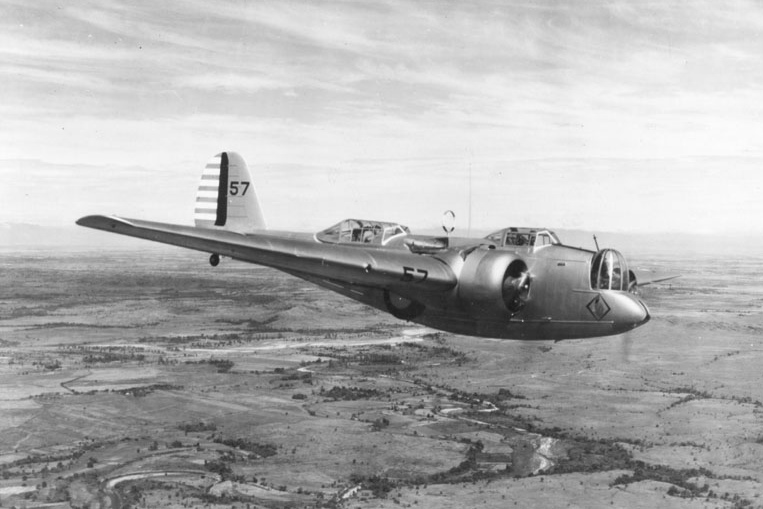
The first US aircraft to incorporate a gun turret was the Martin B-10, which first flew in 1932 and entered service in 1934. It had a rather odd-looking dome-shaped nose turret, immediately christened "The Beehive" by its amused crews. It's shown in the photographs below, mounting a single .30-caliber Browning machine-gun. Two more of these weapons were mounted in the middle fuselage, facing aft, although not in a turret.
Almost simultaneously the British Royal Air Force introduced the Boulton-Paul Overstrand bomber. This biplane aircraft first flew in 1933, and entered service in 1934. It was equipped with the RAF's first powered turret, containing a single Lewis gun. The turret was shaped somewhat like a dustbin (and, of course, was immediately christened as such by its crews). Rotation was powered by pneumatic motors, and the gun was elevated or depressed by hydraulic machinery.
Throughout the 1930's new aircraft carried more and more machine-guns for self-protection. Increasingly, they were turret-mounted. This began to cause problems in production, because each aircraft would have its own custom-designed turrets, with unique mechanical, hydraulic and electrical systems. This also complicated the task of those who had to maintain them: each successive model of aircraft needed new tools, techniques and training for their ground crews. Clearly, some form of standardization was necessary. This was achieved during World War II to a certain extent, although in the USA multiple companies still produced competing models rather than standardize on a competitor's product. In Britain the authorities enforced a standardized approach.
Let's take a look at some of the turrets in common use during World War II before we describe the war experience of the air gunner. We'll begin in the USA.
Consolidated Aircraft produced many successful turrets, including - oddly - a tail turret for the B-24 Liberator that was sometimes mounted in the nose as well!
The B-17 tail "turret" was interesting, in that it was a two-piece design. The gunner sat in a fixed glass cupola and fired the machine-guns (mounted below and behind him) by remote control. It was a difficult mechanism to develop, as the narrow tail of the B-17 offered no room for a conventional turret. It had to be lengthened and adapted to provide space for one. A description of the development of this unique design may be found here. A B-17G's tail turret is shown below.
The Glenn L. Martin Company had some interesting designs. Their ball turret is shown in the final picture below installed in the nose of a Martin PBM Mariner flying-boat.
(It should be noted here that a "ball turret" is shaped as the name suggests, like a ball. The gun(s) is/are fixed in place, and the entire turret moves in elevation and azimuth - in other words, on both the horizontal and vertical axes - to align the gun(s) on the target. The gunner moves with the turret, so he can be in almost any position, including upside-down if the amount of turret travel allows for it! In a conventional turret, the turret turns in azimuth (i.e. on the horizontal axis), while the guns are elevated or depressed (i.e. move on the vertical axis) by a separate mechanism. The ball turret was unique to US aircraft: the British stuck with more traditional turret arrangements.)
The Emerson Electric Company became the world's largest manufacturer of aircraft armament during World War II, including producing aircraft gun turrets.
The Grumman Aircraft Engineering Corporation produced a small ball turret, mounting a single .50-caliber machine-gun, specifically for its TBF Avenger torpedo-bomber. The turret was mounted at the rear of the glass enclosure for the crew, making it look like it was an extension of that compartment - although, in fact, it was a separate unit.
The Sperry Corporation produced the (in)famous retractable ball turret installed on B-17 and B-24 bombers. The turret was lowered from inside the fuselage to its operating position, and could be raised again when the need for its protection had passed. The gunner had to adopt a pretzel-like, almost foetal position to operate it.
This turret was regarded as a particularly hazardous assignment by air gunners, as if it were damaged in almost any position on its arc of movement, and rendered immobile, the gunner could not get out through the entrance hatch. This made it impossible for him to retrieve his parachute (which could not be worn in the turret, due to lack of space) and abandon the aircraft if necessary. Furthermore, if the turret or its lifting mechanism was so badly damaged that it could not be retracted into the fuselage, and if a belly-landing was necessary, the gunner inside the turret would certainly suffer a particularly gruesome death. This happened at least once during World War II.
There's also the story of the B-17 "Carolina Queen", that could not retract its ball turret before a belly landing. In a wonderful display of flying, tools were lowered to the aircraft on a rope from another plane. The "Carolina Queen" then undid its ball turret and dropped it into the English Channel before making a safe belly-landing at its base. The story and photographs may be found here. The aircraft is shown below after its safe landing.
The recollections of another ball turret gunner may be found here. A detailed description of its operation is given here.
From my mother's sleep I fell into the State, And I hunched in its belly till my wet fur froze. Six miles from earth, loosed from its dream of life, I woke to black flak and the nightmare fighters. When I died they washed me out of the turret with a hose.
Certainly, a solid hit on the turret would kill the unfortunate gunner inside. The photograph below shows one that took a direct hit from a cannon shell. It was photographed after being 'washed out with a hose'. You can imagine for yourself the carnage within.
However, a statistical study after the war showed that in reality, the ball gunner had the safest position in a bomber crew. The pilot was statistically the most likely to be injured or killed, with the other crew members not far behind. It was surmised that this was due to incoming fire from ahead or behind raking the length of the fuselage, hitting everyone in its path. However, the ball turret, in its lowered position, was below this line of fire.
The USAAF always envisaged daylight operations for its aircraft, and consequently wanted them to be as heavily armed as possible for their own defense. It did not rely solely on turret-mounted guns, but also installed them (in larger aircraft) on pintle mounts in the waist, shooting out to either side. The B-17 Flying Fortress and B-24 Liberator heavy bombers both used this arrangement. Beneath the diagram showing the layout of the waist guns are two photographs, the first of the B-17, the second of the B-24, showing waist gunners in position.
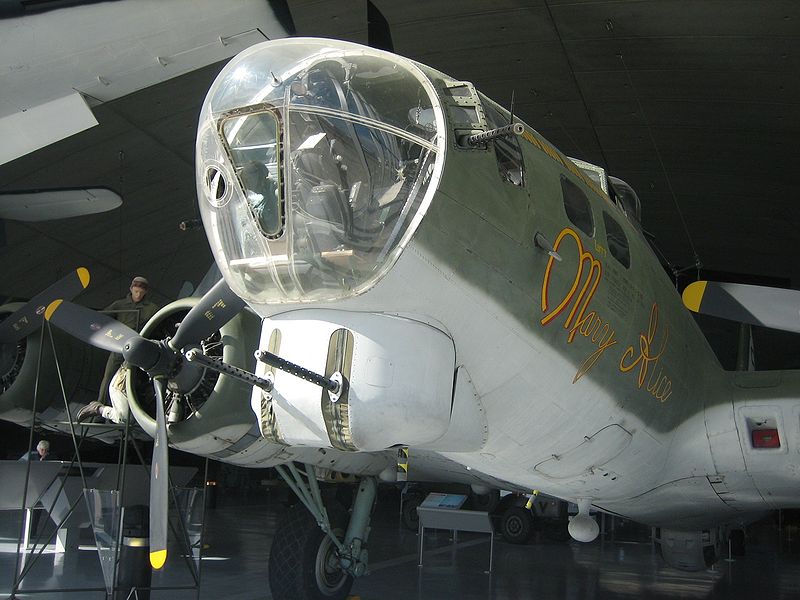
The B-17 also employed single machine-guns in positions at the side of the nose, referred to as "cheek" mountings. These were of limited utility, as they could not fire directly ahead - there was no room inside the fuselage for the gunner to get behind the gun and aim them in that direction. Early models of the B-17 were thus vulnerable to head-on attack, until the B-17G introduced a "chin" turret below the nose to cover this zone. The photograph below shows the "chin" turret, with one of the "cheek" machine-guns visible above it.
The famous PBY Catalina flying-boat also used waist guns, but these were mounted in so-called "blisters" extending beyond the hull. This permitted the gunners to fire them at more acute angles, and engage surface targets. The photographs below show these "blisters" and the mounting of the gun within them.
The USAAF standardized on the .50-caliber Browning M2 heavy machine-gun for its aircraft armament, both fighters and bombers. This superb weapon proved well suited to the air-to-air role, and served throughout World War II. (The common idiomatic expression "The whole nine yards" actually refers to the length of the ammunition belt for the .50-caliber machine-gun, and dates from this era.) It was eventually adopted by Britain as well, although never as a predominant weapon - in that country, the .30-caliber machine-gun soldiered on to the end of the war. It was considerably less powerful than the .50-caliber weapon, as can be seen in the photograph below, showing the two rounds side-by-side.
Britain's reliance on the lighter, shorter-ranged and less effective .30-caliber machine-gun is explained by their smaller, lighter aircraft, particularly those in use before and in the early years of World War II. These could carry more of the smaller machine-guns than they could of the larger M2 or equivalent weapons, and volume of fire was considered particularly important by the RAF. The early versions of its monoplane fighters, the Spitfire and the Hurricane, carried eight .30-caliber Colt-Browning machine-guns, rising to as many as 12 in some models before a combination of two 20mm. cannon and four .30-caliber machine-guns was adopted. By the end of the war the machine-guns had largely been supplanted by cannon as well, so that British fighters often mounted four 20mm. cannon in the wings, with no machine-guns. In its bombers, the RAF turned to the .50-caliber machine-gun for turret armament late in the war, but only in limited numbers.
This was influenced by three factors. First, the RAF's bombers flew at night. Its air gunners reported on numerous occasions that the maximum effective range at which they could see an enemy aircraft was about 300 yards, well within the range of the .30-caliber machine-gun. The longer range of the .50-caliber weapon would therefore have been largely superfluous, even though its greater hitting power would have been very welcome.
Second, wartime ammunition production in Britain was standardized on basic calibers. Their machine-guns for Army use were almost all in .303-inch caliber. To introduce a new caliber, requiring high-volume production, would have been difficult, particularly after Dunkirk, when Britain's Army had to be re-equipped virtually from the ground up. It made logistical sense to stay with the weaker, lighter caliber, simply because production facilities could be dedicated to it.
Finally, the RAF attached great importance to the weight of bombs carried by their aircraft. The USAAF found it acceptable that the B-17, for example, could carry only 2 to 3 tons of bombs on operations over Germany, plus one-and-a-half tons of ammunition for its machine-guns. The RAF wanted to maximize the bomb-load: its Lancaster bomber could carry up to 10 tons, and routinely carried 6 to 7 tons on operations. Fitting .50-caliber machine-guns would have meant trebling or quadrupling the weight of ammunition carried for them, at the expense of bomb load, which was an unacceptable trade-off for Bomber Command.
Air gunners in the RAF bemoaned the lesser hitting power of the .30-caliber round, but were stuck with it. To make up for the lesser power, RAF bomber rear turrets mounted four machine-guns, as opposed to the two fitted to USAAF bombers. Also, for special operations, RAF gunners would sometimes load a very high proportion of tracer rounds, making it look as if their guns were shooting cannon shells. One example of this occurred during Operation Chastise, the famous Dams Raid, when Wing-Commander Guy Gibson's front and rear gunners used a heavy concentration of tracer ammunition, because they knew they'd be shooting at anti-aircraft guns on the wall of the Moehne Dam and wanted to scare the gunners.
(Unfortunately, this expedient also had the effect (particularly at night) of pinpointing the bomber's location for enemy fighters - a mistake that cost many aircraft and lives.)
The RAF seldom used waist or beam guns, except in aircraft like the Sunderland flying-boat. Their bombers did not have sufficient space inside the fuselage to permit the easy deployment of such weapons. Instead, they relied almost exclusively on turret-mounted weapons.
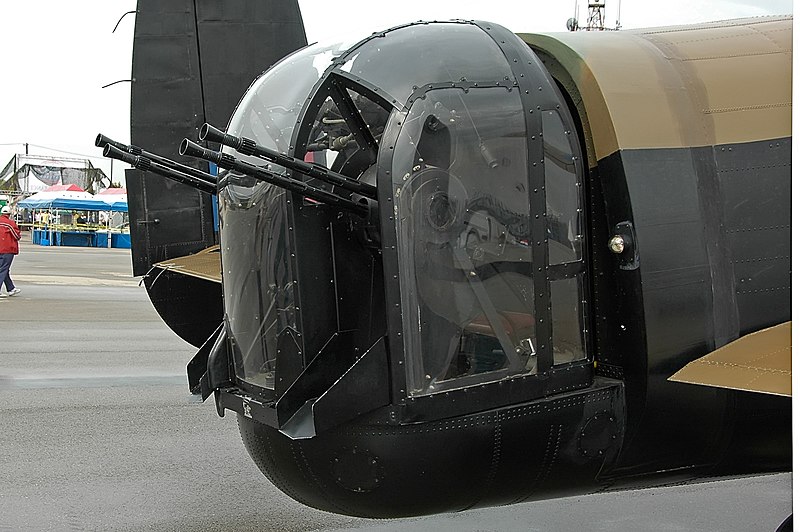
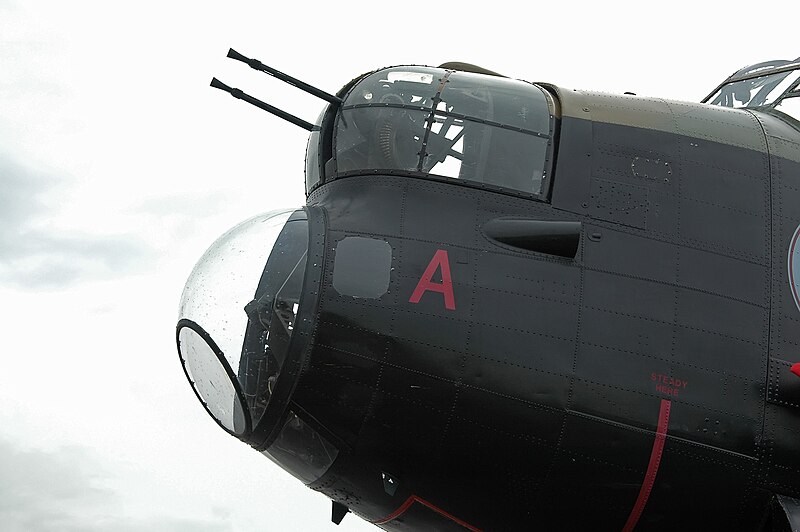
Many British aircraft turrets were designed by the Fraser Nash car company, which set up the Nash & Thompson company to manufacture them. These turrets were known by model numbers, prefixed with the letters FN for Fraser Nash. They were hydraulically powered. Below are shown the FN-20 4-gun tail turret and the FN-5 2-gun nose turret on an Avro Lancaster bomber. All weapons shown are Colt-Browning .30-caliber machine-guns.
Another British turret manufacturer was Boulton Paul Aircraft Ltd., known for such aircraft as the Overstrand bomber, mentioned earlier, and the Defiant "turret fighter". They licensed the turret technology of a French company, SAMM, and produced many turrets for RAF aircraft. The Defiant fighter is shown below, with a second picture showing its turret in more detail.
This turret was adapted in two- and four-gun versions for the Handley Page Halifax heavy bomber. However, the Halifax's performance was not particularly good, and the drag of a front turret degraded it further: so many examples were fitted with a rounded perspex nose, relying on a single machine-gun firing through it for forward defense, and using four-gun turrets in the mid-upper and tail positions to increase overall firepower. An aircraft thus equipped is illustrated below, along with the standard Halifax front and mid-upper/rear turrets.
For those interested in the engineering aspects of aircraft gun turrets, a technical description of the Boulton-Paul turret may be found here.
The Bristol Aeroplane Company manufactured turrets for its light bombers, the Blenheim and Beaufort. Below is shown the B1 Mid-Upper Gun Turret, removed for a museum display, and on a Blenheim Mk IV aircraft. The turret could be partially retracted in flight to reduce aerodynamic drag when no enemy aircraft were present.
In both British and American gun turrets, there often wasn't enough room for both the gunner and his parachute. If it became necessary to abandon the aircraft, the gunner had to turn his turret so that the doors or access opening faced into the fuselage: climb out of the turret: get his parachute: put it on: make his way to an escape hatch: and get out. In a violently maneuvering aircraft, or one spiralling down out of control, this often proved difficult, if not impossible - particularly if the gunner was injured. To illustrate, here's a view of the rear turret of the Lancaster, looking down the fuselage. The gunner's parachute may be seen attached to the wall of the fuselage in front of the turret.
Later, seat-pack parachutes were introduced. The gunner sat on his parachute, which meant he didn't have to find it and put it on in an emergency. However, he still had to make his way from his turret to an emergency exit. If the turret had been damaged, and jammed in such a position that its doors were blocked . . . then the gunner was as good as dead.
None of the turrets or gun positions so far mentioned were air-tight. They allowed the icy air from outside to penetrate the turret and the aircraft. This meant extreme discomfort for the gunners, who had to contend with temperatures of -40° Fahrenheit or even lower. Electrically-heated suits were developed, but early models displayed a regrettable tendency to malfunction - even shorting out in mid-air, causing fires. Air gunners who had to strip almost naked - in those temperatures - to extricate themselves from burning clothing, reportedly complained in such corrosive language that it allegedly shocked even long-serving NCO's! Eventually the heated clothing was perfected, and became more reliable.
The RAF initially trained its wireless operators as air gunners, giving them the combined designation of "WO/AG". As the larger bombers (the Stirling, Halifax and Lancaster) came along, with their seven crew members, the two roles were separated. Gunners were usually given the rank of Sergeant upon completion of their training. This used both ground ranges and aircraft, shooting at drogue targets towed by other airplanes. Training courses were also held in Commonwealth countries such as Canada and South Africa. The photograph below shows air gunners in training at No. 2 Bombing & Gunnery School in Saskatchewan, Canada.
A number of training aids were used: aircraft turrets mounted on fixed or mobile mountings, targets mounted on rails (as illustrated above), skeet shooting with shotguns from fixed and mobile firing points, and specially-developed training aids such as the "Aerial Dart Gun".
Gunners were constantly reminded that their job was not primarily to shoot down enemy aircraft, but to protect their own plane. They would do this by remaining constantly alert, scanning the skies for enemy fighters, and directing their pilot to take evasive action as and when necessary. Indeed, under certain conditions it was considered better for them not to fire, as the muzzle flash from their guns and the tracers in their ammunition would give away their position (remember that RAF bomber operations were mainly conducted at night). It was emphasized during their training that many German night-fighter pilots would avoid a bomber that was clearly on its guard and taking evasive action, preferring to choose another, less alert victim.
The British poet, Philip A. Nicholson, wrote of the air gunner's job:
Alone in his transparent shell, A speck in space, He sits, poised in his airy kingdom; At his back the unknown, Before him the unfolding map Of his journey. Guardian of seven lives, Taut with the concentration of survival, He swings his turret through vigilant arcs, Eyes straining for the fighters, Braced for the violence of surprise.
Unfortunately, the confidence of bomber crews that they could spot enemy fighters at night proved to be vastly over-inflated. British night-fighter crews operating as intruders with the bomber stream found that they could approach bombers almost with impunity, and fly alongside or beneath them at very close range without being detected. They reported this to their superiors, but it was decided not to inform bomber crews of the facts for fear that it might damage their morale. Air gunners who did not detect an approaching fighter often paid with their lives, as their turrets were often the first targets for the enemy. This picture of a Stirling rear turret grimly illustrates the point.
American training for air gunners was more elaborate. It included range training with .30-caliber and .50-caliber machine-guns, during both day and night:
machine-guns mounted in turrets on vehicles, to learn to shoot while both stationary and moving;
aircraft turrets and waist gun installations, with and without their glass "shells", mounted in buildings or on ranges for familiarization;
and shooting at drogue or sleeve targets towed by other aircraft.
Great attention was paid to teaching gunners how to "lead" enemy aircraft: in other words, aim where the bullets would be when the enemy aircraft reached them, rather than at the place the enemy occupied when the trigger was pulled. Some of the instructional materials are shown below.
Some innovative training equipment was developed. A special full-auto BB gun was manufactured by the McGlashan Air Machine Gun Corporation of Long Beach, California. It was used on a 1/20-scale target range, also shown below.
Commercial semi-auto shotguns were also adapted for training use. They were mounted in firing cradles similar to those used for machine-guns, and placed in the back of trucks. The trucks would drive up and down a skeet range while clay pigeons were thrown for the benefit of trainee gunners manning the shotguns.
The USA also developed a special-purpose training aircraft, the AT-21 Gunner, for use in training air gunners.
It wasn't very successful, and only about 175 were built. Before long the USAAF began to use actual operational bombers to train gunners, so that they were quickly familiarized with the planes and equipment they'd use in combat.
Another interesting aircraft designed to help with air-gunner training was a heavily modified version of the Bell P-63 Kingcobra fighter.
The special variant was known as "Pinball", and was:
. . . a manned flying target for gunnery practice. The aircraft was generally painted bright orange to increase its visibility. All armament and the regular armor was removed from these RP-63 aircraft, and over a ton of armored sheet metal was applied to the aircraft. This was fitted with sensors that would detect hits, and these hits were signaled by illuminating a light in the propeller hub where the cannon would have been. This earned the aircraft the unofficial nickname of Pinball. Special frangible rounds made of a lead/graphite combination were developed that would disintegrate upon impact.
Several hundred "Pinball" P-63's were ordered in 1944-45, and they were widely used as targets. There were several problems - not least of which was the occasional accidental inclusion of live ammunition in the belts of training rounds, which shot down more than one aircraft! A more detailed description of the "Pinball" project may be found here.
As the intensity of air combat over Europe grew, the USAAF began to experience a flood of victory claims from its air gunners. This was not surprising, of course. A given formation of bombers might have fifteen to twenty aircraft. Each had five or six people shooting at oncoming enemy fighters. If one enemy aircraft was shot down, dozens of air gunners might claim - in perfectly good faith - that they hit it. However, this led to utterly unrealistic claims of successes, so much so that on some days (as post-war investigations proved), USAAF gunners claimed to have shot down more German aircraft than had actually been in the air! Royal Air Force intelligence experts advised USAAF staff to divide their gunners' claims by at least six in order to obtain a realistic figure. The USAAF refused, somewhat indignantly, and only conceded the point after the war. As one commentator has acknowledged:
Even the best all-round armament was never enough. Deep penetrations in German territory turned out to be extremely costly. The most famous examples are the attacks on Regensburg and Schweinfurt: The first attack, on 17 August, resulted in the loss of 60 bombers out of a force of 363. Some consolation was found in the claims by the gunners, which amounted to a total of 228 enemy fighters shot down; even after careful evaluation of claims the 8th AF estimated the German losses to be between 148 and 100. In fact the Luftwaffe had lost only 25 fighters. A repeat attack on 14 October gave a confirmation, if any was necessary: 65 more B-17s were lost. The initial claim of enemy fighters downed was even higher than in the first attack, 288; but even the official figure of 104 was way above the real German loss: 35.
Air-to-air gunnery was also becoming more and more difficult, for fighters as well as bomber air gunners, as the speed, altitude and maneuverability of aircraft improved. Enhanced gyro-stabilized gunsights were developed for both fighters and bombers, but these could only do so much. As an article in Air Force Magazine has pointed out:
Shooting remained a difficult task, more art than science. The speed of aircraft had tripled between wars, but the rate of fire for machine guns remained at about 800 rounds per minute. When a 450-mile-per-hour fighter attacked a 300-mile-per-hour bomber head on, the rate of closure was close to the speed of sound. In one second, the fighter's relative position changed by 1,100 feet while a gunner was able to get off only about a dozen rounds. A nose gunner barely had time to spot an attacking aircraft and fire before it was gone. Waist and tail gunners had more time to aim but still little time to track targets. The solution was to put more guns on each plane and to use a defensive technique similar to the old Lufbery circle. Based on his plane's position in the formation, each gunner was assigned a specific, narrow area to cover. None had to move his guns more than a few degrees in any direction in order for the formation to confront an attacker with a daunting array of firepower.
Even against these odds, many enemy fighters took the risk, and many scored. More often, however, they looked for straggling bombers that had been crippled by flak or were suffering from mechanical problems. In this position, the lone airplane often could rely only on its own guns for protection. Many fell prey to the fighters, but a remarkable number survived their running gunfights to fly again.
To illustrate the relative speeds involved, here's a clip of wartime gun-camera footage from both US and German aircraft, showing Luftwaffe fighters in action against B-17 bombers. Just look at the closing speed of the fighters, particularly the jet-powered Messerschmitt Me-262. It doesn't give air gunners much time to aim at them, much less hit them!
Gunners were targets for enemy fighters, of course. If they could knock out the bomber's defenses, they could shoot it down at their leisure without having to worry about return fire. Casualties among air gunners were typically very high. This B-24's rear turret was completely blown off by enemy fire, which also caused severe damage to the tail control surfaces.
Bombers didn't only have to worry about enemy aircraft, either. Bombs falling from friendly aircraft above them often caused severe damage - particularly to RAF bombers, flying at night, which couldn't see the danger. This bomber's rear turret was knocked off by a falling bomb, killing the gunner inside. Fortunately for the rest of the crew, the bomb didn't explode, and the aircraft was able to make it back to base.
Bomber losses mounted to such an extent in 1942-43 as to threaten the ongoing strategic bombing campaign as a whole. The RAF responded with an increasingly technological approach, emphasizing electronic warfare, radar, early warning receivers and other electronics. Air Vice-Marshal Donald Bennett, Commanding Officer of Bomber Command's Pathfinder Force, made a serious argument that since gunnery could not protect them, the large, heavy four-engined bombers, with their seven crew members, should be replaced by the twin-engined de Havilland Mosquito. As one report states, Bennett pointed out:
* Mosquito carries to Berlin half the bomb load carried by a Lancaster, but... * Mosquito loss rate is just 1/10 of Lancasters' loss rate * Mosquito costs a third of the cost of a Lancaster * Mosquito has a crew of two, compared to a Lancaster's crew of seven * Mosquito was a proven precision day bomber and the Lancaster was not.
Bennett added that any way you do the math with those data, "It's quite clear that the value of the Mosquito to the war effort is significantly greater than that of any other aircraft in the history of aviation". In the German side, Erhard Milch, the deputy head of the Luftwaffe, said about the Mosquito "I fear that one day the British will start attacking with masses of this aircraft". But in one of the greatest allied mistakes in World War 2, bomber command persisted with its heavy bombers, and less than 1/4 of the Mosquitoes produced were of bomber types.
The Mosquito, of course, carried no defensive armament at all, relying on its speed to evade attack. This foreshadowed the way in which modern jet bomber and strike aircraft seek to avoid enemy attack.
Both the RAF and USAAF sought ways to improve the accuracy of air gunnery, and to find more effective weapons. The RAF developed the Automatic Gun-Laying Turret, code-named Village Inn. It was designed by Fraser Nash (model FN-150), and was very successful, but arrived too late to have much impact on the war. Only about a hundred aircraft were equipped with it before the fighting was over.
A very successful non-radar-guided .50-caliber turret was developed by Rose Brothers, and fitted in the mid-upper and rear positions on some Lancasters in late 1944 and 1945. The extended range and heavier punch of its weapons proved very successful, particularly in the daytime operations that Bomber Command was undertaking at this late stage of the war. Sir Arthur Harris, Commander-in-Chief of Bomber Command, in a letter to Rose Brothers after the war, called it:
. . . easily the best turret to date. Furthermore it is the only turret from which gunners can escape, if they have to abandon the aircraft, with any real chance of getting away with it, and we have had several Rose turret occupants back as the sole survivors of crews . . .
The ease of escape was due to the fact that a Perspex panel between the guns could be easily removed, allowing the gunner to escape between them. By this stage of the war he was wearing a seat-pack parachute, so he did not have to re-enter the fuselage to retrieve it before escaping. The picture below shows such an escape during operational testing.
A later version of this turret was fitted with the Village Inn radar, in the same way as the FN-150 turret, as shown below.
Tests were also conducted with 20mm. cannon replacing machine-guns in turrets. The experimental Boulton-Paul Type H Mark II 20mm. mid-upper turret is shown below, mounted in a Lancaster bomber.
Experiments were also conducted with remotely-operated 20mm. cannon mounted in unmanned upper and lower barbettes, rather than turrets. They are shown below mounted on a Lancaster bomber in 1944.
However, aiming the guns from their remote control station proved difficult, and the problems were not resolved before the end of the war. The barbette mount never entered active service.
The USAF tried converting B-17 bombers into the YB-40, containing many more machine-guns than usual. It was intended to go out with bomber formations to "ambush" attacking fighters.
However, it was found that the extra weight of guns, ammunition and crew, and the additional aerodynamic drag of its guns, meant that the YB-40 was very sluggish, finding it difficult to keep up with the more lightly-laden bombers: so the experiment was abandoned. Nevertheless, lessons learned on the YB-40 project were applied to the B-17G model, improving its defenses and combat effectiveness.
The real advance for the USAAF came with the advent of the B-29 Superfortress.
This huge bomber had a completely new approach to gunnery control:
With the revolutionary Central Fire Control System (CFCS), the B-29 had four remote controlled turrets, each armed with two .50 cal M2/AN machine guns. Four gunners were able to control these turrets with the use of four General Electric made analog computers, one above the Norden bombsight in the nose and three in a pressurized compartment in the rear fuselage which incorporated clear blown sighting blisters. The gunner manning the sight in the upper rear station was the "Central Fire Control gunner" whose job was to allocate turrets to each of the other three gunners, avoiding confusion in the heat of battle. The CFCS had (at that time) a highly advanced analogue computer which corrected for the B-29's airspeed, the target's speed, target lead, gravity, temperature, barrel wear, and humidity. Because of this, the .50 caliber machine guns of the B-29 had a maximum effective range of 1,000 yards, double the range of the manually aimed machine guns of the B-17 Flying Fortress. The tail gunner could only control his own weapons (two M2/AN Brownings plus, in early production B-29s, a 20mm M2 cannon) and the lower rear turret. The tail guns eventually got their own APG-15 gun control radar.
The B-29's weapons were employed against Japanese interceptors with considerable success. Clearly, the speed of modern air-to-air engagements (which was increasing all the time) had made old-fashioned "aim-by-eye" weapons obsolete.
With the dawn of the jet age, the use of defensive turrets and guns on bomber aircraft almost disappeared. They remained only for rearward defense, using radar-guided weapons, and became less and less effective as the speed of attacking fighters increased. With the advent of guided missiles, they were abandoned on later generations of bombers. The last USAF bomber to have guns fitted in its tail was the B-52 Stratofortress, and all were removed during upgrades to the aircraft in the 1970's.
The RAF continued to fit turrets to its Lincoln bombers (successors to the Lancaster), but the service's jet-powered V-bombers carried no defensive armament. The final derivative of the Lancaster family, the Shackleton maritime reconnaissance aircraft, carried two 20mm. cannon in a turret in the nose, partly as defensive armament, partly to attack surfaced submarines and ships.
The days of air gunners are long past. Modern aircraft move so fast and so far that it's almost inconceivable for a gunner, firing a single optically-sighted machine-gun from a moving platform such as another aircraft, to make a hit on them before they've been and gone. Missiles and radar-directed gunsights have taken over the field.
It's also worth remembering the truly appalling casualties among bomber crews in general, and air gunners in particular. If one looks at the loss figures for RAF Bomber Command and the USAAF bomber Air Forces during World War II, in both the European and Pacific theaters, it's clear that at least 50,000 air gunners died in action. Many more were wounded, or shot down and taken prisoner.