Friday, December 17, 2021

Food: higher prices, more shortages - and it's not just inflation


Last month I published an article titled "Remember those warnings about the food supply?"  In it, I noted:


The fertilizer market is currently incapable of supplying enough product to meet demand - and that may affect next season's harvest quite appreciably, not just in the USA, but worldwide.


Now the Wall Street Journal warns that "Surging Fertilizer Costs Push Farmers to Shift Planting Plans, Raise Prices".


Escalating costs are leading some farmers to shift acres toward less fertilizer-intensive crops, like soybeans, while others said they plan to cut back on their overall fertilizer use, potentially reducing future harvests.

Lower grain production could translate to higher prices for farm commodities like corn, analysts and farmers said. They added that higher costs for such commodities would further inflate prices of pantry staples like cereal and cooking oil, as well as beef and other meat, because producers rely heavily on grain to feed livestock and poultry … Fertilizer is typically among farmers’ biggest expenses each year, and higher prices threaten what has been a banner year for many growers.

. . .

The rise in fertilizer costs is partly fueled by elevated natural gas prices, a key ingredient for nitrogen-based fertilizers, as well as by severe storms in the U.S. that disrupted fertilizer plants earlier this year and a move by China this summer to ban exports of phosphate, a major fertilizer component. Some farmers also blame fertilizer companies for the rising prices.

. . .

The potential for higher fertilizer costs to cut into production of corn and other crops could fuel continued food-price inflation. Food costs have already climbed this year as companies have passed along higher labor, transport and packaging costs.


There's more at the link.

We're already seeing the effects of the "food crunch".  Fellow blogger Sgt. Mom at Chicago Boyz notes:


Considering how the price of groceries and everything else is inflating, and how supply-chain issues are leaving unexplained and erratic gaps on store shelves, this indeed might be the last year that we can do the fudge assortments [as Christmas presents]. Butter, cream, chocolate, sugar – all those good things will certainly be more expensive next year. The prices for meat, especially for beef and bacon have all but doubled in the last few months alone. Looking ahead and considering the credible news sources available to me, makes me wonder if grocery store shelves might eventually look like those in Venezuela – bare of anything at all, or like those in Soviet Russia, years ago?

Food austerity looms on the horizon like an oncoming storm-cloud. In the near future, we may not be able to afford certain items, or they aren’t available at any price. We had a taste of what serious shortages might look like, last year during the first weeks of the Covid panic, when shelves of canned goods were practically stripped bare, as was the bakery and fresh meat section, while shoppers waiting impatiently for milk and eggs to be restocked. We worry, and not without reason, about what will happen in the coming year. I can’t see how things can improve, economically and politically, although living in Texas may shelter us from the very worst that can happen.

It has been very nice, living in a world where ordinary, working-class people like my daughter and I can afford to give away a nice edible gift of home-made treats, much less be able to eat protein like eggs and meat for supper five nights out of seven. I wonder if we are living in the last days of the golden era that was an era of plenty; plenty of food, cheap gas, inexpensive luxuries. What a piece of work are our ruling class, that they would cheerfully consign regular citizens to a bleak, cold and deprived future.


Again, more at the link.

I'd say her apprehension is fully justified.  It's why I've increased our own emergency supplies and reserves of food, even taking on additional credit card debt in order to ensure that we've got at least some additional food security.  That's also why more and more consumers, those who can see what's coming and the early effects already visible all around us, are changing their shopping habits right now.  They're buying as much food and other everyday needs as possible, so as to ensure that in future, in a high-inflation environment where everything costs more as time passes, they'll have at least some of them on hand rather than being forced to buy what they may no longer be able to afford.

I respectfully suggest that we should plan our budgets - and our pantries - so as to have at least thirty days of food on hand at all times.  That needn't include luxuries, but it should include a nutritionally adequate, balanced diet for every member of the household for at least that long.  If our budgets can stretch to a three-month balanced food supply, so much the better.  As for the longer term, very few of us can afford (or have the space to store) a full pantry sufficient for a more extended period;  but we can often find or make space for basic foodstuffs like dried beans, rice, etc.  They may not be very appetizing, but they'll last a long time, and beans and rice together make a complete protein that's adequately nutritious.  The way things are going, supplies like that might just come in handy . . .

Peter


"Perverts and fetishists psychologically manipulating and abusing children"


That's what fellow blogger J. Kb, writing at Gun Free Zone, calls aggressive recruitment and propaganda campaigns by California teachers to persuade children that they're either gay and/or transgender.  His conclusion:


Let me be clear, this is not teachers helping troubled kids.

This is perverts and fetishists psychologically manipulating and abusing children.

This is groomer behavior.

For a long time the LGBT community swore up and down they were not child molesters out to get your kids.

As it turns out the activist LGBT community really is out to get your kids and turn them into abused gender-confused sexual playthings.

This is coordinated and orchestrated evil.


There's more at the link.

Reading the articles to which he links to provide evidence, I can't disagree with a word he says.  This is evil, pure and simple.  The trouble is, those who engage in it don't regard themselves or their actions as evil.  They've abandoned conventional "morality", regarding it as old-fashioned and themselves as above its restrictions.  They probably truly believe that they're right to do what they do, and right to encourage the children under their care to explore alternative sexuality and life choices.

When you're dealing with people like that, "true believers" who regard their actions and choices as "normal" and justifiable, there's no common ground on which to negotiate.  They'll regard you as a hopeless stick-in-the-mud, and see their duty as being to "liberate" your children from your "malign influence".  People like me, on the other hand, see things precisely the other way around.  We intend to "liberate" our children from the malign influence of teachers like that - and we're willing to do so by any and all means necessary.

I suggest that to put our kids into public schools today, knowing in advance that they're going to be subject to such pressures, is nothing more or less than child abuse.  They deserve better, and we owe them better.

I further suggest that allowing such teachers to remain in office, knowing in advance what they're going to try to do to all the children in their care, is also child abuse.  Any means necessary to do so are, in my opinion, justified.  The authorities and the law may disagree . . . but they're not the ones responsible for "training up a child in the way he should go".  I wish there were more parents who would observe that precept - and teachers, too.

J. Kb.'s final observation:


California is in desperate need of house cleaning with woodchippers.


It's hard to disagree.


Peter


Creepy!


I had to laugh - and suppress a shiver - when I read about a new knife (actually, more like a short sword) from Jean-Marc Laroche, a French knifemaker and artist.  The hilt (perhaps "handle" would be a better term) is his creation;  the blade is from Swedish knifesmith Roger Bergh.


(Click to enlarge)


Blade magazine reports:


French knifemaker/artist Jean-Marc Laroche refers to his latest creation—this issue’s cover piece—as “The Living Knife.” Since it has a “hand” for a handle with “fingers” that close, an “eye” and an overall lifelike appearance, who are we to argue? As you grab the handle, the “fingers” actually grab back so that it’s hard to tell who’s holding whom. And, as the fingers grab your hand, the “eye” opens. The hand also is embellished with gears in the Steampunk style.

The Living Knife is indeed a most unusual creation—but then Laroche has been making otherworldly pieces for over two decades. Even by his standards, though, this one takes his knife art into uncharted territory.

“It was from the cinema of fantasy films that I drew my inspiration,” he notes. “It took me 12 years to implement my idea, six months to carry it out and a fair number of technical difficulties had to be overcome.

“Yet here it is, like a cunning thing from another time that a mad inventor out of the 19th century would have dreamed up. This biomechanical being activates its workings to move its fingers; it seizes control of the situation with its eye’s intelligence.”

The Living Knife is an assembly of mechanical parts, the prototype having been made in resin. A few rare versions in bronze, gold and silver are in the process of being forged.


There's more at the link, including a brief look at some of the artist's other creations.

Here's a video showing how the knife works.


You'll find more videos from Jean-Marc Laroche at his YouTube channel.  The man obviously has a unique vision of knives as art.

Personally, I find the thought of a knife that grabs my hand in return when I grab it to be more than a little creepy - but then, I'm old-school like that!


Peter


Thursday, December 16, 2021

A nurse reader describes the state of her hospital


We've heard plenty of horror stories about the state of US hospitals at present, both from the perspective of COVID-19 and the state of health care in general.  A reader who's a nurse wrote to me this week describing conditions at her hospital.  She gave me permission to share her message, provided she was not identified in any way.


There are no inpatient beds; we're swamped.

Last weekend, we were holding 16 admissions on gurneys in our ER that there were no beds for upstairs. Some KungFlu, some other stuff. The biggest problem is that admin never replaced the staff they laid off during the lockdown. We are running with skeleton crews in ER and inpatient units, and just waiting for a Sentinel event. We're usually taking 4 patients each in ER; now we have 6-8. Inpatient is worse; I recently handed off a patient getting blood (vitals every 15 minutes) to a nurse who already had 9. I felt so bad for him, but there wasn't anything I could do.

Plus, they cut our housekeeping staff, and now nursing has to clean all the rooms as well.

And they cut our respiratory therapists by half, so when we get a patient in respiratory distress, good luck finding an RT for breathing treatments.

And, I discovered, there are no ambulances to transport between facilities anymore either - we used to have them in house, to take patients to other hospitals, or back to the nursing homes. Now they wait for hours, taking up ER beds.

And, most of our security guards have quit, they won't say why. This is particularly concerning to me, as the level of incivility right now is off the charts. I found out that a drug seeker who shoved me into a wall the last time I had her, brought a gun with her the following week. And the medical director insists that we can't ban her bc it would be rayciss, and she has sickle cell, so acting out is how she shows she's having pain. Ugh.

I just don't know where the employees have gone.

Which leads me to night before last, when one of the hospitalists (not local) came to see a covid admission I was holding in the ER. He said he was sick of covid.

I tend to keep to myself at work, but I just smiled and said, but we're only 18 months into two weeks to flatten the curve!

This pissed him off. Then he read her chart and found out that she was not vaxxed, stood at the nurses desk outside her room, and started on a rant about people who won't get vaxxed, and how they shouldn't be allowed to even come to the hospital, and how people like YOU (me) are making the pandemic all about politics, and how great Biden and Fauci are. (I never brought them up.) Then he segued into a bunch more rants about how whypeepo in jacked up pickup trucks with their American flags make him uncomfortable, and how the American flag is a symbol of oppression…

He went on for SO long, and was so loud, that I just left and started going into random patients' rooms to check on them. Came out, still ranting. He stood there shouting for so long that the patient actually got up and left. I really hope she went to another hospital.

When the doctors are driving patients away bc of their race and vacc status…


I'd be interested to hear the reactions of other nurses to her comments.  Is your institution as bad, or worse, or better?  Paging Aesop…

Peter


The Salvation Army learns the meaning of "Get woke, go broke"


I've long been a supporter of the Salvation Army when it comes to effective, realistic, practical disaster relief and help to the poor.  For decades I've donated to them in preference to the Red Cross or other mammoth, overly bureaucratic relief organizations, and I've recommended them to my readers in these pages.

No longer.

When it came out, last month, that the Salvation Army was circulating a "guide" titled "Let's Talk About Racism", I immediately smelled a rat.  After seeing so many organizations infiltrated by secular-humanist "woke" philosophies, I hoped against hope that the Salvation Army had been able to resist their encroachment.

Sadly, the truth proved to be even worse than I'd feared.  Despite their protestations about being "misunderstood" and their immediate withdrawal of the "guide", it was clear that at least part of the Salvation Army's leadership had been seduced by the theoretical as opposed to the theological.  They had lost sight of the eternal truth that a Christian church's primary, overriding duty and responsibility is to proclaim "Jesus Christ, and Him crucified", rather than any other message (particularly secular ones).  In proclaiming the former, the latter are automatically addressed, albeit from a radically different perspective to the world's answers.

As Sundance notes:


If you wanted to completely destroy the guiding mission of a charity, the Salvation Army is showing everyone exactly how to do it.

I’m not sure what qualifications or prisms others use, but myself, as a donor, I want to see my money used by a charity in such a way as to care for people who are in the most need – and that has absolutely nothing to do with race or any other qualification.  I am literally stunned by the intent of the Salvation Army in this mess, and their cleanup effort is even worse.

This is one of the biggest disappointments of the year, and yet, again shows that organizations can lose their entire purpose by following leadership making stupid decisions.


There's more at the link.

(Tragically, the Salvation Army finds itself in good company.  Many mainstream Christian denominations have done as badly, or worse.  To name just one example, look at how the hierarchy and leadership of the Catholic Church have effectively abandoned the faithful over the past twenty years or so in connection with the clergy child sex abuse scandal and other issues.)

Now the Salvation Army finds itself desperately short of funds and other contributions.


The Salvation Army is facing a shortage of toys and donations ahead of the holiday season, and urge communities to find a way to help.

The nonprofit reports it gets 75% of total annual donations during November and December, and they are once again in need of support ... "There are many reasons why both financial and toy donations are down this year, not the least of which is likely pandemic fatigue and concerns about employment and the future," said Colonel Cindy Foley of the NW Salvation Army Division. "We are actually trying to provide food, shelter, toys and clothing to double the number of families we served last Christmas, and in the midst of the growing need we are seeing fewer people donating at our virtual and physical kettles."


Again, more at the link.

Surprise, surprise!  What else did the Salvation Army expect?  If you, in so many words, accuse your most dedicated supporters of racism, why are you surprised when they withdraw their support?

The Salvation Army should have read their Bibles more carefully before deciding to step away from Scripture and towards secularism.  The prophet Hosea's warning to Israel might have given them pause.  "They have sowed the wind, and now they will reap the whirlwind".

My donations to the Salvation Army will, in future, consist of one of these preprinted slips, cut out and kept in my wallet for use when I encounter one of their famous "Red Kettles" at local supermarkets and other sites.  (Click the image for a larger view.)


That, at least, is a contribution they'll understand.  (Aesop's contributions will be somewhat more graphic, as will his ongoing rejection of their position.)

Peter


Wednesday, December 15, 2021

URGENT - Mike Hendrix at Cold Fury needs our help (UPDATED)


Mike Hendrix, who blogs at Cold Fury, has been admitted to hospital with a case of poisoning that's turned into a SERIOUS, potentially deadly infection.  I'll let fellow blogger Big Country Expat (a.k.a. The Intrepid Reporter) explain, from a post he left at Cold Fury, where he's also one of the contributors.


I just got word that my brother-from-another-mother Mike Hendrix, late of the famed rockabilly band The Belmont Playboys and more recently of the Blog "Cold Fury", has gotten seriously hemmed up medically speaking. Last Thursday after a slightly prolonged absence from his blog, I reached out to him to find out WTF was going on and I heard back that he'd come down with a nasty case of food poisoning.

Since then, apparently something faaar MOR serious happened.

His brother (actual) Jeff called me tonight as I left one of my more 'colorful messages' on his phone (in possession currently by his sainted lil ole Lady Mom) who apparently when she recovered from my diatribe, had Jeff call me to fill me in on whats up.

Essentially Mike's seriously ****** up.

Food Poisoning turned out to be a MAD infection. His diabeetus didn't help the issue, so they had to lop off his foot, then his leg, as the infection was/is spreading. They're fixin' to make it even MOR stumpy as the infection still isn't under control. He's in critical/ICU level condition, but NOT COVID related thank the Gods.

So, My brother-from-another-mother, henceforth now known as "Peg-Leg Mikey" is gonna have some serious medical bills and life altering needs.


There's more at the link.  It sounds very serious indeed:  if they've amputated part of his leg twice, and are considering a third round, that probably means he's been fighting off (or failing to fight off) gangrene.  That's really bad news.

You'll find a fundraiser for Mike at this link.  If you've enjoyed his writing at Cold Fury, please consider donating to his support.  I've done so, and I'm passing the word on behalf of BCE.  Mike's one of the (very) good guys, and I'm sure he'll appreciate the help, as will his family.

Thanks in advance.

Peter

EDITED TO ADD, ON THURSDAY EVENING:  BCE has posted an update about Mike's condition on his blog.  He's still in a bad way, but appears to be holding his own.  A big "Thank you!" to everyone who's donated so far.


An illegal alien invasion, aided, abetted and sponsored by our own government


In case you thought the border crisis had eased any, be aware that it's worse than ever.  Three independent reports bear this out.

Let's start with Michael Yon:


Texas National Guard may as well be working for smuggling cartels. Cartel Coyotes hand off these invaders to TNG, to Texas law enforcement, and they end up on ‘free’ flights to your town.

Just following orders, Sir. They would follow orders to take our microphones and 2nd Amendment. Those true Americans who will not blindly follow orders are being purged.


Next, Ben Bergquam has an on-scene video report.  Click the link to watch it for yourself.

Finally, Jeff Rainforth reports in more detail.


Last week I visited the border with Ben Bergquam ... What we didn’t expect to see was a massive cartel operation in which hundreds of migrants were illegally ferried into the US via rafts, and the Biden administration assisting them. Below are videos I took of the operation with a night vision camcorder.

. . .

I was carrying two drones in their cases and was looking for a good spot to take off and land. Just as I was setting up the infrared drone to get it in the air, a Border Patrol agent pulled up and started asking who we were and said that I couldn’t fly my drones in the area. I asked why and he replied, “you just can’t.” Miffed, I started walking back up the trail to where we had parked our rental truck. A few other Border Patrol agents asked Don (Ben’s cameraman) and me who we were with and what we were doing there.

On the road above the river, I was about to put the drone up away from any law enforcement. It’s not illegal to fly unless the FAA has restricted airspace where you are. I decided to check the FAA’s drone flight app which notifies pilots of flight restrictions. I was shocked to see that the FAA had indeed restricted drone flights in the area for ONLY three hours. In fact, the FAA had restricted drone flights across most of the Texas border, Louisiana, Mississippi, and part of Alabama. Apparently, the Biden administration didn’t want the public to see what was happening that night.

. . .

We crossed through the government staging area where the illegal aliens were being processed, and a man in uniform who identified himself as head of the Mexican unification team (or something) tried to stop us from filming. Bergquam informed him that we had 1st Amendment rights and that we were going to film (Ben is seriously fearless and takes no crap).

. . .

While we were filming at least one National Guard member told us not to, and to stay away from the river staging area where NG and Border Patrol had the illegal aliens waiting. Biden sure didn’t want America to see what was happening ... Several raft loads had crossed before we filmed. We caught the final two raft trips ... We estimate the cartels got in up to 400 illegal immigrants while the Biden administration did everything to stop citizen journalists like Ben and me from filming.

. . .

As you can see, the Biden administration is doing everything they can to keep the American people in the dark with regards to what cartels are doing on the border.


There's more at the link, including a 15-minute video report.

Four points:

  1. The mainstream media, from the left wing to the right, are totally ignoring what's going on along our southern border.  Why the hell aren't more mainstream media voices being raised about this?  It's no longer just illegal aliens - it's an actual, verifiable invasion.
  2. None of these illegal aliens is being screened for diseases, having their backgrounds checked, etc.  For all we know, entire squads of terrorists could be infiltrating the USA with the active assistance of our own government!
  3. Every individual who's crossing the border today will have to be kicked out of the country tomorrow by a more responsible administration.  We're storing up a multi-billion-dollar headache for a future government.
  4. Why the hell is the US government cooperating with Mexican cartels at all???

If anyone has any answers, I'd sure like to hear them.  All I know is, if the Texas National Guard is complicit in this criminal activity, it needs to be severely disciplined.  If Governor Abbott is allowing that to happen, he needs to be removed from office at once, if not sooner, and replaced by someone who'll put this state's interests first.  It's sickening!


Peter


Heh


One of the Web comics I follow daily is Jennie Breeden's "The Devil's Panties".  Yesterday's cartoon made me chuckle.  Click the image to be taken to a larger version at her Web page.


If you aren't reading "The Devil's Panties" regularly, you're missing some prime-grade snark.

Peter


"Where I Live, No One Cares About COVID"


That's the title of an article in - of all outlets! - the progressive-left-wing, over-the-top-about-the-pandemic Atlantic.  Writing from Michigan, the author notes:


I don’t mean to deny COVID’s continuing presence ... What I wish to convey is that the virus simply does not factor into my calculations or those of my neighbors, who have been forgoing masks, tests (unless work imposes them, in which case they are shrugged off as the usual BS from human resources), and other tangible markers of COVID-19’s existence for months—perhaps even longer.

Indeed, in my case, when I say for a long while, I mean for nearly two years, from almost the very beginning. In 2020, I took part in two weddings, traveled extensively, took family vacations with my children, spent hundreds of hours in bars and restaurants, all without wearing a mask. This year my wife and I welcomed our fourth child. Over the course of her pregnancy ... the subject of the virus was never raised by any health-care professional, including her doula, a dear friend from New York.

Meanwhile, our children, who have continued to attend their weekly homeschooling co-op since April 2020, have never donned masks, and they are distinctly uncomfortable on the rare occasions when they see them ... They have continued seeing friends and family, including their great-grandparents, on a weekly basis.

. . .

The CDC recommends that all adults get a booster shot; I do not know a single person who has received one.

. . .

I wager that I am now closer to most of my fellow Americans than the people, almost absurdly overrepresented in media and elite institutions, who are still genuinely concerned about this virus. And in some senses my situation has always been more in line with the typical American’s pandemic experience than that of someone in New York or Washington, D.C., or Los Angeles.


There's more at the link.

I entirely agree with the author.  Here in north Texas, COVID-19 simply isn't a factor of day-to-day concern for anyone I know.  It's a fact of life like the common cold or the seasonal flu.  We take it in our stride.  (I've had two confirmed cases of COVID-19 myself.  Despite being in several high-risk groups for the disease, I recovered each time with no long-term nastiness.  My wife caught it at the same times I did, and she's fully recovered, too.  We haven't been vaccinated, but have all the vitamins and mineral supplements and medications we need - including Ivermectin and Hydroxychloroquine, thank you very much:  despite the negative hype about them from "official sources", they've proved effective against COVID-19 around the world.  I'm familiar with both medications thanks to my many years in Africa, where they're life-savers, so much so that in many countries on that continent, they're freely available without prescription.)

The only - I say again, the only - reason why COVID-19 is such an overhyped, breathless-with-horror reality in so much of America is because politicians and bureaucrats and the medical oligarchy want it to be.  They've made a mountain out of a molehill since the pandemic started.  Remember all those frantic calls for "more ventilators!"?  Well, many of those put on them died . . . but they didn't die of COVID-19 so much as they did of the side effects of ventilators (a well-known medical danger).  Remember how the CDC had to revise its estimated death toll from COVID-19?  They admitted that no less than 94% of those fatalities had more or less extensive comorbidities - conditions that exacerbated their infection and were contributing factors to their deaths.  In other words, they didn't so much die of COVID-19 as with COVID-19 in addition to other factors.  Why would the CDC try to mislead us like that at first?  I'll tell you why - because it was following orders to overhype the dangers of COVID-19.  It's not as guilty as its political and oligarchical masters, who played the tune to which it danced.

The worldwide death rate from COVID-19 remains minuscule - a small fraction of one per cent on average (the USA is currently 0.24333%, or approximately one-quarter of one per cent).  It appears that the US death rate, adjusted for population size, is less than a quarter of that inflicted by the 1918-19 influenza pandemic.

To ward off that tiny risk to our mortality, the vaccines developed in such feverish haste have so far, according to World Health Organization statistics at the time of writing, potentially inflicted worldwide 2,737,374 adverse reactions - many times more than any vaccine previously approved in the history of human medicine.  (It's estimated that the total is vastly underestimated, due to issues with reporting.)  Of that total, at least 2% are estimated to be fatalities.  That proportion may rise to as many as 4% to 5% over time - it's too early to say.

Nevertheless, the reaction from some Atlantic readers and from "blue state" journalists and their ilk has been vociferous.


Since being published, the article has garnered negative attention from readers of The Altantic with some calling Walther's article "enraging" and "dangerous."

Frequent MSNBC guest Dr. Eric Feigl-Ding tweeted "This Atlantic piece ranks up their [sic] with that dangerous ‘kids are practically immune’ oped by Oster. I don’t know what is happening at the Atlantic anymore when it comes to dismissive COVID opeds."

"Problem with that Atlantic piece many are mad about is not that the author represents views of Americans who oppose public health measures or are ignoring COVID—it's that it *does not*. It's a typical finely-tuned *professional* performance of ‘I'm real America’. Uninformative," New York Times columnist Zeynick Tufecki wrote.

WIRED editor-at-large Steven Levy tweeted, "It's important to know that people think that way, and to hear them out---maybe in a reported piece or skeptical Q and A. But should you give a byline to someone ignoring facts and legitimizing a POV that promotes dangerous behavior?"

Others upset by the article, claimed they will unsubscribe from the Atlantic as a form of protest.


Again, more at the link.

Oh, well, the talking heads have to have something to talk about, don't they?

Despite their pontifications, I'm afraid I agree with the author of the original article.  Around these parts, COVID-19 is merely a side issue to the business of living.  We've dealt with it for two years, and we'll continue to deal with it.  It's just another day-to-day fact of life, not something dominating our every waking moment and causing constant, non-stop FUD (fear, uncertainty and doubt).

Peter


Tuesday, December 14, 2021

China and its conflict with the USA - war by non-military means (so far)


John Wilder, he of the esteemed analyses and execrable puns (not that I'm jealous of them, or anything like that!) notes:


The Chinese have been thinking for a very long time about war with the United States.  To be sure, I’m willing to bet some very, very smart people in the United States have been thinking about just the same thing, when they weren’t distracted by Afghanistan or Iraq.

This following is from the 1999 treatise “Unrestricted Warfare” by Qiao Liang and Wang Xiangsui (LINK):

. . . if the attacking side secretly musters large amounts of capital without the enemy nation being aware of this at all and launches a sneak attack against its financial markets, then after causing a financial crisis, buries a computer virus and hacker detachment in the opponent’s computer system in advance, while at the same time carrying out a network attack against the enemy so that the civilian electricity network, traffic dispatching network, financial transaction network, telephone communications network, and mass media network are completely paralyzed, this will cause the enemy nation to fall into social panic, street riots, and a political crisis. There is finally the forceful bearing down by the army, and military means are utilized in gradual stages until the enemy is forced to sign a dishonorable peace treaty. This admittedly does not attain to the domain spoken of by Sun Zi, wherein “the other army is subdued without fighting.”

The idea is simple – warfare encompasses absolutely every facet of the life of the enemy.  Destabilize the government.  Force their economy into chaos.  Starve them.  Own their communications systems.  In other words, it’s just like a Biden presidency.


There's more at the link.

You may think that the throwaway comment at the end about "it's just like a Biden presidency" was an attempt at humor.  Sadly, it's not - it's exactly what's happening in this country, right now.  I've written about some aspects of that before, particularly in these articles:


In the second of those articles, I said (emphasis in original):


We're now faced with a blatant reality that can no longer be hidden or denied.  The current administration is actively seeking to destroy the fabric of American society and remake it in a radical, extremist image.  The Biden administration and the progressive left of the Democratic Party embody and incorporate the teachings of Alinsky, Cloward and Piven to such an extent that they've replaced the constitution and the founding fathers as the foundation of their efforts.


When you add to that the long, sordid history of the Biden family's notorious ties to Chinese companies and officials, and the immense financial leverage China exercises over US corporations and business leaders, it's very hard not to argue that China is busy with precisely the sort of campaign against America that John Wilder outlines in his article.  Two of their strategists even saw fit to warn us about it, in print! - so why are we surprised that it's actually happening?  What's more, it's happening in conjunction with, and aided and abetted by, the Biden administration, which might as well be an organ of the Chinese Communist Party in terms of the damage it's doing to the United States.  Economic chaos and inefficiency, a border crisis that's out of control, rampant crime, political unrest and tensions . . . put all that together, and it's as good a recipe for national decline as you could hope to get.

The question is, what are we going to do about it - and how are we going to punish those responsible for and guilty of it?  Jesse Watters has some ideas about that, not just about the Biden administration, but about every ideological "fellow traveller" with that sort of mindset.  Recommended viewing.


Sounds appropriate to me . . .

Peter


An Android solution to locating snoopers' AirTags?


Yesterday I mentioned how urban criminals were beginning to use Apple AirTags to target vehicles they wanted to steal, or people they wanted to follow.  They use the signal from the AirTag to locate the homes of the prey they've selected.  I noted that those using Apple smartphones could locate AirTags near them, but Android users could not.

Reader paladin3001 commented on that post:


It appears that Apple has released an android app that can spot Air Tags. Just not available in Canada yet.

https://mobilesyrup.com/2021/12/13/you-can-now-scan-for-nearby-airtags-using-tracker-detect-apple/


I haven't tried that app myself, but if it works, I'd say it's probably a must-have for those of us living in areas where that sort of crime is growing more common.  Thanks, paladin3001, for mentioning it.  Very useful information.

Of course, AirTags are unlikely to remain the only hardware of their type on the market.  I'm sure copycats will follow, using a different hardware and/or software architecture, so we'll need more apps to detect them too.  It never ends . . . [sigh].  It doesn't say anything good about our society when an intrusive technology used by law enforcement and security services for decades, previously regulated by court orders and search warrants - and regarded with suspicion by almost everybody else - becomes a widely used and accepted means of locating and following things and/or people.

Peter


Amazing clouds!


I came across this image, posted by user MsOctober1017 on Gab.  Click it for a larger view.


They're Undulatus Asperatus clouds.  I'd never heard the name before, and certainly never seen them myself.  They were added to the cloud "catalog" as recently as 2009.  The Cloud Appreciation Society says:


"Since they look like the surface of a rough sea from below, we call them the 'Jacques Cousteau cloud' in honor of the legendary French diver and ecologist."


They certainly do seem to resemble photographs and video that I've come across elsewhere of the sea surface from below.

Peter


Monday, December 13, 2021

"Follow-home robberies" - a new security threat


It seems that big-city criminals have a new technique that's causing problems to police and residents.


Los Angeles police are ... warning residents of the continuing trend of follow-home robberies.

Suspects in follow-home robberies target victims in affluent areas of Los Angeles, follow them until they are in a remote area and rob them. The Los Angeles Police Department announced a "Follow Home Task Force" on Nov. 23 in response to the crimes.

Police are investigating a video of one such alleged incident, where a group of reported thieves wearing "police-type" gear attacked a group of victims outside a home before forcing their way inside. 

A Los Angeles Police Department spokesperson told Fox News earlier this month that follow-home robberies seem to be "popping up everywhere" in the city.


There's more at the link.

In some cases, the thieves are using high-tech methods to identify potential targets and zero in on their homes.


The $29 AirTag devices that Apple released in April to help users keep track of belongings are being repurposed by crooks to steal cars, according to a police report out of Ontario, Canada.

Investigators with the York Regional Police Auto and Cargo Theft Unit in Aurora are warning area residents that they’ve “identified a new method being used by thieves to track and steal high-end vehicles” across the region, the department warned in a Thursday blog post.

Officers reported they’ve looked into five incidents since September in which suspects used the unassuming tracking technology to commit grand theft auto.

The suspects go about the crime by placing the easily missed tracking devices on the luxury rides in “out-of-sight areas” while they’re parked in “public places like malls or parking lots.” Then, once the unsuspecting owner has driven the car home, the thieves track the vehicle to the victim’s residence.

Criminals are able to hack the vehicle’s ignition with an electronic device “typically used by mechanics to reprogram the factory setting” before driving off from the victim’s driveway in their own car.


Again, more at the link.

I'll be very surprised if this new technique is limited only to Canada.  It also appears to be in use to target individuals, not just their vehicles.  There have been several reports of Apple iPhone users who've been notified by their software that an AirTag is moving with them.  Some have been able to find the device;  others have not.  Apple says any such devices can be disabled, but doesn't provide details on its Web site.  In particular, such warnings are only provided through Apple devices.  If you're using an Android smartphone or other non-Apple device, you won't receive any warning.  In an age of "follow-home robberies" and higher crime rates, this is enough to worry me.

As always, we're our own primary safety and security - not the police or any other external agency.  We'll do well to keep such risks in mind, particularly if we're living in or near a major city.

Peter


"The ultra-violent cult that became a global mafia"


That's how the BBC headlines an article about Nigeria's "Black Axe" criminal fraternity, which has spread worldwide and - if the report is to be believed - rivals the Sicilian/Italian Mafia or Japan's Yakuza as an umbrella organization for crime and violence.  The article is very long, and contains (in my opinion) more hype than substance, but it's worth reading.  Here's a brief excerpt.


For two years BBC Africa Eye has been investigating Black Axe, building a network of whistle-blowers, and uncovering several thousand secret documents - leaked from the gang's private communications. The findings suggest that over the past decade, Black Axe has become one of the most far-reaching and dangerous organised crime groups in the world.

In Africa, Europe, Asia and North America, Axemen are in our midst. You may even have an email from them in your inbox.

. . .

Our search for answers led us to a man who claimed he had hacked tens of thousands of secret Black Axe documents - a huge cache of private communications, from hundreds of suspected members. The messages, which span 2009 to 2019, include communications about murder and drug smuggling. Emails detail elaborate and lucrative internet fraud. Messages plan global expansion. It was a mosaic of Black Axe criminal activity spanning four continents.

The source of the hack claims Black Axe are desperate to kill him. He would not reveal his real name, instead he used a pseudonym - Uche Tobias.

"A manhunt will befall you," reads one death threat, sent to Tobias online. "The AXE will pierce through your skull… I will lick your blood and chew your eyes."

The BBC spent months analysing Tobias's documents. We were able to verify key sections of the data - confirming that individuals mentioned, and a number of the crimes committed in the documents, did take place. Much of the hacked material is too horrifying to publish. Axemen use secret forums - password-protected websites - to share photos of recent murders in internal chat groups. In one post labelled "Hit", a man lies splayed out on the floor of a small room. There are four gashes on his head. His white T-shirt is surrounded by a pool of his own blood. The imprint of a boot, stained red, marks his back.

Within Nigeria, Black Axe is fighting a war of supremacy with rival "cults" - similar criminal gangs with names like the Eiye, the Buccaneers, the Pirates and the Maphites. Messages the BBC have translated from West African Pidgin show Axemen keeping track of how many rivals they have murdered, tallying up the figures like a football score in each region ... But internet fraud, not murder, is the primary source of revenue for the gang. The documents given to the BBC include receipts, bank transfers and thousands of emails showing Black Axe members collaborating on online scams around the world. Members share "formats" - blueprints on how to conduct scams - with each other. Options include romance scams, inheritance scams, real estate scams and business email scams, in which the perpetrators create email accounts that appear to be those of the victim's lawyers, or accountants, in order to intercept payments.

These scams are not small-scale, conducted by a lone wolf on a laptop. They are collaborative, organised and extremely lucrative operations, sometimes involving dozens of individuals working together across continents.

. . .

Black Axe's international cybercrime network is likely to be generating billions of dollars in revenue for their members. In 2017 Canadian authorities say they busted a money laundering scheme linked to the gang worth more than $5bn. Nobody knows how many similar Black Axe schemes are out there. The leaked documents show members communicating between Nigeria, the UK, Malaysia, the Gulf States, and a dozen other countries.

. . .

According to the 2021 Organised Crime Index, based on analysis from 120 experts in Africa, Nigeria has the highest levels of organised crime on the continent - and these networks are expanding abroad.

In Italy, decades-old mafia laws are being revived to tackle the expansion of Black Axe, who are said to be overwhelming local crime networks. In April 2021, 30 suspected members were arrested in the country, charged with human trafficking, prostitution and internet fraud.

The US has taken a more aggressive approach. FBI operations against Black Axe were launched in November 2019 and September 2021, eventually charging more than 35 individuals with multi-million dollar internet fraud. Between September and December this year, the US Secret Service and Interpol launched an international operation to arrest a further nine suspected Black Axe members in South Africa.


There's more at the link.

I have no doubt that the criminal enterprises mentioned - fraud, forgery, blackmail, cybercrime and so on - are real, and are ongoing.  However, I venture to doubt whether the "Black Axe" organization is as far-reaching and well-organized as the BBC claims.  After all, these are Nigerians.  They're notorious in the rest of Africa for their criminal leanings, but also generally despised and regarded with contempt.  That continent isn't afraid of Nigerians as such;  it regards them as pests, and a threat to be dealt with.  (That's pretty much universal, in my experience.  Even decades ago, Nigerians had a very poor reputation in the rest of Africa, and if my correspondents in that continent are to be believed, nothing's changed since my years traveling throughout the sub-Saharan region.)

There are undoubtedly individual Nigerians, and small gangs of Nigerian criminals, who are dangerous.  The same can be said of almost any nation.  However, I find it hard to believe that Nigerian gangs have spread their tentacles over the entire globe, and pose as great a threat to business, commerce and the public as the better-known cartels, families and international organized crime syndicates with which we're familiar.  I think gangs such as MS-13, or cartels such as Jalisco, or criminal alliances such as La Cosa Nostra, would scoff at the thought of Nigerian organized crime offering any sort of competition to their own activities.  They would regard it as very third-rate in comparison to themselves and their peers.  Certainly, if one looks at the high-risk inmates in prisons across America and Europe, Nigerians represent a very small proportion of the truly dangerous criminals behind bars.

Nevertheless, the scope and scale of Nigerian crime is real, even if at a lower level and not so dangerous as the BBC portrays.  Folk tales about "Nigerian princes" or "Lagos lawyers" are endemic.  In some areas (e.g. oil theft and piracy in and around the Gulf of Guinea) it really is dangerous to its victims, and we shouldn't take it lightly.  It's worth reading the article in full, to get some idea of how big the problem has become.  Exaggerated or not, it's informative.

Peter


Memes that made me laugh 88


Gathered from around the Internet over the past week.  Click any image for a larger view.


Sunday, December 12, 2021

Sunday morning music


This unusual rendition of the well-known Carol of the Bells caught my eye (and ear) recently.  It's played, not on bells, but on Boomwhackers.  The added comedic byplay is a bonus.


I'm still not sure about the Biblical authenticity of Boomwhackers in Bethlehem, but you can't have it all!


Peter


Saturday, December 11, 2021

Saturday Snippet: Winston Churchill and "the Prof" during World War II


An aspect of war seldom considered is how the personalities of the leaders involved - politicians, soldiers, sailors, airmen and industrialists - contribute to victory or defeat.  Many of those involved with such people don't speak about their experiences, sometimes due to a sense of loyalty to their superiors, other times because of obstacles such as Official Secrets Acts or similar legislation.

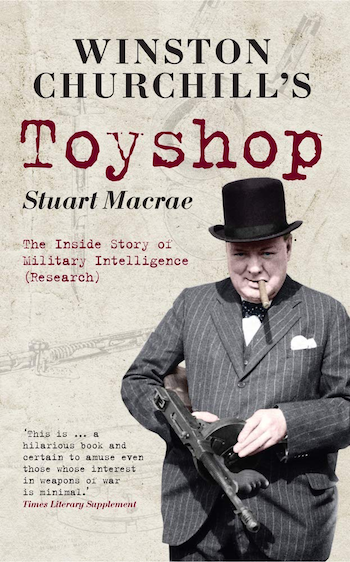
One example is found in "Winston Churchill's Toyshop" by Colonel Stuart Macrae.


The book is a light-hearted but intensely interesting look at how many of the secret weapons of World War II were developed, by a department reporting directly to Winston Churchill and thus exposed to many of the "inside" details of the war.  The author served as its second-in-command for most of the war, taking over command at the end of the conflict.  His sense of humor shines through the pages, and make it a highly entertaining read.

One of the chapters I found most interesting dealt with the personalities of some of the most important people in the British government during the war.  Winston Churchill himself was one of them, of course;  but a person to whom less attention has been paid (much of it ill-informed) was Professor Frederick Lindemann ("the Prof"), who was Churchill's senior scientific advisor and aide.  His insights influenced many of World War II's most important technological developments.  He's been heavily criticized in hindsight, but his influence was undoubtedly great, and he made a major contribution to victory.

Since many people don't know Prof. Lindemann, and few have studied Churchill the man as opposed to Churchill the Prime Minister, I thought you might enjoy a lengthy excerpt from that chapter.


When he first commissioned me to write this book, my publisher, who I should disclose is the Gordon Norwood who was with me right from the War Office days and is, therefore, in a position to make sure I tell the truth, wanted it to be entitled ‘Secret Weapons of the Second World War’ and take the form of a descriptive illustrated catalogue of the products of M.D.1. That struck me as being rather dull, so I induced him to let me write the story of M.D.1. instead and bring people into it as well as mechanisms. I now propose to leave weapons alone for this chapter and deal with the people instead.

Taking them in order of priority at the start, Winston Churchill must come first, and although I could not claim to know him at all well, I might have noticed a few aspects of him that have been missed by his biographers. For, as a journalist before I joined the army, it often fell to my lot to interview celebrities and write articles about them.

To me, the most remarkable thing about Winston Churchill was the way in which, without conscious effort, he would dominate any scene in which he was playing a part, regardless of who else was present. His Midnight Follies meetings, first held when he was First Lord of the Admiralty, were always attended by very distinguished people indeed, including, at various times, the Prime Minister and every member of the Cabinet. Yet so powerful was Churchill’s personality compared with theirs that one hardly noticed they were there.

The amount of information he could store away in that great head of his was fantastic. In discussion, he could without effort remember the present location of almost every important ship in the fleet and could do the same where army divisions were concerned. Millis calculated that it would take about six admirals or generals combined to equal this performance, and I think he underestimated.

One of the myths that sprang up about Winston Churchill was that he would make important decisions on his own without first seeking advice and that nobody could then stop him from putting these decisions into practice. This idea was quite wrong. When faced with any problem, the first thing Churchill would do would be to summon a selection of people best able to give him information on the subject and another selection best able to advise him as to the decision to be taken. Very seldom would he go against their advice. He knew that he had all the power in the world and that it would pay him to be careful how he used it.

It is true that he wrote every word of those wonderful speeches of his — he had to, because nobody else could imitate his style and make words sit up and beg as he did. But every fact in every speech had to be most carefully checked. I was on many occasions one of a dozen or so officers who would be summoned to Chequers at the weekend because he was preparing one of his speeches and proposed to make some reference to the departments we represented or their work. We just had to hang around perhaps for an hour or so until somebody would bring us a couple of typewritten sheets in the enormous type which was the only kind he would allow to be used for documents he was expected to read. These sheets would contain the statements we had to check, and it was our job either to pass them as correct or put them right if they were wrong. Seldom did a correction have to be made, but if it were made, it would be accepted without question.

At our demonstrations at Princes Risborough, we saw another side of Winston Churchill altogether. He would be like a small boy on holiday. The faithful Commander Thompson would be in attendance carrying a Sten gun, and when there was any lull in the proceedings, Winston would lower himself to the ground and bang away with this thing at the nearest target. He could be very troublesome on these occasions through his reluctance to take shelter when necessary — a trait which he also exhibited during air raids, to the intense concern of his staff. I was in charge of these Risborough demonstrations, and on one occasion, after Winston had finished playing with his gun and dusted himself off, I told him I proposed to go on to the next item in the programme. This was the firing of a charge of very considerable size underneath a tank and there was every probability of pieces of shrapnel whizzing around, so I asked the P.M. kindly to step inside the splinter-proof shelter we had put there for his protection. But he perched himself on a little mound nearby and said: ‘No. I’ll watch from here. Go ahead with the firing.’

I argued with him and he got quite cross: ‘Get on with it,’ he said, ‘I’ll take the responsibility.’ I had to tell him that the responsibility was mine not his and that, if he refused to enter the shelter, I refused to give the order to explode the mine. Reluctantly, he gave way but he cheered up at once when the bang was over, because it had been an impressive one and lumps of metal had flown around.

On this particular occasion, Winston had brought along his daughter Mary who was having a grand time chatting away to the kilted Highlanders, who were carrying out the range duties for us. Of course, she asked me the classic question ‘What do they wear underneath?’ I told her she had better go and look and I believe she did.

Mary proved to be a very good friend to M.D.1. We had always been trying to lure the P.M. to Whitchurch after these demonstrations but never succeeded. This time he turned down my invitation once again, but Mary was there. ‘Oh, come on. Daddy,’ she said, ‘I want to go and you know jolly well you can spare an hour. He went off with her like a lamb, and they spent over an hour at The Firs. It made the day for everyone at the establishment and the little Welsh factory girls nearly burst themselves with cheering.

The P.M. did have a drink in the Mess on his arrival and another before leaving. But the other idea that got around that he needed to be topped up with brandy at frequent intervals to keep him going was entirely wrong. Not knowing whether or not it was true, I played for safety, and at these demonstrations, I had a truck fitted up as a mobile bar, the driver being instructed to follow the P.M. around and have his wares handy if wanted. They were never wanted — not by the P.M. anyway. The story that he got through a vast number of cigars every day was not true either. He always carried one — it was a bit of an act, like the funny hats of his earlier days. But it was out a lot of the time and there was no risk of his smoking himself to death.

Finally, to revert to this unwillingness of Winston Churchill to exercise his power unless driven to do so. We suffered from this at M.D.1. as described in the chapter headed ‘More Trials and Tribulations’. Our fate hung in the balance for months. Winston had created us and wanted us. He had only to write a four-line minute stating that we were to come directly under him as Minister of Defence and that would have settled the matter. Nobody could possibly have opposed this move or have the pluck to try to do so. But he just would not do that and wanted the problem to be solved in a constitutional manner. He did turn on the heat a bit in the end, but the Prof. had to work hard on him to get him to do it. The same thing applied when the adoption of some of the M.D.1. devices was opposed. The P.M. would refuse to interfere until he could be assured that there was no hope of persuading the opposers to change their minds. Then, if he were convinced that the cause was a good one, he would put all of his considerable weight behind it and push it along regardless. The ‘Sticky Bomb — Make one million — WSC’ minute is a good example of this.

I find it difficult to stop writing about Winston Churchill once I have started. But I doubt if I have anything to say about him that has not been said before, so I pass on from the greatest man I have ever known or will know to the Prof. Very few people understood the Prof. and I doubt if he understood himself. It would be difficult to find anyone who succeeded in making himself more unpopular than he did. That he did not succeed in making more friends than he did during his lifetime is not so surprising because he never tried to make friends. When, after his death, he was subject to attack in the Press, which seems always to be the fate of great men, it was sad to find that so few people rallied to his defence. Fellow peers such as Lord Snow and Lord Boothby could hardly wait to burst into print with quite absurd statements to the effect that he was an evil man responsible for the bombing of Dresden, that he nearly lost us the war through refusing to recognise the danger offered to us by the German ‘V’ weapons, and that he dissipated the resources of the country by having his own private research establishment (which meant M.D.1., of course) where he insisted on experiments being carried out on his crackpot ideas, none of which proved to be any use at all.

The now-retired managing editor of The Daily Telegraph, Sir Colin Coote, who had known the Prof. was a bit sympathetic towards the Prof. when this campaign started and published an article from me in his defence. But I did not see any others, although some may have been written. It was easy enough to shoot down these assertions. The Prof. could no more have ordered ordered the bombing of Dresden than I could have done — or the P.M. for that matter. The story must have arisen in this way. Early on in the war, it was found that our bombing was ineffective because, apart from failing to hit the targets, we were going for the wrong ones. Some statistics were needed here and neither the Air Ministry nor the Royal Air Force were able to provide them. So the P.M. asked the Prof. to start an organisation to do the job, which he promptly did, taking a house at Marlow as his headquarters for this work and roping in some famous statisticians.

As Winston Churchill says in his history of the war, Vol. II (Their Finest Hour), this department came to be of great value to him by furnishing him with statistics on all kinds of subjects. Where bombing policy was concerned, what it could and did do was to tabulate the results of past bombing raids and deduce from them what kind of target it paid to go for. No doubt Dresden would have appeared in one of these lists, but it is unlikely the Prof. would have put it there himself. He merely controlled the machine that formulated these suggestions. They would then be considered first by the War Cabinet and then by the Chiefs of Staff Committee before any firm decisions were taken. So to accuse the Prof. of being responsible for the bombing of Dresden was quite ridiculous.

As one who was dug out of bed on instructions from the Prof. in the early hours of the morning to go off and inspect the remains of almost the first ‘V’ Bomb to land here, I can state that he was very much aware of this danger. In fact, it had been discussed endlessly at Whitchurch, and for a long time, we had been receiving the most up-to-date reports on the subject. Prof. certainly never suggested that nothing need be done about the ‘V’ weapon; on the contrary, he was always urging us to try to think up some brilliant countermeasure against it, which we were unable to do. What he did maintain, though, was that the weapon as described in the intelligence reports was a non-starter. They claimed that it would have a warhead carrying 10 tons of high explosive. The Prof., who was, of course, a brilliant mathematician, worked out that this was impossible, that the maximum size of warhead for a flying bomb of the sort described would enable no more than 1 ton of high explosive to be carried, and that, therefore, the weapon would not have such devastating effect as had been suggested. He did not say it would have no effect at all. Millis, who was also a brilliant mathematician, was asked by the Prof. to calculate this one independently and he came up with the same answer. They were both dead right. The V1 carried 1 ton of high explosive.

I wish we could have done something by way of countermeasures against the ‘V’ weapons, because this would have been conclusive proof that the Prof. was taking the matter seriously. As a matter of fact, we were working on a guided interception missile, but even with our facilities, we could not produce one quickly. Where the other accusation is concerned, I think I have already said enough in this book to prove that the Prof.’s private research establishment was by no means useless. We were never called upon to work on any of his crackpot ideas because he did not have any. Very seldom would he put forward any proposals in connection with a new weapon and he would content himself with suggesting that we should try to meet some specific requirement which he knew to be vital. For instance, when he wanted a bomb that would damage a battleship more severely than the existing ones, we produced it.

Time and again in my diary there is a note to the effect that the Prof. suggested we should work on some project or other. But he never insisted on our doing so and often there is another note later on stating that we advised him that we would prefer to leave this one alone. He never argued over a matter of this sort. In the same way, although we did not have to get his permission to undertake some new project, we always advised him about it as a matter of courtesy and asked for this permission. It was never refused, although on occasion he might express the view that we were not on a good wicket.

The Prof. was always keenly interested in everything we were doing at Whitchurch, and when he came on his weekly visit to us, I always tried to arrange things so that he could watch a few experiments and talk to the design officers concerned about the progress they were making. Then we would retire to the front office where, after dealing with any paperwork I had saved up for him, he would settle down to a discussion with Millis on some project or other. Generally, some of the others would be there — Norman Angier, Ralph Farrant and James Tuck — and inevitably, sooner or later, mathematics would come into it. Right from the start, it had been evident that this would happen, so in this front office I had provided a nice big blackboard and coloured chalks. They all loved it.

I remember particularly one evening when we had been over at the RAF station at Wing dropping material called ‘Window’ out of aeroplanes to see if it worked. ‘Window’ consisted of strips of silvered tape which, when dropped by our bombers, would fox the enemy radar and put his fighters off the trail. The trouble was that if we started to use this stuff, the Germans would soon get on to it and follow suit, in which case Fighter Command here would be faced with the same difficulty and be unable to locate and’ shoot down the German bombers. So there was a great dispute going on between Bomber Command and Fighter Command about whether or not we should start using ‘Window’. One of the Prof.’s attackers after his death raised this one too and said he was increasing the hazards for our bomber crews by persuading the P.M. not to permit the material to be used. But, of course, this was complete nonsense. The Prof. had no say at all in this decision — it was purely a matter for the Chiefs of Staff Committee and the RAF. His job and ours was to make ‘Window’ work so that it was there if wanted.

On this particular occasion, there was a roll of this material on Millis’ desk. The Prof. asked how much it weighed. Nobody knew, but James Tuck said he could soon find out. He then retired to the blackboard and, after what appeared to me to be an unnecessarily complicated piece of calculation, announced that it would weigh 8 ½ ounces. ‘No, no, James,’ said the Prof., ‘you should try it this way,’ whereupon he proceeded to carry out an even more elaborate calculation which produced a different answer — a fraction over 7 ounces. Not to be outdone, Millis then had a go and came up with yet another answer. During the mathematical argument that ensued, I took the reel into the next office, weighed it on a letter scale, and returned to announce that it was precisely 6 ½ ounces. Nobody was in the slightest interested, and the mathematical argument went on for a further half-hour.

Prof. was not only a teetotaller and non-smoker but also a most sincere vegetarian. He would not even eat the yolk of an egg. This made it very difficult to entertain him. When he was coming to Whitchurch, I would always offer to have any vegetarian dish prepared for him, but he would always refuse and produce his own little packet of sandwiches. He had a very large frame, and how he managed to subsist on so little was a mystery. He made no attempt whatsoever to persuade others to follow his example, and when I went to lunch with him at his rooms at Christchurch or his flat at Marsham Court, he would always provide me with an excellent meal and plenty to drink.

This teetotalism put us in a bit of a spot when he first started coming to Whitchurch. After six o’clock in the evening, one had only to press the bell in the front office for drinks to appear as if by magic; it was a fine system. But with the Prof. there, we did not like to take advantage advantage of it and would sneak away in turn to the bar instead. The Prof. got on to this on about his second visit and said: ‘Please don’t let me stop you from having drinks if you want them.’ From then onwards, the bell was pressed. On one occasion, to our utter astonishment, the Prof. plunged his hand into his trouser pocket and said: ‘Let me pay for this round.’ But, of course, we didn’t.

Why the Prof. made himself so unpopular was because he not only sincerely believed that there was no better brain in the world than his with the one exception of Winston Churchill but also because he made no attempt whatever to conceal this view. Everyone who disagreed with him was a fool. A row had been going on for some time between himself and Professor Tizard, whom he had supplanted as the chief scientific adviser to the government when Churchill became P.M: He ever afterwards referred to ‘that ass Tizard’, which was very stupid of him, because Tizard certainly had as good a brain as he had. Tizard really took it very well, but other scientists did not.

The Prof. did not like people very much or rouse any affection in them. Few of those who worked with or for him would say anything much in his favour, even if they said nothing against him. He was regarded as just a cold fish. Yet he could inspire loyalty in people, one example being the faithful Harvey who looked after him like a mother and served as his secretary, cook-housekeeper and chauffeur all at once. I suppose another example was me, although I cannot quite understand how this came about. When the Prof. first met me at the Admiralty over Operation Royal Marine, it was evident that he regarded me as less than the dust beneath his chariot wheel. I was not a scientist or mathematician but a nonentity — just somebody who worked for that brilliant fellow Jefferis. It was not until we got to Whitchurch that the Prof. began to realise that I had some kind of a brain and was using it. His respect for me greatly increased when he found that I was not only running the establishment, which he had sense enough to see that Millis was not well fitted to do, but was doing my full share of design and development work. In time, he grew to rely on me for keeping the good ship M.D.1. on an even keel, even though I was not the captain.

It would be an exaggeration to say that the Prof. got fond of me but he did find my company very tolerable and quite liked talking to me. Sometimes he would be almost affable and tell me about funny incidents in the House of Lords. He never appeared to have any interest in women but once, when I told him I had met Lady Bath over the weekend and she had sent him her kind regards, his face lit up and he said: ‘Isn’t she lovely?’ When I asked him for advice about a career for my elder son, he said: ‘My dear fellow, make him a university don like me. It’s the softest job in the world.’

Almost bashfully, one day, the Prof. invited me to have lunch with him at Marsham Court and then listen to a speech he was going to make that afternoon in the House of Lords. ‘I doubt if you will be able to hear a word I say,’ he told me, ‘because nobody does.’ He was quite right. After the war, when Millis had left M.D.1. and I had taken over, the Prof. did not come to Whitchurch so much but liked me to run over to Christchurch once a week to tell him what was going on. We would walk round the garden, which went with his rooms and of which he was very proud. When M.D.1. was finally closed down and I decided to quit the army, he made considerable efforts to get me a job, although he was no longer in power and could now pull few strings. When I went after one myself, he wrote me a most glowing reference, and so did Brigadier Hogg.

Nobody could stand more on his dignity than could the Prof., and he was very troublesome over this. He would refuse to attend a meeting which he did not chair unless the chairman was somebody he considered to be of something like equal rank. Once, as the result of a complaint he had taken up about an M.D.1. weapon being turned down, he insisted on a special meeting of the Ordnance Board being called to discuss the matter and announced that he would be present. But when the president of the O.B., Admiral Pridham, went sick and the Prof. was told that a deputy would have to take the chair, the Prof. refused to attend.

The same kind of thing happened when the citizens of Whitchurch got a bit restless and sent in a petition to the government saying that they had put up with The Firs and the noises we made there throughout the war but saw no reason why they should have to go on doing that now, so would they please close down the place. This was a bit unfair, because we had been a godsend to the village during the war, bringing much wanted business to the shopkeepers and pubs, finding employment for anyone who wanted it, and providing free entertainment at our social and cinema shows. And we were still going on doing that.

However, appeasement seemed to me to be the best plan, and as I was now the head of the establishment, I decided to run a whale of a party and invite to it everybody who mattered. In particular, I wanted the Prof. to be there. He said he would consider the matter and would I let him have a list of guests? I did that and thought it quite an impressive one. It included names like that of Sir Charles Ellis, who, like the Prof., was an FRS, Nubar Gulbenkian, who was quite a famous figure, and a host of other celebrities. But after peering through it, the Prof. could find nothing to suit him and said that although he would come if this were a matter of very great importance to me, he would prefer to stay away. Probably the party went better without him, and it did serve its purpose.

The Prof. grew very proud of M.D.1. in time and nothing pleased him more than to bring out some VIP to see the place. Generally, it would be somebody with some technical problem to discuss such as Sir Robert Watson-Watt, the inventor of radar. In one of the attacks on the Prof. after his death, he was accused of opposing Watson-Watt and hindering the development of radar. This too was utter nonsense. He always encouraged Watson-Watt and went on doing it now. I was instructed to give him every assistance should he want to carry out some experimental work at Whitchurch. The same applied to Sir Barnes Wallis when he came out to discuss his cannon-ball bomb with us. Most people had discouraged him, but the Prof. had not.

The Prof.’s enemies did not realise how intensely patriotic he was. His entire energies were devoted to winning the war. I am told that throughout it he refused to accept any salary, even as a Cabinet Minister, and would not make use of the official car to which he was fully entitled or anything of that sort. Harvey had to drive him about in an enormous but ancient Packard. When it passed out at Whitchurch one day, I persuaded him to let our transport section do a bit of work on it and had quite a job to convince him that there was no need to pay. Whilst the Packard was out of action, he would let me drive him about in my own car but would not let me put an army car and driver at his disposal.

It was all too easy to wind up the Prof. into a state of great indignation. Millis had only to suggest to him that somebody was obstructing our work for him to breathe fire and thunder and set about getting whoever it was removed from his job. The difficulty here was that Millis could quite often be in the wrong and would fancy he was being badly treated although, in fact, the other fellow was not being unreasonable but merely wanted more information. I often had great difficulty in smoothing out these situations and preventing drastic action being taken. Indeed, the only thing I could do sometimes was to visit the Prof. on the quiet, assure him that the offending official was now being more co-operative and urge him to forget the whole business. Even when we were all behaving nicely, M.D.1. was unpopular enough in many quarters and we could not afford to be hated.

Although the Prof. was easily put out in this way, he was very slow to take offence where any of us were concerned. I provided him with a very nice office at The Firs, equipping it with a ‘scrambler’ telephone and one of the large-type typewriters we now had to use for all official minutes that might be seen by the P.M.

On his next two visits to Whitchurch, the Prof. inhabited his new office for perhaps five minutes and then joined us in the front office. During the next six months he never entered it at all. By this time, we were desperately short of space in the house so I had this room converted into a bedroom for one of the secretaries. My mistake was in not mentioning this to the Prof. Some months later, on arrival at The Firs, he announced that he proposed to do some work in his office and that put me nicely on the spot. I could only explain the situation as best I could. But the Prof. felt I had slighted him in some way and it took me a little time to get back into favour.

I never saw him get cross with Millis, although he would have done on one occasion if he had known the facts. One time, when Millis was away on leave and I had to visit the Prof., after we had run through a few matters, he suddenly turned quite fierce and said: ‘Now what has happened over that sabotage weapon? This really is too bad.’ I always boasted that I knew of everything that was going on at Whitchurch, but this one beat me. I probed about a little and discovered that over a fortnight back the Prof. had for once actually asked Millis to knock up a sample of some little device for the ready wrecking of radio sets. Millis should have told me about it as this was in my line, but, in fact, it had completely escaped his memory. What is more, when the Prof. had telephoned to ask how this job was going, Millis assured him that it would be finished in another day or so and then forgot it for the second time. I did not find this out until afterwards, but I assured the Prof. that Millis would have put the work in hand and that some unforeseen snag must have arisen since his departure. A little quick work was done, and when the Prof. came out to Whitchurch a couple of days later, I was able to hand over to him a prototype of this device, which he accepted with grace. None of this mattered much because there is an entry in my diary a fortnight later saying: ‘Instructed by the Prof. not to proceed further with the development of his sabotage weapon.’

The Prof. literally adored Winston Churchill. There were one or two other people such as, oddly enough, Ernie Bevin whom he really liked. But there is no question that Millis came top of the form and that he developed a sincere affection for him. The fact that it was not very heartily reciprocated did not seem to worry the Prof. at all. One would think that when Millis tried so hard to duck away from under his patronage and go over to the opposition that would have been the end of a beautiful friendship so far as the Prof. was concerned. When the situation was at last happily resolved, the Prof. simply must have realised that Millis had not returned to his fold under his own power and that we had to drag him there by his heels. Yet there was no sign of his bearing a grudge. On the contrary, he favoured Millis more than ever and took a great deal of trouble to induce the P.M. to have his name included in the Dissolution Honours list for the award of the KBE. This, incidentally, put the cat amongst the pigeons once again, as there were many other major-generals who considered they should have come first if KBEs were being handed out. But the Dissolution Honours list is not subject to the same scrutiny as the normal ones and nobody could stop this award going through.

People used to say that the Prof. was mean-minded, but surely this action proves the contrary. Few big men in such circumstances would have shown such loyalty and generosity to a friend. As I started off by saying, nobody understood him and he did not understand himself. I never became his favoured friend as did Millis, but his death came as a blow to me and I missed him very much.


There you have it:  two of the personalities most involved in Britain's victory in World War II.  There are obviously many more such people, but one can't possibly list them all or go into any detail in a short blog article.  Their lives, experiences and writings make interesting reading, which has kept me informed and entertained throughout my life.  (That's the reason my personal library at one time totaled more than 5,000 books!  The advent of e-books, and the republication of many interesting works in the new format, has made life much easier [and lighter], since e-books don't take up bookshelf space.)

Peter