Gathered from around the Internet over the past week. Click any image for a larger view.


Gathered from around the Internet over the past week. Click any image for a larger view.
This unusual rendition of the well-known Carol of the Bells caught my eye (and ear) recently. It's played, not on bells, but on Boomwhackers. The added comedic byplay is a bonus.
I'm still not sure about the Biblical authenticity of Boomwhackers in Bethlehem, but you can't have it all!

Peter
An aspect of war seldom considered is how the personalities of the leaders involved - politicians, soldiers, sailors, airmen and industrialists - contribute to victory or defeat. Many of those involved with such people don't speak about their experiences, sometimes due to a sense of loyalty to their superiors, other times because of obstacles such as Official Secrets Acts or similar legislation.
One example is found in "Winston Churchill's Toyshop" by Colonel Stuart Macrae.
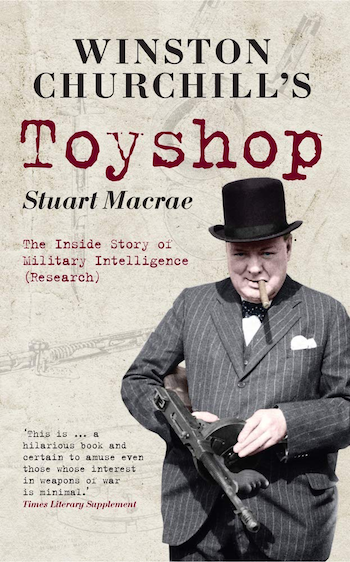
The book is a light-hearted but intensely interesting look at how many of the secret weapons of World War II were developed, by a department reporting directly to Winston Churchill and thus exposed to many of the "inside" details of the war. The author served as its second-in-command for most of the war, taking over command at the end of the conflict. His sense of humor shines through the pages, and make it a highly entertaining read.
One of the chapters I found most interesting dealt with the personalities of some of the most important people in the British government during the war. Winston Churchill himself was one of them, of course; but a person to whom less attention has been paid (much of it ill-informed) was Professor Frederick Lindemann ("the Prof"), who was Churchill's senior scientific advisor and aide. His insights influenced many of World War II's most important technological developments. He's been heavily criticized in hindsight, but his influence was undoubtedly great, and he made a major contribution to victory.
Since many people don't know Prof. Lindemann, and few have studied Churchill the man as opposed to Churchill the Prime Minister, I thought you might enjoy a lengthy excerpt from that chapter.
When he first commissioned me to write this book, my publisher, who I should disclose is the Gordon Norwood who was with me right from the War Office days and is, therefore, in a position to make sure I tell the truth, wanted it to be entitled ‘Secret Weapons of the Second World War’ and take the form of a descriptive illustrated catalogue of the products of M.D.1. That struck me as being rather dull, so I induced him to let me write the story of M.D.1. instead and bring people into it as well as mechanisms. I now propose to leave weapons alone for this chapter and deal with the people instead.
Taking them in order of priority at the start, Winston Churchill must come first, and although I could not claim to know him at all well, I might have noticed a few aspects of him that have been missed by his biographers. For, as a journalist before I joined the army, it often fell to my lot to interview celebrities and write articles about them.
To me, the most remarkable thing about Winston Churchill was the way in which, without conscious effort, he would dominate any scene in which he was playing a part, regardless of who else was present. His Midnight Follies meetings, first held when he was First Lord of the Admiralty, were always attended by very distinguished people indeed, including, at various times, the Prime Minister and every member of the Cabinet. Yet so powerful was Churchill’s personality compared with theirs that one hardly noticed they were there.
The amount of information he could store away in that great head of his was fantastic. In discussion, he could without effort remember the present location of almost every important ship in the fleet and could do the same where army divisions were concerned. Millis calculated that it would take about six admirals or generals combined to equal this performance, and I think he underestimated.
One of the myths that sprang up about Winston Churchill was that he would make important decisions on his own without first seeking advice and that nobody could then stop him from putting these decisions into practice. This idea was quite wrong. When faced with any problem, the first thing Churchill would do would be to summon a selection of people best able to give him information on the subject and another selection best able to advise him as to the decision to be taken. Very seldom would he go against their advice. He knew that he had all the power in the world and that it would pay him to be careful how he used it.
It is true that he wrote every word of those wonderful speeches of his — he had to, because nobody else could imitate his style and make words sit up and beg as he did. But every fact in every speech had to be most carefully checked. I was on many occasions one of a dozen or so officers who would be summoned to Chequers at the weekend because he was preparing one of his speeches and proposed to make some reference to the departments we represented or their work. We just had to hang around perhaps for an hour or so until somebody would bring us a couple of typewritten sheets in the enormous type which was the only kind he would allow to be used for documents he was expected to read. These sheets would contain the statements we had to check, and it was our job either to pass them as correct or put them right if they were wrong. Seldom did a correction have to be made, but if it were made, it would be accepted without question.
At our demonstrations at Princes Risborough, we saw another side of Winston Churchill altogether. He would be like a small boy on holiday. The faithful Commander Thompson would be in attendance carrying a Sten gun, and when there was any lull in the proceedings, Winston would lower himself to the ground and bang away with this thing at the nearest target. He could be very troublesome on these occasions through his reluctance to take shelter when necessary — a trait which he also exhibited during air raids, to the intense concern of his staff. I was in charge of these Risborough demonstrations, and on one occasion, after Winston had finished playing with his gun and dusted himself off, I told him I proposed to go on to the next item in the programme. This was the firing of a charge of very considerable size underneath a tank and there was every probability of pieces of shrapnel whizzing around, so I asked the P.M. kindly to step inside the splinter-proof shelter we had put there for his protection. But he perched himself on a little mound nearby and said: ‘No. I’ll watch from here. Go ahead with the firing.’
I argued with him and he got quite cross: ‘Get on with it,’ he said, ‘I’ll take the responsibility.’ I had to tell him that the responsibility was mine not his and that, if he refused to enter the shelter, I refused to give the order to explode the mine. Reluctantly, he gave way but he cheered up at once when the bang was over, because it had been an impressive one and lumps of metal had flown around.
On this particular occasion, Winston had brought along his daughter Mary who was having a grand time chatting away to the kilted Highlanders, who were carrying out the range duties for us. Of course, she asked me the classic question ‘What do they wear underneath?’ I told her she had better go and look and I believe she did.
Mary proved to be a very good friend to M.D.1. We had always been trying to lure the P.M. to Whitchurch after these demonstrations but never succeeded. This time he turned down my invitation once again, but Mary was there. ‘Oh, come on. Daddy,’ she said, ‘I want to go and you know jolly well you can spare an hour. He went off with her like a lamb, and they spent over an hour at The Firs. It made the day for everyone at the establishment and the little Welsh factory girls nearly burst themselves with cheering.
The P.M. did have a drink in the Mess on his arrival and another before leaving. But the other idea that got around that he needed to be topped up with brandy at frequent intervals to keep him going was entirely wrong. Not knowing whether or not it was true, I played for safety, and at these demonstrations, I had a truck fitted up as a mobile bar, the driver being instructed to follow the P.M. around and have his wares handy if wanted. They were never wanted — not by the P.M. anyway. The story that he got through a vast number of cigars every day was not true either. He always carried one — it was a bit of an act, like the funny hats of his earlier days. But it was out a lot of the time and there was no risk of his smoking himself to death.
Finally, to revert to this unwillingness of Winston Churchill to exercise his power unless driven to do so. We suffered from this at M.D.1. as described in the chapter headed ‘More Trials and Tribulations’. Our fate hung in the balance for months. Winston had created us and wanted us. He had only to write a four-line minute stating that we were to come directly under him as Minister of Defence and that would have settled the matter. Nobody could possibly have opposed this move or have the pluck to try to do so. But he just would not do that and wanted the problem to be solved in a constitutional manner. He did turn on the heat a bit in the end, but the Prof. had to work hard on him to get him to do it. The same thing applied when the adoption of some of the M.D.1. devices was opposed. The P.M. would refuse to interfere until he could be assured that there was no hope of persuading the opposers to change their minds. Then, if he were convinced that the cause was a good one, he would put all of his considerable weight behind it and push it along regardless. The ‘Sticky Bomb — Make one million — WSC’ minute is a good example of this.
I find it difficult to stop writing about Winston Churchill once I have started. But I doubt if I have anything to say about him that has not been said before, so I pass on from the greatest man I have ever known or will know to the Prof. Very few people understood the Prof. and I doubt if he understood himself. It would be difficult to find anyone who succeeded in making himself more unpopular than he did. That he did not succeed in making more friends than he did during his lifetime is not so surprising because he never tried to make friends. When, after his death, he was subject to attack in the Press, which seems always to be the fate of great men, it was sad to find that so few people rallied to his defence. Fellow peers such as Lord Snow and Lord Boothby could hardly wait to burst into print with quite absurd statements to the effect that he was an evil man responsible for the bombing of Dresden, that he nearly lost us the war through refusing to recognise the danger offered to us by the German ‘V’ weapons, and that he dissipated the resources of the country by having his own private research establishment (which meant M.D.1., of course) where he insisted on experiments being carried out on his crackpot ideas, none of which proved to be any use at all.
The now-retired managing editor of The Daily Telegraph, Sir Colin Coote, who had known the Prof. was a bit sympathetic towards the Prof. when this campaign started and published an article from me in his defence. But I did not see any others, although some may have been written. It was easy enough to shoot down these assertions. The Prof. could no more have ordered ordered the bombing of Dresden than I could have done — or the P.M. for that matter. The story must have arisen in this way. Early on in the war, it was found that our bombing was ineffective because, apart from failing to hit the targets, we were going for the wrong ones. Some statistics were needed here and neither the Air Ministry nor the Royal Air Force were able to provide them. So the P.M. asked the Prof. to start an organisation to do the job, which he promptly did, taking a house at Marlow as his headquarters for this work and roping in some famous statisticians.
As Winston Churchill says in his history of the war, Vol. II (Their Finest Hour), this department came to be of great value to him by furnishing him with statistics on all kinds of subjects. Where bombing policy was concerned, what it could and did do was to tabulate the results of past bombing raids and deduce from them what kind of target it paid to go for. No doubt Dresden would have appeared in one of these lists, but it is unlikely the Prof. would have put it there himself. He merely controlled the machine that formulated these suggestions. They would then be considered first by the War Cabinet and then by the Chiefs of Staff Committee before any firm decisions were taken. So to accuse the Prof. of being responsible for the bombing of Dresden was quite ridiculous.
As one who was dug out of bed on instructions from the Prof. in the early hours of the morning to go off and inspect the remains of almost the first ‘V’ Bomb to land here, I can state that he was very much aware of this danger. In fact, it had been discussed endlessly at Whitchurch, and for a long time, we had been receiving the most up-to-date reports on the subject. Prof. certainly never suggested that nothing need be done about the ‘V’ weapon; on the contrary, he was always urging us to try to think up some brilliant countermeasure against it, which we were unable to do. What he did maintain, though, was that the weapon as described in the intelligence reports was a non-starter. They claimed that it would have a warhead carrying 10 tons of high explosive. The Prof., who was, of course, a brilliant mathematician, worked out that this was impossible, that the maximum size of warhead for a flying bomb of the sort described would enable no more than 1 ton of high explosive to be carried, and that, therefore, the weapon would not have such devastating effect as had been suggested. He did not say it would have no effect at all. Millis, who was also a brilliant mathematician, was asked by the Prof. to calculate this one independently and he came up with the same answer. They were both dead right. The V1 carried 1 ton of high explosive.
I wish we could have done something by way of countermeasures against the ‘V’ weapons, because this would have been conclusive proof that the Prof. was taking the matter seriously. As a matter of fact, we were working on a guided interception missile, but even with our facilities, we could not produce one quickly. Where the other accusation is concerned, I think I have already said enough in this book to prove that the Prof.’s private research establishment was by no means useless. We were never called upon to work on any of his crackpot ideas because he did not have any. Very seldom would he put forward any proposals in connection with a new weapon and he would content himself with suggesting that we should try to meet some specific requirement which he knew to be vital. For instance, when he wanted a bomb that would damage a battleship more severely than the existing ones, we produced it.
Time and again in my diary there is a note to the effect that the Prof. suggested we should work on some project or other. But he never insisted on our doing so and often there is another note later on stating that we advised him that we would prefer to leave this one alone. He never argued over a matter of this sort. In the same way, although we did not have to get his permission to undertake some new project, we always advised him about it as a matter of courtesy and asked for this permission. It was never refused, although on occasion he might express the view that we were not on a good wicket.
The Prof. was always keenly interested in everything we were doing at Whitchurch, and when he came on his weekly visit to us, I always tried to arrange things so that he could watch a few experiments and talk to the design officers concerned about the progress they were making. Then we would retire to the front office where, after dealing with any paperwork I had saved up for him, he would settle down to a discussion with Millis on some project or other. Generally, some of the others would be there — Norman Angier, Ralph Farrant and James Tuck — and inevitably, sooner or later, mathematics would come into it. Right from the start, it had been evident that this would happen, so in this front office I had provided a nice big blackboard and coloured chalks. They all loved it.
I remember particularly one evening when we had been over at the RAF station at Wing dropping material called ‘Window’ out of aeroplanes to see if it worked. ‘Window’ consisted of strips of silvered tape which, when dropped by our bombers, would fox the enemy radar and put his fighters off the trail. The trouble was that if we started to use this stuff, the Germans would soon get on to it and follow suit, in which case Fighter Command here would be faced with the same difficulty and be unable to locate and’ shoot down the German bombers. So there was a great dispute going on between Bomber Command and Fighter Command about whether or not we should start using ‘Window’. One of the Prof.’s attackers after his death raised this one too and said he was increasing the hazards for our bomber crews by persuading the P.M. not to permit the material to be used. But, of course, this was complete nonsense. The Prof. had no say at all in this decision — it was purely a matter for the Chiefs of Staff Committee and the RAF. His job and ours was to make ‘Window’ work so that it was there if wanted.
On this particular occasion, there was a roll of this material on Millis’ desk. The Prof. asked how much it weighed. Nobody knew, but James Tuck said he could soon find out. He then retired to the blackboard and, after what appeared to me to be an unnecessarily complicated piece of calculation, announced that it would weigh 8 ½ ounces. ‘No, no, James,’ said the Prof., ‘you should try it this way,’ whereupon he proceeded to carry out an even more elaborate calculation which produced a different answer — a fraction over 7 ounces. Not to be outdone, Millis then had a go and came up with yet another answer. During the mathematical argument that ensued, I took the reel into the next office, weighed it on a letter scale, and returned to announce that it was precisely 6 ½ ounces. Nobody was in the slightest interested, and the mathematical argument went on for a further half-hour.
Prof. was not only a teetotaller and non-smoker but also a most sincere vegetarian. He would not even eat the yolk of an egg. This made it very difficult to entertain him. When he was coming to Whitchurch, I would always offer to have any vegetarian dish prepared for him, but he would always refuse and produce his own little packet of sandwiches. He had a very large frame, and how he managed to subsist on so little was a mystery. He made no attempt whatsoever to persuade others to follow his example, and when I went to lunch with him at his rooms at Christchurch or his flat at Marsham Court, he would always provide me with an excellent meal and plenty to drink.
This teetotalism put us in a bit of a spot when he first started coming to Whitchurch. After six o’clock in the evening, one had only to press the bell in the front office for drinks to appear as if by magic; it was a fine system. But with the Prof. there, we did not like to take advantage advantage of it and would sneak away in turn to the bar instead. The Prof. got on to this on about his second visit and said: ‘Please don’t let me stop you from having drinks if you want them.’ From then onwards, the bell was pressed. On one occasion, to our utter astonishment, the Prof. plunged his hand into his trouser pocket and said: ‘Let me pay for this round.’ But, of course, we didn’t.
Why the Prof. made himself so unpopular was because he not only sincerely believed that there was no better brain in the world than his with the one exception of Winston Churchill but also because he made no attempt whatever to conceal this view. Everyone who disagreed with him was a fool. A row had been going on for some time between himself and Professor Tizard, whom he had supplanted as the chief scientific adviser to the government when Churchill became P.M: He ever afterwards referred to ‘that ass Tizard’, which was very stupid of him, because Tizard certainly had as good a brain as he had. Tizard really took it very well, but other scientists did not.
The Prof. did not like people very much or rouse any affection in them. Few of those who worked with or for him would say anything much in his favour, even if they said nothing against him. He was regarded as just a cold fish. Yet he could inspire loyalty in people, one example being the faithful Harvey who looked after him like a mother and served as his secretary, cook-housekeeper and chauffeur all at once. I suppose another example was me, although I cannot quite understand how this came about. When the Prof. first met me at the Admiralty over Operation Royal Marine, it was evident that he regarded me as less than the dust beneath his chariot wheel. I was not a scientist or mathematician but a nonentity — just somebody who worked for that brilliant fellow Jefferis. It was not until we got to Whitchurch that the Prof. began to realise that I had some kind of a brain and was using it. His respect for me greatly increased when he found that I was not only running the establishment, which he had sense enough to see that Millis was not well fitted to do, but was doing my full share of design and development work. In time, he grew to rely on me for keeping the good ship M.D.1. on an even keel, even though I was not the captain.
It would be an exaggeration to say that the Prof. got fond of me but he did find my company very tolerable and quite liked talking to me. Sometimes he would be almost affable and tell me about funny incidents in the House of Lords. He never appeared to have any interest in women but once, when I told him I had met Lady Bath over the weekend and she had sent him her kind regards, his face lit up and he said: ‘Isn’t she lovely?’ When I asked him for advice about a career for my elder son, he said: ‘My dear fellow, make him a university don like me. It’s the softest job in the world.’
Almost bashfully, one day, the Prof. invited me to have lunch with him at Marsham Court and then listen to a speech he was going to make that afternoon in the House of Lords. ‘I doubt if you will be able to hear a word I say,’ he told me, ‘because nobody does.’ He was quite right. After the war, when Millis had left M.D.1. and I had taken over, the Prof. did not come to Whitchurch so much but liked me to run over to Christchurch once a week to tell him what was going on. We would walk round the garden, which went with his rooms and of which he was very proud. When M.D.1. was finally closed down and I decided to quit the army, he made considerable efforts to get me a job, although he was no longer in power and could now pull few strings. When I went after one myself, he wrote me a most glowing reference, and so did Brigadier Hogg.
Nobody could stand more on his dignity than could the Prof., and he was very troublesome over this. He would refuse to attend a meeting which he did not chair unless the chairman was somebody he considered to be of something like equal rank. Once, as the result of a complaint he had taken up about an M.D.1. weapon being turned down, he insisted on a special meeting of the Ordnance Board being called to discuss the matter and announced that he would be present. But when the president of the O.B., Admiral Pridham, went sick and the Prof. was told that a deputy would have to take the chair, the Prof. refused to attend.
The same kind of thing happened when the citizens of Whitchurch got a bit restless and sent in a petition to the government saying that they had put up with The Firs and the noises we made there throughout the war but saw no reason why they should have to go on doing that now, so would they please close down the place. This was a bit unfair, because we had been a godsend to the village during the war, bringing much wanted business to the shopkeepers and pubs, finding employment for anyone who wanted it, and providing free entertainment at our social and cinema shows. And we were still going on doing that.
However, appeasement seemed to me to be the best plan, and as I was now the head of the establishment, I decided to run a whale of a party and invite to it everybody who mattered. In particular, I wanted the Prof. to be there. He said he would consider the matter and would I let him have a list of guests? I did that and thought it quite an impressive one. It included names like that of Sir Charles Ellis, who, like the Prof., was an FRS, Nubar Gulbenkian, who was quite a famous figure, and a host of other celebrities. But after peering through it, the Prof. could find nothing to suit him and said that although he would come if this were a matter of very great importance to me, he would prefer to stay away. Probably the party went better without him, and it did serve its purpose.
The Prof. grew very proud of M.D.1. in time and nothing pleased him more than to bring out some VIP to see the place. Generally, it would be somebody with some technical problem to discuss such as Sir Robert Watson-Watt, the inventor of radar. In one of the attacks on the Prof. after his death, he was accused of opposing Watson-Watt and hindering the development of radar. This too was utter nonsense. He always encouraged Watson-Watt and went on doing it now. I was instructed to give him every assistance should he want to carry out some experimental work at Whitchurch. The same applied to Sir Barnes Wallis when he came out to discuss his cannon-ball bomb with us. Most people had discouraged him, but the Prof. had not.
The Prof.’s enemies did not realise how intensely patriotic he was. His entire energies were devoted to winning the war. I am told that throughout it he refused to accept any salary, even as a Cabinet Minister, and would not make use of the official car to which he was fully entitled or anything of that sort. Harvey had to drive him about in an enormous but ancient Packard. When it passed out at Whitchurch one day, I persuaded him to let our transport section do a bit of work on it and had quite a job to convince him that there was no need to pay. Whilst the Packard was out of action, he would let me drive him about in my own car but would not let me put an army car and driver at his disposal.
It was all too easy to wind up the Prof. into a state of great indignation. Millis had only to suggest to him that somebody was obstructing our work for him to breathe fire and thunder and set about getting whoever it was removed from his job. The difficulty here was that Millis could quite often be in the wrong and would fancy he was being badly treated although, in fact, the other fellow was not being unreasonable but merely wanted more information. I often had great difficulty in smoothing out these situations and preventing drastic action being taken. Indeed, the only thing I could do sometimes was to visit the Prof. on the quiet, assure him that the offending official was now being more co-operative and urge him to forget the whole business. Even when we were all behaving nicely, M.D.1. was unpopular enough in many quarters and we could not afford to be hated.
Although the Prof. was easily put out in this way, he was very slow to take offence where any of us were concerned. I provided him with a very nice office at The Firs, equipping it with a ‘scrambler’ telephone and one of the large-type typewriters we now had to use for all official minutes that might be seen by the P.M.
On his next two visits to Whitchurch, the Prof. inhabited his new office for perhaps five minutes and then joined us in the front office. During the next six months he never entered it at all. By this time, we were desperately short of space in the house so I had this room converted into a bedroom for one of the secretaries. My mistake was in not mentioning this to the Prof. Some months later, on arrival at The Firs, he announced that he proposed to do some work in his office and that put me nicely on the spot. I could only explain the situation as best I could. But the Prof. felt I had slighted him in some way and it took me a little time to get back into favour.
I never saw him get cross with Millis, although he would have done on one occasion if he had known the facts. One time, when Millis was away on leave and I had to visit the Prof., after we had run through a few matters, he suddenly turned quite fierce and said: ‘Now what has happened over that sabotage weapon? This really is too bad.’ I always boasted that I knew of everything that was going on at Whitchurch, but this one beat me. I probed about a little and discovered that over a fortnight back the Prof. had for once actually asked Millis to knock up a sample of some little device for the ready wrecking of radio sets. Millis should have told me about it as this was in my line, but, in fact, it had completely escaped his memory. What is more, when the Prof. had telephoned to ask how this job was going, Millis assured him that it would be finished in another day or so and then forgot it for the second time. I did not find this out until afterwards, but I assured the Prof. that Millis would have put the work in hand and that some unforeseen snag must have arisen since his departure. A little quick work was done, and when the Prof. came out to Whitchurch a couple of days later, I was able to hand over to him a prototype of this device, which he accepted with grace. None of this mattered much because there is an entry in my diary a fortnight later saying: ‘Instructed by the Prof. not to proceed further with the development of his sabotage weapon.’
The Prof. literally adored Winston Churchill. There were one or two other people such as, oddly enough, Ernie Bevin whom he really liked. But there is no question that Millis came top of the form and that he developed a sincere affection for him. The fact that it was not very heartily reciprocated did not seem to worry the Prof. at all. One would think that when Millis tried so hard to duck away from under his patronage and go over to the opposition that would have been the end of a beautiful friendship so far as the Prof. was concerned. When the situation was at last happily resolved, the Prof. simply must have realised that Millis had not returned to his fold under his own power and that we had to drag him there by his heels. Yet there was no sign of his bearing a grudge. On the contrary, he favoured Millis more than ever and took a great deal of trouble to induce the P.M. to have his name included in the Dissolution Honours list for the award of the KBE. This, incidentally, put the cat amongst the pigeons once again, as there were many other major-generals who considered they should have come first if KBEs were being handed out. But the Dissolution Honours list is not subject to the same scrutiny as the normal ones and nobody could stop this award going through.
People used to say that the Prof. was mean-minded, but surely this action proves the contrary. Few big men in such circumstances would have shown such loyalty and generosity to a friend. As I started off by saying, nobody understood him and he did not understand himself. I never became his favoured friend as did Millis, but his death came as a blow to me and I missed him very much.
There you have it: two of the personalities most involved in Britain's victory in World War II. There are obviously many more such people, but one can't possibly list them all or go into any detail in a short blog article. Their lives, experiences and writings make interesting reading, which has kept me informed and entertained throughout my life. (That's the reason my personal library at one time totaled more than 5,000 books! The advent of e-books, and the republication of many interesting works in the new format, has made life much easier [and lighter], since e-books don't take up bookshelf space.)
Peter
... can you say "Shenanigans"? I thought you could. This report certainly suggests that!
A public hearing on Wisconsin’s voter rolls on Wednesday revealed widespread opportunity for election fraud through old voter rolls.
According to the state’s Committee on Campaign and Elections, there are 119,283 “active voters” and hundreds of thousands more “inactive” voters who have been registered for over a century.
This number, which totals over 500,000, leaves the door wide open for bad actors to cast invalid votes on behalf of those names who have since passed away sometime in the past 100 years.
Also sounding the alarm is 42,000 voters listed as “inactive” as of August 2021, but somehow voted in the November 2020 election.
. . .
This hearing comes amid increasing attention on Wisconsin’s 2020 election results, being that it was a swing state Trump heavily focused on during the campaign and was poised to win. After winning Wisconsin in 2016 against Hillary Clinton, Trump allegedly lost it to Joe Biden by a slim margin of just 20,682 votes.
Because of the speculation regarding the legitimacy of the results, GOP lawmakers recently succeeded in pressing the state to conduct a 2020 election audit, which yielded shocking levels of irregularities and evidences of fraud.
There's more at the link.
Let's see now . . . 42,000 "inactive" voters as of August 2020, who suddenly became "active" in November 2020 . . . and the Biden campaign's winning margin in Wisconsin (against all expectations) was less than half that number. Makes you think, doesn't it? Yes, I'm aware there could be an innocent explanation for it - but that has not been tested, and those 42,000 votes have not been investigated.
I continue to believe that the November 2020 elections were stolen by massive electoral fraud on the part of the Democratic Party and its allies. None of the questions raised by the election (which we've covered exhaustively in these pages) have ever been comprehensively investigated and satisfactorily explained. Democrats have effectively prevented the courts from investigating them, through "lawfare" tactics, procedural motions and bureaucratic obstacles.
The really important question has never been answered at all:
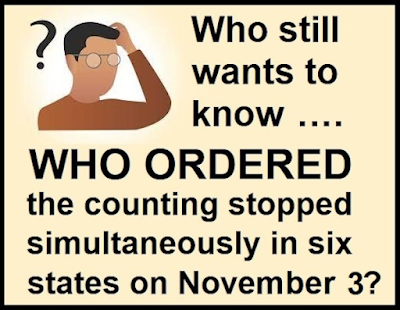
That's a very good question. What's the answer? Remember Ian Fleming's famous dictum: "Once is happenstance. Twice is coincidence. Three times is enemy action." With six states involved - all "battlefield" states, and all showing dramatic changes in voting after the unexplained stoppage - don't tell me that wasn't enemy action (enemies of democracy, that is)!

Peter
A few days ago I wrote an article titled "The crime wave as a precursor to civil war". In the light of that article, I thought this one by Leighton Woodhouse made interesting reading, particularly because the author admits he's a progressive rather than a conservative.
My wife and I are scrambling to find daycare for our 16-month-old son. We’ve had a “nanny share” up until now, which means we and another couple employ a nanny for both couples’ kids and split the cost. Our nanny is wonderful, and she lives just a few blocks from us. But a few weeks ago, someone walked up her street spraying bullets into random houses. One of the bullets found its way into her living room, as she and her family ducked for cover. At that moment, she and her husband decided they were moving their family out of Oakland.
The shooting didn’t even make the local news. Apparently, in the Bay Area right now, you can walk up a residential street firing your gun into houses, and you still won’t be able to compete for attention with all of the other sensational crimes.
Perhaps you’ve heard about some of them or seen the videos.
Shoplifters casually walk into Walgreens stores in San Francisco filling garbage bags full of merchandise. They’ve spat on, bitten, assaulted, and thrown bottles of urine at employees.
The flashmob-style “smash and grab” robberies that originated here—in places like Union Square in San Francisco and the shopping plaza in affluent Walnut Creek—have now spread across the country.
Asian seniors are brazenly assaulted in the street; one octogenarian was body slammed to death. This week, an Afghan refugee—a father of three who had worked as a translator for the U.S. army—was shot dead near a playground in San Francisco’s Potrero Hill neighborhood.
And now freeway shootings are a thing. A few weeks ago, at nine in the morning, a 29-year-old mom on her way from Oakland to San Francisco for a job interview with her fiancé and two kids was randomly shot and killed in her SUV at the Bay Bridge toll plaza. In an interview, the victim’s mother recalled being heartbroken after hearing the story of an earlier crime, in which Jasper Wu, a two year-old who was sleeping in his car seat, was shot and killed by a stray bullet fired from another car driving in the opposite direction. It was not even two weeks later when she lost her own daughter the same way.
I recently finished reading “San Fransicko”, by Michael Shellenberger. I recommend it.
The subtitle is provocative: “Why Progressives Ruin Cities.” But, as Shellenberger explains, he does not mean to imply that progressives always ruin the cities they govern. He’s just interested in the specific phenomenon of when progressives do ruin cities, and explaining why that happens.
And progressives—I count myself as one of them—do ruin cities. Or, at least, they put in place policies that cause profound harm to the people living in them.
. . .
We live in the aftermath of the progressives’ triumph over institutionalization, and it looks like San Francisco’s Tenderloin District or L.A.’s Skid Row. Today, with few exceptions, there is no more involuntary treatment for serious mental disease or drug addiction. But nor is there a humane alternative. There is only jail or the streets.
The same thing is now happening with criminal justice. Progressives today are passionate about dismantling the status quo, but have offered little in terms of a viable alternative. It’s a posture Shellenberger calls “left libertarianism,” and it assumes that those kinder, better, more forward-looking criminal justice systems will spontaneously emerge. The past year has given us plenty of evidence to reveal that idea as the wishful thinking it is.
There's more at the link.
I guess, sooner or later, even progressives have to face reality - and reality isn't progressive. Who'd've thunk it?

Peter
This one did, to mine.
On Dec. 2, Haley and her husband Jb Parke welcomed their newborn son John Beeson Parke (Jb), three weeks early.
The Sunday before, her husband was admitted to the hospital with complications from cancer.
While the couple thought they had 6 months, they found out on Wednesday that it would just be a matter of days.
“With our second son’s due date 3 weeks away, my husband and I knew asking for an induction was the right thing to do. Without hesitation, the team of ICU doctors communicated with the head of high risk labor and delivery doctors. They offered me an induction as soon as I was ready,” Haley wrote.
The induction process began, but Jb’s condition was declining fast as of Thursday morning, so the medical team worked quickly to deliver the baby via a c-section.
“In a matter of literally one minute, I was in the OR, and in just a short 20 minutes later, our son was born. He was given to me for a quick kiss, and then a team of doctors and nurses ran him up 2 floors, and he was placed on his daddy’s chest,” she wrote.
Once the baby was placed on Jb’s chest, Haley wrote that her husband’s vitals instantly improved, and he was able to acknowledge their new precious son.
Jb’s last moments were spent with his newborn son and his wife in his hospital room.
Haley said Jb took his last breaths with their son on his chest and her hand in his.
The couple hadn’t picked out a name before their son’s arrival, but Haley wrote that she knew the right thing to do was honor her husband, and named him John Beeson Parke (Jb).
There's more at the link.
A fund-raiser has been set up for the family. If you click over there, you can read a longer, more detailed account of events by Haley Parke. I think this is one fundraiser anyone in his or her right mind can support, and I'll be doing so. How about you, readers?
May John Beeson Parke the elder rest in peace; and may his son grow up to be a Godly man, to carry on the work that his father had to lay down. May John's wife and John Jr.'s mother, Haley, be blessed for her very special contribution to both the life and the death of her loved ones, and may she find comfort and strength in the days ahead.
Peter
It looks like the supply chain crunch isn't about to ease up, despite positive comments from a number of sources. The latest sector to take a hit is the transport industry - the very people who have to move supplies through the chain from origin to destination.
Supply headwinds facing the trucking industry were front and center at an investor conference on Wednesday and Thursday. While executives said driver recruiting and broader supply chain bottlenecks are ever so slightly easing, the procurement of equipment has gotten tougher.
. . .
Derek Leathers, Werner Enterprises ... said current tractor and trailer orderbooks extend well beyond the OEMs’ manufacturing capacity for all of next year, meaning the industry fleet, which has gotten older and smaller during the pandemic, won’t be increasing anytime soon.
. . .
Trailer manufacturer Wabash said it would build only 50,000 dry van trailers next year compared to more than 57,000 in 2019. The company’s backlog, which extends into 2023, has increased to more than $2.3 billion from $1.9 billion at the close of the third quarter. It’s in the process of converting refrigerated manufacturing capacity to dry van production lines but that won’t be completed until early 2023.
. . .
Difficulty finding workers throughout all levels, from maintenance techs to office employees, has been a burden for the company.
“In the past, we were able to tweak pay or turn pay and that typically would fix 95% of the problem. Today, that’s not the case when it comes to labor,” Simpson continued.
The American Trucking Associations’ estimate of the current driver shortfall is approximately 80,000. But the organization sees that number moving to more than 160,000 by 2030.
“It’s the most difficult driver market I’ve ever seen,” Leathers said. “Has it stabilized at very difficult? That seems to be the case. So it’s staying very difficult but it doesn’t seem to be worsening.”
There's more at the link.
I understand the problem with truck and trailer production is the non-availability of critical parts, which are also stuck somewhere in the supply chain. I know a couple of major hauliers in this area have started to remanufacture older trucks and trailers, spending up to 30% of the cost of a new unit to keep old ones in service for a few more years. They'd prefer to replace them, of course, but since that's not possible in today's market - particularly when bigger, wealthier competitors are outbidding them for the available stock - they're doing the best they can.
The driver shortage will be made worse, at least in the short term, by new and more stringent training requirements that take effect in February 2022. This is a positive development for driver and road safety, but it'll mean getting new drivers certified and into productive work will take longer and cost more. I understand existing drivers, particularly older ones, are getting more than fed up with the pressures they're facing from shippers and customers. No matter how much money they're getting, they're voting with their feet and deciding that the stress and tension of the job isn't worth it any more. It's hard to blame them.
If there are any transport operators or truck drivers among our readers, I'm sure we'd love to hear from them in Comments. How are they finding the present situation?
Peter
It's not often that a headline can make me do a double-take in disbelief, but this one certainly did.
Huh???
Saudi Arabia’s popular King Abdulaziz Camel Festival, which kicked off earlier this month, invites the breeders of the most beautiful camels to compete for some $66 million in prize money.
Botox injections, face lifts and other cosmetic alterations to make the camels more attractive are strictly prohibited. Jurors decide the winner based on the shape of the camels’ heads, necks, humps, dress and postures.
Judges at the monthlong festival in the desert northeast of the Saudi capital, Riyadh, are escalating their clamp down on artificially enhanced camels, the official news agency reported, using “specialized and advanced” technology to detect tampering.
This year, authorities discovered dozens of breeders had stretched out the lips and noses of camels, used hormones to boost the beasts’ muscles, injected camels’ heads and lips with Botox to make them bigger, inflated body parts with rubber bands and used fillers to relax their faces.
There's more at the link.
Er . . . ah . . . well, yes, quite!
Looking at our current crop of wattled, bulbous, enervated politicians in Washington D.C., one wonders whether some of those "beauty treatments" might not be appropriate for them, too? Surgical attachment and/or enhancement of humps might be appropriate as well, given how they gorge themselves on taxpayer dollars during their tenure there . . .

Peter
There appears to be a growing movement around the world to "shut out" those who will not accept the COVID-19 vaccination. They're being denied basic rights like access to stores, ordered to quarantine themselves, threatened with imprisonment if they refuse to comply, and more of the same. A few examples from overseas:
And in America:
Every state in the union has its own measures in place - far too many to summarize here. Some are very restrictive, others less so.
I've made my own position on COVID-19 vaccination very clear. I regard the existing vaccines as profoundly unsafe, and more of a health risk than the disease itself (which I've already had twice in two years, and come through with no major difficulties despite being in several of the high-risk groups for it).
If you don't agree with that perspective, consider this information from the World Health Organization (click the image for a larger view):

(EDITED TO ADD: To access the raw information and a breakdown of reported reactions, search http://www.vigiaccess.org/ using the keyword "COVID-19 vaccine". At the time of writing, the total number of adverse reactions recorded had risen to 2,703,969 in 2021 so far.)
Obviously, those raw numbers are hedged about with official warnings and cautions about the further investigations that are needed. That's a given. Nevertheless, if you can look at those bars on the graph and tell me that you're still absolutely confident that the available COVID-19 vaccines pose no risk at all to your health . . . all I can say is, you're living in cloud cuckoo land.
Meanwhile, those of us who won't accept vaccination find ourselves increasingly shut out of normal everyday life in many parts of the world. Well, if the powers that be want to play that game, let's do the same. We can inflict just as much pain as they can, if we put our minds to it. A few ideas:
As John Nolte profanely points out, speaking about right-wingers in general rather than only those opposed to COVID-19 vaccinations:
And so, like a mob of fat, comfortable, uptight Margaret Dumonts in the face of Groucho Marx, the media’s jaws still drop when our response to their shame campaigns is a middle finger and poke in the eye.. . .
This is the beauty of building our own thing. All these filthy crooks can do is sputter out their helplessness. But, best of all, they sputter it from their own velvet echo chambers.
. . .
Yes, of course, we will build our own thing, you fascist Nazis.
That’s what free people do; that’s what the human spirit is engineered to do. Even in the Soviet Union, even under Nazi occupation, people never stopped fighting to be free, to live in a country where they could say and do whatever they wanted. If Hitler and Stalin couldn’t stop us, do you think a bunch of snobby “journalists” and a pasty, dead-eyed freak like Mark Zuckerberg will?
There's more at the link.
Don't get mad - get even.
Peter
Back in October I wrote:
I'm willing to bet a large sum of money that as soon as FDA approval is given to vaccinate children against COVID-19, some schools in some parts of the country will begin inoculating children with or without their parents' consent. They'll arrogate to themselves the right to decide what's best for the child.
Well, guess what?
Los Angeles School District Vaccinates Students Without Parents Knowledge or Consent
I hate being proved right about something as dire as this.
Personally, I think every parent who finds that their school district has done this should hunt down and personally punish every single person who had a hand in it - administrators, school nurses, bureaucrats, the whole damned lot. I don't care what the punishment is, so long as it's sufficiently severe to be a salutary deterrent to all the other blissninnies who think they can decide instead of parents what's best for their children.
Hanging, drawing and quartering may be an old-fashioned punishment, as is keelhauling . . . but I think they may still have a place in modern society, to punish something like this. What say you, readers?

Peter
We've met Neil Oliver before in these pages. He's a trenchant observer of current affairs in Britain and Europe, and many of his observations apply to the United States as well.
He points out that the emerging COVID-19 tyranny will finally, inevitably, reveal the true nature of those behind it - those who claim to govern us.
Barring only the unvaccinated from bars and cinemas and the rest, making the vaccines an unavoidable, legal requirement for participation in the ordinary stuff of life – these are the contents of a closed box politicians all over the world have been contemplating for a while.
It’s a box I think they always planned to open eventually. It was always and only a matter of time, a matter of when. But, I say again that it is not all bad news, because the contents of that box – that box in which lies the ultimate say over own bodies, our children’s bodies, our freedom to live our lives unmolested – are dangerous for all.
Because once that box is fully opened, the masks – and I don’t mean the trillions of strips of plasticised fabric presently littering the streets, hanging from trees and fences, sinking into our oceans and choking the life out of wildlife – I mean the masks disguising totalitarians as democrats and liberals … will finally be off.
And that, emerging as though from chrysalis as a fully-fledged totalitarian, takes some nerve.
As they do say, you can’t ride two horses with only one backside. If our elected representatives open that box, the days of masquerading as freedom-loving, liberal-minded public servants, the trustees of generations of democracy, will be over, for ever. Once that box is open, once we step over that edge, there will be no going back for anyone.
. . .
What, anyway, will be the truth, the reality, of compulsory vaccinations. I have wondered what they will look like. No doubt it starts with tighter and tighter lockdown for the unclean – more and more restrictions on movement until such folk are effectively shut up in their homes. There will be loss of jobs, punitive fines, confiscation of property, maybe seizing of bank accounts – the opportunities are endless for a government seeking to force people to do that which they do not want to do.
But eventually, I imagine, if all else fails, it must come down to force – naked force. Eventually it comes down to a citizen held down in a room and a needle stuck into his or her arm. I know that sounds dramatic – and it is – but if a government decrees that every man, woman and child has to take the vaccine, willingly or not, well, force is how it ends.
. . .
The outcome of all this is up to us. And there is something else worth remembering every day.
I have said it before and I will say it again now.
Governments amount to hundreds, while we amount to millions. They are few and we are many.
There's more at the link.
I've embedded a video of Mr. Oliver's talk below, which I highly recommend watching, or (if you'd prefer) reading the full transcript of his speech at the link provided.
Trenchant thoughts indeed. We should all be asking ourselves, "What if that actually happens? What if jackbooted thugs try to hold down me, or my spouse, or our children, and forcibly inject us with a vaccine we don't want and regard as dangerous?"
I made my decision about that a long time ago.
Peter
I have to laugh at the current mess in the California marijuana "industry". Citizens there voted to legalize marijuana, and the state set up a structured "industry" - complete with taxes, etc. Trouble is, they taxed it too heavily.
Two and a half centuries after the Boston Tea Party, legal cannabis operators say it might be time for a California Weed Party.
But rather than dump their agricultural product into the Pacific Ocean, shop owners and others are floating the idea of withholding their state tax payments. This year, that could add up to $1.3 billion.
The goal is to express frustration with the state of the industry in California, where legal cannabis merchants struggle to compete with illicit operators who have a huge price advantage specifically because they don’t follow the rules.
. . .
Since voters opted to regulate cannabis in 2016, all products legally sold in California have come with a 15 percent excise tax. Cultivators also pay a tax based on the weight of what they sell, which in turn bumps up the retail price. Then there’s regular state sales tax, which typically runs between 8 and 10 percent. Plus, cities and counties that allow marijuana businesses typically tack on local cannabis taxes, which can reach as high as 15%.
It all adds up to an effective tax rate for California cannabis businesses that can easily top 45%.
. . .
But, to date, the high tax rate — and the revenues collected — have done little to level the playing field. California’s underground cannabis business is estimated to be twice as big as the legal side of the industry.
And the legal operators suffer because the costs of following the rules inevitably get passed along to consumers, exacerbating the price gap between legal and illegal cannabis. Products sold from underground shops and hustlers with backpacks often cost half as much as the products sold in Kiloh’s licensed L.A. store, he grudgingly acknowledges.
. . .
That daunting outlook might be why the legal side of the industry is shrinking. In 2018, there were roughly 16,000 licenses for cannabis businesses in California, a figure that by 2020 had fallen to about 10,000 licenses, according to an analysis earlier this year by the Legislative Analyst’s Office.
Some of those operators surely left the state or industry entirely. But Kiloh said he personally knows many who simply returned to an unregulated industry that’s thrived since Californians became the first in the nation to loosely legalize medical marijuana in 1996.
There's more at the link.
Everybody keeps piling on with new taxes, too. San Francisco has just been forced to suspend its local marijuana tax for a year because of the proliferation of unlicensed weed. Legal shops there can't cope with their lower-priced illegal competition, and the new tax would have made it even worse.
The states where marijuana is legal have also become major supply points for the states where it isn't. US 287 is a highway that runs down from the Canadian border, through Colorado, into northern Texas, where it makes a sharp left turn at Amarillo and cuts down to Dallas/Fort Worth. Drug dealers there are constantly trying to ship carloads of weed from Colorado (where it's relatively cheap compared to local prices) to DFW. I doubt a week goes by without Miss D. and/or myself seeing an old, rusted pickup truck or van, or a U-haul or Penske or Budget rent-a-truck, pulled over on Highway 287, with a couple of cop cars (state troopers, sheriff's deputies or town police) enthusiastically rooting through it. They usually find what they're looking for.
Legalizing marijuana doesn't make things better. It's like the many places that have legalized prostitution over the years. Very often the increased regulation, medical examinations and certifications, etc. that have accompanied legalization meant increased prices to pay for them. Therefore, many prostitutes continued to ply their trade illegally, rather than accept the expense and additional hassle of jumping through the necessary hoops to obtain a permit. A lot of places tried to tax prostitutes' income, with a predictable lack of success. As one Dutch newspaper famously observed, "What are they going to do - install a parking meter next to the bed, charging customers according to the time spent there?"
Laws against immorality simply don't work - just like preaching against immorality. In the latter case, it's important to remind people what's right and what's not in one's system of belief, but whether or not they'll comply is up to them. Those who want to do the right thing will do it. Those who don't want to, won't.
It's like the poster put up outside an evangelical church in London, England some years ago. It read: "Brother, if you're tired of sin, step inside!" It didn't take long at all for someone to add underneath, in bold black marker ink, "If you're not, call this number!" So much for morality . . .

Many of us were enthralled by the 2001 television series "Band of Brothers", which followed the men of "Easy" Company, 2nd Battalion, 506th Parachute Infantry Regiment, 101st Airborne Division, through 1944 and 1945 during World War II in Europe. I still regard it as one of the finest cinematic portrayals of men in combat I've ever seen.
Sadly, we learn that the last surviving member of Easy Company has gone to his reward.
Col. Edward Shames, final surviving member of the World War II parachute infantry regiment known as the “Band of Brothers” which inspired the HBO miniseries and book of the same name, died Friday. He was 99.
An obituary posted by the Hollomon-Brown Funeral Home & Crematory said Shames, of Norfolk, Virginia, died peacefully at home.
Shames enlisted in the Army in 1942, parachuted into Normandy and fought in the Battle of the Bulge as part of the “Easy Company,” 506th Parachute Infantry Regiment, 101st Airborne Division.
. . .
“He made his first combat jump into Normandy on D-Day as part of Operation Overlord. He volunteered for Operation Pegasus and then fought with Easy Company in Operation Market Garden and the Battle of the Bulge in Bastogne,” according to the obituary.
Shames was the first member of the 101st to enter Dachau concentration camp, just days after its liberation.
“When Germany surrendered, Ed and his men of Easy Company entered Hitler’s Eagle’s Nest where Ed managed to acquire a few bottles of cognac, a label indicating they were ‘for the Fuhrer’s use only.’ Later, he would use the cognac to toast his oldest son’s Bar Mitzvah,” the obituary outlined.
Shames worked for the National Security Agency as an expert on Middle East affairs at war’s end. He also served in the U.S. Army Reserve Division and later retired as a colonel.
There's more at the link.
Here's Col. Shames a few years ago, talking about his experiences from Normandy to the Eagle's Nest in Germany.
May he rest in peace, and may his reunion with his former comrades-in-arms be blessed. We are diminished by the loss of men such as he.
Peter
Yesterday I put up a video clip of Ken Hackathorn. I titled it "Staying alive in today's urban crime and unrest". It wasn't comforting viewing, to put it mildly.
Michael Yon sees the burgeoning crime wave in more sinister terms.
Civil War is not yet obvious to everyone. My estimate is civil war is not obvious to most Americans yet. This crime uptick is exactly and specifically one of the symptoms I have long warned about.
In context of current global and national situation, this crime wave is a symptom of something more intense, beyond crime. The economy is collapsing. Supply chains terribly disrupted. Fuel and fertilizer prices increasing. None of these trends have reversed, or even leveled.
During all these, somewhere around 2 million 'migrants' have crossed our border. Nobody knows the true number. It's big. I have personally witnessed many.
As food prices skyrocket and shortages increase, crime will explode. Vigilantism will follow.
Another symptom will be REAL neighborhood watches, such as armed men setting up checkpoints. Rich people hiring actual militias.
Road blockages followed by mass murders and robberies targeting trapped passengers. This all is 'normal' in these situations. States with vibrant 2nd Amendment laws such as Texas and Florida likely will suffer far less outside of particularly dangerous areas. California and all the defenseless States will be perfect places for criminal migration.
Smart criminals with foresight who wish to strike their fortunes in the Great Blue Gold-Rush of 2022, will abandon testosterone States like Texas and Idaho, migrating to weaker soy States such as California, New York, and Massachusetts.
There's more at the link.
He's not alone in his forecast. Effectively, "blue" states and cities - those controlled by Democrats - have given free rein to the criminals infesting their streets. Politically correct prosecutors are soft on crime; police are "defunded", if not actively ordered not to interfere; those who try to defend themselves and their property are demonized, if not actively retaliated against by the so-called "justice" system; and, as Yeats would put it, "Mere anarchy is loosed upon the world".
Sundance calls it "the Safari Rules".
An inevitable evolution now takes place as rampant crime, violence and anarchy take over the municipal regions controlled by leftists and Democrats. What is described, in the video excerpt from ABC news in Maryland, is what we have described as the “Safari Rules.”
As stunning as it may seem at first glance, the media are informing the public on how to behave when entering any area were Democrats are in charge of civil society. It is important not to accept this new normal; instead think about this broadcast in the larger picture of what it represents. The media no longer question if you will be attacked; the media are now advising us on how to mitigate our pending attack. The attack itself is a foregone conclusion.
In essence, the underlying elements of the Safari Principle narrative begin with a pretense that victims of the mob, any mob or individual predator, have no one except themselves to blame because they did not follow the rules of the safari. When in the proximity of any person, event or situation that is engaged in an unlawful act supported by the political left, you are not permitted to exit your vehicle or engage in activity that will lead to your targeting.
If you enter their “space to destroy“, you are to blame for your own outcome. The safari narrative includes catch phrases like “he/she should not have gotten out of the car,” and “she/he shouldn’t have traveled to (fill_in_blank)”, or “he/she should have known better when…“, etc.
. . .
None of this is accidental, this massive crime wave is an outcome of ideology. However, and this is the important part to emphasize, unlike previous times when this cycle of violence took place – this time there is no capacity to reverse course. There are no police or law enforcement left in these regions with the motivation or support to save you.
If you can leave, get out. If you cannot leave, at least arm yourself while you still can.
Again, more at the link.
I have a number of friends and acquaintances in "deep blue" cities and states who shake their heads at such "alarmist" reporting. In so many words, they all say "It's not that bad where I live. That's the other side of town. We're safe here." I don't know what makes them think that the criminals on the other side of town can't very easily take a drive to their neighborhood whenever the fancy takes them. (Vox Day points to a good example.) Some cities are now so terrorized by crime that their citizens appear to have decided to roll over and play dead. Seattle is a good example. So is Portland. So is Minneapolis. A certain (high) level of crime is acceptable in the city, so long as it doesn't become personal - so long as it doesn't affect them.
I can't help but agree with Mr. Yon. All too often, a breakdown in law and order is a precursor to full-blown civil war. I've also seen how the police and security services first stop trying to prevent the breakdown (out of sheer self-preservation), and then become part of the problem themselves, because if everybody else is getting away with it, why shouldn't they? That hasn't happened in this country to any great extent yet, but I won't be surprised if it does, in due course. It's happened almost everywhere else I've seen that progression. (It may already have happened in Minneapolis.)
I've said it before, and I'll say it again. If you live in or near a "blue city" or "blue state", do yourself a favor and get the hell out of there before it's too late. If you can't, for whatever reason, then prepare yourself, your family, your home and your neighborhood to defend what's yours, because the time is, repeat, is coming when you'll have to do so. What's more, it'll be very hard to do so on your own, because the enemy will probably have the strength of numbers, and will act with a ruthlessness and callousness that will shock you. You'll probably need the support of family, neighbors and friends to withstand it.
Finally, go back and re-read my warnings from last year: "Self-defense under a justice system that's no longer on your side" and its follow-up article. They apply now more than ever.
Peter


