Wednesday, January 25, 2023

Medical frustrations


Regular readers will recall that early in January, I developed a large abscess on my left leg.  It was drained by my local physician a couple of days later, and since then I've been waiting to hear from a surgeon to get a drain installed for further healing.  Unfortunately the surgeon never called, despite repeated follow-ups.  Turns out his staff simply didn't bother to inform us that his schedule was full until late February, so we had to find someone else.  We only found that out yesterday!  Fortunately, another surgeon agreed to fit me into his schedule today, given that delay in this situation is sub-optimal.

I saw the surgeon this morning. He reckons the abscess, even though now largely drained, is simply too large to deal with in his surgery;  so I have to go into hospital on Monday for an out-patient procedure to cut it open and deal with it.  He said he wanted a properly aseptic environment, lots of lights, and professional help if needed.  Not at all what I wanted to hear (I've been in hospital a lot more than most people, and have a hearty dislike for them), but needs must, etc. 

What infuriates me is that within half an hour of his staff scheduling the surgery, I had three phone calls in rapid succession from the hospital, all from different people.  Not one of them said a word about my condition, or asked how I was doing.  All they wanted was money:  credit card info, insurance, etc.  It was never this bad in the past.  Now, it looks like health care is nothing more than a money-making racket.  Whether or not you recover is neither here nor there, just as long as they get paid!

Anyway, I'll deal with all that later.  We'll see what happens on Monday.  Thanks in advance for your prayers, friends.

Peter


Modern dating and courtship


Scott Adams is running a series of cartoons on the subject.  Here's Dilbert from January 24th this year.  Click the image to be taken to a larger view at the comic's Web page.


"After a baby or two"?  Seems a bit late by then, doesn't it?


Peter


A friend and fellow blogger needs help


Jennifer Hast and her husband have been part of our team at the North Texas Troublemakers for years, even though they live in Oklahoma and can only occasionally get down our way.  They've been regulars at our annual Blogorado gathering, too.


Sadly, Jennifer has just been diagnosed with breast cancer.  Both her mother and her sister have already survived this disease, so as you can imagine, she's taking it very seriously.  She's asking for help with some big medical expenses, plus the cost of being off work for a month to recover from the procedure.  You can read all about it at her GiveSendGo fund-raiser.  She was in the process of starting her own business, but that's obviously on hold until she can put this behind her.

My wife and I have already donated, and we'll both be very grateful if you'll please read what Jennifer has to say, then contribute what you can to help her get through this.  She's worth it.  (I'm not just saying that because of the utterly delicious lumpia she sometimes brings to Blogorado, either!  They're a bonus. If I could figure out how to wheedle a lumpia out of her for every $10 my readers contribute, I would in a heartbeat!)

Thanks in advance.

Peter


Tuesday, January 24, 2023

Antifa - tool of the establishment


Tucker Carlson points out the obvious.  I've embedded his talk below in video form, and excerpts from the transcript follow if you prefer to read rather than listen.


Antifa is the armed instrument of the permanent Democratic establishment in Washington. Their job is to mobilize when politically necessary. Now, this is a new thing in the United States, but political militia are a common feature in third world politics. They were a staple in Haiti. In our country, however, only one party has them, the Democratic Party. They're the only ones with armed militia in the street.

So with that in mind, it's interesting to note that Antifa is back in force, and that's probably not a very good sign for Joe Biden. If nothing else, Antifa has a solid track record of getting rid of sitting presidents.

. . .

But what you have in effect here is the official endorsement of domestic terrorism from the highest level of the Democratic Party. And why wouldn't you? Again, this is their militia. These are their state-sanctioned shock troops, and they are effectively immune from criticism. 

So you go to jail for owning a 10-round magazine, but they get to do whatever they want. Merrick Garland and Christopher Wray, who runs the FBI, are making certain that every last January 6 defendant spends years in jail. Their lives are destroyed, on the no fly list. And yet Antifa terrorists get released almost as soon as they're arrested.

. . .

Is anyone going to ask what Antifa is? Who leads this group? How many more riots do they have to lead before the New York Times gets interested and does a five-part series on what is this? Who are these people? Who pays for this? Where do they stay at night? What's their background? Give us some news on Antifa. They're the biggest armed militia in the United States, and we know nothing about them. Why? Because they're aligned with the Democratic Party.

But they're telling you the real threat is rural voters with AR-15s, assault weapons. You must disarm Republican voters. No, thanks. 

Disarm? Why don't you go ahead and disband Antifa? Go full RICO on them. Let's find out who their leaders are. Let's see them in jail. Then maybe you can tackle street crime and then pay a little bit of attention to the drug cartels that control the southwestern United States. And then maybe at that point, you will convince some people to register their AR-15s, But until you do that, up yours.


There's more at the link.

I can't disagree with a word Tucker Carlson says.  The reality is painfully obvious to everyone except those in lock-step with the progressive left-wingers who currently control the reins of federal power.  We're very fortunate - some of us - to live in states that are not of that persuasion, and are strong enough to resist federal and progressive-left encroachment to at least some extent.

I've had to deal with government bully-boys on more than one occasion, in more than one country.  I learned the hard way that there's only one way to stop them.  They're convinced that they're in the right, they know they won't face any consequences for what they do, and the legal system is on their side, so they keep on coming, no matter what.  There's only one way to stop them, and that is physically - by resisting their force with equal or greater force, making them stop.  I suspect that's the reality more and more Americans will have to accept from here onward.

Oh, well.  Time to check out the ammo locker and replenish any gaps.  (I doubt there'll be many . . . after literally decades of witnessing violence and anarchy at first hand, I lost my innocence about that sort of thing a long, long time ago!)  Given how many of these Antifa domestic terrorists are wearing body armor, though, it might be a good idea to stock up on things that can defeat such measures.

Peter


So much for the 'Rule of Law' in Seattle


The far-left cabal that runs Seattle has demonstrated, yet again, its contempt for anything and anyone that tries to hold it accountable for its misdeeds.  This time, it's flagrant disobedience to court orders.


The city of Seattle has been hit with sanctions by a federal judge for deleting thousands of text messages between officials, including the former mayor, police chief, and fire chief during the deadly three-week-long Capitol Hill Occupied Protest, also known as the Capitol Hill Autonomous Zone, or what was termed the CHAZ or CHOP.

. . .

The destruction of the evidence was intentional and officials worked for months to hide the evidence, which included deleting texts, according to the judge. He wrote, “The Court finds substantial circumstantial evidence that the city acted with the requisite intent necessary to impose a severe sanction and that the city’s conduct exceeds gross negligence.”

The judge added that when the case goes to trial he will impose a “severe sanction” on the city and instruct the jury to presume the text messages were detrimental to the city’s case and that there is plenty of circumstantial evidence they were deleted intentionally.

Zilly wrote in the 39-page order, “City officials deleted thousands of text messages from their city-owned phones in complete disregard of their legal obligation to preserve relevant evidence. Further, the city significantly delayed disclosing … that thousands of text messages had been deleted” and could not be recovered or recovered.

He concluded, “As a result, substantial evidence has been destroyed by the city and is unavailable to plaintiffs to support their position in this litigation.”

. . .

Zilly wrote, “Although the city issued a significant number of litigation holds” that required the preservation of all evidence pertaining to the lawsuits that had been filed months earlier, “Officials at the highest levels of city government completely disregarded these holds and deleted thousands of relevant text messages.”

He stated in the order, “Instead, Mayor Durkan, Chief Best, Chief Scoggins, and other key city officials purged (through factory resets, changed retention settings, or manual deletions) thousands of CHOP-related text messages from their phones after they were under a clear legal obligation to preserve such information and without confirming that all of their text messages had been preserved through other means.”


There's more at the link.

Therefore, those businesses suing the Seattle city council for the disruption and financial losses caused to their businesses by the CHAZ/CHOP fiasco must now make their case without much of the evidence they need to prove it.  That, of course, was probably the entire point of the mass deletion of messages.

I think the judge was absolutely correct to say that at the trial, he would "instruct the jury to presume the text messages were detrimental to the city’s case and that there is plenty of circumstantial evidence they were deleted intentionally".  However, we're dealing with a Seattle jury.  What are the odds that there won't be sufficient hard-progressive-left jurors that they'll ignore the judge's instructions and vote according to their political views?

I'm glad I'm not on trial for anything in Seattle.  I'm far from sure I'd get a fair trial, or a just verdict and sentence.


Peter


Monday, January 23, 2023

He who has ears to hear, let him hear...


Clickit to biggit.  (Source)


If, after seeing that, you're still optimistic about the US economy in the short to medium term, I have this bridge in Brooklyn, NYC to sell you.  It's not just a bargain, it's a steal!  Cash only, please, and in small bills.

Peter


"A Created Global Food Crisis"


Sundance at The Last Refuge puts the ongoing food crisis in a nutshell, echoing much of what I've been saying over the past year or more.


Joe Biden, NATO, the G7, the European Union, the World Bank, USAID, and every western leader in the United States and Europe stated in early and mid 2022 there will be food shortages in 2023.

They did not say there might be shortages; their statements were emphatic, there will be shortages.

Accept this basic cornerstone.  Then ask why not a single proactive step has been taken by any of the aforementioned institutions or governments to alleviate what they declare is a certainty.  Why?

Simple question, “why?”

If all of the western nations, non-govt organizations and heads of state, are aware of a coming food crisis, why is there no proactive response?

It is a question that even the most hardcore leftists will not answer, because there is only one answer.  No action is being taken because they do not want to take action.  No effort to avoid the crisis is being done, because they do not want the crisis avoided.

Peel all the layers of obfuscation and causation away, and what we find is the epicenter of the food shortage is directly the result of the Build Back Better agenda.  A post-pandemic western government deliberate decision to radically change global energy development.  In succinct terms, the climate change agenda.

However, regardless of how you feel about the validity of “climate change,” the cause of diminished food supplies is purposeful.  It is not climate change causing food shortages. It is the purposeful action taken under the guise of mitigating climate change that is causing the shortage of food.

The collective Build Back Better energy policy of western governments’ is the reason for massive increases in energy costs, massive oil price jumps, gasoline price increases, significant increases in chemical costs, increases in diesel fuel costs, shortages of fertilizer created using natural gas, and the end result is lower crop yields, higher farming costs and eventually, food shortages.  They knew this.

All of the organizations and government who have been decrying the future shortage of food, know it is the radical shift in energy resource development that is creating the crisis.  This acceptance of reality begins the framework to understand just how entrenched and committed these western leaders are toward their beloved climate change agenda.

We are only just now beginning to see the first aspects of the food shortage.  However, once the issue becomes unavoidable the western leaders will not and cannot accept the blame for what they have done.  They will blame-cast, excuse and justify what is surfacing.

Food shortages will be blamed on the Ukraine conflict, Russian aggression, climate change and any various iteration of justification that does not identify the true cause, their energy ideology.

I’m not so sure that people fully understand what the entire system of western government would be willing to do to avoid being blamed for avoidable death on a potential scale that is quite alarming.  All of the western leaders, institutions and governments are on the same boat.   They are all in this together.


There's more at the link.  Recommended reading.

Notice, too, how those who are trying to prepare for what's so clearly coming down the pike at us are already being vilified as "hoarders" and "black marketeers".  Never mind that it's a matter of simple, basic responsibility to prepare to feed one's family during hard times:  that's now an indicator that one is being anti-social, selfish and mean-spirited.  Those who've seen the writing on the wall and are preparing for what it predicts know better, of course.

Nevertheless, "preppers" had best be prepared not only for natural and man-made disasters, but for official vilification.  Their food stocks might - no, not "might", but almost certainly will - be targeted for confiscation, and they may face prosecution if they don't proactively hand them over to the Nanny State.  That's yet another way that the powers that be - who are, let us remember, ultimately responsible for the food crisis - will try to deflect responsibility from themselves onto other, easier targets for the anger of the mob.  It's easier to get the residents of a street, or a suburb, worked up about and angry at a local Henry the Hoarder or Paul the Profiteer than at some nebulous bureaucrat or politician in a city far away.  That takes the heat off those guilty of the problem, and diverts it onto some poor schmuck who just wanted to feed his family.

It's very, very late to begin preparations for food shortages and increase your family's security, if you haven't already done so.  Nevertheless, every little helps:  and even now, at this very late stage, you can still stock up enough supplies to get you through a month or two of hard times without breaking your budget.  I can only recommend very strongly that you do so.

Furthermore, make sure you have enough security equipment on hand, and have trained in its effective use, and have taken sufficient security precautions, to make sure you can keep your supplies.  That may well become necessary.  Certainly, in every one of the (multiple) countries where I've seen serious food shortages, it has been necessary.  Every time.  Hungry people aren't widely known as respecters of rights or persons.  Nor are bureaucrats and politicians trying to cover their asses.

Peter


Memes that made me laugh 143


Gathered around the Internet over the past week.  Click any image for a larger view.


Sunday, January 22, 2023

Sunday morning music


I found this over at Phil's place.  It made me laugh, so I figured my readers would enjoy it too.


I still question whether Starbucks can be classified as coffee at all, but there you are . . .


Peter


Saturday, January 21, 2023

Saturday Snippet: Everything goes wrong at a triumphal celebration


I was in my teens when I first discovered Dorothy Dunnett's six-book Crawford of Lymond saga.  It remains one of the finest works of historical fiction I've ever read, and I've had paper copies in my library for decades.  I've just invested in the Kindle edition of the set, which is remarkably low-cost given the amount of pages it contains - a bargain in anyone's language.

The six volumes of the series are, in order, The Game of Kings:  Queen's Play:  The Disorderly Knights:  Pawn in Frankincense:  The Ringed Castle:  and Checkmate.  For today, I've chosen an excerpt from the last of those volumes.


There's so much excellence in the book that it's hard to pick out one short excerpt to post here.  I decided that humor would be a welcome antidote to some of the darker pieces I've posted in the past;  and Ms. Dunnett's humor shines through the piece I've chosen like a well-tuned searchlight.  This piece is set in France in 1557, at what is supposed to be a triumphal celebration of a military victory.  Enjoy!


He was not to know, his strung-up nerves doctored with alcohol, that disaster upon glorious disaster was about to befall the City of Paris’s Antique Triumph for the Heroes of Calais; or to guess what was to follow it. He had no premonition even when the curving line of royal carriages drew up on the gentle riverside slope of the Grève and rested there closed in the downpour while the City Fathers waited civilly ranked, their plumes and satins and erminetails buffeted like furzy wrack in the cataract.

In time, the rainstorm abated. The City Fathers stood, water running down their humble features. The King’s carriage door opened. The King’s steps were placed before it. The King emerged and placed his foot, smiling, upon them. The Town Battery embarked on an offering of deafening salvoes. The King’s carriage horses reared, and the King fell out on to the paving.

Lymond buried his face in his hands.

* * *

The guns were still firing as the Royal family, the Princes of the Blood, the victors of Calais and their ladies moved within the pictured arcade erected about the HĂ´tel de Ville portals. The Town’s fifty standing hackbuts also began their salute, followed almost immediately with a carillon of bells from the church of St. Jean en Grève, another from the belltower of St. Esprit and a third, a little behindhand, from St. Jacques de la Boucherie, whose tenor rope had broken.

A small concert of fifes, trumpets, clarions and tambours struck up inside the arcade (Hoc Hercule Dignae and cardboard marble) where the PrĂ©vĂ´t des Marchands, his mouth opening and shutting, delivered his message of welcome. The King, his mouth also opening and shutting, could be seen to be persevering with an affable reply. Philippa’s husband, crimson with suppressed laughter beside her, was discovered to be talking also.

“What?” Philippa screamed.

“I said,” shrieked the noble and puissant seigneur François, comte de Sevigny, “thank God the guns are pointing…”

Silence fell.

“…away from us.”

He had dropped his voice in time, but Marshal Strozzi, also unfortunately commenting just behind, had not. There was an explosion of laughter, abruptly cut off. With her husband, very slightly out of hand, walking beside her Philippa followed the others up the staircase between the breathing ranks of Archers, Arbalestriers and Hackbutters of the Town and past Vicissitude, France In Triumph, the royal arms, the town arms and the motto, GRADATIM, or gradually repeated above every third step of an almost imperceptible progress into the Grand’ Salle of the HĂ´tel de Ville de Paris.

They had done their best, with tapestries, with paintings, with fleurs-de-lis and ships on the rafters, to create an Antique Triumph fit for the monarch. Pinned with ivy, painted on friezes were the escutcheons and the devices of everyone: the crescent of the King, the iris of the Queen, the Eclipse of Monsieur, the Gorgon of the King’s sister, the thistle of the Queen of Scotland, its purple still faintly running; the emblem, chastely sportive, of Madame de Valentinois, the King’s permanent mistress.

Happy fancies abounded. Along each tapestried wall hung ten twinned ivy crescents tied with taffeta: a reminder, had the Cardinals needed one, of the long and useful alliance between the Turkish and Christian kingdoms. At the service end of the room a Latin inscription, big enough to be read by the king and commencing SCOTIA TUTA SUIS, ACCEPTA BOLONIA…extolled the present reign’s finest successes. At the royal end hung the choicest offering: a rose-decked goddess with Bacchus and Satyrs and a verse beginning TU DEA. BACCHUS, AMOR…and ending, PRAELIA MNEMOSYNE, NON POCULA REGIA CURET, or, Count only the battles and not the cups the king drinks.

The names of the Duke de Guise, of Calais, of GuĂ®nes were everywhere, interwoven with heroic parallels: Jason; Ganymede; the banner of Caesar with four V’s instead of one, signifying that M. de Guise, having come, seen and conquered at last, should this time trap his good fortune by chains in case, as ever, it dodged him. The town had worked very hard.

On the other hand, although twenty years had passed since the PrĂ©vĂ´t and Echevins, armed with silver trowels, had laid the foundation stone of the new HĂ´tel de Ville, it stood still only two storeys high, and its Grand’ Salle did not allow any elbow room when its tables were set for a hundred. Those invited by the PrĂ©vĂ´t to watch, already admitted, lined the walls of the room on a scaffolding. Those invited by the PrĂ©vĂ´t to sup, in their best clothes and early, naturally made sure of their places also.

The King entered, the trumpets blew, the bells rang out afresh from the churches, and the twenty-six merchants’ wives already ensconced at the High Board rose, curtseyed and settled again, smiling at their less privileged friends. It was clear where the King was to go, since the royal chairs had been placed on a dais. Where the princes of the blood, the victors of Calais and the great lords of the court were to be seated was for fifteen minutes a matter of frenzy.

Steering purposefully, Philippa found two vacated places just below the Sieur d’Andelot, the Duke de Nevers and Seigneur d’EstrĂ©e for the former Voevoda of Russia and King’s Lieutenant-General in Paris, who was showing a maddening preference for simply standing stock-still, looking virtuous.

Unfortunately, Piero Strozzi elected to come and sit on her other side. He caught Lymond’s eye, which was not hard to do. Philippa Somerville turned to the Marshal and addressed him in succinct Italian. “If you laugh, I shall kick you.”

“Signora,” said Piero Strozzi, “if you care to continue in this field of discussion after dinner, we should have much to say to one another. That is——”

He broke off, his eye arrested by something on her other side, and then resumed, injured, “…that is, if you had not brought your Russian retinue with you. In bocca serrata mai non entrò mosca. I give you a friendly warning. You think M. de Sevigny is drunk. He is not.”

“You might not think so,” said Lymond amiably. “But in ten minutes or so, I am going to slip under the table and lie there.” On his other side, the comtesse de Laval put her hands over her ears and pulled a face at him. The noise, ringing back from the beams, was quite dizzying, and so were the fumes of sweat and scent and wet clothes and incoming food. The doors, which had been with difficulty shut, burst open again to admit a group of noisy, wet people. They closed, and then opened again. There were not enough places at the table. The benches jostled with incomers. The narrow space between the long trestles was filled with parties looking for seats, parties standing or kneeling on seats or parties simply meeting other parties and exchanging various witty ripostes.

They were all, Philippa saw, minor members of the Court, who had had no invitations in the first place. Perrot, speaking to the King, looked extremely flustered. The MaĂ®tre d’HĂ´tel was sweating. More people began to pour in. The superfluity of blue blood, it was clear, was more than thirty Archers without benefit of password knew how to control. The reeking air, pushed by the heat from the two raging fires, moved and swung and swirled up to the rafters where the municipal chandeliers, specially made in black and white, the King’s colours, tossed and swayed from their herbaceous pinnings.

The comte de Sevigny looked up, his hair, and the priceless collar he wore neat and spiteful and glittering in the candlelight. “Christ,” he said. “Piero. What are you going to do when the candelabra fall down?”

Piero Strozzi leaped to his feet. “Messeigneurs!” The roar of it cut across even that febrile cacophony. “Messeigneurs nearest the door! The candelabra are about to fall on you!”

That got rid of twenty-five people. By a miracle of sinuous movement, Lymond was by the outer doors as the last of them backed out, exclaiming. The outer doors shut, then the inner doors. Marshal Strozzi, leaping to his feet, roared, “Messeigneurs! All has been made safe! The PrĂ©vĂ´t begs you all to sit and be welcome!”

Everyone subsided. Opposite her, Philippa noticed, she had the god Janus with a key in his hand, and a verse beginning QUI BIFRONS FUERAM, GALLIS SUM GALLICUS UNA FRONTE DEUS, indicating, she took it, that he was prepared to be two-faced for everyone except Frenchmen. It reminded her of something. Lymond, sliding back, said, “I’ve told Jacob if his Archers let another soul in, I’ll shout Fire. They’ll all jump through the windows.” A braying noise, creeping into the room while he was speaking, broadened, intensified, and began to permeate the clangorous gases.

Strozzi screamed. Lymond, not in the least disturbed, frowned at him. “I asked the hautboys and clarions to play for us. Paris, fontaine de toutes sciences. If you can’t lay your hands on three hundred Tartar horsemen with scimitars, I recommend clarions for quelling a riot. What, then?”

Piero Strozzi had screamed again. The Queen’s cousin rose to his feet. Below the black hair, tightly curled with the damp, his lips were drawn back in a rictus of passion, displaying his broken teeth. Then, raising one pink and ribboned arm, he swept it across the table and tore from a startled Ă©chevin’s grasp the silver cup from which he was drinking. Gouts of claret soaked the municipal rust and crimson velvet. The merchant jumped to his feet.

Nose to nose: “You have many ill-deserved rights as Ă©chevin of this undesirable city,” said Piero Strozzi, “but stealing my table silver is not one of them!”

Someone hauled, with steady violence, at his coat. He rocked, but remained standing.

“Monseigneur!” Where visible through beard and winestains, the merchant’s face was blotched with fury. “I demand reparation! You insult me and the city which honours you!”

“Honours me!” roared Marshal Strozzi, staggering and recovering with aplomb. He interrupted himself, staring along the crowded table. “Mon petit François, there is your silver, also.”

“So it is,” said Lymond with interest. The merchant’s wife who was admiring a great salt in cut glass and silver snatched her hands back, turning white. The man at her side began to rise slowly, piping like a Chinese ocarina. Lymond, concentrating, surveyed him closely. “Now I think of it, the shirt is very familiar.”

“My lord count!” said the Councillor.

“…But I couldn’t swear to it, in a court of law. I don’t object. The intention is to make us feel at home.” He lifted a heavy silver-gilt object from the table far to his left and showed it helpfully to Marshal Strozzi. “There’s one of your livery pots.” Marshal Strozzi lunged.

This time Philippa waited until he was off-balance. Then she took a strong grasp of his fur-trimmed coat with both hands and jerked.

With a crash and a hooting of oaths which out-trumpeted even the clarion, Marshal Strozzi fell on his back. It was a gradual fall, broken by the short row of pages behind him. He dropped into a dish of roast swan, and from there into a platter of bustards, and ended with a liquid sigh on the floor in a bowl of small pullets with vinegar. Gilded plumes from the swan quilled, with chic, a bubbling tippet of gravy. From the ruffled merchants, there came a squeal of shocked glee. He lay, speechless.

Across his fallen chair, Lymond gazed reflectively at his wife. “You borrowed the silver,” he said.

“Someone had to help them,” said Philippa. “The King invited himself, and left them eight days to get ready. Baptiste had four days to finish the paintings. The tinsmith could only supply so much on short notice. They had to have linen brought in and laundered and buy rose water to scent it, and torch batons and wine, and get a Folder of Linen for the napkins. The master roasters and bakers haven’t had any sleep for three days, and Jodelle for four, and they’ve all been here since this morning, slaving to make everything ready.”

Piero Strozzi sat up, his gravy-stained hands negligently clasped about his steaming and redolent knees. “But why the comtesse de Sevigny?” he inquired. He was no longer annoyed.

Philippa glanced at Lymond. “The comte de Sevigny had protected the walls of their city. They were willing to entrust me with their pride.”

“Ah.” Piero Strozzi rose to his feet, righted his chair and removing his ruined coat, seated himself in his doublet. “I think, mon petit François, that your wife delivers a reprimand and a warning. We watch our conduct?”

“It’s going to be awful,” Philippa said, flinching as the King’s trumpets, shrieking, announced the general serving of the banquet. “But if your bone-headed scions make fools of them, the PrĂ©vĂ´t and Councillors will never forgive them.”

Piero Strozzi and Francis Crawford looked at one another. “A hint,” said Lymond, “sufficeth for the wise, but a thousand speeches profit not the heedless. Did you hear what she said?”

“Unfortunately,” said Piero Strozzi, “I heard what she said. She spoke good sense.”

“No bloodshed, harrows and ffrayes?”

“I have said this before,” said Piero Strozzi austerely. “You have no sense of responsibility. Look at those titled louts at the end of the table who will not sit because they have not been brought wine. Do they not realize that pages cannot pass between the tables if they move about and meet their friends and slap one another, laughing?”

“We have wine?” said Lymond.

“Yes. And some of us have had too much of it. Let us pass it,” said Piero Strozzi, picking up two of the willow-covered flasks standing before him, “to those more deserving.”

The two bottles sailed through the air. Pursued by three other pairs they made their way, hurtling, from one end of the table to the other. As it happened, there were no mishaps. The young men clambering over the end of the table desisted for the nonce and sat down. A dam of steaming dishes, thus released, proceeded like a millrace down the room and then halted again, blocked by a hilarious group. “Why,” said the comtesse de Laval on Lymond’s other side, “are the pages four feet high? They cannot see where they are going.”

“And yellow and violet silk!” said Piero Strozzi. “It martyrs the eye even more than your vulgar collar, mon fils.”

“They’re children. Whose?” said Lymond sharply.

“The merchants’ sons,” said Philippa. The Marshal had been right. He was sober. “The children are serving everywhere except the royal table, to honour the King and allow them a share of the celebration. But of course, they’re frightened. And the crowd won’t let them through.”

“They will,” said Lymond briefly.

She caught his arm, and then dropped her hand instantly, her colour heightened. “No. You can’t control it for them.”

“No,” he agreed after a moment. He dropped back into his seat. “But I can dispatch some very dirty stares. Piero?”

“I heard you,” said Piero. “You have become responsible. No te quiero. No te quiero, Juliano.”

“You will,” Lymond said, “when the Paris Parlement votes us all that beautiful money to enable you to squeeze more victory prizes out of the poor bleeding treasury of France. If you will control that little bastard Paliano at your end, I shall petrify the equerries by the fireplace at mine. Oh Christ, he’s going to spill jelly all over us.” He switched to French. “I see, mon cher, you carry this as the King’s pages do. I know a better way. Hold it thus, and thus. You see? And smile. The King likes smiling faces.”

Piero Strozzi closed his mouth, which had fallen ajar. “Of course,” he said. “You have a son, don’t…”

He roared. “I beg your pardon. My foot slipped,” said Philippa. “Have a date flan, and don’t talk so much while the hautboys are playing. If you lose your voice, none of us will know what to do.”

In fact, they did their best to salvage the occasion. The Sieur d’EstrĂ©e and the d’Andelots helped. But disaster, like a dropped stitch in knitwear spread running and, torn between sympathy and hysteria, Philippa was forced to watch the evening steadily and formidably falling apart.

Children were sick, burst into tears and dropped dishes. All the marzipan arrived at one table and all the cream dariolles at another. The trestle nearest the serving door captured all the Auxerre wine as it came through and refused to let the serving children carry it further.

The tables further from the serving door began throwing dragees in protest, followed by harder objects: Piero Strozzi at this point collected his own silverware and the Sevigny crystal and put it under his bench, which led to a good deal of excitement from the deprived diners who had to drink out of the wine flasks, share cups or pour wine on their platters and lap it, which some of them unhappily did.

A brief moment of uneasy silence fell during the saying of grace by the Cardinal, and another was accorded the eulogy to the Duke de Guise by the Prévôt des Marchands.

There followed a modest reply by the Duke, the hero of Calais himself, dressed, as Lymond had predicted, in white and gold velvet and diamonds. He made courteous reference, in the course of it, to the able support of his many brave captains and applause broke out all round the tables where Philippa and her companions were sitting.

When the Lieutenant-General had resumed speaking: “Chacun son tour,” said Piero Strozzi under his breath. “You know why M. de Guise kept none of the booty from Calais? A million pounds in gold, he gave to his captains, and fifty thousand livres’ worth of English fleeces to d’Andelot alone—the painting of Jason there, mon fils, should bear a Coligny face. Monseigneur required a military success and a popular success both, and you and I gave it to him. O, God in heaven: we are to suffer a fanfare?”

The speech had ended, and the comte de Sevigny’s antiseptic blue gaze was turned on his garrulous companion. “He’s going to recite,” Philippa said.

Lymond recited. It was, happily, something she could help him with.

“His prayses with the princely noyse—”

“—Of sounding trumpets blow”:

“Prayse hym upon the viole, and—”

“—Upon the harpe also.”

“Prayse him with Timbrel and with Flute—”

“—Organnes and Virginalles,”

“With sounding Cymbals prayse ye hym—”

“—Prayse hym with loude Cymbals.”

“—There are times when I feel,” Philippa said, “that one set of cymbals would be sufficient.”

“But the Duke de Guise,” Lymond said, “is happy with two sets of cymbals, and quand le bâtiment va, tout va…Philippa, Philippa, what have you been hiding from us? A plague of demons is attempting to enter the room, a sword of fire out of the gullet of each of them, and every one of them as high as the clouds of heaven. The City Fathers have commissioned a Spectacle?”

“Oh dear!” said Philippa, groaning. “The City Fathers have commissioned two entertainments from Jodelle. But they should have drawn the boards first.”

“They should certainly have drawn the boards first,” Lymond concurred. “They’re going to act in and out of the King’s jacket buttons….Oh, Christ. Orpheus?”

“Orpheus,” agreed Philippa sorrowfully. Fighting his way through the crowd, his laurel wreath knocked quite a little askew, trod a singular figure with a carmine smile, a paunch and a lyre. From the shifting shape of his mouth, but from nothing else, one could tell he was singing.

The court, being accustomed to mime, made no concessions. The volume of greeting, conversation and comment rose, intensified and thundered back on itself, carrying Orpheus into masterful inaudibility. A pasteboard belfry jammed in the doorway, tripped, and entered on six dirty feet. A second one followed.

“Francis…” said Piero Strozzi. 

“Be quiet,” said Lymond. “I’m lip-reading. ChantĂ©s rochers, et avecq’ vostre Orphee, AdorĂ©s moy d’un grand Roy le Trophee. Rochers?”

“Chlochers,” Philippa said. “They ordered rocks and got belfries. Bad handwriting.”

“Hell’s own bells too, if I may say so,” said Lymond.

“Rocks with Sirens in them,” Philippa corrected him patiently. “You’re very slow. It’s Jason and the Argonauts.”

“No one’s handwriting could be that bad,” said Lymond. The Sirens, quavering, retrieved their meandering minims, breathed, and arrived in scratchy unison at their ultimate lines.

O trois trois fois trois fois heureus Orphee
O trois trois fois trois fois heureus Trophee.

A yap of hysteria rose from the audience. “Francis,” said Piero Strozzi. “Mon petit François; Madame; I have done my best to help make of this historic Triumph an event which Messieurs of the Ville will relate to their grandsons. I have tried. You have tried. But nothing, mort-Dieu, can redeem this bella cagata. I, Hesychast,” said Piero Strozzi, “am going to lie on the floor and—forgive me—study my belly-button.”

And he did, gracefully, accompanied by the claret flask. Philippa Somerville looked up at Lymond, who had risen and was concentrating visibly on the players.

“Well?” said Philippa kindly.

He turned his head slowly and stared at her. “Minerva in a canvas shirt of mail and a helm with a cock on the top. There’s a gorgon’s head on her shield.”

“Oh.”

“She has quite a short ginger beard. She’s forgotten her lines. In any case, she can’t hear the prompt.”

“That must be awkward for her,” Philippa said.

“Yes. There she goes. You should listen. How about that?

“…Me suis de ton Paris faite la gardienne
Par ton Pere, qui seul me rend Parisienne…”

“And now,” continued the architect of the battle of Calais, his voice somewhat stifled, “there is a very large ship attempting to walk through the doorway.”

“Argo,” said Philippa. “I told you.”

“And you recall those little budge wigs made of lambskin…? Could it be Jason?” said Lymond. “In leopard fur, kicking the belfries in their white satin slops? It’s not their fault. They can’t see where the door is. But they’ve got the ship through. They’re trying to put up the mast. And who’s that?”

Philippa craned. “That’s Mopsus, the Argonauts’ soothsayer. He was killed by the bite of a serpent.”

“Not this one. This one,” said Lymond, “is going to be hanged like Mumphazard for saying nothing. You know how Jason died?”

“Naturally,” said Philippa, severely. “A beam from the ship fell on his…Oh, dear.”

“Philippa,” said Lymond weakly against the rising gale of anguish and laughter, “I do beg your pardon, but if I am to attend court again, I shall have to retire under the table with Piero. Gradatim.”

He gazed owlishly at her and she, her eyes brimming, stared back at him. Acutely as she felt for the Ă©chevins’ suffering, there was a limit to one’s powers of civil endurance.

They exploded together, and Lymond slid, as he had threatened, under the table to lie silently shrieking beside the reclining figure of the Queen’s favourite cousin while Philippa, covering her face with her hands, sat helplessly through the heroic dregs of the Antique Triumph of Calais.


There really was such a celebration following the French capture of Calais from the English, way back then.  Ms. Dunnett has described it so beautifully that I doubt the historical reality could ever match the image she draws for us.  Brilliant comedic writing!

Peter


Friday, January 20, 2023

Vehicle market upheaval?


We've heard before in these pages from The Economic Ninja on YouTube.  He's been active in the car industry for a long time, and has been warning of the growing turmoil in that economic sector.  His latest warning is a doozy.  It's well worth your time to watch it, particularly if you're considering buying or selling a vehicle in the next few months.


In particular, click over to that video's YouTube page and read the comments from other viewers, especially those who are also in the auto industry.  They're eye-opening.

Money quote from the video:


"People ask me all the time, 'When should I buy?  When should I buy?'  I am not going to be buying until the second - end of second - or third quarter, at least, of 2023.  All right?  Because you want more of this to shake out, more of it to be in front of the public eye, fewer buyers showing up, car dealers forced to liquidate, all right?  So it's going to get gnarly."


Word.

Peter


Looks like the medication shortage is getting worse


In a blog post last September, I cited a news report that claimed the supply of vital US medications was getting worse.


As of Thursday, the Food and Drug Administration reported 184 drug shortages nationwide. The Association of Health-System Pharmacists put the figure higher, tracking a scarcity of 210 drugs.

U.S. drug shortages may be caused by a host of issues, including manufacturing and quality problems and delays and discontinuations, along with a regulatory system seen by many healthcare providers as more reactive than proactive in making fixes.

It's a long-standing problem worsened by supply chain issues and huge demands during the COVID-19 pandemic, with many drugs languishing on the shortage lists for months or years.


There's more at the link.

It seems the European Union is battling the same problem.


The European Commission (EC) has begun stockpiling drugs and organising joint procurement of pharmaceutical supplies following a Europe-wide medicines shortage.

A surge in demand for drugs across the European Union has pushed the European Medicines Agency to register shortages across drugs including penicillin and paracetamol. 

In response, the EC has started stockpiling drugs, obliging manufacturers to guarantee supplies, and organising joint procurements. Regulatory reform is also in the pipeline.

. . .

Greece banned the export of drugs earlier this month, after pharmaceutical companies were found to be importing drugs into the country at low prices before exporting them again with considerable mark-ups.

France has banned the sale of online paracetamol ... to ensure the availability of stock in shops.

The UK has enacted multiple Serious Shortage Protocols, allowing pharmacies to substitute prescriptions of drugs in high demand and low supply with alternatives under less pressure.


Again, more at the link.

A couple of weeks ago, while picking up a prescription for my latest medical misadventure, I asked the pharmacists what their recent experience has been.  They reported routine shortages of up to 150 medications, with some causing delays of one to two weeks in filling prescriptions - long enough to pose a serious health risk to people who really need their medications.  That's affected me personally on two occasions so far, although fortunately I've had reserves to cover the gap between prescribing and filling the prescription.

I've mentioned on several occasions in these pages that if you're reliant on prescription medications, it's a very smart move to build up reserve supplies of them for precisely this eventuality.  I've gotten my wife and myself to the point that we have 180 days (6 months) of reserves for every essential prescription medication we take.  It's not easy to do that legally, but if you have a sympathetic doctor who's willing to write a prescription for an extended supply, and your pharmacist is willing to accept payment in full, in cash, rather than bill it to a medical insurer (which obviously can't be expected to pay for such reserves), it can be done.  If those issues get in the way, there are alternatives.  It may not be legal, but I know a lot of people buy their medications outside the US, either by traveling to Mexico or ordering them from India or other countries.  The latter runs the risk of having them intercepted and confiscated by US customs authorities, but you pays your money and you takes your choice.

Another useful solution is to keep a basic supply of common antibiotics in reserve.  Obviously, if you don't know whether or not you're allergic to any of them, don't stock them:  but if you've taken them before and know your body won't react badly to them, I think you'd be silly not to have an emergency stash.  Many common antibiotics like amoxicillin, azithromycin (the so-called Z-Pac), bactrim (sulfamethoxazole/trimethoprim), cephalexin, ciprofloxacin, doxycycline and penicillin are available in the form of animal medications, manufactured in pill form to human standards of hygiene and purity, and can be purchased without a prescription, in person or online.  A surprising number of people take advantage of this loophole.  Again I stress, you can't just take them unless you know what you're doing, what your medical issue is, and what the correct antibiotic and dosage is to treat it:  but if you know all that, there's no reason not to have the necessary supplies on hand.  In many parts of the Third World you have no choice but to do so, because there's no doctor or nurse or clinic available for scores or hundreds of miles.  That's where I learned about such things.

Forewarned is forearmed.

Peter


Doofus Of The Day #1,101


I'd say it's time to elect an entire new school board in a Massachusetts school district.


For nearly a year and a half, a Massachusetts high school has been lit up around the clock because the district can’t turn off the roughly 7,000 lights in the sprawling building.

The lighting system was installed at Minnechaug Regional High School when it was built over a decade ago and was intended to save money and energy. But ever since the software that runs it failed on Aug. 24, 2021, the lights in the Springfield suburbs school have been on continuously, costing taxpayers a small fortune.

“We are very much aware this is costing taxpayers a significant amount of money,” Aaron Osborne, the assistant superintendent of finance at the Hampden-Wilbraham Regional School District, told NBC News. “And we have been doing everything we can to get this problem solved.”

. . .

The original high school building, which dates back to 1959, was replaced with the current 248,000-square foot structure in 2012.

One of the cost-saving measures the school board insisted on was a “green lighting system” run on software installed by a company called 5th Light to control the lights in the building. The system was designed to save energy — and thus save money — by automatically adjusting the lights as needed.

But in August 2021, staffers at the school noticed that the lights were not dimming in the daytime and burning brightly through the night.

“The lighting system went into default,” said Osborne. “And the default position for the lighting system is for the lights to be on.”


There's more at the link.

So, let me get this straight.  They installed (presumably at vast expense) a new, high-tech lighting system . . . with no on or off switches in each classroom?  And no master on/off switch controlling the entire shebang?

Just how did they expect to cope with this sort of problem?  Did they plan on necromancy, calling the executed Salem witches to control it with spells?

And as for "doing everything we can to get this problem solved" . . . just how the hell does leaving it unrepaired for more than a year qualify as "doing everything we can"?  Sounds more like dereliction of duty and waste of taxpayer dollars to me!  Couldn't a local electrical contractor have simply installed a master on/off switch as a temporary measure, saving thousands of dollars in electricity?

Why have the taxpayers of that school district not run the members of their School Board out of town on a rail, complete with tar and feathers?

Yea, verily, the mind doth boggle . . .


Peter


Thursday, January 19, 2023

Tomato soup inflation - it's not fruitful any more


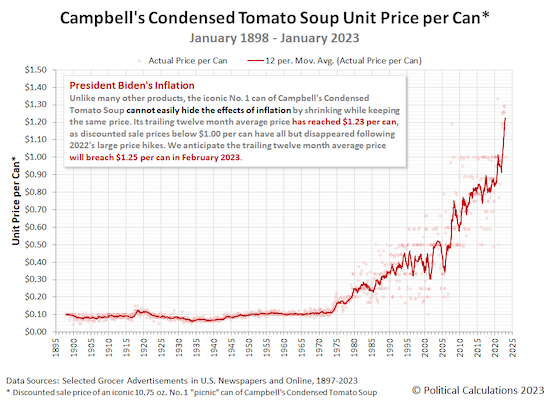
Political Calculations has tracked the price of a can of Campbell's Tomato Soup over the past 126 years.  It's proved to be a pretty accurate bellwether of inflation.  Its latest calculation is not comforting.


(Click the image to be taken to a larger view at Political Calculations)


Political Calculations has tracked the price history of Campbell's Condensed Tomato Soup over the past 126 years because of its remarkable consistency as an identifiable product over time. In fact, if you had a time machine and could travel to nearly any point in time from January 1898 to the present, you could likely find a 10.75 ounce size (Number 1) can of Campbell's condensed tomato soup stocked for sale in American grocery stores.

That long-running consistency makes Campbell's Condensed Tomato Soup an ideal product to follow to understand how inflation has affected American consumers through its history.

In January 2023, we find the prevailing average sale price for this food product over the past 12 months is $1.23 per can. That figure has risen by over 29% from the trailing 12 month average of $0.95 per can we recorded in January 2022.


There's more at the link.  Recommended reading.

You'll note the relatively steady price progression from 1898 until the early 1970's.  From then onward, it's been a steady upward progression.  Why, you ask?  It's simple.  President Nixon took the USA off the gold standard, and exited the Bretton Woods system, in 1971.  Since then, the dollar has steadily lost its buying power.  It's not that tomato soup has become more expensive:  it's that the dollar is that much weaker today than it was then.  Food - in this case, soup - for thought.

(A tip o' the hat to reader Jon T. for sending me the link.)

Peter


This is why it costs so much more to live in big cities


There are a number of reasons why big cities cost more to live in - provision of services, concentrated demand driving up local costs, and so on.  However, two of the biggest are taxes and service costs.  Two recent reports highlight both aspects.

First, from New York, new "green" emissions regulations are going to make living there a whole lot more expensive.


This seldom-discussed policy is Local Law 97, or the Climate Mobilization Act, set to start phasing in next year. When that happens, the only New Yorkers mobilized by this act will be those continuing the flight to lower-cost states down south.

The law demands an unattainable greenhouse-emission standard in existing buildings more than 25,000 square feet, condo and co-op developments more than 50,000 square feet and buildings with up to one-third of units rent-stabilized.

If you’re a New York City apartment dweller, the odds are overwhelming that you’re living in a building targeted by eco-woke zealotry. A 2019 Wall Street Journal survey found that 20% of all buildings would face fines in the law’s first year, a figure that jumps to 80% by 2030.

And the penalties that eventually will be passed down to you are massive.

Failure to comply with Local Law 97 in its first year will result in fines of $268 per metric ton of carbon dioxide over the limit. Within five years, it more than doubles to $583.

What does that mean in practical terms? The Cotocon Group, a noted sustainability consulting firm, published an alarming case study on the law’s fine structure. A sample 150,000-square-foot residential building with a mid-range Energy Star score of 43 will face an annual fine of $167,000 by 2029. Thus if this hypothetical building has 100 condo units, each owner would be responsible for about $1,670 per year.

So much for any promise of alleviating our affordability crisis.

. . .

The crippling cost of compliance is so severe, the city saw fit to exempt its own buildings, meaning some of the Big Apple’s oldest carbon-challenged structures, including those the New York City Housing Authority owns, are spared. Perhaps the issue is not so urgently existential after all.

But if your building attempts to comply, we aren’t just talking about cutting the pipes to those gas stoves. This law requires massive overhauls of existing structures and HVAC systems.

The board president of Glen Oaks Village, a middle-class Queens co-op with 2,900 units, testified at a City Council hearing last year that the cost to convert their 47 boilers will amount to more than $20 million, or $7,000 per apartment, plus a 5% increase in maintenance costs. Yet even after the change, the law’s emission algorithm would still bang them out for an $800,000-per-year fine.

To make matters worse, many building managers and owners recently incurred massive costs to convert heating units from oil to gas to comply with the previous round of climate mandates. Now those will be noncompliant, even if the boilers aren’t yet paid off.


There's more at the link.

This will affect both home-owners and renters in NYC, because building owners will have no choice but to pass on such drastic cost increases to their tenants.  All I can say is, I'm glad I don't live there, and have to cope with such a crippling financial burden on top of all the others we already carry.

There's also the old problem of municipal rates and taxes.  Chicago provides an example of what happens when a city has to finance all its "woke" programs, and puts the screws on its property owners to pay for them.


A Chicago family said their latest property tax bill increased 440% and now their modest apartment complex could go bankrupt.

A one bedroom apartment will now cost Michael Markellos $17,494 in property taxes for one year.

"This has put us in a tremendous financial bind, the building has gone negative in the bills," he said.

He and his mother own the 10-unit Lincoln Park apartment complex. Last year's tax bill for all 10 units combined was $23,674, but now the same 10 units are $128,282 dollars this year; up 440%.

"I was outraged. These are basically simple one bedroom units for college graduates who work downtown," added Markellos.

The majority of the annual increases are from the latest installment of tax bills just sent out at the beginning of December. The payment is due before the end of the year, and in just a few months another installment of taxes will be due.

"Merry Christmas and Happy Valentine's Day," said Markellos sarcastically.

He said the only way to pay for recent tax hike would be to raise the rent on the one bedroom apartments, but the rent hike would scare renters away.

"They would have to pay $5,000-$6,000 to pay the bills. No one in their right mind will pay that," he said.


Again, more at the link.

Note, in the example above, that the actual market value of the property in question was never even mentioned.  The increase in rates was accomplished by simply and arbitrarily reclassifying the property from one category to another.  The owner wasn't even given advance notice of the reclassification.  The city says he can appeal to have it reclassified again, back to what it originally was, but he'll have to pay at least one year of the new rates before that can wind its way through the bureaucracy - assuming he wins, of course.  When the city's hungry for money, its bureaucratic processes may be more inclined to stall, obfuscate and prevaricate rather than offer speedy solutions.  Yes, the property owner can sue, but then he's got to carry those legal costs on top of all his other expenses - and good luck getting any form of cooperation from the city bureaucracy while he's suing them!  He might run up fines for littering, improper disposal of trash, or any other issue;  and inspectors might "do an unscheduled routine inspection" and find problems with his water lines, or sewers, or electricity supply, or... get the idea?

Try putting those costs together, as an increasing number of property owners and renters in many cities are now discovering.  Rates go up.  Environmental taxes go up.  The "double whammy" of those cost increases means that rents have to increase very steeply - but in rent-controlled areas and properties (another common big-city issue), owners may not be allowed to impose increases big enough to cover their increased costs.  That means their only option is to evict tenants and stop offering their properties for rent.  They'll sell them if they can, perhaps even abandon them if they can't.  That, in turn, leaves their former tenants looking for other properties they can afford, at a time when fewer and fewer are affordable, thanks to rate and tax increases.  Catch-22, anyone?

I'm very glad my wife and I decided to get out of a big city several years ago.  Our income may have dropped as a result, but our cost of living has declined even more, making it a winning proposition for us.  We wanted to achieve three objectives:

  1. Move west of the Mississippi, where population pressures are less;
  2. Move to a smaller town, where more people know each other and there's a stronger community spirit;
  3. Move a reasonable distance away from any major metropolis, so that the crime, violence, poverty and other stresses of inner-city environments would be further away and more controllable if push came to shove.
I'm delighted to say that in our present location, we've accomplished all three objectives, and saved a lot of money into the bargain.  Unless we have to, due to circumstances beyond our control, we're unlikely to ever move back to a big city, thank you very much.

Peter


The World Economic Forum, summed up in a masterly rant


Quoth The Raven has given his impressions of the World Economic Forum (meeting this week in Davos, Switzerland) in a masterly (and sometimes profane) rant.  Here's an excerpt.


Among the many wretched, slimy and odious things that are increasingly giving me the creeps as the sands of my life’s hourglass continue to fall is the World Economic Forum: a collective of self-righteous global elites handing down virtues, values, lessons, lectures and political initiatives to us peons out here in the rest of the world.

The “Forum” is increasingly starting to resemble a globalist government, stocked with globally unelected turbo-douchebags, who have been assembling quietly in the background while no one has noticed.

One minute you’ve never heard of them - did you know the WEF has been around for about 5 decades? - the next, the “Forum” is harboring incredible influence, mostly with “useful” bureaucratic idiots on the left who are happy to take their cues on how to napalm individual rights for betterment of advancing their agendas from anyone who will help, regardless of their motivation.

That’s right: gone are the days of joking about The Great Reset, owning nothing and liking it and shifting to a diet of mealworms and crickets.

I’ve arrived at a point past that - a point of being sickened by watching people that in no way, shape or form represent me or the people in my life, yammer on about what my future will or won’t look like and what things I stand for are “right” or “wrong”.


He concludes:


I’m a citizen of the world - but I don’t need a world forum to speak for me or involuntarily deputize me in whatever ideological or social justice cause they deem important. What’s best for one person isn’t necessarily what’s best for the next, and the arrogance of a “select group of human beings” thinking they can speak and act for everyone under the manufactured guise of “saving the planet” and doing what’s best for everyone tells you everything you need to know about these sociopaths.


There's much more at the link.  Recommended reading.

This is precisely the point about the progressive left in all its forms.  They won't leave people alone.  They insist that it's their way or the highway, and if you disagree, they'll get in your face and persuade and argue and coerce and wheedle and shout and scream and carry on until either you change your mind and "get with the program", or you give up out of sheer exhaustion and stress and they get their way regardless.

Davos is simply progressivism writ large.  Like the author above, I can't remember hearing or worrying much about the World Economic Forum for decades, until its pronouncements gained prominence over the past decade or so.  It's now clear they were working behind the scenes for a very long time to get to this point, until their acolytes occupy commanding positions in many of the world's governments.  They seem to believe that their success, their conquest, is now inevitable.  Well, perhaps it is in their own circles - but they've forgotten one thing.  The "little people", the ordinary men and women like you and I who'll be affected by their pronouncements, have not got on board their train, and - given that it offers us no advantages whatsoever except the loss of individual rights, freedoms and choices - we have no incentive to get aboard it.

We saw what happened in Sri Lanka over the past few years, where government policies that slavishly tried to implement the Davos agenda led to catastrophe and its overthrow by its own people.  The globalists there keep trying to make a comeback, but they daren't go too far, because its citizens have now realized - and experienced - that they can overthrow their rulers if they do.  One wonders why more governments around the world haven't yet learned from that lesson.  I suspect many of them are going to do so over the next few years.

Go read both linked articles above, particularly the one in the preceding paragraph (it highlights the WEF's influence in Sri Lanka, to the disastrous detriment of that nation).  Both are worth your time.

Peter


Wednesday, January 18, 2023

There's no hell hot enough for this filth in human form


I'm not going to post a lengthy excerpt from this article, because it's just too sickening for words.  I'll let the headline speak for it, and leave you to click over there if you want to read it.


I've been exposed to some of the most ghastly crimes - including offenses against children - during my work as a prison chaplain.  However, I've never come across something as bad as this before.  To homosexually assault your own adopted children, make pornographic movies of it, and pimp them out to other pedophiles . . . it's beyond comprehension.

All I can say is, I hope the investigation yields the names of many more offenders, and that all of them are prosecuted to the fullest extent of the law.  If those responsible are convicted, I also hope their fellow inmates behind bars learn of their crimes.  They'll most likely provide a far more appropriate punishment than anything the law might allow.  (Personally, I think it might be time to bring back public burning at the stake.  I'll gladly contribute firewood and/or charcoal.)


Peter


That's an amazing-looking car


I was struck by this photograph, posted by Larry Langman on Gab:


Intrigued, I looked for more information, and found an entry for Brewster & Co. on Wikipedia.  According to the entry:


Brewster & Company was an American custom carriage-maker and automobile coachbuilder founded by James Brewster in 1810 and active for almost 130 years.

. . .

By the time of the Great Depression which began at the end of 1929 there was strong sentiment against the wealthy and their archetypal Brewster-bodied Rolls-Royces and Brewster's bodies were not selling well. In 1934 sales chief J.S. Inskip, who had taken control of operations in the hope of saving Brewster, bought 135 Ford V8 roadster chassis for model year 1934 and designed a body for them easily identified by its swoopy fenders and a heart-shaped grille. Stylish and sold for US$3,500 ($70,897 in 2021 dollars), it was a hit at the 1934 New York Auto Show. The bodies were worth more than the chassis. These cars were branded Brewster and sold at Rolls-Royce showrooms.


There's more at the link, including this photograph.


"Swoopy" it certainly is!  I'd never seen that design before.  It's an amazing example of Art Deco automotive artistry.

Peter