Friday, January 20, 2023

Vehicle market upheaval?


We've heard before in these pages from The Economic Ninja on YouTube.  He's been active in the car industry for a long time, and has been warning of the growing turmoil in that economic sector.  His latest warning is a doozy.  It's well worth your time to watch it, particularly if you're considering buying or selling a vehicle in the next few months.


In particular, click over to that video's YouTube page and read the comments from other viewers, especially those who are also in the auto industry.  They're eye-opening.

Money quote from the video:


"People ask me all the time, 'When should I buy?  When should I buy?'  I am not going to be buying until the second - end of second - or third quarter, at least, of 2023.  All right?  Because you want more of this to shake out, more of it to be in front of the public eye, fewer buyers showing up, car dealers forced to liquidate, all right?  So it's going to get gnarly."


Word.

Peter


Looks like the medication shortage is getting worse


In a blog post last September, I cited a news report that claimed the supply of vital US medications was getting worse.


As of Thursday, the Food and Drug Administration reported 184 drug shortages nationwide. The Association of Health-System Pharmacists put the figure higher, tracking a scarcity of 210 drugs.

U.S. drug shortages may be caused by a host of issues, including manufacturing and quality problems and delays and discontinuations, along with a regulatory system seen by many healthcare providers as more reactive than proactive in making fixes.

It's a long-standing problem worsened by supply chain issues and huge demands during the COVID-19 pandemic, with many drugs languishing on the shortage lists for months or years.


There's more at the link.

It seems the European Union is battling the same problem.


The European Commission (EC) has begun stockpiling drugs and organising joint procurement of pharmaceutical supplies following a Europe-wide medicines shortage.

A surge in demand for drugs across the European Union has pushed the European Medicines Agency to register shortages across drugs including penicillin and paracetamol. 

In response, the EC has started stockpiling drugs, obliging manufacturers to guarantee supplies, and organising joint procurements. Regulatory reform is also in the pipeline.

. . .

Greece banned the export of drugs earlier this month, after pharmaceutical companies were found to be importing drugs into the country at low prices before exporting them again with considerable mark-ups.

France has banned the sale of online paracetamol ... to ensure the availability of stock in shops.

The UK has enacted multiple Serious Shortage Protocols, allowing pharmacies to substitute prescriptions of drugs in high demand and low supply with alternatives under less pressure.


Again, more at the link.

A couple of weeks ago, while picking up a prescription for my latest medical misadventure, I asked the pharmacists what their recent experience has been.  They reported routine shortages of up to 150 medications, with some causing delays of one to two weeks in filling prescriptions - long enough to pose a serious health risk to people who really need their medications.  That's affected me personally on two occasions so far, although fortunately I've had reserves to cover the gap between prescribing and filling the prescription.

I've mentioned on several occasions in these pages that if you're reliant on prescription medications, it's a very smart move to build up reserve supplies of them for precisely this eventuality.  I've gotten my wife and myself to the point that we have 180 days (6 months) of reserves for every essential prescription medication we take.  It's not easy to do that legally, but if you have a sympathetic doctor who's willing to write a prescription for an extended supply, and your pharmacist is willing to accept payment in full, in cash, rather than bill it to a medical insurer (which obviously can't be expected to pay for such reserves), it can be done.  If those issues get in the way, there are alternatives.  It may not be legal, but I know a lot of people buy their medications outside the US, either by traveling to Mexico or ordering them from India or other countries.  The latter runs the risk of having them intercepted and confiscated by US customs authorities, but you pays your money and you takes your choice.

Another useful solution is to keep a basic supply of common antibiotics in reserve.  Obviously, if you don't know whether or not you're allergic to any of them, don't stock them:  but if you've taken them before and know your body won't react badly to them, I think you'd be silly not to have an emergency stash.  Many common antibiotics like amoxicillin, azithromycin (the so-called Z-Pac), bactrim (sulfamethoxazole/trimethoprim), cephalexin, ciprofloxacin, doxycycline and penicillin are available in the form of animal medications, manufactured in pill form to human standards of hygiene and purity, and can be purchased without a prescription, in person or online.  A surprising number of people take advantage of this loophole.  Again I stress, you can't just take them unless you know what you're doing, what your medical issue is, and what the correct antibiotic and dosage is to treat it:  but if you know all that, there's no reason not to have the necessary supplies on hand.  In many parts of the Third World you have no choice but to do so, because there's no doctor or nurse or clinic available for scores or hundreds of miles.  That's where I learned about such things.

Forewarned is forearmed.

Peter


Doofus Of The Day #1,101


I'd say it's time to elect an entire new school board in a Massachusetts school district.


For nearly a year and a half, a Massachusetts high school has been lit up around the clock because the district can’t turn off the roughly 7,000 lights in the sprawling building.

The lighting system was installed at Minnechaug Regional High School when it was built over a decade ago and was intended to save money and energy. But ever since the software that runs it failed on Aug. 24, 2021, the lights in the Springfield suburbs school have been on continuously, costing taxpayers a small fortune.

“We are very much aware this is costing taxpayers a significant amount of money,” Aaron Osborne, the assistant superintendent of finance at the Hampden-Wilbraham Regional School District, told NBC News. “And we have been doing everything we can to get this problem solved.”

. . .

The original high school building, which dates back to 1959, was replaced with the current 248,000-square foot structure in 2012.

One of the cost-saving measures the school board insisted on was a “green lighting system” run on software installed by a company called 5th Light to control the lights in the building. The system was designed to save energy — and thus save money — by automatically adjusting the lights as needed.

But in August 2021, staffers at the school noticed that the lights were not dimming in the daytime and burning brightly through the night.

“The lighting system went into default,” said Osborne. “And the default position for the lighting system is for the lights to be on.”


There's more at the link.

So, let me get this straight.  They installed (presumably at vast expense) a new, high-tech lighting system . . . with no on or off switches in each classroom?  And no master on/off switch controlling the entire shebang?

Just how did they expect to cope with this sort of problem?  Did they plan on necromancy, calling the executed Salem witches to control it with spells?

And as for "doing everything we can to get this problem solved" . . . just how the hell does leaving it unrepaired for more than a year qualify as "doing everything we can"?  Sounds more like dereliction of duty and waste of taxpayer dollars to me!  Couldn't a local electrical contractor have simply installed a master on/off switch as a temporary measure, saving thousands of dollars in electricity?

Why have the taxpayers of that school district not run the members of their School Board out of town on a rail, complete with tar and feathers?

Yea, verily, the mind doth boggle . . .


Peter


Thursday, January 19, 2023

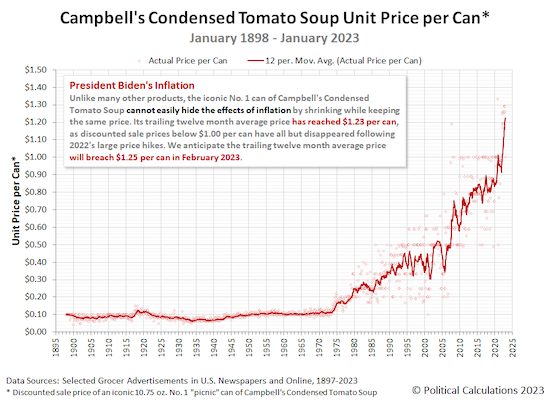
Tomato soup inflation - it's not fruitful any more


Political Calculations has tracked the price of a can of Campbell's Tomato Soup over the past 126 years.  It's proved to be a pretty accurate bellwether of inflation.  Its latest calculation is not comforting.


(Click the image to be taken to a larger view at Political Calculations)


Political Calculations has tracked the price history of Campbell's Condensed Tomato Soup over the past 126 years because of its remarkable consistency as an identifiable product over time. In fact, if you had a time machine and could travel to nearly any point in time from January 1898 to the present, you could likely find a 10.75 ounce size (Number 1) can of Campbell's condensed tomato soup stocked for sale in American grocery stores.

That long-running consistency makes Campbell's Condensed Tomato Soup an ideal product to follow to understand how inflation has affected American consumers through its history.

In January 2023, we find the prevailing average sale price for this food product over the past 12 months is $1.23 per can. That figure has risen by over 29% from the trailing 12 month average of $0.95 per can we recorded in January 2022.


There's more at the link.  Recommended reading.

You'll note the relatively steady price progression from 1898 until the early 1970's.  From then onward, it's been a steady upward progression.  Why, you ask?  It's simple.  President Nixon took the USA off the gold standard, and exited the Bretton Woods system, in 1971.  Since then, the dollar has steadily lost its buying power.  It's not that tomato soup has become more expensive:  it's that the dollar is that much weaker today than it was then.  Food - in this case, soup - for thought.

(A tip o' the hat to reader Jon T. for sending me the link.)

Peter


This is why it costs so much more to live in big cities


There are a number of reasons why big cities cost more to live in - provision of services, concentrated demand driving up local costs, and so on.  However, two of the biggest are taxes and service costs.  Two recent reports highlight both aspects.

First, from New York, new "green" emissions regulations are going to make living there a whole lot more expensive.


This seldom-discussed policy is Local Law 97, or the Climate Mobilization Act, set to start phasing in next year. When that happens, the only New Yorkers mobilized by this act will be those continuing the flight to lower-cost states down south.

The law demands an unattainable greenhouse-emission standard in existing buildings more than 25,000 square feet, condo and co-op developments more than 50,000 square feet and buildings with up to one-third of units rent-stabilized.

If you’re a New York City apartment dweller, the odds are overwhelming that you’re living in a building targeted by eco-woke zealotry. A 2019 Wall Street Journal survey found that 20% of all buildings would face fines in the law’s first year, a figure that jumps to 80% by 2030.

And the penalties that eventually will be passed down to you are massive.

Failure to comply with Local Law 97 in its first year will result in fines of $268 per metric ton of carbon dioxide over the limit. Within five years, it more than doubles to $583.

What does that mean in practical terms? The Cotocon Group, a noted sustainability consulting firm, published an alarming case study on the law’s fine structure. A sample 150,000-square-foot residential building with a mid-range Energy Star score of 43 will face an annual fine of $167,000 by 2029. Thus if this hypothetical building has 100 condo units, each owner would be responsible for about $1,670 per year.

So much for any promise of alleviating our affordability crisis.

. . .

The crippling cost of compliance is so severe, the city saw fit to exempt its own buildings, meaning some of the Big Apple’s oldest carbon-challenged structures, including those the New York City Housing Authority owns, are spared. Perhaps the issue is not so urgently existential after all.

But if your building attempts to comply, we aren’t just talking about cutting the pipes to those gas stoves. This law requires massive overhauls of existing structures and HVAC systems.

The board president of Glen Oaks Village, a middle-class Queens co-op with 2,900 units, testified at a City Council hearing last year that the cost to convert their 47 boilers will amount to more than $20 million, or $7,000 per apartment, plus a 5% increase in maintenance costs. Yet even after the change, the law’s emission algorithm would still bang them out for an $800,000-per-year fine.

To make matters worse, many building managers and owners recently incurred massive costs to convert heating units from oil to gas to comply with the previous round of climate mandates. Now those will be noncompliant, even if the boilers aren’t yet paid off.


There's more at the link.

This will affect both home-owners and renters in NYC, because building owners will have no choice but to pass on such drastic cost increases to their tenants.  All I can say is, I'm glad I don't live there, and have to cope with such a crippling financial burden on top of all the others we already carry.

There's also the old problem of municipal rates and taxes.  Chicago provides an example of what happens when a city has to finance all its "woke" programs, and puts the screws on its property owners to pay for them.


A Chicago family said their latest property tax bill increased 440% and now their modest apartment complex could go bankrupt.

A one bedroom apartment will now cost Michael Markellos $17,494 in property taxes for one year.

"This has put us in a tremendous financial bind, the building has gone negative in the bills," he said.

He and his mother own the 10-unit Lincoln Park apartment complex. Last year's tax bill for all 10 units combined was $23,674, but now the same 10 units are $128,282 dollars this year; up 440%.

"I was outraged. These are basically simple one bedroom units for college graduates who work downtown," added Markellos.

The majority of the annual increases are from the latest installment of tax bills just sent out at the beginning of December. The payment is due before the end of the year, and in just a few months another installment of taxes will be due.

"Merry Christmas and Happy Valentine's Day," said Markellos sarcastically.

He said the only way to pay for recent tax hike would be to raise the rent on the one bedroom apartments, but the rent hike would scare renters away.

"They would have to pay $5,000-$6,000 to pay the bills. No one in their right mind will pay that," he said.


Again, more at the link.

Note, in the example above, that the actual market value of the property in question was never even mentioned.  The increase in rates was accomplished by simply and arbitrarily reclassifying the property from one category to another.  The owner wasn't even given advance notice of the reclassification.  The city says he can appeal to have it reclassified again, back to what it originally was, but he'll have to pay at least one year of the new rates before that can wind its way through the bureaucracy - assuming he wins, of course.  When the city's hungry for money, its bureaucratic processes may be more inclined to stall, obfuscate and prevaricate rather than offer speedy solutions.  Yes, the property owner can sue, but then he's got to carry those legal costs on top of all his other expenses - and good luck getting any form of cooperation from the city bureaucracy while he's suing them!  He might run up fines for littering, improper disposal of trash, or any other issue;  and inspectors might "do an unscheduled routine inspection" and find problems with his water lines, or sewers, or electricity supply, or... get the idea?

Try putting those costs together, as an increasing number of property owners and renters in many cities are now discovering.  Rates go up.  Environmental taxes go up.  The "double whammy" of those cost increases means that rents have to increase very steeply - but in rent-controlled areas and properties (another common big-city issue), owners may not be allowed to impose increases big enough to cover their increased costs.  That means their only option is to evict tenants and stop offering their properties for rent.  They'll sell them if they can, perhaps even abandon them if they can't.  That, in turn, leaves their former tenants looking for other properties they can afford, at a time when fewer and fewer are affordable, thanks to rate and tax increases.  Catch-22, anyone?

I'm very glad my wife and I decided to get out of a big city several years ago.  Our income may have dropped as a result, but our cost of living has declined even more, making it a winning proposition for us.  We wanted to achieve three objectives:

  1. Move west of the Mississippi, where population pressures are less;
  2. Move to a smaller town, where more people know each other and there's a stronger community spirit;
  3. Move a reasonable distance away from any major metropolis, so that the crime, violence, poverty and other stresses of inner-city environments would be further away and more controllable if push came to shove.
I'm delighted to say that in our present location, we've accomplished all three objectives, and saved a lot of money into the bargain.  Unless we have to, due to circumstances beyond our control, we're unlikely to ever move back to a big city, thank you very much.

Peter


The World Economic Forum, summed up in a masterly rant


Quoth The Raven has given his impressions of the World Economic Forum (meeting this week in Davos, Switzerland) in a masterly (and sometimes profane) rant.  Here's an excerpt.


Among the many wretched, slimy and odious things that are increasingly giving me the creeps as the sands of my life’s hourglass continue to fall is the World Economic Forum: a collective of self-righteous global elites handing down virtues, values, lessons, lectures and political initiatives to us peons out here in the rest of the world.

The “Forum” is increasingly starting to resemble a globalist government, stocked with globally unelected turbo-douchebags, who have been assembling quietly in the background while no one has noticed.

One minute you’ve never heard of them - did you know the WEF has been around for about 5 decades? - the next, the “Forum” is harboring incredible influence, mostly with “useful” bureaucratic idiots on the left who are happy to take their cues on how to napalm individual rights for betterment of advancing their agendas from anyone who will help, regardless of their motivation.

That’s right: gone are the days of joking about The Great Reset, owning nothing and liking it and shifting to a diet of mealworms and crickets.

I’ve arrived at a point past that - a point of being sickened by watching people that in no way, shape or form represent me or the people in my life, yammer on about what my future will or won’t look like and what things I stand for are “right” or “wrong”.


He concludes:


I’m a citizen of the world - but I don’t need a world forum to speak for me or involuntarily deputize me in whatever ideological or social justice cause they deem important. What’s best for one person isn’t necessarily what’s best for the next, and the arrogance of a “select group of human beings” thinking they can speak and act for everyone under the manufactured guise of “saving the planet” and doing what’s best for everyone tells you everything you need to know about these sociopaths.


There's much more at the link.  Recommended reading.

This is precisely the point about the progressive left in all its forms.  They won't leave people alone.  They insist that it's their way or the highway, and if you disagree, they'll get in your face and persuade and argue and coerce and wheedle and shout and scream and carry on until either you change your mind and "get with the program", or you give up out of sheer exhaustion and stress and they get their way regardless.

Davos is simply progressivism writ large.  Like the author above, I can't remember hearing or worrying much about the World Economic Forum for decades, until its pronouncements gained prominence over the past decade or so.  It's now clear they were working behind the scenes for a very long time to get to this point, until their acolytes occupy commanding positions in many of the world's governments.  They seem to believe that their success, their conquest, is now inevitable.  Well, perhaps it is in their own circles - but they've forgotten one thing.  The "little people", the ordinary men and women like you and I who'll be affected by their pronouncements, have not got on board their train, and - given that it offers us no advantages whatsoever except the loss of individual rights, freedoms and choices - we have no incentive to get aboard it.

We saw what happened in Sri Lanka over the past few years, where government policies that slavishly tried to implement the Davos agenda led to catastrophe and its overthrow by its own people.  The globalists there keep trying to make a comeback, but they daren't go too far, because its citizens have now realized - and experienced - that they can overthrow their rulers if they do.  One wonders why more governments around the world haven't yet learned from that lesson.  I suspect many of them are going to do so over the next few years.

Go read both linked articles above, particularly the one in the preceding paragraph (it highlights the WEF's influence in Sri Lanka, to the disastrous detriment of that nation).  Both are worth your time.

Peter


Wednesday, January 18, 2023

There's no hell hot enough for this filth in human form


I'm not going to post a lengthy excerpt from this article, because it's just too sickening for words.  I'll let the headline speak for it, and leave you to click over there if you want to read it.


I've been exposed to some of the most ghastly crimes - including offenses against children - during my work as a prison chaplain.  However, I've never come across something as bad as this before.  To homosexually assault your own adopted children, make pornographic movies of it, and pimp them out to other pedophiles . . . it's beyond comprehension.

All I can say is, I hope the investigation yields the names of many more offenders, and that all of them are prosecuted to the fullest extent of the law.  If those responsible are convicted, I also hope their fellow inmates behind bars learn of their crimes.  They'll most likely provide a far more appropriate punishment than anything the law might allow.  (Personally, I think it might be time to bring back public burning at the stake.  I'll gladly contribute firewood and/or charcoal.)


Peter


That's an amazing-looking car


I was struck by this photograph, posted by Larry Langman on Gab:


Intrigued, I looked for more information, and found an entry for Brewster & Co. on Wikipedia.  According to the entry:


Brewster & Company was an American custom carriage-maker and automobile coachbuilder founded by James Brewster in 1810 and active for almost 130 years.

. . .

By the time of the Great Depression which began at the end of 1929 there was strong sentiment against the wealthy and their archetypal Brewster-bodied Rolls-Royces and Brewster's bodies were not selling well. In 1934 sales chief J.S. Inskip, who had taken control of operations in the hope of saving Brewster, bought 135 Ford V8 roadster chassis for model year 1934 and designed a body for them easily identified by its swoopy fenders and a heart-shaped grille. Stylish and sold for US$3,500 ($70,897 in 2021 dollars), it was a hit at the 1934 New York Auto Show. The bodies were worth more than the chassis. These cars were branded Brewster and sold at Rolls-Royce showrooms.


There's more at the link, including this photograph.


"Swoopy" it certainly is!  I'd never seen that design before.  It's an amazing example of Art Deco automotive artistry.

Peter


Water wars in Arizona and California


I note that Arizona is cracking down hard on new residential and commercial construction, requiring any new development to have long-term water supplies in place before building permits will be issued.  CNBC reports:


Water sources are dwindling across the Western United States and mounting restrictions on the Colorado River are affecting all sectors of the economy, including homebuilding. But amid a nationwide housing shortage, developers are bombarding Arizona with plans to build homes even as water shortages worsen.

. . .

Developers in the Phoenix area are required to get state certificates proving that they have 100 years’ worth of water supplies in the ground over which they’re building before they’re approved to construct any properties. 

The megadrought has generated the driest two decades in the West in at least 1,200 years, and human-caused climate change has helped to fuel the conditions. Arizona has experienced cuts to its Colorado River water allocation and now must curb 21% of its water usage from the river, or roughly 592,000 acre-feet each year, an amount that would supply more than 2 million Arizona households annually.


There's more at the link.

At least one Arizona city is shutting off water to areas beyond its municipal boundaries due to the shortfall in supply.  CNBC again:


An Arizona suburb has filed a lawsuit against the city of Scottsdale after the city cut off the community from its municipal water supply amid extreme drought conditions and declining water levels in the Colorado River.

In the lawsuit, filed Thursday in Maricopa County Superior Court, residents in the unincorporated community of Rio Verde Foothills are seeking an injunction against Scottsdale to force the city to resume water services.

. . .

Scottsdale warned Rio Verde Foothills more than a year ago that the town’s water supply would be cut off as it faced projections of a historic drought and dwindling reservoir levels in the western U.S. Scottsdale said it must focus on water conservation for its own residents and would not continue to sell water to the roughly 500 homes in Rio Verde Foothills.

Earlier this month, hundreds of homes outside of Scottsdale could no longer access water from the city, leaving residents with no reliable source of water.

. . .

Scottsdale has said it would not work with any external companies to provide Rio Verde Foothills residents with water, arguing that it’s not legally obligated to continue providing water service to Rio Verde Foothills since the town lies beyond Scottsdale’s municipal boundaries.


Again, more at the link.

One wonders how many property purchasers in Rio Verde Foothills were informed of the water situation there before putting down their money?  If they weren't, I foresee lawsuits ahead as they try to recover their now-suddenly-devalued investment.

California's in an even worse situation, but it's the state's own fault.  For decades, no new major dams or water storage and treatment facilities have been built in the state.  The result is that most of the water that fell in such over-abundance on that state over the past couple of weeks has been lost.  The New York Times reports:


After a series of downpours over the past week dumped up to nine inches of rain on the San Gabriel Mountains, some 8.4 billion gallons were impounded behind 14 large dams, easing floods and building up valuable stores of water for the drier summer months ahead.

But in a state that is weathering a crippling, multiyear drought, much larger streams of water — estimated at tens of billions of gallons — have been rushing in recent days straight into the Pacific Ocean, a devastating conundrum for a state whose future depends on holding on to any drop it can.

. . .

The drought of the last few years has left reservoirs depleted across the state, burned forests, fallowed farm fields, brown urban lawns, barren ski slopes and disappearing lakes. The crisis on the Colorado River adds to the worries.

After years of deadly drought, images of floodwaters rushing into the ocean as people watch helplessly has been a cruel irony ... Capturing water in extreme events like those this year is a colossal engineering, environmental and financial challenge, experts say. Even with the planned improvements, water supplies are going to get tighter for major users: the environment, the public and agriculture.

“Everybody is going to lose something,” said Jay Lund, director of the Center for Watershed Sciences at the University of California, Davis, and a member of the National Academy of Engineering. Mr. Lund estimates that up to 25 percent of agricultural land could go out of production.


More at the link.

Other western states are faced with the same problem.  Las Vegas tried for more than three decades to take water from northern Nevada and southern Utah to feed its residents and tourist trade - which might have left a wasteland in those places as they lost the water they need to the demands of the big city.  Only after intense, hard-fought opposition was the plan defeated.  Meanwhile, the city has implemented some of the most stringent water restrictions in the nation, but it still needs more water, and is still looking to get it anywhere it can - even, if necessary, at the expense of other areas.

Many predict that water will be the proximate cause of open war in many parts of the world in future.  See, for example, this BBC overview of the water situation around the world.  It's going to be yet another point of conflict in our internal dissension and unrest in the USA.  "Woke" cities are likely to demand more water to help provide for their residents, and in the process minimize dissatisfaction that might turn violent.  The rural communities around them are likely to resist that, because they need their water for themselves, particularly for farming and food processing - without which cities will be in even more trouble.

Who's going to win?  Your guess is as good as mine, right now.  I can only suggest that if you live in a city or region where water is scarce, or likely to become a source of conflict, take that into account in your planning for the future.  If you don't, still take it into account, because you don't want to move to such an area unless you have to.

Peter


Tuesday, January 17, 2023

Yes, that's insane - but what a rush!


I'm obliged to reader R. D. for sending me the link to this video clip of Austrian freestyle skier Markus Eder letting it all hang out (literally and figuratively) in the mountains above Zermatt, Switzerland.


I've never skied in my life, and I probably never will, so I can't appreciate that from an insider's perspective:  but it's breathtaking to watch.  I'm not surprised to learn that it took almost three months to film it all.  I'm surprised Mr. Eder wasn't injured or killed in the process!

Peter


What makes Russia what it is?


In a lengthy article by a Finnish intelligence officer who spent much time in the former Soviet Union and Russia, we find that there are many layers in the latter country, and many answers to that question.  It's a fascinating look at a nation that Winston Churchill once described as "a riddle, wrapped in a mystery, inside an enigma".  Here's an excerpt.


We kind of have many layers of Russia. Different historical layers still influence the thinking of the Russians about how the Russians work today. If we start from that very first movement, that is, Slavic Russia. Language and entity and Russianness were born there. Also the belief that all Slavic people, as it were, are one was created there. And the Russian people, the largest of the Slavic peoples, have the duty of keeping them all in check and protecting them.

When we go further in history. With the fall of Constantinople, the traditions of Eastern Rome were transferred to Moscow. Moscow uses the term “Third and Eternal Rome” for itself. The Russians are, as it were, followers of the Eastern Roman tradition. Religion, conservatism, and the relationship to authority came from there. It means that one does not challenge authority. Authority is obtained from God. He who leads us has received authority from God to lead us. He is infallible. Authority will not be challenged under any circumstances. This idea comes from Byzantine Russia.

The third era that influenced Russian thought in a great manner is Mongol Russia. In the 1200s, the Mongols conquered Russia. They held Russia for years. That time was cruel. There are a lot of words in Russian, related to torture, taxation, and corruption that come from the Mongol language. Dominance under personal authority was rooted in the administrative culture of the Mongols. That is, there is only one khan that leads. It is he who leads, no one else. Others are passive followers. That one guy leads and takes responsibility and the initiative. When the belief of divine legitimacy to lead is attached to this, the leader will appear fairly tough in their worldview.

The corruption and cruelty also come from the Mongol era. During Mongol rule, the only ways to survive were lying, corruption, and violence. This still lives very deep in Russia’s strategic culture. When Mongol rule ended, the Mongols did not just pack their bags and disappear from Russia. Instead, they mixed with the locals. So the traditions also stayed with the people. In particular, to the leading caste. The Mongols who had previously ruled the country merged into the ruling layers, which is still visible today. When looking at genetic inheritance, they are pretty dark; dark eyes, for example. There are not many blondes in Russia.

Then came this era of turmoil. Although it was a short period of time, it had great importance to the Russians. Because then both external and internal enemies roared. The Poles who conquered Moscow and Russia did not have a strong leader. Romanov was then elected Tsar and the Russians realized that a strong leader was better than chaos.

In addition to all this, the authority comes from God and the autocrat is indeed a leader. It was stated there that only sovereignty will save Russia. It has been several hundred years in their genetic inheritance that autocracy is the only right solution. That is, autocracy is better than chaos and mayhem.

Then we came to European Russia. Peter the Great founded the city of St. Petersburg in the early 18th century on the Finnish swamp of the Neva estuary. After that, the Russians began to clash whether they were in the West or in the East. The Westernizers (Západniki) favored the West and the Slavophiles favored the East. This struggle is still going on.

Russia began to rise into a great power. As Russia modernized, they also started to mystify themselves. That is, Russia itself began to mystify itself through authors for example. They kind of built a smokescreen between us and them, consciously mystifying Russia.

Then came the great power of the Soviet Union and the Cold War. The power politics and the sphere of influence of Russia come from the Cold War era. World War II taught them that it is better to fight not in their own territory but on the territories of others. The Soviet Union lost more than 27 million people during World War II.

Authoritarian rule has followed Russian rule since the Mongol era. It hasn’t changed since then. The name of the leader has changed but authoritarian rule itself has always remained the same. Russia sees itself as the heir to the Soviet Union, as it is in some respects.

So these are the six layers of Russia.


There's much more at the link, going into detail about how those "layers" have translated into a uniquely Russian psyche and outlook on the rest of the world.  The background it provides helps us to understand how the current situation in Ukraine became what it is, and what might develop there.

The article is fascinating reading.  Highly recommended.

Peter


Great air-to-air imagery


Courtesy of The Feral Irishman, here's video shot from a drone showing the late, lamented sole example of the Antonov An-225 Mriya taking off from Kyiv in Ukraine a few years ago.  I don't know whether any permission was given for filming so close to the flight path;  I have to presume not - but the result was extraordinary.  The world's largest aircraft went by the drone at a distance that can't have been more than a couple of hundred yards.  Watch in full-screen mode for best results.  (Don't adjust the volume - there's no sound.)


The An-225, the only one of its kind, was destroyed early last year during the Russian invasion of Ukraine.  Antonov has on hand another partly-built airframe that was never completed, and has vowed to finish it and fly it as a memorial to the giant aircraft (and as a raised aviation finger to the Russians).  I'm not sure that'll be a worthwhile exercise in economic terms, but I daresay it's a point of national pride to Ukraine.

Peter


Monday, January 16, 2023

A superb answer to Woke activists


A few days ago, the Oxford Union in Britain, famous for its debates on all sorts of weighty matters, took up the topic of "Woke" culture.  Konstantin Kisin delivered this superb analysis, which I think is spot on.  It's worth ten minutes of your time to listen to him.


I'd love to have every wokescold listen to that short talk.  They won't, of course - they'll shut down their listening and analytical faculties within the first minute, because they don't tolerate opposition - but it would do them no end of good if they would.


*Sigh*


Peter


The best summary of Davos 2023 that I've yet read


The annual gathering of the Davos crowd is currently under way in Switzerland.  Phil sums it up like this:


The Satan Worshiping Pedophile Power Mongers are currently over in Switzerland at Davos, desperately trying to figure out how to finish us off, now that they discovered several million of us weren’t quite as docile and stupid as they had assumed and told them to shove that Jab straight up their asses.

That threw a wrench in their plans. The fact that we have been spreading information, gathering together even if virtually and finding ways to further interrupt their agenda has caused them no end of consternation so now you can expect them to take the gloves off here very shortly.

Did you know that the current head of the Eff Bee Eye is over there attending that little get together?

Ask yourself why he would need to be attending that and if you answer yourself honestly you will get a real uncomfortable feeling.

As you should.


There's more at the link.

I've wondered myself why the boss of the FBI would find it necessary to attend the World Economic Forum's annual gathering.  It certainly doesn't fall under a normal law enforcement function . . . unless, of course, law enforcement is to be co-opted into enforcing the WEF's authoritarian, totalitarian agenda.  Say it ain't so!

(Insert pause for hollow laughter . . . )


Peter


Memes that made me laugh 142


Collected from around the Internet over the past week.  Click any image for a larger view.


Sunday, January 15, 2023

Sunday morning music


This morning I tip my hat to Francis Porretto of "Liberty's Torch".  Last year he posted a music video from the British folk group "Tranquility", of whom I'd not heard before.  I liked it, so I thought I'd share it with you this morning, as well as a couple of other tracks.

The group only published two albums before disappearing into history, neither of which was a major seller.  That's a pity, I think, because their style was very similar to other groups of the period like Magna Carta or Fairport Convention, both of which were rather more successful.  All the tracks I've selected come from their first album, "Tranquility", about which you can read more here.

I'll start with the track Francis Porretto selected, "Oyster Catcher".


Here's "Try Again".


And finally, their track "Lady of the Lake".


You can hear all of the tracks on that album at this YouTube topic page;  and those from their second album, "Silver" (reviewed here), may be found at this page.  I enjoyed most of them.

Peter


Saturday, January 14, 2023

Saturday Snippet: Death and recrimination


This weekend I'd like to introduce many of you to Vox Day's "A Throne of Bones".


It's grand fantasy in the line of "Game of Thrones", except that I think it's better written than the latter.  The blurb reads:


In Selenoth, the race of Man is on the ascendant. The ancient dragons sleep. The ghastly Witchkings are no more; their evil power destroyed by the courage of Men and the fearsome magic of the Elves. The Dwarves have retreated to the kingdoms of the Underdeep, the trolls hide in their mountains, and even the savage orc tribes have learned to dread the iron discipline of Amorr's mighty legions. But after four hundred years of mutual suspicion, the rivalry between two of the Houses Martial that rule the Amorran Senate threatens to turn violent, and unrest sparks rebellion throughout the imperial provinces. In the north, the barbarian reavers who have long plagued the coasts of the White Sea unexpectedly plead for the royal protection of the King of Savondir, as they flee a vicious race of wolf-demons who have invaded their islands. And in the distant east, the war drums echo throughout the mountains as orcs and goblins gather in vast numbers, summoned by their bestial gods.


It's a long and complex book, almost defying one to select just one excerpt for a blog article like this.  I've chosen one that depicts family conflicts and rivalries that will grow into a major plot element in the book.


They had made excellent time, all things considered, thought Corvus as he and Saturnius approached the bridge over the river that separated the Republic of Amorr from the vast empire over which it ruled. They had left most of the twenty guards who had accompanied them the day before, freeing them to separate and visit their families, which were settled in Vallyrium. The two who lacked families, and the two whose families lived in the city, were following a few lengths behind where they could talk freely without concern for their officers overhearing. Saturnius had initially balked at abandoning most of their honor guard, but he’d withdrawn his objections when Corvus had pointed out that no brigand would attempt to interfere with six armed men wearing legionary cloaks within a day’s ride of Amorr.

He was more eager than ever to see Romilia but reluctantly concluded that it was Magnus to whom they must go first. Corvus didn’t relish delivering the bones that were presently stowed away on the back of one of their two pack horses. But over the course of their travels he had convinced himself that Magnus would be inclined to receive the news as a proper stoic should. Did he not pride himself on his equanimity? The guards at the bridge tower recognized their rank and saluted as he and Saturnius passed. One of them must have been acquainted with one of the legionaries, as a series of glad cries erupted behind them.

Corvus smiled at the sight of the hustle and bustle of the city life that was so familiar, and yet seemed so foreign after four months in the wilderness of Gorignia. The smells were nearly as strong as the stench of the battlefield from which they’d come, but far more varied and significantly less vile. And some of them were mouth-wateringly delicious.

“I have dreamed about those for months,” Saturnius said, eyeing a vendor who was selling garlic-fried songbirds on a stick.

“Go on then, buy as many as you like. Get me one, no two, as well.”

“As the consul commands,” Saturnius said with a grin. He didn’t even bother dickering with the vendor, but simply grabbed a handful, tossed the man a silver coin, and popped one in his mouth as he rejoined Corvus. “Mmmmph, now that is really good! Why can’t our cursed cooks manage to feed us decently if these fellows can create such delicacies out of the birds they catch on the street?”

Corvus wrinkled his nose after taking a bite of his bird. It was crunchy, and all he could taste was the potent garlic in which the little bird had apparently been stuffed, rubbed, and fried. “I think you could serve goblin this way and it would taste no different.”

“If goblin tasted like this, I’d eat it.” Saturnius vowed. “It would certainly simplify the logistical situation.”

“My son once told me he read the orcs do just that when they march. They use the goblins as shock troops and provisions alike. Probably just a story, though. They’re also said to grow from rocks. Or maybe that’s trolls, I don’t recall.”

“Not a bad idea, actually. Although I don’t see either the men or the Church smiling on it.” He looked at Corvus appraisingly. “And I can’t imagine you’d be good for anything but soup, being as lean and stringy as you are.”

They had no sooner turned into the quarter in which both Magnus and Corvus himself resided when Corvus spotted a pair of familiar faces among a group of young men dicing on a corner. One was Marcipor, his son’s longtime slave, and the other was a man from Magnus’s stables. Both of them looked up at the sound of the iron-shod hooves on the cobblestones, but their reactions were completely different. Marcipor smiled and rose to his feet, but Magnus’s stable slave’s eyes narrowed and after exchanging a word or two with the young man holding the stakes, he ran off in the direction of Magnus’s domus.

Corvus sighed. It wasn’t as if he intended to surprise Magnus, but something about the slave’s reaction suggested that there might be trouble ahead.

He glanced back. The four guards were only a few lengths behind them. But surely they wouldn’t be needed!

“My lord Corvus, welcome back to Amorr,” Marcipor said, following his words with a deep and theatrical bow. The slave was a tall, golden lion of a man but about as martial as a kitten. He was deeply attached to Corvus’s son, and Corvus found him quite likable in his own right. “Did my master accompany you?”

“I’m afraid not, Marce,” Corvus replied. “But thank you, it is good to see a friendly face. Speaking of which, that slave, Magnus’s man. He ran off to warn Magnus, I presume, and he did not appear pleased.”

It was as if a light switched off. Marcipor’s face abruptly grew serious and his voice dropped. “I fear your welcome will be rather chillier at Magnus’s manse, my lord. There are rumors abounding, some of which I can scarcely credit! It is said that Gaius Valerius is dead, and not by the hand of the enemy either.”

Corvus and Saturnius looked at each other. Had word of the execution gotten back ahead of them somehow? Was it even possible?

“Who says it?” he asked the slave. “Who told you?”

“Sextus,” Marcipor replied. Corvus shook his head. Magnus must already know then, for he recalled that the young slave was as close to Marcus’s cousin as he was to Marcus himself. Damn that Clodipor. He should have sent the man back at once, empty-handed, no matter how strange it would have seemed under the circumstances.

“Trouble?” Saturnius asked.

“There may be.” Corvus reached into one of his saddlebags and withdrew a scroll with a broken Valerian seal. “Marce, run to the Senate, as quickly as you can. Find the primus fascitor and tell him their new Consul Aquilae requires eight fascitors at Magnus’s domus at once. At once! Accept no delays, and tell them to run, don’t walk. The primus should comply once he learns you’re of my household, but give him this letter if he requires additional convincing.”

“Consul, Lord Valerius?” The young man stared at him in astonishment. “Congratulations, my lord!”

“Consul Suffectus, it would seem. At any rate, I am entitled to the fascitors, so if you will please fetch them for me now.”

“At once, my lord consul!” His son’s slave took the scroll, bowed more respectfully than Corvus could ever recall seeing him do before, and ran off toward the heart of the city.

“Fine-looking lad,” Saturnius commented. “One of yours?”

“My son’s birth-companion. They used to be all but inseparable, but he’s always been on close terms with Magnus’s son Sextus, as well. Marcus gave him to Sextus when he kissed the eagle. Whatever he’s heard, rest assured it has reached Magnus’s ears as well.”

Saturnius sighed. “Damn that Fortex!” The legate immediately regretted his outburst and made the sign of the tree. “No, no, requiscat in pace and let there be mercy upon his soul. But truly, Corvus, how hard is it to not engage in a bloody single combat? Were my orders unclear? Three hundred other knights didn’t seem to have any trouble comprehending them.”

“Don’t waste time thinking about it. Your orders were perfectly clear. The boy was always headstrong to a fault.”

“It can be hard to tell the difference. The lad fought like a demon, though, I’ll give him that. And I was surprised when he returned to the field that day. Once the Second broke their cavalry and chased them off, I was certain we’d seen the last of him until nightfall. So he had a modicum of discipline.”

“Well, we did see the last of him that night,” Corvus said grimly. “And therein lies the problem. Are you sure you want to involve yourself in this, old friend? Magnus will make for a bad enemy. I’m family and a senator besides. You don’t have the protection of either.”

“I’m already involved, General. The dice will fall as they will. Even if I make an enemy of Magnus, Amorr doesn’t have so many competent generals that he can justify interfering with my appointments. No one would take him seriously, and he wouldn’t risk that. But you don’t honestly believe you’ll need the fascitors, do you?”

“I’d rather have them and not need them than need them and not have them. You know as well as I do that Magnus is accustomed to having things his way.” Corvus took a deep breath as their horses trotted past the curve and the white gates of his elder brother’s domus came within view. They were open and unguarded. As they rode past them, Corvus could see Magnus was sitting on the top step of the mansion, leaning back against a marble column. He looked old and unwell, and he was uncharacteristically attired in a torn and wine-stained tunica.

But upon catching sight of Corvus and Saturnius, he rose unsteadily to his feet, and his unshaved face darkened. He was a big man, Magnus, and as he approached, Corvus realized he was glad he had the advantage of being mounted, especially when he saw the size of the empty wineskin that had been concealed behind Magnus before he rose.

“Hail, Nepoticus!” He greeted Corvus with an angry, contempt-filled sneer. “Hail, to the uncle of corpses! How proud you must be to have defeated those unpronounceable goblin tribes, at the cost of a mere tribune? Shall the Senate grant you a triumph? Shall we name you Tribunicus?”

Corvus remained on his horse. “Brother, I mourn with you, and I regret exceedingly what has happened. I rode here immediately to bring you the news myself. Marcus Saturnius came as well, out of respect for both you and Gaius Valerius.”

“Never speak his name!” Magnus raged, taking a step closer and jabbing his finger up toward him. “You damnable crow! You say you mourn, but where is my son? Where is my son!”

Corvus been prepared for anger, he had been prepared for outrage, he had even contemplated the possibility of violence, but he had not been ready to witness such raw and boundless grief. He had seen his elder brother bury two infant daughters, as well as their own father, without shedding so much as a single tear, and he knew Magnus had sent hundreds, no, thousands, of men to their deaths without a pang of conscience or even a later moment of regret. And yet, the erstwhile stoic had been as unmanned by his son’s death as a eunuch by a heated blade.

Filled with pity and grief, Corvus could not find it within himself to meet his brother’s anger with anger.

“He is there, brother,” he said hoarsely. “On the grey.”

Magnus staggered past him, as if unseeing, toward the white horse that bore his son’s remains. At a gesture from Saturnius, two of the guards slipped off their mounts and loosened the straps that held the heavy canvas bag tight against the horse’s back. Sobbing, he embraced the bag. One of the legionaries reached out to steady him when it looked as if his legs might buckle. He staggered backward with it in his arms, then fell to his knees and unfolded the top. He did not reach in, but merely looked inside, as if to confirm that the bones he could undoubtedly feel through the canvas were really there.

It was a dreadful thing to see. Corvus felt his eyes watering, and he tried to control them, but even though he blinked repeatedly, a single insistent tear burned its way slowly down his left cheek. He didn’t look at Saturnius, but he heard the legate clear his throat twice and knew that Saturnius too was having to keep his emotions in check. Neither of them had ever wished this on the late tribune or his father.

Magnus arose with some difficulty, still clutching the charred remains of Gaius Valerius to his breast. Tears streaked his face, but when he looked up at Corvus, what he saw on his brother’s face provoked him to fury again. “You would shed tears?” he demanded. “Better you shed blood! I sent you my son, I trusted you with my son, and you bring me back this…this bag of blackened bones? What did you do to him? How did he die?”

“You don’t know?” Corvus asked, confused.

“Of course I don’t know, you bloody fool! You wrote that he died after the battle in your letter. Clodipor didn’t see him or Marcus in the camp. Was he wounded? Did he take ill?”

Oh, dear God, cleanse and purify us now, Corvus thought. This was not good. His brother’s derangement was bad enough just knowing that his son was dead. Hearing the actual reason for his death could only make matters worse. Steeling himself as if for a blow, he forced himself to swallow and look his brother directly in his grief-reddened eyes.

“I am sorry, but there is no easy way to tell you this, so I will be direct. He was executed, Magnus.”

His brother stared dully at him, so long that Corvus wondered if he needed to repeat himself.

“What?” Magnus finally shouted. “He was executed? My son was executed? At whose command?”

“Mine.”

His brother’s eyes widened with utter astonishment and, for a moment, Corvus seriously thought Magnus was going to drop his son’s bones and attack him. “You executed him? You executed your own nephew? For what? You can’t expect me to believe he was a coward or that he ran from bloody goblins!”

“Fortex was no coward, Magnus,” Saturnius said. “He was brave, certainly. One might even say he was too brave. But his orders were clear. The legion was under special discipline, and before the battle I ordered the cavalry to accept no individual challenges. Fortex defied my order and engaged in single combat with the commander of the enemy cavalry. He killed him, and his men scattered the enemy afterward, but the entire legion witnessed his action. Sextus Valerius had no choice. He was honor-bound to issue the sentence.”

“Honor? Where is the honor in killing young officers, especially one as courageous and promising as Gaius? Young officers make mistakes, they make stupid decisions, and they give ludicrous orders, but you don’t kill them for it! How can they ever learn, if the penalty for every mistake is death? Good lord, Corvus, have you gone mad? You once killed an Avaran in single combat yourself!”

“I’m here to mourn with you, brother, not to argue with you.” If you weren’t half out of your mind with grief and anger and wine, you’d remember we weren’t under austeris at the time and I didn’t defy any orders either. And you would know it all perfectly well, since you were the one who told me to accept the bastard’s challenge. “Magnus, please, I beg you, forgive me. I had no choice in this, no choice at all.”

“Spare me your false tears! Of course you had a choice! You were the stragister militum! You could have subjected him to degradation or stripped him of his rank, you could have put him on rations. Or you could have done what you should have done and simply sent him home to me! If you didn’t want him on your staff, there are ten other legates who would have been delighted to have a Valerius as their tribune! Blood and bones, you didn’t have him stoned or beaten by common legionaries, did you?”

“He was beheaded, Magnus, by the primus pilus, Junius Honoratus. He died well.”

“With all the courage that befitted his name,” Saturnius added.

Their assurances were not helpful.

“Is that supposed to comfort me?” spat Magnus. “Post-mortem plaudits from the murderers of my son?”

Suddenly, Corvus found that he had had enough. “Brother, your grief maddens you. Gaius Valerius was not murdered! He was guilty, and he admitted his crime openly before the legion. His fate was the same as would have been meted out to any other man in the legion. I did not tell you how he died in order to comfort you or to ease my conscience, but to honor his last wishes. Those were his last words, his last and final request. ‘Tell my father I died well.’ And so he did.”

Their raised voices had attracted attention within the domus. Several of the household slaves had already gathered around the windows, and now the front doors opened slowly. Julia, Magnus’s wife, appeared. She had been well past her prime when Corvus had last seen her eighteen months ago, but she had still been an attractive woman, tall, with long black hair fading gracefully into grey. Now she looked like the grandmother she was, as if her son’s death had aged her a decade or more. She was painfully thin, and she leaned on Galerus, the majordomus of Magnus’s household in the city, for support.

“Corvus?” she asked, as if bewildered at his presence. “It is good of you to come. Do you bring word of our poor boy? And Magnus, why are you shouting at your brother?” She looked from one to the other, and both of them were reluctant to answer her.

Magnus turned toward her. “Corvus has brought us back our son, my love. He has brought us back his bones.”

Julia closed her eyes and clutched at her chest, but she did not otherwise react. Lost in the depths of mourning, she looked to have no more tears left in her. Corvus desperately hoped Magnus would not say anything about the execution, as there was already an ugliness in the air that a woman’s hysterics could easily set on fire. Fortunately, he merely stared at Corvus as if daring him to speak.

Instead, Corvus dismounted from his horse.

“Help the ex-consul bring his son’s remains into the atrium,” he ordered the two soldiers already dismounted. But Magnus waved them off, instead beckoning his slaves to come and take his burden from him. Four of them came forward, and they handled Gaius Valerius’s remains with reverent care. From their stricken faces, it was easy to see the lad had been well-loved throughout the household.

Corvus approached Julia with care, and with half an eye on Magnus. He took her too-thin hands in his and squeezed them gently. “Sister, I am deeply sorry I could not bring your son back safely to you. Gaius Valerius was the bravest officer in the legion, and his men admired him exceedingly.”

She nodded hesitantly. “Thank you, Corvus. He was a man, and he took a man’s chances. Do not blame yourself.”

That was too much for Magnus to bear. “Galerus, take Julia inside,” he snapped with barely repressed rage. “My love, see that Gaius’s bones are washed and laid out on clean linen cloth. I must speak with my brother about the funeral. And Galerus, see that you find something to occupy these eavesdroppers. If you catch any of them sneaking back and trying to listen, have them flogged. To death.”

“Of course, my lord,” the majordomus said, his eyes wide with surprise.

“Yes, Magnus.” Julia took Galerus’s arm and bade farewell to Corvus with a sad half-smile, then followed the slaves bearing her son’s bones inside the house.

Magnus watched her go, and as soon as the doors were safely closed behind her, he turned back toward Corvus and fairly spat at him.

“To Hell with your pretense at pity! If I see you at the funeral, I will kill you. I don’t give a damn about your imperium, I will strangle you with my own hands. Do you understand me, Corvus?”

“Magnus,” Saturnius said, “with all respect for you and your son, you must know that if your brother hadn’t taken it upon himself to pronounce the sentence, I would have done so. With no hesitation. We conferred with the senior centurions, as well. It was agreed. To ignore such a blatant violation of discipline on the battlefield could not be done. You know as well as I do that the law of the legion is iron, and there is no mercy in them.”

Magnus scoffed. “Who are you, Marcus Saturnius, to speak of the law of the legion to the head of House Valerius? A Valerian has led Amorr’s legions since the city still had kings! I was leading three legions against the Avarii when you were but a tribune. Would that I had the foresight to take your damned head! Tell me, Marcus Saturnius Inglorious, who was your father? Who was your father’s father’s father? Has Amorr fallen so far already? Can this be the city I, my father, and generations of Valerians before him have fought to defend, a city where Amorr’s noblest patrician blood is shed by plebian scum?”

Saturnius appeared unruffled. “I have never sought fame or fortune, only victory for Amorr. And it is not noble blood that makes the general, Magnus—it is noble deeds. Amorr knows only one law. There is not one law for the patrician and another for the plebian.”

“Our House is Amorr,” Magnus shot back. “Surely you have heard that before. Neither you nor any pleb can ever truly understand what it means. Without House Valerius, without the other Houses Insurgus, there is no Amorr.”

“No, it is you who have never understood what that means, brother.” Corvus shook his head, half in pity, half in contempt. “You have it precisely backward. Other great houses are loyal to the family first, the city second. House Valerius stands apart because we do not distinguish between our interests and the nation’s interests. Honor demands, honor dictates, that we will be the last to exclude ourselves from the standards we demand of others. Even Gaius Valerius Fortex understood it at the end, and he died a true Valerian’s death.”

“Honor! You were always so damned concerned about your precious honor! That’s all this was, wasn’t it? You murdered my Gaius as a sacrifice to your filthy honor!” Magnus spat upon the ground. “That for your honor. It’s not even worth my piss, let alone my son!”

Corvus started to reply, but a rhythmic tromp-tromping of iron-studded sandals over the cobble-stoned street caught his attention. He looked back and saw the eight fascitori enter through the open gate in two lines of four. They were helmed and armored, and they bore the ceremonial axes indicative of their authority. They marched without hesitation past the horses, wheeled around, and stopped in front of Corvus’s horse.

“My lord consul, we are at your service.” The fascitori saluted as one, and Corvus nodded to acknowledge them. “I am Caius Vecellius.”

Magnus, however, only sneered at their arrival. “I see you feared to face me alone, little brother. Four legionaries, a squad of fascitors, and even a legate to hold your hand while you offer me sanctimonious justifications in defense of your murder.”

Corvus didn’t bother trying to argue with Magnus. What was the point? After all, it wasn’t entirely untrue, and he certainly felt safer now that the fascitors had arrived. But his brother wasn’t finished.

“Don’t make the mistake of thinking your imperium renders you immune from consequence, Corvus! I made you consul, and I can unmake you just as easily. And as for you, Marcus Saturnius, you had better leave for Cynothicus now if you know what’s good for you. I’ll find a way to see my son avenged. Just see if I don’t!”

“To think I once wondered where Gaius learned his lack of discipline!” Corvus spat back.

His brother struck Corvus across the face with an open hand. Magnus might be over fifty, but he was still a big man, and the force of the blow drove Corvus to one knee.

He tasted blood in his mouth; the unexpected slap had caused one of his canines to puncture his lip.

Slightly dazed, he rose to his feet again to see two of the fascitors had dropped their axes and seized Magnus.

Between them, they forced him to his knees, and Caius Vecellius stepped toward the kneeling man with a lethally impassive expression as he shifted his grip on his axe to hold it in both hands. The two legionaries had drawn their swords, as well.

The fascetor looked to Corvus.

“Do you want this man arrested, my lord consul? In striking you, he has struck the city.” Corvus, his cheek burning, stared into his kneeling brother’s eyes. They were still red and filled with madness, but the fury had faded enough for him to see grief and despair behind it. Corvus suspected that his brother half-wanted to be executed for treason, if only to escape his pain. Fascitors had been known to behead men for lesser crimes than the one Magnus had just committed. And for the crime of vituper-maiestas, arrest meant summary execution.

He realized he had to leave right now and get the fascitors out of Magnus’s presence before what was already an ugly situation spiraled completely out of control. It was bad enough that he had had his nephew beheaded. If he didn’t end this farce immediately, he’d find himself saddled with the reputation as a fratricide, as well.

Corvus wiped the blood away from his mouth. “The ex-consul has insulted neither me nor Amorr, Caius Vecellius. He has only just now learned of the manner of his son’s death, and he is understandably aggrieved. It would be unjust to hold him responsible for his actions. Release him, and we will leave him and his family to their mourning. Now, I must speak with my consular colleagues, so if you will lead us to the Forum?”

“At once, my lord consul!” Caius Vecellius bowed smartly and returned his axe to his shoulder.

Two of his fellows helped Magnus to his feet, then rejoined the others and began to follow Vecellius toward the gates.

Corvus didn’t say anything to Magnus, he remounted in silence and turned his horse around.

Saturnius did likewise, and the two knights also clambered into their saddles and followed them out to the safety of the street.

When he reached the gates, Corvus looked back and saw that Magnus was still standing motionless, watching him, and his eyes burned with an unfraternal hatred that chilled Corvus’s soul.

“Well, that went well,” Marcus Saturnius said.

“In what way?” Corvus spat, and a red gobbet splattered against the white wall outside the gate, leaving a faint crimson stain behind as it slowly trickled its way down the wall.

“I was listening to the lads earlier,” the legate indicated the knights riding behind them. “It was four to one that either you or your brother wouldn’t survive that meeting.”

“And yet you decided to ride along—out of morbid curiosity?”

Saturnius grinned up at him. “I always bet the chalk, General. But sometimes it helps to keep an eye on your investment.”


I'm currently re-reading the book for the third time.  Its sequel, "A Sea of Skulls", was published some years ago, but is currently being expanded.  Those who've bought the current version will receive the expanded edition free of charge when it becomes available.  I'm looking forward to reading it, hopefully later this year.

Peter