Friday, March 11, 2011

Another nifty invention!


In my younger days, to earn a bit of extra cash, I'd sometimes help out with laying paving stones to form driveways, patios, and so on. It was hard work, and making sure everything came out level, aligned, and in the desired pattern wasn't always easy.

I was therefore very interested to read about a Dutch invention - a machine that automatically lays paving stones! According to Gizmag:

Henk van Kuijk, director of Dutch industrial company Vanku, evidently decided that squatting/kneeling and shoving the bricks into place on the ground was just a little too slow, so he invented the Tiger Stone paving machine. The road-wide device is fed loose bricks, and lays them out onto the road as it slowly moves along. A quick going-over with a tamper, and you’ve got an instant brick road.


One to three human operators stand on the platform of the Tiger Stone, and move loose bricks by hand from its hopper to its sloping "pusher" slot - the bricks do have to be fed into the pusher in the desired finished pattern. From there, gravity causes them to slide together, in one road-wide sheet, down onto the sand.


The tread-tracked machine is electrically-powered, and has few moving parts, so noise and maintenance are kept to a minimum. It stays on course thanks to built-in sensors, which follow the curbs. According to Vanku, a machine with two operators can pave at least 300 square meters (3,229 sq.ft.) of road per day, whereas a single conventional paver on their hands and knees manages between 75 and 100.


There's more at the link. Here's a video clip of the Tiger-stone machine in operation.


All I can say, looking at that thing, is "Why didn't someone invent one of these years ago?" And how about a smaller version, that home-owners can hire to lay their own pathways and patios over a weekend?

Peter

Abbreviations in your medical report may bother you . . .


. . . according to a Daily Mail report.

Hospital doctors may treat their patients with professional concern.

But privately they could well be summing them up as GLMs, FLKs or even TBPs.

The initials are part of a code used by doctors to describe their patients to colleagues in sometimes unflattering terms.

For while a GLM is a ‘good looking mum’ who probably has GLL - ‘great looking legs’ - an FLK is a ‘funny looking kid’ while a TBP is a ‘total bloody pain’.

GROLIES, meanwhile, refers to a ‘Guardian reader of low intelligence in an ethnic skirt’.

An intoxicated man turning up in A&E might well have a UBI, or ‘unexplained beer injury’, and if he was particularly rude he might be a CLL or ‘complete low life’.

Other terms include ‘house red’ for blood, ‘slashers’ for general surgeons and the ‘Freud Squad’ for psychiatrists.

Details of the slang have been revealed by senior consultant Dr Adam Fox, based at Guy’s and St Thomas’ hospital in London, who said it had been used on wards for years.

He claimed that staff would once write the code on medical records, but this was now less common as many patients want to see their own files.

Dr Fox said: ‘Humour is a way of coping with patients’ distress at loss, grief, disease and death.’

A ‘Handbag Positive’ refers to an elderly woman lying on the bed still clutching her handbag, a TBP, is a ‘total bloody pain’ and an FLK is a ‘funny looking kid’.

The ‘departure lounge’ is the geriatric ward, ‘house red’ is blood and ‘PRATFO’ describes ‘patient reassured and told to f*** off’.


There's more at the link, including a long list of the abbreviations in question. Given a couple of my previous articles on this blog, I particularly liked TEETH - 'Tried Everything Else, Try Homeopathy'!

With two nurses in the family (not to mention a blogging buddy who's into this stuff), I'm accustomed to medical humor of this sort. Some readers may be scandalized that medical personnel would joke in this way, but as Dr. Fox points out in the article, it's a coping mechanism, something designed to help bear what is sometimes all but unbearable.

I'm irresistibly reminded of a difficult time at Groote Schuur Hospital in Cape Town during the 1970's. My girlfriend at the time had qualified as a nurse, and was doing her post-graduate Midwifery training there. There was an unfortunate spate of 'blue baby' births. The Matron in charge of the midwifery class wanted to remind her students to be alert for symptoms of this problem, and so she put up a big notice in their lounge. It read:


THE FIRST FIVE MINUTES OF LIFE ARE THE MOST DANGEROUS!


It didn't take long before someone added, in large black letters:


THE LAST FIVE MINUTES ARE A BIT DODGY, TOO!


Peter

The lighter side of submarine training


I'm currently reading the book "Submarine Commander" by the late Paul R. Schratz. It's an account of his service in US submarines during World War II and the Korean War. So far, I'm enjoying it very much.

In early 1942 Schratz reported to the US Navy's Submarine School in Groton, Connecticut (part of the New London urban area). Students trained aboard World War I-vintage O Class submarines, eight of which had been reactivated from the Reserve Fleet for training duties.


US Navy O Class submarines in Boston, 1921 (image courtesy of Wikipedia)


Schratz has this to say about one early wartime experience.

At New London, parking was available for submariners at the head of the finger piers. Should a submarine be brought alongside at too high a speed, or if a backing bell failed to be answered, the heavy, protruding bow on occasion overrode the dock and damaged the car parked at the head of the pier. To emphasize the need for caution in avoiding a possible submarine-auto collision, the first parking place was reserved for the skipper of the submarine, thereby guaranteeing the enthusiastic co-operation of the CO in preventing possible damage to a U.S. naval vessel, if only to avoid more serious damage to the family wheels. Insurance claims based on collisions between submarine and automobile in New London were unusual but far from unknown.


I wonder what the insurance companies' reaction was to such claims? Did they sue the US Navy for salvage rights?


Peter

A pox on global warming alarmists!


I'm so angry with (at least some of) the global warming crowd right now, I could spit-roast them over coals and not turn a hair. Japan's just experienced one of the worst earthquakes in recorded history,. Hundreds are already known to be dead, with hundreds more missing. The death toll may rise into the thousands. That's not even considering the injured, those trapped right now under the rubble and wreckage of buildings, those who can't get to their homes, or who've lost their homes, or who've been forced to evacuate their homes due to threats from overheating nuclear reactors, or flooding, or . . . the list of tragedies is just too ghastly to contemplate.

And, in the midst of all this suffering and heartbreak, what do the global warming apologists do?

Hours after a massive earthquake rattled Japan, environmental advocates connected the natural disaster to global warming. The president of the European Economic and Social Committee, Staffan Nilsson, issued a statement calling for solidarity in tackling the global warming problem.

"Some islands affected by climate change have been hit," said Nilsson. "Has not the time come to demonstrate on solidarity - not least solidarity in combating and adapting to climate change and global warming?"

"Mother Nature has again given us a sign that that is what we need to do," he added.

Global warming enthusiasts have also taken to Twitter to raise awareness of the need to respond to the earthquake by finally acting on climate change. And the Competitive Enterprise Institute’s Lee Doren compiled some of the best ones.

Some examples:

. . .

Arbiterofwords tweeted "I’m worried that Japan earthquake, on top of other recent natural ‘disasters’, is a sign we’ve passed point of no return for climate change."

. . .

Tayyclayy noted her frustration by tweeting "An earthquake with an 8.9 magnitude struck Japan.. And some say climate change isn’t real?!"

. . .

"Global warming alarmists will exploit any natural disaster to promote their anti-fossil fuel agenda," Tom Borelli of the Free Enterprise Project told The Daily Caller, adding that the climate change reaction is a result of the "global warming spin machine".

"First it’s global warming, then it’s climate change, now it’s probably tectonic instability - no doubt all caused by man," he said.

When contacted by TheDC, Dan Weiss, Director of Climate Strategy at the Center for American Progress, also expressed skepticism at the link between global warming and the earthquake in Japan.

"I am not a scientist," said Weiss, "but I have never heard of a link between global warming and earthquakes."


There's more at the link.

A pox on them! May the fleas of a thousand camels infest their genitals! May their toes fall off, their knees pop, and their thighs bloat!

Quite apart from their scientific illiteracy in trying to link subterranean tectonic plates to atmospheric temperature, anyone who'd try to take advantage of the suffering and death of others to defend an indefensible position (I highly recommend all four linked articles, in sequence, if you're in any doubt about its indefensibility), and propagate a patently false philosophy, isn't worthy of consideration as a human being. They're lower than the gutter.

Let them all wither and rot!


Peter

Thursday, March 10, 2011

A very strange musical instrument!


I was highly amused to find a video clip on YouTube of a rather strange set of bagpipes - made using a double condom as the air chamber! It's not exactly safe for work, so I won't embed the video here, but you can click on this link to watch it.

(Do read the comments below it as well. Some of them are priceless!)


Peter

Illinois abolishes the death penalty


I was pleased to read today that the state of Illinois has abolished the death penalty.

I don't dispute the right of the State to execute criminals deserving of such a penalty: but I'm profoundly troubled by the number of people who've been convicted of serious crimes (and some of them sentenced to death), only to be exonerated by subsequent evidence. Illinois has seen more than a dozen such cases, and there've been well over 200 in the whole of the USA.

Illinois Governor Quinn is quoted as saying: "We have found over and over again: Mistakes have been made. Innocent people have been freed. It's not possible to create a perfect, mistake-free death penalty system." I absolutely agree with him. If we can't guarantee that the people we're executing are definitely guilty, beyond any possibility of doubt, then we shouldn't be executing them. At least a life sentence holds out the possibility that subsequent evidence, if it exists, may correct a judicial wrong. If the convicted person has been executed before that evidence can be presented, it's too late.

I know many will accuse me of being 'soft' on crime because of my opposition to capital punishment, but it's not that at all. Give me a system that's absolutely, unfailingly guaranteed to convict only the guilty, and I'll support capital punishment. However, to execute even one innocent person is too many. As long as that risk exists, I'll oppose capital punishment.

Peter

An incredible escape!


I can hardly believe the guts and determination shown by an Australian fisherman. The Sydney Morning Herald reports:

A fisherman has survived a crocodile attack after fighting the reptile for 40 minutes and clinging to mangroves on the bank of a creek in far north Queensland.

Todd Bairstow's father Luke told brisbanetimes.com.au the four-metre long crocodile tried to drag his son into the water for a death roll, but the 28-year-old was able to keep his head above the shallow water and eventually grab onto the mangroves.

Mr Bairstow, a Rio Tinto mine worker, was fishing on the bank of Trunding Creek, Weipa, about 4pm yesterday when the crocodile attacked.

His close friend Kev Beven happened to be checking the creek level on the opposite side of the creek from the carpark of the Albatross Bay Restort when he heard Mr Bairstow’s cries for help and came to his rescue.

Mr Beven struggled to recount the horrifying experience this morning.

"All I can say is that I grabbed him onto him as best I could. He was wet and slippery. By the time I got to him he was up to his neck in the water," he said.

"I stayed on the bank and I told him to hold onto my legs."

Eventually the crocodile gave in.

"The crocodile let go and I managed to pull him out, but I couldn’t get him up over the mangroves."

More locals soon rushed to the scene and helped pull Mr Bairstow to safety and chase off the crocodile.

Mr Bairstow suffered a severe injury to his left hand, deep puncture wounds, lacerations and dislocated joints.


There's more at the link.

That would be a salt water crocodile, perhaps the deadliest 'version' of the species, and very dangerous to humans.


Salt water crocodile (image courtesy of Wikipedia)


A four-meter specimen (that's about 13 feet long) would be very large indeed, weighing close to a ton, and really deadly. For that reason, I suspect this one wasn't actually that large, because if it was, it'd have been more than strong enough to tear a man loose from whatever he was grasping. Nevertheless, it was certainly very dangerous, as Mr. Bairstow's injuries show. Hats off to him for his courage in fighting it for so long, and so successfully!

Peter

The ATF scandal spreads beyond US borders


Following the exposure of the scandal about the ATF's "Operation Gunrunner", which has allegedly led to the death of at least one Federal law enforcement officer, it seems Mexican politicians are jumping on the bandwagon.

Legislators from all of Mexico's three major parties in congress are calling for a joint U.S.-Mexico working group to examine accusations that U.S. federal agents allowed hundreds of guns to flow into Mexico.

Congressman Humberto Trevino estimated Tuesday that 150 shooting injuries or deaths have been linked to guns that were allowed to proceed into Mexico as part of a U.S. effort to build cases against traffickers.


There's more at the link.

I'm not sure where Congressman Trevino got his figure of '150 shooting injuries or deaths'; I suspect he plucked it out of thin air. Nevertheless, with this many politicians getting involved, I suspect the ATF's apparent efforts to suppress the scandal are doomed to failure - at any rate, I sincerely hope so.

I want every official who approved Project Gunrunner, every official who was responsible for overseeing it, and every official who tried to cover it up, prosecuted to the fullest possible extent of the law; I want the most guilty imprisoned for as long as possible; and I want the rest fired from Government and law enforcement service, and never trusted again.


Peter

Care to sing our new National Anthem?


Humorist Gene Weingarten wasn't very happy with the way Christina Aguilera messed up the US National Anthem at this year's Superbowl: but then, he wasn't very happy with our anthem, either.

Because our anthem is famously difficult, many people gave Christina a pass. I do not. If you pay someone, say, $250,000 to build a house, it is reasonable to expect that the toilets will not empty into the dining room. If you pay someone, say, $250,000 to sing 81 words, it is likewise reasonable to expect her to assemble them in reasonably good order.

Still, even when sung correctly, our anthem is a mess: 15 dangling clauses that seem more or less mix-and-match interchangeable (Oh, say! can you see/through the perilous fight/o'er the land of the free/by the dawn's early light ... ), all of it amounting to a single, convoluted question that is then ... not answered. The printed lyrics actually end in a question mark.

Does the flag still wave? As yet undetermined! The answer doesn't arrive until the second stanza, which no one knows because it is mostly sung in creepy, hyper-patriotic gatherings of, say, ladies who are direct descendants of Cotton Mather, or during secret Masonic initiation rites involving men wearing aprons.

. . .

... I have been listening to other nations' anthems to the point where I like ours more, by comparison.

One thing you notice is that the smaller and crappier a country is, the more soaring and grandiloquent is the music of its anthem, even where the lyrics don't say a lot because the country doesn't have much to brag about inasmuch as it has a turnip-based economy.

. . .

So, for the moment, I'll stick with our stupid ramparts. And by "for the moment," I mean "until next week," when, in this here space, as a service for generations to come, I'll rewrite our anthem.


There's more at the link.

He kept his promise.

... I started to write the lyrics, jotting down the best things about America. That's when I realized that they're already compiled in one place. We already have a better national anthem; it's just never been recognized as such. It was a masterpiece written in 1789 by a short man with long hair and black tights. His name was James Madison. I'm talking about the Bill of Rights, those 10 simple guarantees of individual liberty that - unlike any chauvinistic, militaristic, jingoistic, overwrought, self-celebratory song - are truly great.

Cramming the entire Bill of Rights into a containable whole demanded that it be sung in a gallop, and so "Clementine" lost out to Rossini's "William Tell Overture." And if you think it inappropriate that our new national anthem was written by an Italian fop about a Swiss crossbow artist, just put on a Stetson and think about that great Native American Tonto and his masked friend.


Again, more at the link, including the lyrics to his proposed national anthem. You'll find the sheet music here (link is to an Adobe Acrobat document in .PDF format), and an MP3 recording of the anthem here. You can watch it performed on video here.

Mr. Weingarten invites all his readers to make a video recording of themselves singing the proposed anthem, and to upload it to the Washington Post. Favorite responses will be posted at the link.

I daresay my readers could turn in some pretty respectable performances . . . so how about it, boys and girls?


Peter

Wednesday, March 9, 2011

Full marks for creativity!


I'd never heard of the Banpo Bridge over the Han River in Seoul, South Korea, until a reader e-mailed me the link to this article.

The fountain installed at Banpo Bridge in Seoul is 1,140-meter-long [about 3,740 feet] (it runs 570 meters [about 1,870 feet] on each side) - setting the world record for the longest bridge fountain.


Banpo Bridge (image courtesy of Wikipedia)


. . .

About 200 lights illuminate the bridge in a kaleidoscope of colors.

The jets of water 'dance' to music in 100 different choreographed movements. Creating an even more fantastic scene at night is a dynamic lighting scheme from 190 exterior 600 colour changing luminaires.


There's more at the link.

There are some remarkable video clips of the bridge and its fountain on YouTube. The first one below is a longer clip, showing the fountain by day and by night. The second, shorter clip concentrates on a night view, showing the different colors generated during the 'performance'.


That's something I'd like to see for myself one day. Kudos to whoever thought of the idea, as well as those who designed, built, and operate it.

Peter

Doofus Of The Day #452


Today's award goes to two 'young men' in Minneapolis.

A couple young Minneapolis men who hired two exotic dancers they found on Craigslist ended up getting robbed at gunpoint.

The guys, who are both in their mid-20s, spent an evening drinking and celebrating last weekend. They decided to cap off their evening with entertainment provided by exotic dancers. However, barely two minutes after the women showed up at an Uptown condo, two men armed with guns burst into the unit.

The victims told police the robbers forced them at gunpoint to stay in a bathroom while they raided the place, taking off with cell phones, wallets, bags and a watch.

"It is a terrible idea to invite total strangers into your house, especially after you have been drinking," said Minneapolis Lt. Mike Fossum. "You are going to be set up for a future burglary or you are going to get a home-invasion that night."

Almost four days later, investigators are still looking for the armed robbers.


There's more at the link.

Just how dumb - or drunk - or both! - do you have to be to figure out that people who advertise illegal sexual services over the Internet might just possibly be into other illegal activities as well?

I note that one of the 'young men' was quoted as saying:

... he hopes that by reporting the crime to police it will help prevent someone else from getting hurt.

He also said he hopes his experience will make other men "think before you go drinking. It skews your decision-making process."


No s**t, Sherlock!!!


Peter

That would be an "Oops!", right there . . .


In a comment to a story I posted yesterday, about the use of US Navy radar technology in weather forecasting, fellow blogger Dad29 had this to say:

Story time.

When GE was developing PAR, the work was being done in Syracuse. (This goes back quite a number of years.)

The R&D was being done in and atop a building near I-90. Engineers would turn the PAR on using various levels of 'power' and observe the results.

Well. One day, a semi-load bound from GE/Nela Park to Kodak's NY State facility happened to be on I-90, lined up with the PAR beams when it was switched 'on' at full-power.

The semi was filled with flashcubes.

Tremendous FLASH and 'boom' occurs. Semi-driver looks in his mirrors and there is (literally) no trailer left--just a few black-rubber scorch-marks on the pavement 1/4 mile behind him.

Poor soul spent DAYS writing the same report.

About 6 months later, GE figured it out...


Thanks for a great story, Dad29! I wonder whether the insurers ever paid out for that loss? (I added hyperlinks to some of your abbreviations for the benefit of non-US readers, who might not understand them.)

The funniest part for me was, when she read this, Miss D. asked blankly, "What's a flashcube?" Turns out she was born too late to have used them, or even seen them! Makes me feel old . . .


Peter

This is too nifty for words!


A Swiss company has just begun marketing an electric-powered folding bicycle called the Voltitude.


It folds up and unfolds with what looks like incredible ease and simplicity. Here's a video demonstration.


It has disc brakes, and integrated front and rear LED lighting. It's powered by a small electric motor and a battery similar to that of a laptop computer. It's claimed it can recharge within four hours (either on the bike, or taken off and recharged separately, so you could have a second battery charging while you ride around using the first - or take a second battery with you for longer-distance rides). The battery's claimed to have a range of 12-24 miles, depending on terrain and how much you use the pedals to assist it.


European Union and Swiss legislation limit the maximum speed of the Voltitude to about 15½ miles per hour on motor power. (Of course, you can pedal faster, or exceed that speed while traveling downhill.)


The Voltitude is presently in pre-production, and is being sold only to Swiss buyers. It goes on general sale later this year, and can be ordered over the Internet. You'll find more information about it at the link.

(No, I'm not being paid to advertise it - but it looks so nifty that I want one! It might be just what the doctor ordered for a partly-disabled person like me. I'll be interested to see whether the price is affordable.)

Peter

Tuesday, March 8, 2011

Remembering a wartime rescue


The Experimental Aircraft Association (EAA) has a story on its Web site that's a fascinating piece of aviation history. It includes a video clip of a B-29 bomber crashing after a raid on Japan in 1945, and the rescue of its crew (who parachuted to safety before the aircraft hit the sea) by a US submarine.

The aircraft had sustained heavy damage on a mission over Japan. Running with only one engine, the pilot had communicated with the submarine USS Pintado that they were going to crash as another B-29 led the crippled craft to where the sub was and they all jumped out. Shortly after the Superfort crash-landed into the sea.

"When I ’chuted out was 71 miles off the coast of Japan," Vanden Heuvel told EAA. "An officer on board the sub - I never did get his name - filmed the whole thing. I got a Mae West on (life jacket), got in a 1-man dinghy and the sub pulled up and picked me up. The video shows me holding my rip chord."

The officer who shot the film stored it away and 65 years later came across it. The found footage shows parachuting airmen, the airplane plunging into the ocean and exploding, plus the rescue of the airmen.


There's more at the link. Here's a modern news report describing what happened.


And here's the footage from 1945.


Some happy memories from a very unhappy war!

Peter

Weather radar goes high-tech


I was intrigued by this report at the indispensable Watts Up With That? blog.

Oklahoma tech scenery

One of the most interesting things around here is the hi-tech/low-tech scenery. For example, where else can you see cutting edge weather radar systems juxtaposed with ... pump jacks?


. . .

The blue radome shown above is home to this:

National Weather Radar Testbed

. . .

This is the kind of visual output coming from it, and it is rather stunning:


Phased array radar isosurface image. 3-D contour surface with red
indicating the hail core of the storm, blue showing the area of rotation,
and grey/black showing the entire thunderstorm structure.
(Click the image for a larger view)


Phased array radar’s rapid scanning ability gives it the potential to be a multi-mission, adaptively scanning radar, meaning it is used for weather, wind profiling, and aircraft tracking and can adaptively change its scans to look at the most important features.

Look for this sort of technology to be the "next big thing" in television weather reports, though it may be just a bit over the heads of the average Joe.


There's more at the link.

The NOAA says of this project:

NSSL's National Weather Radar Testbed (NWRT) is the official facility where phased array technology will be tested and evaluated. PAR has the potential to provide revolutionary improvements in NWS tornado, severe storm, and flash flood warnings. The phased array radar is expected to eventually replace the current network of WSR-88D radars. Scientists at NSSL and across the nation will be able to remotely operate the phased array radar to collect data in support of their research. A new Radar Control Interface (RCI) is being developed to simplify radar control and data collection operations. Hardware and software design and development carried out at NSSL have made the NWRT a world-class research facility.

. . .

HISTORY OF PHASED ARRAY RADAR

Navy ships originally used AEGIS phased array radar (called SPY-1) technology to protect naval battle groups from missile threats. Researchers believe the same technology has great potential for increasing lead-time for tornado warnings.


USS Lake Champlain, with two of her four SPY-1 radar antennae circled in red.
(Image courtesy of Wikipedia)


In 2000, the U.S. Navy agreed to loan a phased array antenna to NSSL and provided the $10,000,000 in funding to help build the National Weather Radar Testbed (NWRT). The NWRT is a facility focused on developing faster and more accurate warning, analysis and forecast techniques for severe and hazardous weather using phased array and also upgraded WSR-88D radar technology. The National Weather Service provided the transmitter and the additional funding from NOAA, OU, Lockheed Martin, and OSRHE purchased the environmental processor. In addition, the FAA provided initial funding for research, program management and initial upgrades, and the NWS has donated equipment. The NWRT became operational in September 2003, the first data were collected in May, 2004, and data sets were collected during the 2005 storm season.


Again, more at the link.

As a former electronic warfare and computer systems geek, this is very interesting to me. I hadn't thought of the application of Active Electronically Scanned Array radars such as SPY-1 to weather prediction, but it's a very logical development when you think about it. After all, if they can track small, 'stealthy' high-speed aircraft and cruise missiles, moisture-laden air currents and vectors should be - literally - a breeze! I'll try to find out more about this, and perhaps post a future article about it.

Peter

Quote of the day


From Earthbound Misfit, commenting on the resumption of military trials at Guantanamo Bay in Cuba:

If you only have rights when it is convenient for the government to let you exercise them, then you have no rights.


I couldn't agree more! I don't share Earthbound Misfit's political leanings, but on this she and I are most certainly in accord.

As far as I'm concerned, once you bring someone into the physical jurisdiction of the United States, he or she should be granted their full rights under the Constitution and laws of this country. If you don't want them to have those rights, then don't bring them into US jurisdiction at all! Keep them elsewhere. There are plenty of jails in Afghanistan, for example . . . If they were fighting against US forces on foreign soil, let them be tried and dealt with by the authorities in that country. If they wanted a better deal, and offered to provide information in exchange for more lenient treatment, that could have been arranged without ever bringing them back here. If they deserved trial and punishment for their actions while opposing US forces, again, why bring them back here for that? Keep them in foreign jurisdictions, and avoid complications!

However, once the decision was made to bring them into a US jurisdiction, then I'm afraid it was nothing more than a cop-out to deny them the legal rights afforded to every US citizen and resident under the Constitution. Worse still, that decision has led to the unbelievable, the incomprehensible situation that the Executive Branch can define a US citizen as a terrorist, and thereby deny him his Constitutional rights - something that should be anathema to every right-thinking American.

Peter

A century later, history repeats itself


I noted a report in the Daily Mail today about air raids by forces loyal to Colonel Gaddafi of Libya against the rebels trying to depose him. The article showed several photographs of exploding bombs and insurgents trying to return fire, and included a video report (embedded below) about a Libyan Air Force jet that was shot down by the rebels.


This is supremely ironic, from an historical point of view: because it was in Libya, a century ago this year, in 1911, that the first air raids in the world took place! I wrote about them in Weekend Wings #32, more than two years ago. Here's what I said about them:

The first aerial bombardment by powered aircraft recorded in history was conducted during the Italo-Turkish War of 1911-12. Italy sent nine aircraft of four different types to Libya as part of its invasion force, under the command of Captain Carlo Piazza, a well-known racing pilot. Piazza flew a Blériot XI (the same type used by Louis Blériot to fly the English Channel for the first time in 1909) on the first military reconnaissance flight by an airplane in history on October 23rd, 1911.


Replica of Blériot XI


On November 1st, 1911, Lieutenant Giulio Gavotti took aloft with him four small 4½-pound grenades. Flying his Rumpler Taube monoplane at an altitude of 600 feet over Turkish positions at Ain Zara in Libya, he took the grenades from a leather pouch, screwed in the detonators, and dropped them over the side of the aircraft. No-one was killed or injured, and little damage done: but Lt. Gavotti had earned his place in history as the first person to drop bombs on an enemy in wartime from an aircraft.


Rumpler Taube


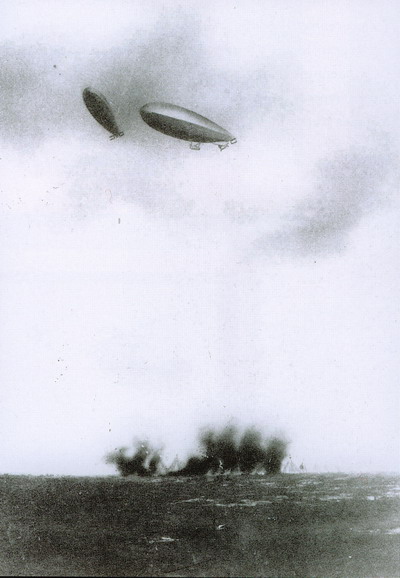
Italian airships were used for military reconnaissance West of Tripoli, behind Turkish lines, on March 5th, 1912, and in doing so became the first dirigibles ever used for a military purpose. They also bombarded Turkish positions near Tripoli later that same month - once again with little to show for it apart from some spectacular plumes of sand.


Of course, in both cases there were no means to aim the bombs. The pilots simply tried to determine ‘by eye’ when they were over their targets, then physically manhandled the tiny ‘bombs’ over the side of their cockpits, hoping for the best. They weren't even able to determine their true airspeed, in the absence of any reliable instruments. Needless to say, the results weren’t very satisfactory. Nevertheless, these first primitive aerial bombardments were a portent of the far more lethal and damaging techniques to come.


Plus ça change, plus c'est la même chose . . .

Peter

Over-reliance on technology might kill you . . .


I noted a link on the Drudge Report today to a France24 story that scientists were warning of a 'dangerous over-reliance on GPS', or the Global Positioning System.

The Royal Academy of Engineering said the application of the technology was now so broad -- from car sat-navs to the time stamp on financial transactions -- that without adequate backup, any disruption could have a major impact.

It cited a recent European Commission study showing that six to seven percent of economic growth in western countries -- about 800 billion euros ($1,100 billion) in the EU -- is already dependent on such navigation.

. . .

Disruption could come from technological problems or from deliberate interference, by criminals using small-scale jammers to avoid road tolls or block the tracking of cargo, or terrorists seeking to attack entire systems.

The report also warns of political interference, such as when North Korea reportedly recently disrupted South Korean military communications.

"A significant failure of GPS could cause lots of services to fail at the same time, including many that are thought to be completely independent of each other," said Martyn Thomas, who led the academy's work on the issue.

The US-operated Global Positioning System is currently used for everything from commercial aircraft and the tracking of cargo to the opening of train doors at stations.

The report said all these are vulnerable, with consequences ranging from "the inconvenient -- such as passenger information system failures -- to possible loss of life -- such as interruptions to emergency services communications".


There's more at the link.

It's not just over-dependence on GPS that worries me. I've said this about technology in general for many years, beginning with my military career, continuing with my involvement in computer hardware and software for major corporations in another country, through to service as a prison chaplain. I've seen more and more reliance on technology in every field, to the extent that it's displaced many skills that were once taken for granted as the norm for anyone claiming to 'know his stuff'. Consider these areas:

  • How many sailors - the recreational variety, those you see off the coast of the USA every day - know how to 'shoot' a star sight? How many can even take and plot a bearing on a coastal landmark? Do they have a compass on board? Could they navigate at all if their GPS systems went down?
  • Miss D. tells (profanely!) the story of the pilot who called her (via satellite phone) from a sandbar somewhere in Alaska. His GPS system had failed, and he'd hurriedly landed before he became even more lost. He wanted her (sitting in Anchorage) to tell him where he was. After all, Alaska covers a mere 663,268 square miles - surely she, whom he regarded as a 'technology guru', could tell him where, in that expanse, his current sandbar was located? (Her re-telling of the story becomes a little less than polite at this point . . . but yes, she was able to get him to reorient his GPS and find his way back to base!)
  • Veterans of military service will recall the old truism: "The most dangerous creature in the world is a newly-minted Second Lieutenant with a map, a compass, and a plan." Nowadays that's changed to "a map, a GPS receiver and a plan." Many of the Second Lieutenants I've met (fortunately, not all of them) wouldn't recognize a compass if it jumped up and bit them on the butt!
  • According to PhysOrg.com, 'The average U.S. soldier on a 72-hour patrol carries between 10 and 20 pounds of batteries. There are seven kinds of batteries that power flashlights, GPS devices, night-vision gear, and other equipment considered essential for the modern soldier. Including spares, a soldier lugs 70 batteries, along with the devices themselves, weapons, food, water, and other necessities. All together, the modern soldier is carrying so much weight that it can interfere with his mobility and lead to injuries. "We’re seeing pack weights of 130 pounds these days," said Sharon Burke, assistant secretary of defense for operational energy plans and programs. "You can’t carry 130 pounds without turning up with injuries." '


In my military service, if we carried more than 60-65 pounds (including a full combat load of ammo), we bitched like hell! We had to cover more than 20 miles a day, and sometimes fight during or after that march. I just can't imagine what it must be like to carry more than twice that load - and fight while doing so!

Similarly, we had to learn to fight without technological aids. We had them, sure, but we were taught that they were to be used while they worked, but not relied on, because Murphy's Law was alive and well and living in the Army. Sure as shootin', sooner or later, every technological bell and whistle we had was going to break - no ifs, buts or maybes about it. When that happened, we'd better be ready, willing and able to fight on without them . . . or we were likely to die. Are US soldiers trained and able to do that today?

I do worry about what will happen to modern civil society if we suddenly lose the basic technological infrastructure we've come to depend on. Solar storms threaten satellites in orbit and power transmission networks. One nuclear explosion at altitude over the USA would produce an electromagnetic pulse (EMP) that would destroy or damage almost every item of electrical and electronic equipment in the country. How would we cope without them? Could we cope without them? I daresay I could, if I had to . . . but I fear many younger people today have never learned the skills I grew up regarding as basic, normal and essential.

Peter

Monday, March 7, 2011

A real Son Of A Gun!


Some readers might not be familiar with the Discovery Channel program, 'Sons Of Guns'. Wikipedia describes it as follows: "The series centers on owners Will Hayden and his daughter Stephanie who manufacture and sell custom weapons at Red Jacket Firearms LLC."

A recent episode was called The Flamethrower. It told the story of a World War II Marine, Hershel W. Williams, who won the Medal of Honor on Iwo Jima in 1945 for his use of a flamethrower during the battle to conquer that island. Here's an interview with retired Chief Warrant Officer Williams about his exploits.


Will Hayden met CWO Williams in a New Orleans museum. (You can see a video clip of their meeting here.) He discovered that the veteran owned a World War II flamethrower that was no longer in working order. To make a long story short, Hayden restored it to operational condition. When the time came to test it, there was no question who would pull the trigger!


Well done, Sir!

Peter

Hypocrisy in action


I've mentioned many times before that I distrust both the Democratic and Republican parties equally. That distrust extends to the extremes of both the Left and Right wing of politics in general. I've found that the more extreme someone's views, the less balanced and sane that person is likely to be. Someone who spends their time ranting and raving about 'Bushitler', and demanding the impeachment of everyone who approved of the invasion of Iraq, is just as bad as someone who rants and raves about President Obama being a Muslim, and/or a closet Communist, and/or not eligible to be President.

I therefore find it cynically amusing when the extremist partisans of one side call out the extremist partisans of the other side. The latest example of this brouhaha is typical. My online buddy Gay_Cynic posted this morning about a call at DailyKos, that bastion of progressive opinion, to boycott goods produced by firms associated with the Koch family because of their support for right-wing causes. The author cites a ThinkProgress article about how terrible the Kochs are for supporting non-progressive things. (A New Yorker article provides more information, if you're interested in such things.)

What's funny about all this nonsense is that ThinkProgress, which has 'exposed' the Kochs and their terrible, oh-so-nasty right-wing leanings, says this about itself:

Think Progress is a project of the Center for American Progress Action Fund. The Center for American Progress Action Fund is a nonpartisan organization. Through this blog, CAPAF seeks to provide a forum that advances progressive ideas and policies.


How it can claim that the Action Fund is 'nonpartisan', and keep a straight face, I don't know. Wikipedia describes the Center for American Progress as "a progressive public policy research and advocacy organization" - hardly 'nonpartisan' in anyone's book. Furthermore, it points out that one of the individuals funding the organization is none other than George Soros, who's as much of a bogeyman to the Right as the Koch family is to the Left. He's cited as funding both the Action Fund and the organization as a whole.

My question for the DailyKos author is this: why is it perfectly in order for George Soros to fund Left-leaning individuals, organizations and causes to his heart's content, but not in order for the Koch family to do the same for Right-leaning individuals, organizations and causes? Why boycott the products of firms associated with the Koch brothers, just because you don't like their politics? If you expect to have the freedom to voice, support and exercise your political freedoms, and have George Soros fund your efforts, why are you trying to deny the same freedom to to those with whom you disagree, and deny their supporters the right to fund their efforts?

Pot, meet kettle. Kettle, pot.

Peter

Revenge of a sibling!


I laughed out loud at a very funny post on Imperial Invectives the other day. The author describes how she 'related to' her younger sister. There's lots to laugh at, but this paragraph in particular gave me a fit of the giggles:

I also managed to exact a bit of revenge when I convinced her that the clothes dryer was a confessional. I directed her to climb in and talk to the air vents inside, telling God all her sins. If she heard one "boom" she was forgiven, if she heard two "booms" she had to do penance. And never mind the whirring sound (as I tried to start the dryer). And of course, I derived great pleasure in telling our parents all her dirty little secrets.


There's more at the link. Recommended and amusing reading.

As a retired pastor, I'm afraid that just tickles my funny-bone! I've had to "have a talk" with children like that . . . but it's very difficult to be sternly paternal when, inside, you're cracking up!


Peter

A food crisis in the making - or an Internet rumor?


A post at Crucis' Court this morning mentioned a report that FEMA had just ordered a billion dollars' worth of dehydrated meals, disrupting normal supplies of these foods. This made me wonder, as I hadn't read any reports of this in the mainstream media, who normally cover FEMA affairs fairly thoroughly; so I decided to read further.

Crucis' post linked to an article at Examiner.com, which in turn linked to an article in the Beaufort Observer, which linked to an article at Forbes.com from October last year, and another article dated February 15 from Yahoo! news. Both the latter articles appeared to support the Beaufort Observer article's contention that a food crisis might - might - be imminent.

In response, a Beaufort Observer reader responded with the claim about FEMA's billion-dollar purchase of dehydrated meals. She alleged it had been reported in "Off The Grid News Letter" - but I haven't been able to find that specific report on the Web, despite coming across any number of "Off The Grid" Web sites, newsletters and groups. However, a Web search revealed that the same rumor of massive government purchases of dehydrated meals was widespread.

Curious, I went to the Web sites of a number of manufacturers and vendors of freeze-dried and dehydrated meals, and found no shortage of supply. However, I did find this notice on the home page of the Mountain House Web site (bold print is my emphasis):

As you know we have removed #10 cans from our website temporarily. The reason for this is sales of #10 cans have continued to increase. OFD is allocating as much production capacity as possible to this market segment, but we must maintain capacity for our other market segments as well.

Currently we are able to meet demand for Mountain House pouches and most of these products are still available for purchase on our website. We do have a small number of dealers that we will continue to make and ship #10 cans to and you will need to contact them directly to place an order. For a list of dealers, please contact us at MH-Info@ofd.com

We want to clarify inaccurate information that is being said on the internet, news and radio. This situation is not due to sales to the government domestically or internationally. We do sell products to this market, but we also sell other market segments, including Ingredient and Private Brand markets. The reason for this decision is solely due to an unexpected sales spike in #10 cans sales.

We expect this situation to be necessary for several months although this isn’t a guarantee. We will update this information as soon as we know more. We apologize for this inconvenience and appreciate your patience. We sincerely hope you will continue to be Mountain House customers in the future.


So it looks like the reader's response to the Beaufort Observer article was based on misinformation . . . but how many people have been led astray by that misinformation? Look at how many other sites on the Web are repeating it!

There are approximately three hundred million residents of the United States. If only one per cent of them (three million people) believe such reports, and decide to stock up on (say) a year's supply of emergency rations, that's three million years' worth of individual rations being taken out of circulation - all at once. It may be more than that, if they decide to stock up for their families as well as themselves. What will that do to already low stockpiles of food? Do you think this might actually manufacture the very crisis that rumor-mongers are talking about? Can you say 'self-fulfilling prophecy'?

Please note that I'm not criticizing Crucis in the least for his blog post. I think it's one of our functions as bloggers to highlight interesting news that comes to our attention - matters that the mainstream media might not cover adequately. (Witness the current ATF scandal, which has been brought into the limelight almost exclusively through the efforts of two bloggers, the latter also a news correspondent.) It's just that there's so much 'news' out there that's actually false, put out by people with a hidden agenda, that one has to be very, very careful about what one chooses to believe!

Peter

Sunday, March 6, 2011

Sometimes it hurts just to watch!


The video clip below illustrates what happens when doofi encounter wheels.


Peter

"Never fight a land war in Asia"


Stratfor, the private intelligence company based in Austin, Texas, last week released a very interesting analysis of Secretary of Defense Gates' remarks at West Point. "Never fight a land war in Asia" is republished with permission of Stratfor.

U.S. Secretary of Defense Robert Gates, speaking at West Point, said last week that “Any future defense secretary who advises the president to again send a big American land army into Asia or into the Middle East or Africa should have his head examined.” In saying this, Gates was repeating a dictum laid down by Douglas MacArthur after the Korean War, who urged the United States to avoid land wars in Asia. Given that the United States has fought four major land wars in Asia since World War II — Korea, Vietnam, Afghanistan and Iraq — none of which had ideal outcomes, it is useful to ask three questions: First, why is fighting a land war in Asia a bad idea? Second, why does the United States seem compelled to fight these wars? And third, what is the alternative that protects U.S. interests in Asia without large-scale military land wars?

The Hindrances of Overseas Wars

Let’s begin with the first question, the answer to which is rooted in demographics and space. The population of Iraq is currently about 32 million. Afghanistan has a population of less than 30 million. The U.S. military, all told, consists of about 1.5 million active-duty personnel (plus 980,000 in the reserves), of whom more than 550,000 belong to the Army and about 200,000 are part of the Marine Corps. Given this, it is important to note that the United States strains to deploy about 200,000 troops at any one time in Iraq and Afghanistan, and that many of these troops are in support rather than combat roles. The same was true in Vietnam, where the United States was challenged to field a maximum of about 550,000 troops (in a country much more populous than Iraq or Afghanistan) despite conscription and a larger standing army. Indeed, the same problem existed in World War II.

When the United States fights in the Eastern Hemisphere, it fights at great distances, and the greater the distance, the greater the logistical cost. More ships are needed to deliver the same amount of material, for example. That absorbs many troops. The logistical cost of fighting at a distance is that it diverts numbers of troops (or requires numbers of civilian personnel) disproportionate to the size of the combat force.

Regardless of the number of troops deployed, the U.S. military is always vastly outnumbered by the populations of the countries to which it is deployed. If parts of these populations resist as light-infantry guerrilla forces or employ terrorist tactics, the enemy rapidly swells to a size that can outnumber U.S. forces, as in Vietnam and Korea. At the same time, the enemy adopts strategies to take advantage of the core weakness of the United States — tactical intelligence. The resistance is fighting at home. It understands the terrain and the culture. The United States is fighting in an alien environment. It is constantly at an intelligence disadvantage. That means that the effectiveness of the native forces is multiplied by excellent intelligence, while the effectiveness of U.S. forces is divided by lack of intelligence.

The United States compensates with technology, from space-based reconnaissance and air power to counter-battery systems and advanced communications. This can make up the deficit but only by massive diversions of manpower from ground-combat operations. Maintaining a helicopter requires dozens of ground-crew personnel. Where the enemy operates with minimal technology multiplied by intelligence, the United States compensates for lack of intelligence with massive technology that further reduces available combat personnel. Between logistics and technological force multipliers, the U.S. “point of the spear” shrinks. If you add the need to train, relieve, rest and recuperate the ground-combat forces, you are left with a small percentage available to fight.

The paradox of this is that American forces will win the engagements but may still lose the war. Having identified the enemy, the United States can overwhelm it with firepower. The problem the United States has is finding the enemy and distinguishing it from the general population. As a result, the United States is well-suited for the initial phases of combat, when the task is to defeat a conventional force. But after the conventional force has been defeated, the resistance can switch to methods difficult for American intelligence to deal with. The enemy can then control the tempo of operations by declining combat where it is at a disadvantage and initiating combat when it chooses.

The example of the capitulation of Germany and Japan in World War II is frequently cited as a model of U.S. forces defeating and pacifying an opposing nation. But the Germans were not defeated primarily by U.S. ground troops. The back of the Wehrmacht was broken by the Soviets on their own soil with the logistical advantages of short supply lines. And, of course, Britain and numerous other countries were involved. It is doubtful that the Germans would have capitulated to the Americans alone. The force the United States deployed was insufficient to defeat Germany. The Germans had no appetite for continuing a resistance against the Russians and saw surrendering to the Americans and British as sanctuary from the Russians. They weren’t going to resist them. As for Japan, it was not ground forces but air power, submarine warfare and atomic bombs that finished them — and the emperor’s willingness to order a surrender. It was not land power that prevented resistance but air and sea power, plus a political compromise by MacArthur in retaining and using the emperor. Had the Japanese emperor been removed, I suspect that the occupation of Japan would have been much more costly. Neither Germany nor Japan are examples in which U.S. land forces compelled capitulation and suppressed resistance.

The problem the United States has in the Eastern Hemisphere is that the size of the force needed to occupy a country initially is much smaller than the force needed to pacify the country. The force available for pacification is much smaller than needed because the force the United States can deploy demographically without committing to total war is simply too small to do the job — and the size needed to do the job is unknown.

U.S. Global Interests

The deeper problem is this: The United States has global interests. While the Soviet Union was the primary focus of the United States during the Cold War, no power threatens to dominate Eurasia now, and therefore no threat justifies the singular focus of the United States. In time of war in Iraq and Afghanistan, the United States must still retain a strategic reserve for other unanticipated contingencies. This further reduces the available force for combat.

Some people argue that the United States is insufficiently ruthless in prosecuting war, as if it would be more successful without political restraints at home. The Soviets and the Nazis, neither noted for gentleness, were unable to destroy the partisans behind German lines or the Yugoslav resistance, in spite of brutal tactics. The guerrilla has built-in advantages in warfare for which brutality cannot compensate.

Given all this, the question is why the United States has gotten involved in wars in Eurasia four times since World War II. In each case it is obvious: for political reasons. In Korea and Vietnam, it was to demonstrate to doubting allies that the United States had the will to resist the Soviets. In Afghanistan, it was to uproot al Qaeda. In Iraq, the reasons are murkier, more complex and less convincing, but the United States ultimately went in, in my opinion, to convince the Islamic world of American will.

The United States has tried to shape events in the Eastern Hemisphere by the direct application of land power. In Korea and Vietnam, it was trying to demonstrate resolve against Soviet and Chinese power. In Afghanistan and Iraq, it was trying to shape the politics of the Muslim world. The goal was understandable but the amount of ground force available was not. In Korea, it resulted in stalemate; in Vietnam, defeat. We await the outcome in Iraq and Afghanistan, but given Gates’ statement, the situation for the United States is not necessarily hopeful.

In each case, the military was given an ambiguous mission. This was because a clear outcome — defeating the enemy — was unattainable. At the same time, there were political interests in each. Having engaged, simply leaving did not seem an option. Therefore, Korea turned into an extended presence in a near-combat posture, Vietnam ended in defeat for the American side, and Iraq and Afghanistan have turned, for the time being, into an uncertain muddle that no reasonable person expects to end with the declared goals of a freed and democratic pair of countries.

Problems of Strategy

There are two problems with American strategy. The first is using the appropriate force for the political mission. This is not a question so much of the force as it is of the mission. The use of military force requires clarity of purpose; otherwise, a coherent strategy cannot emerge. Moreover, it requires an offensive mission. Defensive missions (such as Vietnam and Korea) by definition have no terminal point or any criteria for victory. Given the limited availability of ground combat forces, defensive missions allow the enemy’s level of effort to determine the size of the force inserted, and if the force is insufficient to achieve the mission, the result is indefinite deployment of scarce forces.

Then there are missions with clear goals initially but without an understanding of how to deal with Act II. Iraq suffered from an offensive intention ill suited to the enemy’s response. Having destroyed the conventional forces of Iraq, the United States was unprepared for the Iraqi response, which was guerrilla resistance on a wide scale. The same was true in Afghanistan. Counterinsurgency is occupation warfare. It is the need to render a population — rather than an army — unwilling and incapable of resisting. It requires vast resources and large numbers of troops that outstrip the interest. Low-cost counter-insurgency with insufficient forces will always fail. Since the United States uses limited forces because it has to, counterinsurgency is the most dangerous kind of war for the United States. The idea has always been that the people prefer the U.S. occupation to the threats posed by their fellow countrymen and that the United States can protect those who genuinely do prefer the former. That may be the idea, but there is never enough U.S. force available.

Another model for dealing with the problem of shaping political realities can be seen in the Iran-Iraq war. In that war, the United States allowed the mutual distrust of the two countries to eliminate the threats posed by both. When the Iraqis responded by invading Kuwait, the United States responded with a massive counter with very limited ends — the reconquest of Kuwait and the withdrawal of forces. It was a land war in Asia designed to defeat a known and finite enemy army without any attempt at occupation.

The problem with all four wars is that they were not wars in a conventional sense and did not use the military as militaries are supposed to be used. The purpose of a military is to defeat enemy conventional forces. As an army of occupation against a hostile population, military forces are relatively weak. The problem for the United States is that such an army must occupy a country for a long time, and the U.S. military simply lacks the ground forces needed to occupy countries and still be available to deal with other threats.

By having an unclear mission, you have an uncertain terminal point. When does it end? You then wind up with a political problem internationally — having engaged in the war, you have allies inside and outside of the country that have fought with you and taken risks with you. Withdrawal leaves them exposed, and potential allies will be cautious in joining with you in another war. The political costs spiral and the decision to disengage is postponed. The United States winds up in the worst of all worlds. It terminates not on its own but when its position becomes untenable, as in Vietnam. This pyramids the political costs dramatically.

Wars need to be fought with ends that can be achieved by the forces available. Donald Rumsfeld once said, “You go to war with the Army you have. They’re not the Army you might want or wish to have at a later time.” I think that is a fundamental misunderstanding of war. You do not engage in war if the army you have is insufficient. When you understand the foundations of American military capability and its limits in Eurasia, Gates’ view on war in the Eastern Hemisphere is far more sound than Rumsfeld’s.

The Diplomatic Alternative

The alternative is diplomacy, not understood as an alternative to war but as another tool in statecraft alongside war. Diplomacy can find the common ground between nations. It can also be used to identify the hostility of nations and use that hostility to insulate the United States by diverting the attention of other nations from challenging the United States. That is what happened during the Iran-Iraq war. It wasn’t pretty, but neither was the alternative.

Diplomacy for the United States is about maintaining the balance of power and using and diverting conflict to manage the international system. Force is the last resort, and when it is used, it must be devastating. The argument I have made, and which I think Gates is asserting, is that at a distance, the United States cannot be devastating in wars dependent on land power. That is the weakest aspect of American international power and the one the United States has resorted to all too often since World War II, with unacceptable results. Using U.S. land power as part of a combined arms strategy is occasionally effective in defeating conventional forces, as it was with North Korea (and not China) but is inadequate to the demands of occupation warfare. It makes too few troops available for success, and it does not know how many troops might be needed.

This is not a policy failure of any particular U.S. president. George W. Bush and Barack Obama have encountered precisely the same problem, which is that the forces that have existed in Eurasia, from the Chinese People’s Liberation Army in Korea to the Taliban in Afghanistan, have either been too numerous or too agile (or both) for U.S. ground forces to deal with. In any war, the primary goal is not to be defeated. An elective war in which the criteria for success are unclear and for which the amount of land force is insufficient must be avoided. That is Gates’ message. It is the same one MacArthur delivered, and the one Dwight Eisenhower exercised when he refused to intervene in Vietnam on France’s behalf. As with the Monroe Doctrine, it should be elevated to a principle of U.S. foreign policy, not because it is a moral principle but because it is a very practical one.


I certainly agree with Stratfor's perspective on what we used to call the "tooth-to-tail ratio": the number of soldiers actually doing the fighting (the teeth) versus the number of soldiers required to perform support services, to permit them to fight (the tail). It's true that the further away from base soldiers have to fight, the more soldiers are needed to get supplies from the base to the front lines, and recover casualties, damaged gear, etc. from the front lines back to base. Right now, the US front lines in Afghanistan are just about as far away from 'home base' as it's possible to get!

I think Stratfor's analysis bears careful reading, and equally careful thought.

Peter