I've warned, and warned, and warned about the danger posed by living in a big American city. I've done so for years. Many other observers and commentators have done the same. It seems like few, if any people are actually listening, and even fewer are taking active steps to heed those warnings.
If this past week hasn't made the point more strongly than my words ever can, I don't know what it'll take for people to listen. In case you missed the point:
THERE IS LITERALLY
NO PLACE
IN MOST BIG AMERICAN CITIES
WHERE YOUR SAFETY CAN BE GUARANTEED
The mall shoppers in Allen, Texas probably never in their worst nightmares imagined an illegal alien arriving by car, heavily armed, and starting to shoot at them as they went about their daily activities. Yet... it happened. As of this morning, eight are dead, and others are wounded. If it wasn't for a very brave policeman who "ran to the sound of the guns" and took out the shooter at grave risk to himself, there would have been many more. I hope they give that cop a honking great medal. He deserves it. Even better, I'd like every shopper in that mall (on any day, at any time) to drop $5 or $10 into a tip jar for him, and have the management present him with the proceeds after a few months, when they've had time to swell to a meaningful total. He's earned every penny.
Such mass shootings appear to be happening more and more often. There appear to be few common factors in them, apart from the alienation, frustration and isolation of the shooter. Most notably, they're almost all taking place in larger cities. That's where the levels of tension and social angst are highest, and that seems to affect potential mass murderers more there than elsewhere. If you live in a city . . . take note.
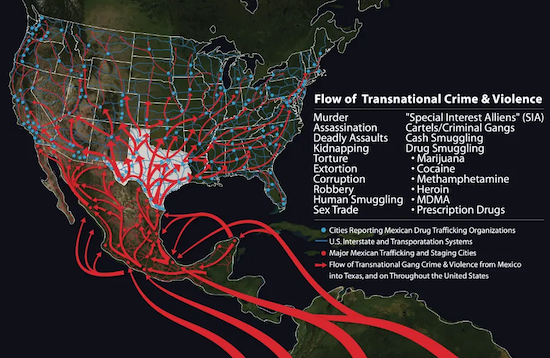
It doesn't stop there. The tidal wave of illegal aliens crashing onto (and over) our borders is getting worse, not better, and many of them are either criminals themselves, or come from countries where criminals dominate, and criminal ways of life, thought and behavior are rampant. They're bringing that with them, and they will behave that way here too. The crime gangs and cartels and syndicates are not targeting deserted countryside - they're targeting our cities, and sending their gunmen and drug dealers and enforcers there.
As if the map of the United States were the board from a game of Risk, cartels push to cities of increasing distance from the border and strengthen their support networks there, fanning out to touch nearly every major population center and minor ones in between with new waves of crime and deadly narcotics...
The present administration is not taking this threat seriously at all. In fact, it's largely ignoring it.
To be clear, we’re not just fighting Mexican drug traffickers, we’re fighting the world’s most powerful and prolific narcoterrorists who happen to be based in Mexico. Narcoterrorists who not only control the entirety of U.S.-Mexico border, but have their largest presence outside of their own country right here in ours. It has been estimated that the various Mexican cartels have a presence in over 3,000 American cities and towns. They are here solely to sell drugs to Americans and engage in other types of organized crime like human trafficking. I can think of no greater modern example of Cicero’s warning to his fellow Romans about allowing an enemy within the gates. Just like international terrorists, the various Mexican organizations are single-minded, zealous, highly ethnocentric, and shockingly violent. And, whether we like it or not, they take our forgiving multiculturalism and our moral and cultural relativism as weakness.
There's more at the link.
You can add increasing racial and criminal tension to the mix of underlying problems in our cities. As HMS Defiant notes:
One of the joys of living in California for over 30 years in both the south and the Bay Area was watching demographic change swirl through some of it and revise whole towns overnight as the newcomers swept away the old. Such a case in point was the City of Compton. Almost 100% white into the '50s with all the usual tricks of a society that wanted to live by itself was completely replaced by blacks in the 60's and they remained the majority of the population until into the 90s when they were all swept away by the incoming Mexicans and other hispanics with all the violence and turf wars and shootouts that presage big changes in little places.
New York and some of the other Atlantic states are slowly figuring out that what happened so dramatically in Florida could and will happen in their towns as the newcomers from south of the border kick the ever loving crap out of the old denizens and demons that run the drugs, gangs, pimps in places like New York City and either exterminate them or drive them out. Perhaps they'll head to the suburbs and New Jersey. It's hard to tell where they'll end up.
What the current demons don't really understand is that the Mexicans? The guys that routinely take on the Mexican Army and own the Mexican police forces from the local level all the way up to the Minister of Justice and Minister of Defense.....those cartels you hear about from time to time if you look for news other than in the mainstream of media foulness, they are the utterly amoral killers and they're more heavily armed than anybody in the United States and they're coming here. They also know that the richest pickings are in places like New York, Delaware, Massachusetts, Connecticut and the other urban hellholes that spawned the gangs, the drugs and the crime that make urban living so darned pleasant for commuters in those places.
When the mayors of towns like NYC bleat about a mere 45,000 illegals dumped on his city by the mayors of Texas and Oklahoma towns and the Federales who answer to literally noone, he aint seen nothing yet. What a pity they **** on their police, defunded their police and voted for socialist progressive liberal BLM types to administer justice in their fair little cities.
In 20 years you will not be able to recognize them. Kind of like Compton.
He's not wrong, IMHO.
Proof of his forecast may be found in the increasingly angry reaction of black communities in our northern cities to the influx of aliens from south of the border. Here's one example from a largely black neighborhood in Chicago. (Note that the article never mentions the race of those involved - a typical trick by the mainstream media to hide the reality of rising racial tensions in such situations.)
The issue of the migrant crisis boiled over Thursday night in Chicago, as the city discussed plans to board more migrants at a shuttered school in the South Shore neighborhood.
As CBS 2's Marissa Perlman reported, an emotional – and at times intense – community meeting was held on the issue.
The event was packed, and the truth is – nobody learned too much about the city's plan for the respite stop for migrants at the old South Shore High School, 7626 S. Constance Ave.
That is because leaders could not get a word in edgewise.
Neighbors overwhelmingly say they do not support the space in their community going to supporting migrants. Community members said the city has put very little thought into the move, calling it an "intrusion into daily life" in South Shore.
"How could you do that without consulting us?" a woman said.
"I'm outraged, and I don't understand why our community was chosen," another woman said.
Passionate South Shore neighbors would not let city leaders share their plans to turn the former high school site into what they call a "respite" center.
"I think what's really important is that we establish this is a humanitarian crisis," said city Chief Engagement Officer Nubia Willman.
But neither neighbors nor Ald. Michelle Harris (8th) wanted to hear that.
"While this may constitute an emergency for the city of Chicago, it does not constitute an emergency for the South Shore community," Harris said.
Again, more at the link.
Jeffery Tucker has a gloomy prognosis for large American cities.
There was something deeply demoralizing about the recent Mayoral election in Chicago, once among America’s greatest cities. The good news is that the catastrophic reign of a deeply corrupt and crazed mayor, who piled egregiously racist policies on top of one of the worst COVID responses in the country, came to an end. The bad news is that a guy who is arguably worse took her place.
As Allysia Finley put it in the Wall Street Journal, “Brandon Johnson’s victory in last week’s Chicago mayoral race is a reminder that no matter how bad things get, they can always get worse.”
The city itself is facing bankruptcy but that economic reality is changing nothing about city policies. Crime is out of control. Poverty and despair are on the rise. And the residents who can leave are fleeing. Businesses are closing up shop and 175,000 people have left the city in the last two years, leaving the place at the mercy of people who only vote for more handouts and union controls.
The people who leave feel a sense of guilt, but the decision is entirely rational. One person’s vote makes no difference and no one has the obligation to stick around and become a sacrificial victim of pillaging politicians and dangerous criminals.
. . .
Incredibly, however, this same spiral of exodus plus the entrenchment of crime and corruption seems to be affecting other great cities too ... New York City ... is massively deprecated compared with what it was only a few years ago.
For my part, I avoid the city as much as possible, simply because I cannot bear the Gotham-like feel of the place, with the inescapable stench of trash, sewage, and weed, plus the ever-present threat of crime ... And the bureaucracy of the state in general is absolutely overwhelming. If you own a business with an employee in New York State, you know this. Navigating the endless bureaucracies just to get a basic payroll in place is maddening beyond belief. One agency doesn’t talk to another and has no idea what they are doing. Compliance alone is too complicated even for online payroll platforms like Gusto. I know of companies that refuse even to hire anyone who lives there just to avoid this mess.
There are two other cities on the deathwatch list: San Francisco and Seattle. You know of the deep tragedy of San Francisco if you have visited lately. The place is an appalling mess and deeply dangerous too. Murder has nearly become normalized as something that just happens ... I wasn’t entirely aware of the turn Seattle had taken until I visited last month, and found the same thing, with residents fleeing as fast as they could if they had the resources to do so. This trend leaves the cities in the hands of hoodlums public and private and dooms the place to go a long time without reform.
This is a reversal of the past when big cities would go through cycles of bust and boom once city fathers saw the errors of their ways. That is no longer a dynamic that seems plausible now. In other words, this time could be permanent.
More at the link.
Add the existing deterioration in our cities to the invasion by criminal organizations from south of the border, and you have a recipe for disaster.
It's not just crime, of course. When you cram lots of people together into a smaller and smaller space per person, anarchy can result. Jeff Thomas described the process in this recent interview.
How do you view the value proposition of living in a big city today, given what is transpiring?
Well, in my college years, I found cities to be very attractive. Lots of social opportunities, lots of shops, a greater variety of goods, etc. But, during that time, I was very fortunate to have experienced two city crises from which I learned valuable lessons.
The first was an oil crisis in the winter of 1973. It was bad enough that many people had to abandon their cars, some out on the highway, in the snow. Some people died from exposure.
But at that time, I seemed to be the only one who was wondering what would happen if it got just a bit worse. What if there were no fuel to heat houses? People in the country can find a way to survive, but in the city, you have no options. Many would die without heat. But first, they’d become desperate and desperate people are a threat to your well-being.
The second was a city riot. Until I was in the midst of one, I didn’t fully understand their real nature. A riot isn’t merely a crime spree; it’s random chaos, fueled by anger and desperation. They occur due to built-up tension that’s sparked off, often by a “last straw” event. Because they’re spontaneous, mini-riots tend to pop up all over the city like popcorn. And they’re uncontrollable. When the sirens are heard, rioters may disperse, but as soon as the police drive on to the next neighbourhood, the rioters start in again. Riots are similar to guerrilla warfare, except that they have no organization whatsoever. They are high on anger and low on reason and, as such, are very dangerous.
For someone living in a city who’s hoping to be left in peace, there’s no chance of that in a riot. Sooner or later, you have to go out, and when you do, you may become a casualty.
Those two occurrences provided me with the important lesson that, whilst cities are very attractive in good times, you want to be well out of them in a chaotic period.
What are some risks of living in a city during a prolonged crisis?
One of the greatest attractions of a city is that, all around you, there are small businesses that do everything for you. It’s wonderfully convenient. As long as you can pay, you can have anything. The great advantage is that a host of others have control of everything you may need. And, in a crisis, it’s that very condition that becomes your greatest danger. You can’t remove yourself from the dependency on others and suddenly become self-reliant. You have very little control over your surroundings and the services you need.
In a crisis, the first locations to be hit with food shortages are cities, and you find you have no alternate supply of food. And this is true of any city, no matter how nice it is in good times. The West End of London is a neighbourhood that I’m fond of, but if there’s a food shortage and some people are desperate, I’m not going to want to be walking home from Sainsbury’s with a loaf of bread under my arm.
And this holds true of all things in a city. You need the shops for your food. You may need a laundromat to wash your clothes. Your building has a central water supply, gas supply and electrical supply. Your ability for self-reliance is very low indeed.
In a crisis, none of the attractions of city life continue to have value. The city becomes a liability.
. . .
We’ve just begun a period that will evolve into what may be the crisis of our lifetimes. There’s no guarantee that one reader out there will be luckier than another and will fare better. In such times, the likelihood of very major unrest and shortages is high enough that it would be quite unwise to just “wait and see what happens,” or “hope for the best.”
More at the link.
Folks, what more evidence can I advance to persuade you? The reality is as plain and easy to see as the nose on your face. If you live in almost any large American city today, but particularly those in "blue" states, governed by liberal progressive administrations, or already facing serious problems with poverty, crime, violence and racial tensions, you need to leave. Now. If you don't, and you run headlong into those problems as they escalate, it's on your own head - nobody else's.
I've heard all the excuses, and I'm sure they're real to many people: but this boils down to a simple, existential pair of questions. What's your life worth? What are the lives of your spouse, children, etc. worth?
The answer is up to you, and the solution is in your hands. Don't expect the government to provide one, because it's largely caused the problems to begin with.
Peter